


Telehealth and Remote Patient Monitoring Market Overview
The global telehealth and remote patient monitoring market is experiencing rapid growth due to technological advancements, increasing healthcare demand, and a shift towards digital health solutions. The market enables remote consultations and continuous tracking of vital signs and health metrics, improving clinical outcomes and reducing in-person visits.
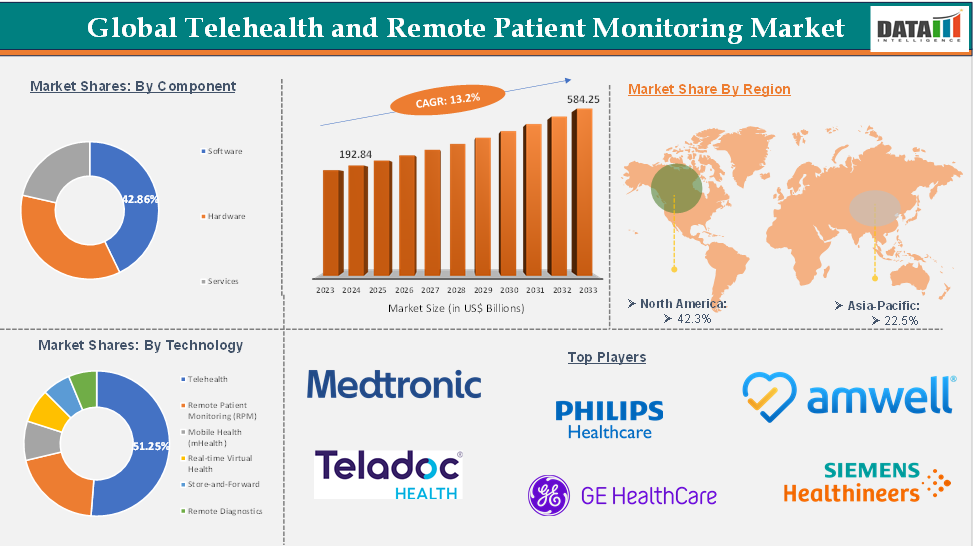
The COVID-19 pandemic has accelerated adoption, prompting policy changes and investment in digital infrastructure. Key market segments include software, hardware, and services, with AI-powered and cloud-based platforms leading innovation and integration. North America leads in adoption due to favorable regulations and established technology ecosystems, while Asia Pacific is emerging as a high-growth region due to healthcare access challenges and mobile penetration. However, data privacy concerns and robust cybersecurity remain key challenges.
Telehealth and Remote Patient Monitoring Market Executive Summary
For more details on this report, Request for Sample
Telehealth and RPM Market Growth Drivers & Restraints
Driver: Rising prevalence of chronic diseases
The global telehealth and remote patient monitoring (RPM) market is growing due to the increasing prevalence of chronic diseases like diabetes, cardiovascular diseases, COPD, and hypertension. These conditions require ongoing medical attention, frequent monitoring, and lifestyle management, straining traditional healthcare systems.
Telehealth and RPM technologies enable continuous, remote tracking of patients' health data, facilitating early interventions, and reducing the need for in-person visits or hospitalizations. This is especially important in rural or underserved areas with limited access to specialists. These technologies empower patients to take an active role in their health, improving treatment adherence and clinical outcomes. The growing global burden of chronic illness is driving demand for advanced digital health solutions.
For instance, according to Centers for Disease Control and Prevention, chronic diseases like heart disease, cancer, and diabetes are the leading causes of death and disability in the US, contributing to $4.5 trillion in annual healthcare costs. Six in 10 Americans have at least one chronic disease, with many preventable diseases caused by risk behaviors like smoking, poor nutrition, physical inactivity, and excessive alcohol use.
Hence, chronic diseases increase demand for continuous health monitoring, leading to telehealth and RPM adoption. Lifestyle risks necessitate proactive, remote interventions. Rising healthcare costs drive home-based care models like telehealth. Aging and chronically ill populations demand real-time, remote health services.
Restraint: Data privacy and security concerns
The telehealth and remote patient monitoring market is expanding rapidly, but it faces challenges in data privacy and cybersecurity. These technologies rely on sensitive patient information, making them vulnerable to breaches and cyberattacks. Many healthcare providers, particularly in developing regions, lack robust IT infrastructure and security protocols. Inconsistent regulatory standards across countries complicate compliance with laws like HIPAA and GDPR, reducing patient trust and hindering technology adoption. These concerns can lead to legal and financial issues.
Telehealth and Remote Patient Monitoring Market Segmentation Analysis
The global telehealth and remote patient monitoring market is segmented based on component, technology, delivery mode, application, end user, and region.
Product Type: The software segment from the product type is expected to hold 42.86% of the telehealth and remote patient monitoring market
The software segment in the telehealth and remote patient monitoring market includes digital platforms that enable virtual care delivery, data integration, real-time communication, remote diagnostics, and patient monitoring. These solutions include EHR integration tools, teleconsultation platforms, RPM dashboards, mobile health apps, AI-driven analytics, and data security software.
The telehealth software market is expanding due to the demand for interoperable, scalable, and user-friendly digital health platforms. As healthcare providers adopt value-based care and patient-centric models, there is a growing need for software that integrates health systems, enables real-time data sharing, and automates clinical workflows.
Cloud computing and mobile technologies have made telehealth solutions more accessible and cost-effective, especially for smaller clinics and rural providers. The focus on data-driven healthcare is driving the development of advanced software tools that use AI, predictive analytics, and machine learning for remote diagnostics, risk stratification, and personalized treatment planning. Regulatory support and subscription-based SaaS models have made telehealth software implementation and scaling easier.
For instance, in January 2025, PMC360 launched an AI in Telemedicine + AI Platform in Southeast Nigeria to improve healthcare access in underserved communities. The platform combines AI-powered diagnostics, telehealth consultations, and smart appointment scheduling to enhance patient care and streamline healthcare delivery. It also includes a Health Education Hub to raise awareness of health issues. With thousands of consultations completed and trained healthcare professionals, PMC360 is bridging health equity gaps.
Telehealth and Remote Patient Monitoring Market Geographical Analysis
North America dominated the global telehealth and remote patient monitoring market with the highest share of 42.3%
In North America and particularly the United States and Canada, the telehealth and remote patient monitoring markets are experiencing strong growth owing to their maturity in technology, regulatory framework support, and high levels of expenditure in healthcare.
The Centers for Medicare & Medicaid Services (CMS) of the United States expanded and intensified reimbursement policies on telehealth services and especially after the COVID-19 pandemic, giving ample incentive for healthcare providers to consider adopting and implementing at a fast pace. Additionally, the consumer shift to value-based care and a patient-focused healthcare model also emphasizes remote monitoring and teleconsultations, thus augmenting long-term adoption trends in the region.
Smart Meter, a leading provider of Cellular Remote Patient Monitoring (RPM) solutions, launched the healthcare industry's first commercial e-commerce shopping experience for RPM products and services. Based on feedback from over 500 US healthcare customers, the Smart Solutions Platform (SSP) Marketplace offers a seamless customer experience for immediate health monitoring.
Asia-Pacific is the global telehealth and remote patient monitoring market with a market share of 22.5%
The Asia Pacific region is experiencing a surge in the telehealth and remote patient monitoring market due to growing healthcare needs, smartphone penetration, and government-led digital health initiatives. Countries like India, China, Japan, South Korea, and Australia are leveraging telehealth to bridge healthcare access gaps. The rapid growth of internet connectivity, including 4G and 5G, supports real-time virtual consultations and data transfer for RPM solutions.
Governments are promoting digital health transformation, such as India's Ayushman Bharat Digital Mission and China's expansion of Internet hospitals. The growing awareness of chronic diseases and the elderly population is driving demand for continuous health monitoring and remote care solutions. The Asia Pacific's diverse population presents a significant growth opportunity for scalable, affordable digital healthcare models.
Amazon launched Amazon Clinic, a telemedicine service for Indian users, offering online consultations for over 50 medical conditions. The service, available exclusively on Android and iOS apps, allows users to consult with doctors across various specialisations, including dermatology, gynaecology, paediatrics, nutrition, and counselling. All listed doctors have a minimum of three years of telemedicine experience, and consultation records are anonymized and protected to uphold patient privacy.
Regulatory Compliance for Telehealth and Remote Patient Monitoring (RPM) – 2026 Update
United States
- HIPAA remains the primary regulation governing patient privacy, electronic protected health information (ePHI), and cybersecurity for telehealth and RPM platforms. Organizations must implement encryption, access controls, audit logs, and breach notification procedures.
- The FDA regulates wearable medical devices and Software as a Medical Device (SaMD), including AI-enabled remote monitoring solutions, under a risk-based regulatory framework with increasing emphasis on cybersecurity and post-market surveillance.
- CMS continues expanding Remote Patient Monitoring reimbursement through CPT codes while encouraging interoperability between RPM devices and Electronic Health Records (EHRs) to improve chronic disease management and value-based care.
European Union
- The General Data Protection Regulation (GDPR) requires healthcare organizations to ensure lawful processing of patient data, explicit consent, strong cybersecurity measures, and data portability for telehealth services.
- The European Health Data Space (EHDS) supports secure cross-border exchange of electronic health data and greater interoperability among digital health platforms across EU member states.
- The EU AI Act classifies many AI-enabled healthcare applications, including clinical decision-support and remote monitoring systems, as high-risk, requiring comprehensive risk management, transparency, human oversight, and ongoing monitoring.
Global Compliance Trends
- Healthcare providers increasingly require compliance with ISO 27001:2022 information security standards to strengthen cybersecurity, vendor risk management, and governance for telehealth platforms.
- Regulatory authorities worldwide are placing greater emphasis on cybersecurity-by-design, secure device connectivity, software updates, interoperability, AI governance, and real-world performance monitoring for connected medical devices and wearable technologies.
Key Regulatory Authorities
- U.S. Food and Drug Administration (FDA) – Medical device and digital health regulation.
- Centers for Medicare & Medicaid Services (CMS) – RPM reimbursement and telehealth payment policies.
- U.S. Department of Health and Human Services (HHS)/Office for Civil Rights (OCR) – HIPAA privacy and security enforcement.
- European Commission – European Health Data Space (EHDS) and EU AI Act implementation.
- European Medicines Agency (EMA) and national competent authorities – Digital health and medical device oversight within Europe.
Key Players in the Telehealth and RPM Market
The major global players in market include Teladoc Health, Inc., Amwell (American Well Corporation), Philips Healthcare, GE HealthCare, Medtronic, Siemens Healthineers, Cerner Corporation (Oracle Health), MDLIVE, Inc., Doctor on Demand, and GlobalMed, among others.
Company Profiles & Strategy Analysis
- Teladoc Health, Inc. – Expanding its AI-enabled virtual care and remote patient monitoring ecosystem through integrated chronic care solutions.
- Philips Healthcare – Strengthening connected care offerings with advanced remote monitoring platforms for hospital and home healthcare.
Key Company Evaluation
- Medtronic – Maintains a strong market position through its portfolio of connected cardiac, diabetes, and patient monitoring devices.
- GE HealthCare – Enhances clinical decision-making with AI-powered remote monitoring and enterprise digital health solutions.
Business Strategy Analysis
- Siemens Healthineers – Focuses on digital health innovation, strategic collaborations, and cloud-enabled patient monitoring technologies.
- Oracle Health (Cerner Corporation) – Expands interoperability by integrating remote monitoring data into electronic health record (EHR) platforms.
Product Portfolio Assessment
- Amwell (American Well Corporation) – Offers comprehensive telehealth, virtual care, and remote patient monitoring solutions for healthcare providers.
- GlobalMed – Delivers telemedicine platforms integrated with remote diagnostic devices for hospitals, clinics, and government healthcare programs.
Expansion & Partnership Strategy
- MDLIVE, Inc. – Expands market reach through partnerships with health plans, employers, and healthcare systems to enhance virtual care services.
- Doctor On Demand – Strengthens its digital healthcare footprint through collaborations with insurers and employers, delivering integrated virtual primary and behavioral healthcare services.
Latest Developments in
May 2026: Nsight Health was recognized as the Best Remote Patient Monitoring Solution in the 2026 MedTech Breakthrough Awards, highlighting the company’s continued innovation in scalable RPM technologies and digitally connected care delivery. The recognition reflects advancements in clinically managed remote monitoring platforms that improve chronic disease management and patient engagement.
- February 2026: Researchers and healthcare technology innovators reported the development of autonomous AI-powered clinical triage agents for Remote Patient Monitoring (RPM), capable of analyzing patient vitals and prioritizing interventions with clinician-level reliability. The technology significantly reduces review times and enhances the scalability of remote care programs.
- November 2025: HALO-X and collaborating research teams introduced a multi-modal AI framework for remote patient monitoring in cancer care, integrating wearable sensor data, patient-reported outcomes, and clinical records. The platform demonstrated strong predictive capabilities for adverse events, enabling earlier intervention and more proactive virtual care management.
- October 2025: Academic and healthcare technology researchers developed a fog-based IoT-enabled remote patient monitoring platform with integrated speech recognition capabilities. The advancement improved data processing efficiency, reduced latency, and enhanced patient interaction, supporting next-generation telehealth and home-monitoring applications.
Key Takeaways Telehealth and RPM
- The growing integration of digital healthcare technologies and connected medical devices is emerging as a key industry trend, with healthcare providers increasingly adopting telehealth and remote patient monitoring solutions to improve care accessibility, patient engagement, and chronic disease management.
- North America maintains a leading position due to its advanced healthcare infrastructure, high adoption of digital health platforms, favorable reimbursement frameworks, and strong presence of leading telehealth and remote monitoring technology providers.
- Asia-Pacific is projected to record significant growth as expanding internet penetration, rising smartphone adoption, increasing healthcare digitization initiatives, and growing demand for accessible healthcare services continue to accelerate market expansion.
- The increasing prevalence of chronic diseases, aging populations, and the need for continuous patient monitoring are becoming major factors driving the adoption of telehealth and remote patient monitoring solutions across healthcare systems worldwide.
- The growing use of wearable health devices, connected sensors, artificial intelligence-enabled analytics, and cloud-based healthcare platforms is increasing demand for advanced remote monitoring technologies capable of delivering real-time patient insights and proactive clinical interventions.
- Healthcare organizations are increasingly evaluating investments based on platform interoperability, data security capabilities, clinical effectiveness, regulatory compliance, and patient engagement outcomes rather than relying solely on virtual consultation functionalities.
- Rising investments in digital health infrastructure, value-based care models, home healthcare services, and remote chronic disease management programs are creating significant opportunities for telehealth providers, remote patient monitoring platform developers, and connected healthcare technology companies globally.
Telehealth and Remote Patient Monitoring Market Scope
Metrics | Details | |
CAGR | 13.2% | |
Market Size Available for Years | 2023-2033 | |
Estimation Forecast Period | 2026-2033 | |
Revenue Units | Value (US$ Bn) | |
Segments Covered | Component | Software, Hardware, Services |
Technology | Telehealth, Remote Patient Monitoring (RPM), Mobile Health (mHealth), Real-time Virtual Health, Store-and-Forward, Remote Diagnostics | |
Delivery Mode | Web-based, Cloud-based, On-premise | |
Application | Chronic Disease Management, Post-Acute Care, Preventive Care, Primary Care, Emergency Response, Behavioral and Mental Health | |
End User | Providers (Hospitals & Clinics), Payers (Insurance Companies), Patients (Home Healthcare), Employers & Government Organizations | |
Regions Covered | North America, Europe, Asia-Pacific, South America, and the Middle East & Africa | |
Why Purchase This Report?
The Telehealth and Remote Patient Monitoring Market report provides comprehensive intelligence for healthcare providers, digital health companies, medical device manufacturers, investors, payers, technology vendors, and policymakers seeking to understand emerging opportunities across the virtual care ecosystem.
Gain detailed insights into market drivers, restraints, opportunities, and evolving healthcare delivery trends.
Assess the impact of digital transformation, chronic disease management initiatives, and healthcare accessibility requirements on market growth.
Understand adoption trends across teleconsultation platforms, remote patient monitoring devices, mobile health applications, and virtual care solutions.
Evaluate demand patterns across healthcare settings, patient populations, and geographic regions.
Benchmark leading market participants, strategic partnerships, product innovations, and competitive positioning.
Identify high-growth segments associated with chronic disease monitoring, elderly care, post-acute care management, and connected health technologies.
- Support investment planning, product development, market entry, and long-term business strategy decisions.
Target Audience
- Telehealth Platform Providers
- Remote Patient Monitoring (RPM) Solution Providers
- Wearable Medical Device Manufacturers
- Digital Health and HealthTech Companies
- Hospitals and Integrated Healthcare Systems
- Ambulatory Care Centers and Specialty Clinics
- Home Healthcare Service Providers
- Healthcare IT and Electronic Health Record (EHR) Vendors
- Medical Device Manufacturers and OEMs
- Artificial Intelligence (AI) Healthcare Solution Providers
- Internet of Medical Things (IoMT) Technology Companies
- Cloud Computing and Healthcare Analytics Providers
- Health Insurance and Payer Organizations
- Government Healthcare Agencies and Public Health Authorities
- Pharmaceutical and Biotechnology Companies
- Clinical Research Organizations (CROs)
- Contract Development and Manufacturing Organizations (CDMOs)
- Telecommunication and 5G Infrastructure Providers
- Venture Capital, Private Equity, and Digital Health Investors
- Academic Medical Centers and Healthcare Research Institutes




























































