


Psychedelic Drugs Market - Industry Outlook
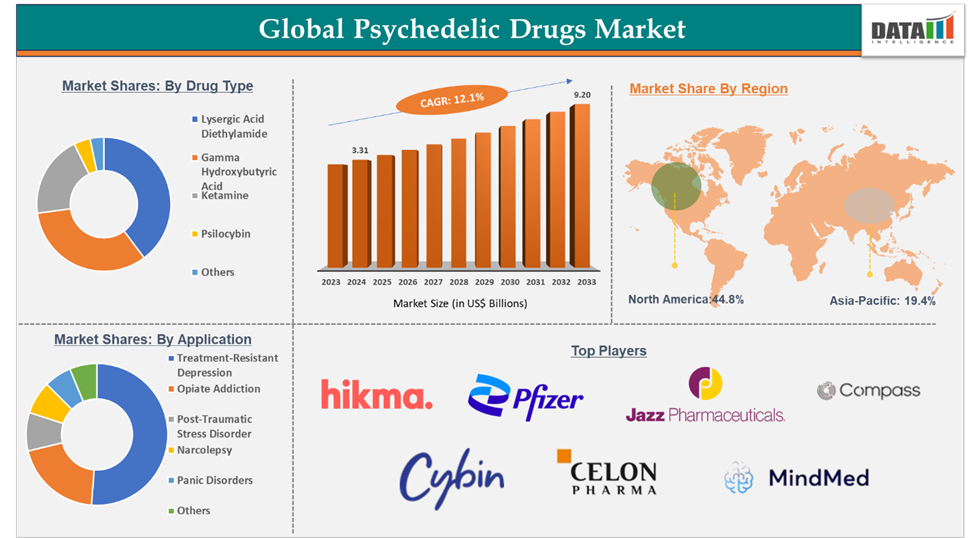
The psychedelic drugs market reached US$3.71 billion in 2025 and is expected to reach US$9.20 billion by 2033, growing at a CAGR of 12.1% during the forecast period 2026-2033.
The global psychedelic drugs market is experiencing significant growth due to the growing awareness of alternative mental health treatments, particularly for conditions like depression, anxiety, PTSD, and substance use disorders. Psychedelic compounds like psilocybin, MDMA, and LSD are gaining attention due to promising clinical trials and favorable regulatory designations, particularly in North America and Europe. Investment from both public and private sectors is accelerating research and development, while shifts in public perception and regulatory policies create new opportunities for commercialization. Despite challenges like legal restrictions and social stigma, the outlook remains optimistic, with expanding research efforts and increasing mental health needs expected to drive market growth.
For more details on this report, Request for Sample
Psychedelic Drugs Market Dynamics: Drivers & Restraints
Driver: Rising Prevalence of Mental Health Disorders
The rise in mental health conditions like depression, anxiety, and PTSD has sparked a surge in the psychedelic drugs market. Traditional treatments often lack effectiveness or side effects, prompting patients and healthcare providers to explore alternative therapies. Psychedelic drugs like psilocybin and MDMA have shown promising results in clinical trials, attracting interest from pharmaceutical companies, researchers, and investors.
For instance, according to the Press Information Bureau (PIB), India has a significant prevalence of mental disorders, with 13.7% of adults experiencing mental health issues requiring intervention. Urban areas have a higher prevalence (13.5%) compared to rural areas (6.9%). The Economic Survey 2024-25 emphasizes the importance of community-based approaches and preventive strategies for mental well-being, highlighting the need for mental, emotional, social, cognitive, and physical capabilities.
Restraint: Regulatory and Legal Challenges
The psychedelic drugs market faces significant regulatory and legal challenges, with most substances classified as Schedule I drugs, indicating high potential for abuse and no medical use. This classification hinders research, development, and commercialization. The stigma associated with psychedelics, complex approval processes, and inconsistent regulatory frameworks limit market growth and access to innovative therapies.
Psychedelic Drugs Market Segment Analysis
The global psychedelic drugs market is segmented based on drug type, application, distribution channel, and region.
Drug Type:
The lysergic acid diethylamide segment of the product type is expected to hold 38.4% of the psychedelic drugs market
Lysergic Acid Diethylamide (LSD) is a hallucinogenic compound that alters perception, mood, and cognitive processes. Synthesized from lysergic acid, found in a fungus on rye, it affects serotonin receptors in the brain, leading to altered sensory experiences and thought patterns. LSD has regained scientific interest in recent years due to potential therapeutic applications in treating mental health conditions like anxiety, depression, and substance use disorders.
The LSD segment in the global psychedelic drugs market is gaining momentum due to increased interest in its therapeutic potential and clinical research in mental health treatment. Studies suggest LSD-assisted psychotherapy may provide long-term relief for patients with treatment-resistant conditions, particularly anxiety and depression. Private investors and research organizations are supporting LSD-based therapies, while regulatory bodies' openness to clinical trials and public interest in alternative mental health solutions contribute to its growth.
Psychedelic Drugs Market Geographical Analysis
North America dominated the global psychedelic drugs market with the highest share of 44.8% in 2025
The North American psychedelic drugs market is fueled by advanced clinical research infrastructure and investment in mental health innovation. Leading pharmaceutical companies, research institutions, and startups are conducting clinical trials to explore psychedelic compounds like psilocybin and MDMA for treating depression, PTSD, and anxiety. Public acceptance and regulatory developments, such as FDA breakthrough therapy designations, are accelerating drug development and commercialization. Advocacy groups and progressive state-level legal reforms also contribute to market growth.
For instance, in June 2024, MindBio Therapeutics has announced that its drug MB22001, based on Lysergic Acid Diethylamide (LSD), has shown a 65% reduction in depression symptoms in a Phase IIa trial. The drug also showed significant improvements in mood, energy, creativity, well-being, depression, and sleep, including REM sleep, one-month post-treatment.
Asia-Pacific region in the global psychedelic drugs market is expected to grow with the highest CAGR of 13.8% in the forecast period of 2026 to 2033
The Asia Pacific market for psychedelic drugs is gaining interest due to rising mental health awareness and demand for effective treatment options. Despite conservative regulatory environments, countries like Australia and Southeast Asia are showing interest through pilot studies and academic research. Expanding healthcare infrastructure and openness towards alternative medicines are also driving interest. Partnerships between international pharmaceutical companies and regional research institutions are boosting future market development.
For instance, in May 2025, Otsuka Pharmaceutical Co., Ltd. signed a non-clinical research agreement with Keio University for infrastructure development for social implementation of psychedelics in Japan. Conventional treatments for depression, anxiety, obsessive-compulsive disorder, and PTSD are often insufficient in terms of treatment efficacy and relapse prevention, leading to significant economic and social losses. There is a strong demand for new treatments for refractory mental disorders.
Psychedelic Drugs Market Key Players
The major global players in the psychedelic drugs market include Compass Pathways, MindMed, Hikma Pharmaceuticals, Celon Pharmaceuticals, Cybin Corp, Pfizer Inc., Jazz Pharmaceuticals Inc., Atai Life Sciences N.V., PharmaTher Holdings Ltd., and GH Research PLC, among others.
Key Developments
February 2026: Rising advancements in psilocybin therapies, ketamine-based treatments, and AI-assisted mental health platforms accelerated growth in the psychedelic drugs market across North America and Europe. Major companies including Compass Pathways, MindMed, Cybin Inc., and Atai Life Sciences expanded late-stage clinical development programs for depression, PTSD, and anxiety disorders.
January 2026: Increasing investments in psychedelic drug research and supportive regulatory reforms across the United States, Canada, Germany, and Australia strengthened commercialization opportunities for psychedelic-assisted therapies. North America maintained market leadership, while Asia-Pacific emerged as a rapidly growing regional market driven by mental healthcare investments and clinical research expansion.
December 2025: Growing prevalence of treatment-resistant depression, PTSD, and anxiety disorders accelerated adoption of psychedelic-assisted therapy programs globally. Healthcare providers and specialty mental health clinics expanded integration of supervised ketamine and psilocybin treatment models.
November 2025: Expansion of clinical trials evaluating MDMA, LSD, psilocybin, and ketamine therapies increased development opportunities in the psychedelic drugs market worldwide. Compass Pathways initiated global Phase III trials for COMP360 psilocybin therapy targeting treatment-resistant depression across North America and Europe.
October 2025: Rising advancements in biomarker-driven psychiatry, digital therapeutics, and precision psychedelic medicine improved patient monitoring and treatment personalization globally. Research institutions accelerated innovation in neuroscience platforms supporting safe and scalable psychedelic-assisted therapy delivery.
September 2025: Increasing collaborations between biotechnology companies, academic institutions, and mental health organizations accelerated psychedelic drug discovery and commercialization initiatives worldwide. Europe and Latin America strengthened policy reforms and clinical infrastructure supporting regulated psychedelic treatment programs.
August 2025: Growing regulatory momentum and FDA breakthrough therapy designations strengthened investor confidence in psychedelic drug development globally. MAPS Public Benefit Corporation submitted a New Drug Application for MDMA-assisted therapy in PTSD, while MindMed received FDA Breakthrough Therapy designation for MM-120 targeting generalized anxiety disorder.
July 2025: Rising investments and merger activities among psychedelic biotechnology firms accelerated innovation in novel psychiatric treatment platforms worldwide. Psychedelic companies raised more than US$1.2 billion in funding in 2025, supporting late-stage trials and commercialization strategies.
June 2025: Increasing focus on alternative mental health therapies, treatment-resistant psychiatric disorders, and precision neuropsychiatry supported strong growth in the psychedelic drugs market worldwide. North America dominated the market due to advanced research infrastructure, while Europe and Asia-Pacific emerged as major growth regions driven by expanding clinical research and regulatory progress.
Market Scope
Metrics | Details | |
CAGR | 12.1% | |
Market Size Available for Years | 2023-2033 | |
Estimation Forecast Period | 2026-2033 | |
Revenue Units | Value (US$ Bn) | |
Segments Covered | Drug Type | Lysergic Acid Diethylamide, Gamma Hydroxybutyric Acid, Ketamine, Psilocybin, Others |
Application | Treatment-Resistant Depression, Opiate Addiction, Post-Traumatic Stress Disorder, Narcolepsy, Panic Disorders, Others | |
Distribution Channel | Hospital Pharmacies, Retail Pharmacies, Online Pharmacies | |
Regions Covered | North America, Europe, Asia-Pacific, South America, and the Middle East & Africa | |



























































