


Narcolepsy Therapeutics Market Size and Overview
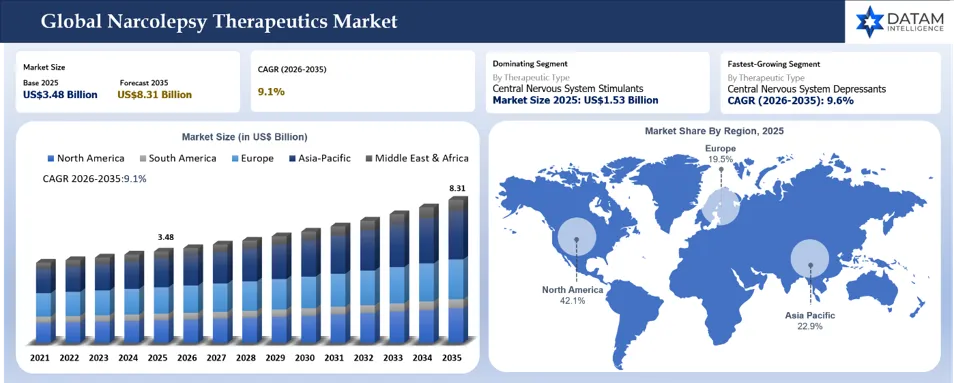
The global narcolepsy therapeutics market reached US$3.48 billion in 2025 and is expected to reach US$8.31 billion by 2035, growing with a CAGR of 9.1% during the forecast period 2026-2035. Narcolepsy Type 1 and Narcolepsy Type 2 remain the principal disease segments, while treatment is centered on wake-promoting agents, oxybate therapies, central nervous system stimulants and newer mechanism-based therapies.
A major transformation in the market is the emergence of orexin receptor 2 agonists, which aim to address the underlying orexin deficiency associated with Narcolepsy Type 1 rather than treating individual symptoms alone. This shift is increasing competitive intensity among established companies such as Jazz Pharmaceuticals, Harmony Biosciences, Takeda Pharmaceutical and Alkermes, while companies including Eli Lilly, Axsome Therapeutics and other pipeline developers are strengthening investment in next-generation sleep-wake therapies. Product differentiation is increasingly based on multi-symptom efficacy, dosing convenience, safety, treatment adherence, controlled-substance status and ability to reduce nighttime dosing burden.
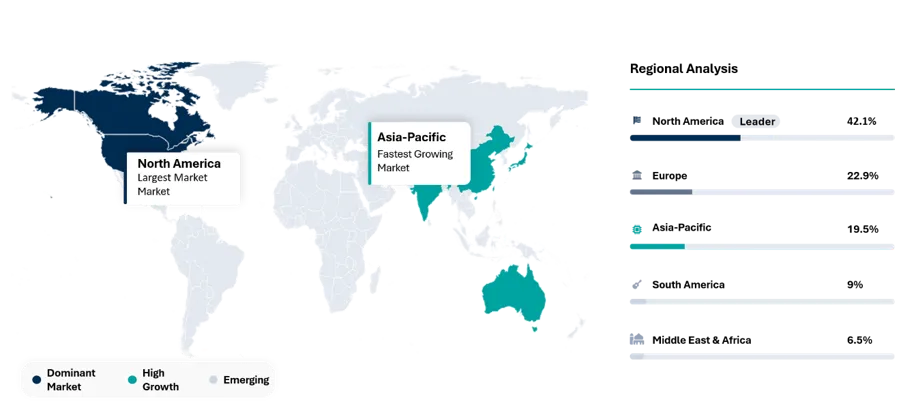
North America represents the leading regional market due to strong diagnosis rates, high treatment penetration, availability of specialty sleep centers and rapid adoption of innovative therapies. Europe maintains a significant position, while Asia-Pacific is expected to experience comparatively faster growth as awareness, diagnosis and treatment accessibility improve. Despite positive market momentum, delayed diagnosis, high treatment costs, reimbursement barriers, safety concerns and limited therapeutic options for certain patient groups continue to restrain adoption. Future growth opportunities are expected to center on orexin-based therapies, Narcolepsy Type 2 treatments, pediatric indications, long-acting formulations, improved diagnostic pathways and therapies capable of addressing multiple symptoms through a single treatment approach.
Narcolepsy Therapeutics Market Key Takeaways
- Strong Market Growth: The global narcolepsy therapeutics market is estimated at approximately US$3.48 billion in 2025 and is projected to reach around US$8.31 billion by 2035, expanding at a CAGR of about 9.1%.
- Orexin Therapies Are Reshaping Treatment: The market is shifting from primarily symptom-management therapies toward orexin receptor 2 agonists, which target the underlying orexin deficiency associated with Narcolepsy Type 1.
- Established Brands Continue To Dominate: Jazz Pharmaceuticals, Harmony Biosciences, Takeda and Alkermes maintain strong competitive positions through differentiated products such as Xywav, Wakix, Orzeyful and Lumryz.
- Pipeline Competition Is Intensifying: Companies including Eli Lilly, Axsome Therapeutics and Alkermes are advancing next-generation narcolepsy candidates, increasing competition around wakefulness, cataplexy control, dosing convenience and broader symptom coverage.
- Unmet Need Remains Significant: Diagnostic delays, residual excessive daytime sleepiness, cataplexy, nighttime dosing burden, controlled-substance concerns and variable treatment response continue to create opportunities for safer, longer-acting and more convenient therapies.
Narcolepsy Therapeutics Market Scope
| Metrics | Details | |
| 2025 Market Size | US$3.48 Billion | |
| 2035 Projected Market Size | US$8.31 Billion | |
| CAGR (2026-2035) | 9.1% | |
| Largest Market | North America | |
| Fastest Growing Market | Asia-Pacific | |
| By Disease Type | Narcolepsy Type 1, Narcolepsy Type 2 | |
| By Therapeutic Type | Central Nervous System Stimulants, Central Nervous System Depressants, Others | |
| By Distribution Channel | Hospital Pharmacies, Retail Pharmacies, Other Pharmacies | |
| By Region | North America | U.S., Canada, Mexico |
| Europe | Germany, UK, France, Spain, Italy, Poland | |
| Asia-Pacific | China, India, Japan, Australia, South Korea, Indonesia, Malaysia, Singapore, Vietnam, Thailand, Philippines, Taiwan | |
| South America | Brazil, Argentina | |
| Middle East and Africa | Israel, Saudi Arabia, UAE, Turkiye, South Africa, Nigeria | |
| Report Insights Covered | Competitive Landscape Analysis, Company Profile Analysis, Market Size, Share, Growth | |
Narcolepsy Therapeutics Market White Space & Investment Opportunities
- Next-Generation Orexin Therapies Beyond Narcolepsy Type 1: Invest in oral orexin receptor agonists capable of extending disease-mechanism-targeted treatment beyond Narcolepsy Type 1 into Narcolepsy Type 2 and other hypersomnolence disorders. Takeda’s 2026 approvals of oveporexton validate orexin restoration as a new therapeutic class, while programs such as TAK-360 indicate further opportunities across broader sleep-wake disorders.
- Multi-Symptom Therapies With Broader Clinical Benefit: Develop treatments capable of simultaneously improving excessive daytime sleepiness, cataplexy, disrupted nighttime sleep, cognition, fatigue and daily functioning. Many patients continue to experience residual symptoms despite existing treatment, creating an opportunity for therapies that provide broader symptom control through a single mechanism rather than requiring multiple medications.
- Convenient, Long-Acting and Lower-Burden Treatment Regimens: Expand investment in once-daily, extended-release and simplified oral therapies that reduce nighttime dosing, complex administration and treatment burden. Greater convenience can improve adherence and persistence while providing meaningful differentiation from traditional oxybate and stimulant-based treatment approaches, particularly among patients requiring lifelong therapy.
- Narcolepsy Type 2 and Underserved Patient Populations: Increase development specifically targeting Narcolepsy Type 2, where disease biology is less clearly defined and therapeutic innovation remains more limited than in Narcolepsy Type 1. Opportunities also exist in pediatric patients, patients with incomplete responses to current therapies and individuals unable to tolerate stimulants or oxybate treatments. Axsome’s Phase III AXS-12 program illustrates continued investment in alternative narcolepsy mechanisms.
- Earlier Diagnosis and Digital Patient Identification: Invest in diagnostic algorithms, sleep-monitoring technologies, digital biomarkers and physician-support tools capable of shortening the time between symptom onset and diagnosis. Persistent diagnostic delays, limited access to specialist sleep testing and insurance barriers leave substantial numbers of patients inadequately diagnosed or treated, creating opportunities across both diagnostics and therapeutics.
- Safer Non-Scheduled and Lower-Risk Therapies: Develop effective treatments with reduced abuse potential, fewer central nervous system safety concerns and simpler prescribing requirements. Therapies that combine strong wakefulness and cataplexy control with favorable long-term safety and limited controlled-substance restrictions could gain significant competitive advantage, particularly among patients and clinicians seeking alternatives to stimulant- and oxybate-based regimens.
Narcolepsy Therapeutics Market Buyer Decision-Making Criteria
Major Buyer Decision-Making Criteria:
- Reduction in Excessive Daytime Sleepiness
- Reduction in Cataplexy Frequency and Severity
- Improvement in Wakefulness and Daytime Functioning
- Ability to Address Multiple Narcolepsy Symptoms
- Speed, Consistency and Durability of Clinical Response
- Safety, Tolerability and Risk of Dependence or Misuse
- Dosing Convenience, Treatment Adherence and Nighttime Administration Burden
Narcolepsy Therapeutics Market BCG Matrix: Company Evaluation
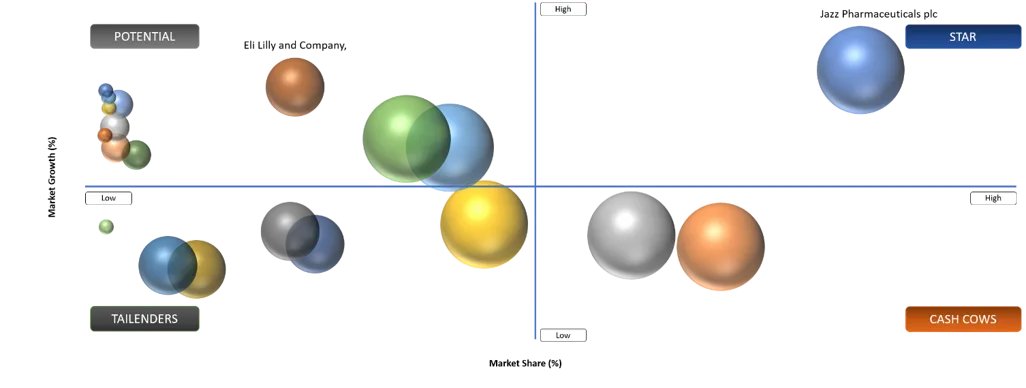
STAR
Jazz Pharmaceuticals plc, Harmony Biosciences Holdings, Inc., Takeda Pharmaceutical Company Limited and Alkermes plc are positioned in the Star category based on their strong commercial presence in narcolepsy, differentiated approved therapies, established sleep-medicine franchises and continued lifecycle or pipeline expansion. Jazz Pharmaceuticals maintains a leading position through Xywav, the only FDA-approved low-sodium oxybate for cataplexy or excessive daytime sleepiness in patients aged seven years and older with narcolepsy, supported by continued clinical and real-world evidence generation. In June 2026, Jazz presented 21 abstracts at SLEEP 2026 evaluating Xywav across narcolepsy and idiopathic hypersomnia, reinforcing its established leadership in oxybate-based therapy. Harmony Biosciences continues strengthening its narcolepsy franchise through Wakix (pitolisant), which generated approximately US$868.5 million in 2025 and is projected to exceed US$1 billion in 2026. In February 2026, the FDA expanded Wakix to include treatment of cataplexy in pediatric patients aged six years and older, making it the first and only FDA-approved non-scheduled treatment addressing narcolepsy patients with or without cataplexy across pediatric and adult populations. Harmony is also advancing gastro-resistant and high-dose pitolisant formulations and an orexin-2 receptor agonist program.
Takeda significantly strengthened its competitive position in August 2026 when the U.S. FDA approved Orzeyful (oveporexton) for adults with Narcolepsy Type 1. Oveporexton is the first approved oral orexin receptor 2 agonist designed to restore orexin signaling and address the underlying orexin deficiency associated with Narcolepsy Type 1 rather than solely managing individual symptoms. By September 2026, the therapy had secured approvals in the United States, China and Japan, providing Takeda with a differentiated first-in-class position in the evolving narcolepsy treatment landscape. Alkermes strengthened its commercial sleep-medicine presence through its February 2026 acquisition of Avadel Pharmaceuticals, adding Lumryz, the first once-at-bedtime oxybate approved for cataplexy or excessive daytime sleepiness in patients aged seven years and older with narcolepsy. Alkermes is simultaneously developing alixorexton, an oral selective orexin-2 receptor agonist for Narcolepsy Type 1, Narcolepsy Type 2 and idiopathic hypersomnia, creating a combined marketed and next-generation pipeline position.
POTENTIAL
Eli Lilly and Company, Axsome Therapeutics, Inc., Bioprojet Pharma SAS and Apotex Inc. are positioned in the Potential category based on emerging orexin programs, late-stage narcolepsy candidates, established wake-promoting therapies and opportunities to expand their commercial presence. Eli Lilly entered the sleep-wake therapeutics field through its June 2026 acquisition of Centessa Pharmaceuticals. The transaction added a portfolio of orexin receptor 2 agonists led by cleminorexton, formerly ORX750, which is being developed for Narcolepsy Type 1, Narcolepsy Type 2 and idiopathic hypersomnia and has demonstrated encouraging clinical activity across these patient groups. Lilly's global development, regulatory and commercialization capabilities could substantially accelerate the program and establish the company as a major future competitor in orexin-based narcolepsy therapy.
Axsome Therapeutics has an established narcolepsy presence through Sunosi (solriamfetol) and is expanding its pipeline with AXS-12 (reboxetine), a Phase III investigational treatment for narcolepsy that has received FDA Orphan Drug designation. AXS-12 is being developed to address wakefulness, muscle tone and cognitive symptoms, providing Axsome with an opportunity to broaden its position beyond excessive daytime sleepiness. Bioprojet Pharma remains strategically relevant as the developer of pitolisant, commercialized as Wakix for narcolepsy with or without cataplexy, with commercialization conducted directly in parts of Europe and through Harmony Biosciences in the United States. Apotex expanded its direct presence in the U.S. sleep-disorder market through the acquisition of U.S. rights to Provigil (modafinil) and Nuvigil (armodafinil) in 2025. Both therapies are established wake-promoting treatments for excessive sleepiness associated with narcolepsy, giving Apotex an established commercial platform from which to expand its specialty pharmaceutical presence in sleep medicine.
Narcolepsy Therapeutics Market Dynamics
Driver Impact Analysis
| Driver | Market Growth Impact (%) | Demand Concentration | Impacted Use Case | Strategic Impact |
Increasing Diagnosis of Narcolepsy and Expansion of the Treatment-Eligible Patient Population | 15.4% | Patient identification, prescription initiation and long-term pharmacological treatment | Patients with Narcolepsy Type 1 and Narcolepsy Type 2 experiencing excessive daytime sleepiness and cataplexy | Earlier diagnosis expands the addressable patient pool and increases sustained demand for wake-promoting agents, oxybate therapies and other long-term narcolepsy treatments. Diagnostic delays remain substantial, highlighting further opportunity from improved disease awareness and screening. |
Emergence of Orexin Receptor Agonists Targeting Underlying Disease Biology | 13.8% | Novel therapy adoption, treatment switching and premium innovative medicines | Narcolepsy Type 1 patients with orexin deficiency and multiple symptoms including excessive daytime sleepiness and cataplexy | Shifts treatment from symptom management toward disease-mechanism-targeted therapy. FDA approval of oveporexton in August 2026 established the first therapy directly restoring orexin signaling, potentially reshaping future treatment algorithms. |
Expanding Availability of Differentiated Branded and Generic Narcolepsy Therapies | 11.6% | Treatment accessibility, therapy switching, affordability and broader prescription penetration | Patients requiring wake-promoting therapies, pitolisant, oxybate therapies and alternative long-term treatment options | Increasing branded innovation alongside generic entry broadens therapeutic choice and improves access. In 2026, the FDA approved first generics of solriamfetol and pitolisant, increasing competitive intensity and potentially supporting wider treatment penetration. |
Driver: Increasing Diagnosis of Narcolepsy and Expansion of the Treatment-Eligible Patient Population
Increasing diagnosis of narcolepsy and expansion of the treatment-eligible patient population are key drivers of the global narcolepsy therapeutics market. Greater awareness among healthcare professionals, improved access to sleep specialists and wider use of diagnostic tools are helping identify patients with Narcolepsy Type 1 and Narcolepsy Type 2 earlier. As more individuals receive an accurate diagnosis, demand for long-term pharmacological management of excessive daytime sleepiness, cataplexy and related symptoms is increasing. This trend supports greater use of wake-promoting agents, oxybate therapies and newer targeted treatments, while also expanding the commercial opportunity for pharmaceutical companies developing differentiated narcolepsy therapies.
Restraint Impact Analysis
| Restraint | Drag on Market Growth (%) | Primary Impact Area | Impacted Use Case | Strategic Impact |
Delayed Diagnosis and Underdiagnosis of Narcolepsy | 14.3% | Patient identification, treatment initiation and specialist referrals | Patients with unrecognized Narcolepsy Type 1 and Narcolepsy Type 2 | Long diagnostic delays reduce the diagnosed and treatment-eligible population, delaying prescription uptake and limiting market penetration. A 2025 multicenter study reported a median diagnostic delay of approximately seven years. |
Safety Concerns and Controlled-Substance Restrictions | 12.5% | Oxybate therapies, stimulants and long-term pharmacological management | Patients requiring sodium oxybate, low-sodium oxybate or stimulant treatment | CNS depression, abuse and misuse risks, controlled-substance requirements and REMS-related restrictions can complicate prescribing and patient access. FDA documentation identifies oxybate therapies as controlled substances requiring specific risk-management measures. |
High Treatment Costs and Reimbursement Barriers | 10.8% | Branded therapies, specialty pharmacy distribution and long-term treatment | Patients requiring premium branded or newer targeted therapies | High medication costs, restrictive insurance coverage and specialty-access requirements can reduce therapy initiation and persistence, particularly where reimbursement systems provide limited coverage for narcolepsy treatment. Recent literature identifies cost and insurance barriers as continuing contributors to treatment disparities. |
Restraint: Delayed Diagnosis and Underdiagnosis of Narcolepsy
Delayed diagnosis and underdiagnosis represent a major restraint on the global narcolepsy therapeutics market. Narcolepsy symptoms such as excessive daytime sleepiness, fatigue and disrupted nighttime sleep can be mistaken for psychiatric, behavioral or other sleep-related conditions, delaying referral to sleep specialists. A 2025 multicenter study reported a median diagnostic delay of approximately seven years, demonstrating the persistent gap between symptom onset and treatment initiation. These delays reduce the diagnosed patient pool, postpone prescription uptake and limit commercial penetration of narcolepsy therapies. Improving physician awareness, diagnostic pathways and access to specialized sleep testing remains critical for expanding treatment adoption.
Narcolepsy Therapeutics Market Segment Analysis
The global narcolepsy therapeutics market is segmented by disease type, therapeutic type, and distribution channel, and region.
Product Type: The central nervous system stimulants segment is estimated to have 39.2% of the narcolepsy therapeutics market share.
Central nervous system (CNS) stimulants dominate the narcolepsy therapeutics market because they effectively target excessive daytime sleepiness (EDS), the most debilitating symptom of narcolepsy, making them the preferred first-line treatment.
Medications like modafinil (PROVIGIL), armodafinil (NUVIGIL), and methylphenidate work by promoting wakefulness and improving alertness without significantly disturbing nighttime sleep. Their widespread clinical use, established safety profiles, and ability to enhance daily functioning for patients contribute to their market dominance.
Additionally, these stimulants can be combined with other therapies, such as sodium oxybate for cataplexy management, allowing a flexible, symptom-focused approach that further reinforces their central role in narcolepsy care. Moreover, CNS stimulants are widely supported by clinical guidelines and real-world evidence, which further reinforces physician confidence in prescribing them.
Recent developments in this landscape have further solidified the segment’s position. For instance, in January 2025, Apotex Inc., Canada’s largest pharmaceutical company, announced that its affiliate Nuvo Pharmaceuticals (Ireland) DAC acquired U.S. rights to PROVIGIL (modafinil) and NUVIGIL (armodafinil), adding these branded therapies to Apotex Group’s global portfolio of over 550 prescription, OTC, and biosimilar products.
Narcolepsy Therapeutics Market Geographical Penetration
U.S. Narcolepsy Therapeutics Market Landscape
The United States represents the largest market for narcolepsy therapeutics, supported by high diagnosis rates, strong specialist access, established reimbursement pathways and broad availability of branded therapies such as Xywav, Wakix, Lumryz and Sunosi. Competition is increasingly shifting toward disease-mechanism-targeted treatment. In August 2026, the FDA approved Takeda’s Orzeyful (oveporexton) for adults with Narcolepsy Type 1, making it the first approved therapy to directly restore orexin signaling and address the underlying biology of the disease. Continued pipeline activity from Alkermes, Axsome Therapeutics and other developers is expected to further intensify competition and expand treatment options.
Japan Narcolepsy Therapeutics Market Outlook
Japan is an important and innovation-driven market for narcolepsy therapeutics, supported by established sleep-medicine expertise, growing disease awareness and domestic pharmaceutical research capabilities. The market gained significant momentum in August 2026 when Japan’s Ministry of Health, Labour and Welfare approved Takeda’s Orzeyful (oveporexton) for adults with Narcolepsy Type 1. Developed from research conducted by Takeda in Japan, Orzeyful became the first selective orexin receptor 2 agonist approved in the country to address the underlying orexin deficiency rather than individual symptoms alone. The approval is expected to accelerate adoption of mechanism-targeted therapies and strengthen Japan’s role in next-generation narcolepsy treatment innovation.
Narcolepsy Therapeutics Market Competitive Landscape
- The global narcolepsy therapeutics market is moderately consolidated, with competition centered around differentiated oxybate therapies, wake-promoting agents, histamine H3 receptor antagonists and emerging orexin receptor agonists. Jazz Pharmaceuticals plc, Harmony Biosciences Holdings, Inc., Takeda Pharmaceutical Company Limited and Alkermes plc currently represent some of the strongest competitive participants due to established commercial products, dedicated sleep-medicine infrastructure and continued investment in next-generation therapies. Jazz Pharmaceuticals maintains a significant position through Xywav, with approximately 11,275 active narcolepsy patients using the therapy at the end of the second quarter of 2026. The company continues to strengthen its franchise through clinical and real-world studies evaluating treatment outcomes and alternative dosing approaches.
- Harmony Biosciences competes through Wakix (pitolisant), a differentiated non-scheduled treatment for narcolepsy. Wakix generated approximately US$868.5 million in 2025, while Harmony expects 2026 revenue of US$1.0–1.04 billion. The company is also developing next-generation pitolisant formulations and an orexin-2 receptor agonist, supporting potential long-term franchise expansion. Takeda significantly altered the competitive landscape in August 2026 with U.S. approval of Orzeyful (oveporexton), the first oral orexin receptor 2 agonist approved to address the underlying orexin deficiency associated with Narcolepsy Type 1. The therapy has also received approvals in China and Japan, positioning Takeda at the forefront of disease-mechanism-targeted narcolepsy treatment.
- Alkermes strengthened its position through the February 2026 acquisition of Avadel Pharmaceuticals, adding Lumryz, a once-at-bedtime extended-release sodium oxybate therapy, while simultaneously advancing alixorexton, an investigational orexin-2 receptor agonist for Narcolepsy Type 1, Narcolepsy Type 2 and idiopathic hypersomnia. Eli Lilly and Company is emerging as another important future competitor following its June 2026 acquisition of Centessa Pharmaceuticals, which brought cleminorexton and additional orexin receptor 2 agonists into Lilly's neuroscience pipeline.
- Other participants including Axsome Therapeutics, Inc., Bioprojet Pharma SAS, Apotex Inc., Teva Pharmaceutical Industries Limited, Novartis AG, Azurity Pharmaceuticals, Inc., Amneal Pharmaceuticals, Inc., Hikma Pharmaceuticals PLC, Lupin Limited, Aurobindo Pharma Limited, Sandoz Group AG, Viatris Inc., Natco Pharma Limited, Alembic Pharmaceuticals Limited and Commave Therapeutics SA contribute through branded wake-promoting therapies, stimulants, generic modafinil and armodafinil products, oxybate alternatives and pipeline candidates. Competitive intensity is expected to increase as the market shifts from primarily symptom-management therapies toward orexin-based treatments that target underlying disease biology. Product differentiation around dosing convenience, sodium content, controlled-substance status, symptom coverage, pediatric indications and long-term safety is therefore expected to become increasingly important in determining future market positioning.
Key Companies of the Narcolepsy Therapeutics Market
- Jazz Pharmaceuticals plc (Ireland)
- Harmony Biosciences Holdings, Inc. (United States)
- Takeda Pharmaceutical Company Limited (Japan)
- Alkermes plc (Ireland)
- Axsome Therapeutics, Inc. (United States)
- Apotex Inc. (Canada)
- Bioprojet Pharma SAS (France)
- Centessa Pharmaceuticals plc (United States)
- Teva Pharmaceutical Industries Limited (Israel)
- Novartis AG (Switzerland)
- Azurity Pharmaceuticals, Inc. (United States)
- Amneal Pharmaceuticals, Inc. (United States)
- Hikma Pharmaceuticals PLC (United Kingdom)
- Lupin Limited (India)
- Aurobindo Pharma Limited (India)
- Sandoz Group AG (Switzerland)
- Viatris Inc. (United States)
- Natco Pharma Limited (India)
- Alembic Pharmaceuticals Limited (India)
- Commave Therapeutics SA (Switzerland)
- Eli Lilly and Company (United States)
Narcolepsy Therapeutics Market Recent Developments
- September 2026: Takeda Pharmaceutical Company Limited announced that the New England Journal of Medicine published results from two Phase III studies of ORZEYFUL (oveporexton) in Narcolepsy Type 1. The studies demonstrated significant and clinically meaningful improvements across multiple symptoms and quality-of-life measures. ORZEYFUL is the first approved orexin receptor 2 agonist designed to restore orexin signaling and address the underlying orexin deficiency associated with Narcolepsy Type 1.
- August 2026: Takeda Pharmaceutical Company Limited received approval from Japan's Ministry of Health, Labour and Welfare for ORZEYFUL (oveporexton) for adults with Narcolepsy Type 1. The approval represented the therapy's third major regulatory authorization globally, following approvals in China and the United States, strengthening Takeda's position in disease-mechanism-targeted narcolepsy treatment.
- August 2026: Alkermes plc announced publication in The Lancet Neurology of positive Phase II Vibrance-1 data evaluating alixorexton, an investigational oral selective orexin 2 receptor agonist, in adults with Narcolepsy Type 1. The therapy demonstrated statistically significant and clinically meaningful improvements in wakefulness and cataplexy, alongside improvements in fatigue, cognition, disease severity and health-related quality of life.
- August 2026: The U.S. Food and Drug Administration approved Takeda's ORZEYFUL (oveporexton) for adults with Narcolepsy Type 1. The approval made ORZEYFUL the first medicine approved to address the full range of Narcolepsy Type 1 symptoms by directly restoring orexin signaling, representing an important transition from predominantly symptom-focused therapies toward treatment targeting the underlying disease biology.
- July 2026: Alkermes plc reported interim results from the long-term extension study of alixorexton in adults with Narcolepsy Type 1 and Narcolepsy Type 2. The investigational therapy demonstrated sustained clinically meaningful improvements in wakefulness and excessive daytime sleepiness for up to approximately nine months, with improvements in patient-reported cognition and fatigue also maintained during treatment.
- July 2026: China's National Medical Products Administration approved Takeda's ORZEYFUL (oveporexton) for Narcolepsy Type 1 in patients aged 16 years and older. The approval established oveporexton as the first oral selective orexin receptor 2 agonist approved in China and introduced a new disease-mechanism-targeted therapeutic class for narcolepsy management.
What DATAM Uniquely Provides
- In-depth segmentation of the Narcolepsy Therapeutics Market by disease type, therapeutic type, distribution channel and region, with additional assessment of Narcolepsy Type 1, Narcolepsy Type 2, central nervous system stimulants, depressants, wake-promoting therapies, oxybate therapies and emerging orexin-targeted treatments.
- Competitive analysis of leading narcolepsy therapeutics companies covering approved product portfolios, mechanism of action, symptom coverage, efficacy, dosing frequency, safety profile, controlled-substance status, pediatric indications, pipeline maturity, regulatory progress, commercialization strategy and geographic expansion.
- Comprehensive assessment of diagnosed and treatment-eligible narcolepsy populations, including patients with Narcolepsy Type 1, Narcolepsy Type 2, excessive daytime sleepiness, cataplexy, disrupted nighttime sleep, sleep paralysis and related symptom burdens influencing treatment selection.
- Detailed evaluation of the evolving treatment landscape, including sodium oxybate, low-sodium oxybate, once-nightly oxybate formulations, modafinil, armodafinil, solriamfetol, pitolisant, stimulant therapies and next-generation orexin receptor 2 agonists.
- Pipeline and clinical-development intelligence covering emerging orexin-based therapies, novel wake-promoting agents, reformulated therapies, late-stage clinical candidates, trial outcomes, regulatory milestones and potential product launches that could reshape future treatment algorithms.
- Patient journey and unmet-need analysis assessing diagnostic delays, treatment switching, persistence, adherence, residual excessive daytime sleepiness, cataplexy control, nighttime dosing burden, safety concerns and limitations of existing symptom-management therapies.
- Commercial opportunity assessment across hospital pharmacies, retail pharmacies and other pharmacy channels, including branded versus generic competition, pricing dynamics, reimbursement considerations, market access barriers and opportunities for differentiated therapies.
- Strategic analysis of the transition toward disease-mechanism-targeted treatment, particularly orexin receptor agonists that aim to restore orexin signaling and potentially address multiple Narcolepsy Type 1 symptoms within a single therapeutic approach.



























































