


Psychotherapeutic Drugs Market Size and Trends
The global psychotherapeutic drugs market reached US$ 23.27 billion in 2025, with a rise to US$ 24.64 billion in 2026, and is expected to reach US$ 36.80 billion by 2033, growing at a CAGR of 5.9% during the forecast period 2026–2033.
The global psychotherapeutic drugs market is witnessing strong growth, driven by the increasing prevalence of mental health disorders and greater focus on psychiatric care. Rising cases of depression, anxiety, bipolar disorder, and schizophrenia are fueling demand for effective pharmacological treatments, while innovations such as extended-release formulations and novel therapies are improving treatment outcomes and patient adherence. Psychotherapeutic drugs are primarily used to manage mood, anxiety, and psychotic disorders, helping patients achieve better symptom control, enhance daily functioning, and improve overall quality of life.
Key Market highlights
- North America leads the psychotherapeutic drugs market, accounting for approximately 43.2% of global revenue. The region’s dominance is supported by advanced healthcare infrastructure, high awareness of mental health, widespread access to psychiatric care, and the presence of leading pharmaceutical companies actively investing in research, development, and commercialization of innovative psychotherapeutic drugs.
- Asia–Pacific is the fastest-growing regional market, holding around 21.9% of the global share. Growth is driven by increasing prevalence of mental health disorders, expanding healthcare infrastructure, rising awareness of psychiatric care, and government initiatives aimed at improving access to effective psychotherapeutic treatments in major economies such as China, India, Japan, and South Korea.
- Anti-psychotics remain the dominant product segment, contributing approximately 38.6% of global revenue. Their leadership is fueled by widespread clinical use in managing schizophrenia, bipolar disorder, and other psychotic conditions, the introduction of newer and long-acting formulations, and growing adoption across hospitals, specialty clinics, and outpatient care settings.
Market Size & Forecast
- 2025 Market Size: US$ 23.27 billion
- 2033 Projected Market Size: US$ 36.80 billion
- CAGR (2026–2033): 5.9%
- North America: Largest market
- Asia Pacific: Fastest-growing market
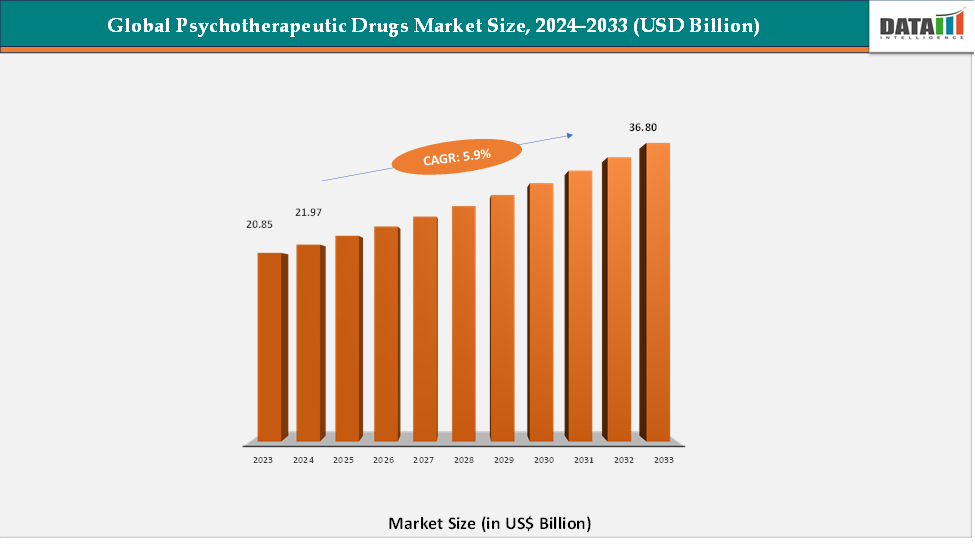
Source- DataM Intelligence
For more details on this report, Request for Sample
Market Dynamics:
Driver: Rising Prevalence of Mental Health Disorders
The rising prevalence of mental health disorders is a key factor driving growth in the Psychotherapeutic Drugs market. Globally, conditions such as depression, anxiety, bipolar disorder, and schizophrenia are increasing due to factors like urbanization, lifestyle stress, and an aging population, creating a substantial and growing patient base in need of effective treatment. As awareness of mental health improves and more individuals seek professional care, the demand for psychotherapeutic medications rises accordingly. These drugs play a critical role in managing symptoms, improving daily functioning, and enhancing quality of life, making them indispensable in psychiatric treatment plans.
The combination of higher incidence rates and greater healthcare-seeking behavior ensures that pharmaceutical companies continue to expand production, develop innovative therapies, and focus on improving patient adherence, collectively propelling market growth.
Restraint: High Device and Treatment Cost
Side effects and patient non-compliance are significant factors that could hamper the growth of the Psychotherapeutic Drugs market. Many psychotherapeutic medications, including antidepressants, antipsychotics, and mood stabilizers, can cause adverse effects such as weight gain, sedation, metabolic disturbances, or gastrointestinal issues.
Segmentation Analysis
The global psychotherapeutic drugs market is segmented by drug class, application, distribution channel, and region.
Psychotherapeutic Drugs: The anti-psychotics segment is estimated to have 44.8% of the Psychotherapeutic Drugs market share.
The anti-psychotics segment is the dominant segment in the global psychotherapeutic drugs market, accounting for the largest share of revenue. This dominance is primarily driven by the high prevalence of schizophrenia, bipolar disorder, and other psychotic disorders that require continuous pharmacological management. Anti-psychotic medications are essential not only for controlling acute psychotic episodes but also for long-term maintenance therapy, helping to prevent relapses and hospitalizations.
The segment’s growth is further supported by the introduction of newer, long-acting, and atypical antipsychotic formulations that improve patient adherence, minimize side effects, and enhance overall treatment outcomes. Hospitals, specialty clinics, and outpatient care centers continue to rely heavily on these drugs, making anti-psychotics the backbone of psychotherapeutic treatment strategies and securing their position as the largest segment in the market.
The antidepressants segment is estimated to have 21.4% of the Psychotherapeutic Drugs market share.
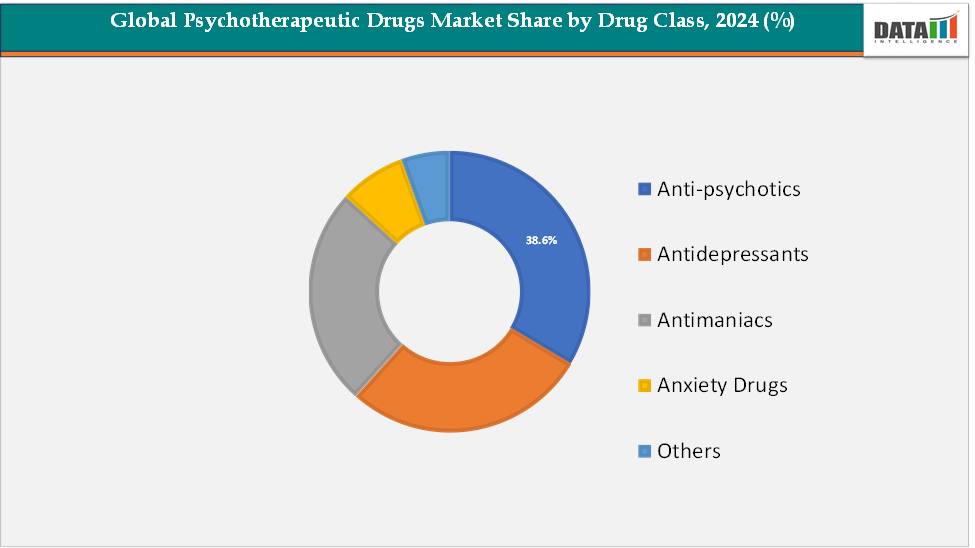
Source- DataM Intelligence
The antidepressants segment is currently the fastest-growing segment in the psychotherapeutic drugs market, reflecting the rising prevalence of depression, anxiety, and related mood disorders globally. Increasing awareness about mental health, reduction of stigma, and early intervention initiatives have led to a greater number of patients seeking treatment, thereby boosting demand for antidepressant therapies. Pharmaceutical companies are responding with innovations such as extended-release formulations, fast-acting medications, and drugs with improved safety profiles, all aimed at enhancing patient compliance and treatment efficacy.
The growth is also fueled by expanding healthcare infrastructure in emerging economies, where access to mental health services is improving rapidly. As more patients and healthcare providers adopt these therapies for both acute management and long-term maintenance, antidepressants are experiencing accelerated market adoption and are positioned as the fastest-growing segment in the psychotherapeutic drugs market.
Geographical Analysis
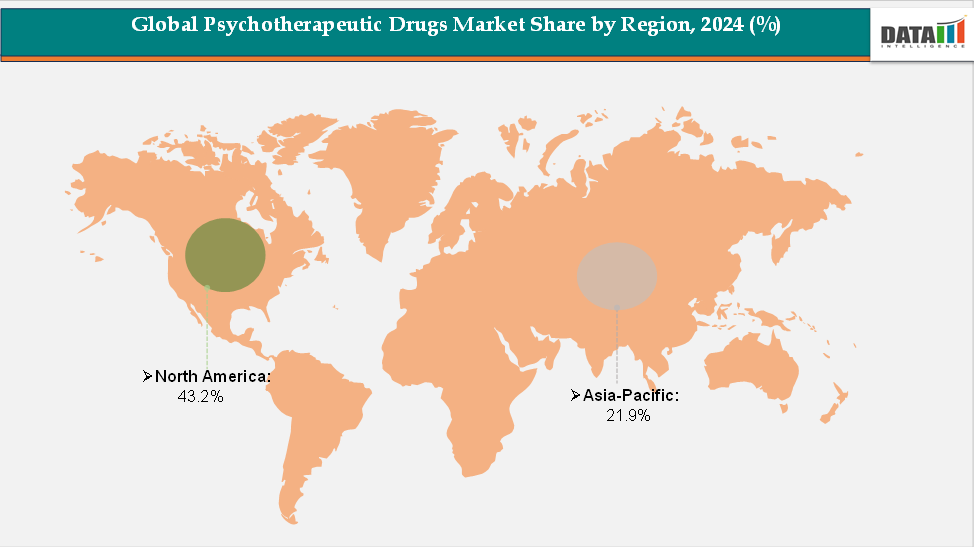
Source- DataM Intelligence
The North America psychotherapeutic drugs market was valued at 43.2% market share
North America continues to lead the global psychotherapeutic drugs market, accounting for the largest share of revenue. The region’s growth is largely driven by the high prevalence of mental health disorders, including depression, anxiety, bipolar disorder, and schizophrenia, which necessitate consistent pharmacological intervention. Anti-psychotics, antidepressants, and anxiety medications are widely prescribed across hospitals, specialty clinics, and outpatient care settings, reflecting strong adoption of these therapies among patients.
Additionally, supportive reimbursement policies in the United States encourage access to advanced and novel psychotherapeutic drugs, while early diagnosis and patient adherence programs ensure ongoing demand. The region also benefits from continuous innovation and the introduction of long-acting and extended-release formulations, which improve treatment outcomes and help maintain North America’s dominant position in the market.
The Europe Psychotherapeutic Drugs market was valued at 23.8% market share
Europe holds a significant and stable position in the psychotherapeutic drugs market, supported by proactive mental health programs and high patient awareness. Major markets such as Germany, the United Kingdom, and France contribute significantly to the adoption of anti-psychotics, antidepressants, and anxiety medications, which are widely utilized across hospitals, outpatient clinics, and specialty care settings.
The region benefits from ongoing clinical research and trials, as well as initiatives promoting early diagnosis and long-term management of psychiatric conditions. Increasing focus on treatment adherence and the introduction of innovative drug formulations, including extended-release and long-acting therapies, have reinforced Europe’s role as a major player in the global psychotherapeutic drugs market, ensuring steady demand and continued market stability.
The Asia-Pacific psychotherapeutic drugs market was valued at 21.9% market share
Asia-Pacific is emerging as the fastest-growing market for psychotherapeutic drugs, driven by the rising prevalence of mental health disorders and increasing awareness of psychiatric care among patients and caregivers. Countries such as China, India, Japan, and South Korea are witnessing a growing number of individuals seeking treatment for depression, anxiety, and other mood and psychotic disorders, creating substantial demand for both established and novel psychotherapeutic therapies. Government initiatives to improve access to mental health services, along with public awareness campaigns, have further encouraged treatment uptake.
The increasing incidence of stress-related and lifestyle-associated mental health conditions has created significant opportunities for antidepressants, anti-psychotics, and other emerging therapies. This combination of rising patient demand and expanding treatment adoption positions Asia-Pacific as a key growth region in the global psychotherapeutic drugs market.
Competitive Landscape
The major players in the psychotherapeutic drugs market include AbbVie, Pfizer Inc., Johnson & Johnson, Bristol-Myers Squibb Company, Abbott, Otsuka America Pharmaceutical, Inc., Biofield Pharma Pvt Ltd, Axsome Therapeutics, Inc., CHEPLAPHARM Arzneimittel GmbH, among others.
Recent Developments:
- February 2026: Eli Lilly and Company announced positive late-stage clinical trial results for donanemab expansion studies in early Alzheimer’s-related psychosis, showing improved cognitive and behavioral outcomes. The company is advancing regulatory discussions with the FDA for label expansion in neuropsychiatric indications.
- February 2026: Roche Holding AG announced progress in digital therapeutics integration with psychotherapeutic drugs, combining pharmacological treatments with AI-driven mental health monitoring platforms to improve patient adherence and outcomes.
- January 2026: Novartis AG advanced its neuroscience drug pipeline by investing in next-generation antidepressants targeting glutamate pathways, with ongoing global clinical trials focusing on rapid-acting depression treatments.
- January 2026: Johnson & Johnson (via Janssen) reported continued commercial uptake of Spravato (esketamine) for treatment-resistant depression, alongside new real-world evidence studies demonstrating long-term efficacy and reduced relapse rates in U.S. patient populations.
Market Scope
| Metrics | Details | |
| CAGR | 5.9% | |
| Market Size Available for Years | 2023-2033 | |
| Estimation Forecast Period | 2026-2033 | |
| Revenue Units | Value (US$ Bn) | |
| Segments Covered | Drug Class | Anti-psychotics, Antidepressants, Antimaniacs, Anxiety Drugs, Others |
| Application | Schizophrenia, Dementia, Bipolar, Unipolar Depression, Others | |
| Distribution Channel | Hospital Pharmacy, Pharmacy Stores, Other | |
| Regions Covered | North America, Europe, Asia-Pacific, South America, and the Middle East & Africa | |
The global psychotherapeutic drugs market report delivers a detailed analysis with 70 key tables, more than 66 visually impactful figures, and 195 pages of expert insights, providing a complete view of the market landscape
Suggestions for Related Report
For more pharmaceuticals-related reports, please click here



























































