


Mental Health Technology Market Size & Forecast 2033
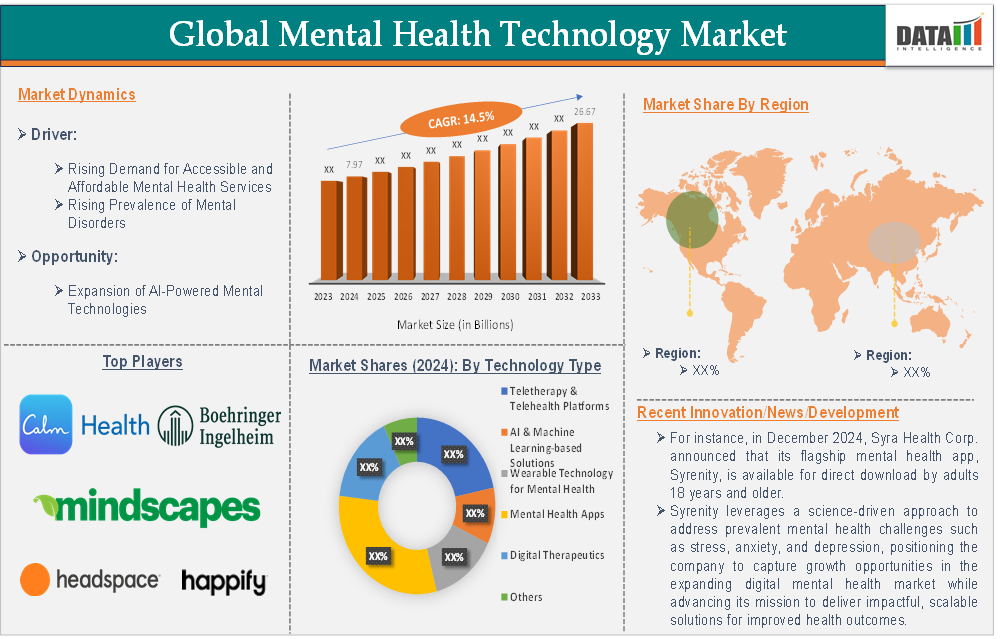
Global mental health technology market reached US$ 7.97 billion in 2024 and is expected to reach US$ 22.67 billion by 2033, growing at a CAGR of 12.8% during the forecast period of 2025-2033.
Mental health technology refers to using various technological tools, devices, platforms, and apps to support the management, treatment, and prevention of mental health conditions. It involves leveraging advancements in digital technology to deliver mental health services, enhance patient care, and improve the overall mental well-being of individuals. These technologies aim to make mental health services more accessible, personalized, efficient, and scalable while also addressing the stigma and barriers traditionally associated with seeking mental health support. It is an evolving field that integrates artificial intelligence, telemedicine, data analytics, and innovative digital solutions to address the growing need for mental health support globally.
Mental Health Technology Market Key Takeaways
- North America remains a leading market, supported by digital mental health adoption, teletherapy platforms, AI-enabled tools, and favorable reimbursement trends.
- Asia-Pacific is expected to record strong growth, driven by expanding smartphone access, digital healthcare infrastructure, and increasing awareness of mental health services.
- AI-powered mental health solutions are gaining adoption through personalized therapy, virtual assistants, mood monitoring, and early detection of behavioral health conditions.
- Telehealth and digital therapeutics are improving access to mental healthcare, particularly for patients in underserved and remote areas.
- Wearable devices and mobile applications are increasingly used for continuous monitoring of stress, sleep, mood, and other behavioral indicators.
- Healthcare providers and technology companies are focusing on integrating mental health platforms with electronic health records and broader digital healthcare ecosystems.
- Data privacy, clinical validation, and regulatory compliance remain important challenges as AI and digital tools become more involved in mental health assessment and treatment.
- Personalized and preventive mental healthcare is becoming a major market focus, with technology enabling earlier intervention and more patient-centered treatment approaches.
Executive Summary
For more details on this report – Request for Sample
Mental Health Technology Market Dynamics: Drivers & Restraints
The rising demand for accessible and affordable mental health services is significantly driving the mental health technology market growth
Mental health conditions, including anxiety, depression, and stress, are on the rise globally. The World Health Organization (WHO) reports that 1 in 4 people globally will experience a mental health issue at some point in their lives, driving the need for accessible services.
Additionally, according to the National Institute of Health (NIH), it is estimated that more than one in five U.S. adults live with a mental illness (59.3 million in 2022; 23.1% of the U.S. adult population), but over 60% of people with mental health conditions do not receive treatment. This gap highlights the demand for accessible mental health solutions.
Mental health technology platforms, such as teletherapy, apps, and AI-driven chatbots, are helping bridge this gap by providing immediate, remote access to mental health services, bypassing long wait times or geographical barriers. Thus, the key market players are developing various apps and other mental health technology products for better patient outcomes, which makes a key market trend in the mental health technology field.
For instance, in September 2024, Magellan Health, Inc., a leader in behavioral health and related services, launched a Teen Mental Wellbeing app to support the mental and emotional well-being of teenagers and young adults ages 13-22. Powered by BeMe Health's advanced digital health platform, the app helps promote self-understanding, builds resilience, and supports the journey to mental well-being through science-backed digital tools and evidence-based approaches.
Data privacy and security concerns are hampering market growth
Mental health data, including personal information, medical histories, and therapy sessions, is highly sensitive. A breach in this data can have serious personal, legal, and financial consequences. This makes individuals hesitant to use mental health technologies that require sharing such confidential information. The HIPAA (Health Insurance Portability and Accountability Act) in the U.S. mandates strict data security measures for health-related information, including mental health data. However, mental health apps and teletherapy platforms often face difficulties in ensuring full compliance with such regulations, leading to concerns over the security of users' data.
For instance, according to the HIPAA Journal, in August 2023, 23 million breached healthcare records were noticed. Over the past 12 months, an average of 9,989,003 healthcare records were breached each month. In the year to August 31, 2024, there have been 491 data breaches of 500 or more records, and at least 58,668,002 records are known to have been breached. The average breach size in 2024 is currently 119,487 records, and the median breach size is 4,109 records.
Mental Health Technology Market Segment Analysis
The global mental health technology market is segmented based on technology type, deployment mode, application, and region.
Technology Type:
The mental health apps from the technology type segment are expected to dominate the mental health technology market with the highest market share
The mental health apps segment grew from US$ 2.25 billion in 2022 to US$ 2.39 billion in 2023, owing to rising adoption in the global market.
Mental health apps provide 24/7 accessibility, allowing users to engage in therapy, mindfulness practices, stress management, or self-help exercises at their convenience and without the need for in-person visits. This flexibility has made mental health apps particularly appealing, especially in light of the increasing demand for remote mental health solutions. Thus, major players in the mental health technology market are focusing on mental health apps for better market growth.
For instance, in December 2024, Syra Health Corp. announced that its flagship mental health app, Syrenity, is available for direct download by adults 18 years and older. Syrenity leverages a science-driven approach to address prevalent mental health challenges such as stress, anxiety, and depression, positioning the company to capture growth opportunities in the expanding digital mental health market while advancing its mission to deliver impactful, scalable solutions for improved health outcomes.
Additionally, in June 2024, Talkspace, a leading online behavioral health care company, announced it will join forces with FitOn, the No. 1 fitness app and digital health and wellness platform, to provide a holistic mental health and fitness solution to employers, and showcase the power of bringing together physical and mental fitness into an everyday setting. Employers and organizations can now turn to Talkspace for its comprehensive suite of mental health services, including its core virtual therapy offering, and have the option to add FitOn within the same engagement.
The mental health apps segment dominates the mental health technology market due to their accessibility, affordability, and ability to reach a wide audience with personalized care. As the market continues to grow, the increasing adoption of AI and self-help features and the rising demand for remote therapy solutions position mental health apps as a leading force in the sector. With a rapidly expanding user base and the convenience they offer, mental health apps are expected to remain at the forefront of mental health technology development.
Mental Health Technology Market Geographical Share
North America is expected to hold a 37.8% market share in the global mental health technology market
North America led the global mental health technology market in 2022 with a market size of US$ 2.60 billion and reached further to US$ 2.79 billion in 2023.
Mental health conditions are widespread in North America. The National Institute of Mental Health (NIMH) reports that in the U.S., nearly 1 in 5 adults (59.3 million in 2022; 23.1% of the U.S. adult population) experience mental illness annually. This high prevalence drives the demand for mental health technologies to help manage and treat these conditions. The increasing recognition of mental health as a crucial aspect of overall health has pushed for the widespread adoption of mental health solutions, including digital tools and telehealth services.
North America boasts a well-established digital health infrastructure. The region has seen strong integration of telemedicine, teletherapy, and mental health apps into its healthcare system, particularly in the U.S. and Canada. This infrastructure facilitates easy access to mental health services for a large portion of the population.
Additionally, North America is a major market for mental health apps, with millions of downloads each year. For instance, Calm and Headspace, two of the most popular mental health apps globally, have seen high adoption in the U.S. Calm alone has been downloaded over 100 million times, a large portion of which is from North American users.
Mental Health Technology Market Top Companies
Top companies in the mental health technology market include Mindscapes, Calm.com, Inc., MoodMission Pty Ltd, Boehringer Ingelheim Pharmaceuticals, Inc., Headspace Inc., Youper Inc., Happify, Inc., Bearable Ltd, BetterHelp, Talkspace, and others.
Mental Health Technology Market Key Developments
July 2026: Mindoula expanded its technology-enabled behavioral health platform through the acquisitions of Valera Health and Janus Healthcare Partners, strengthening virtual and in-person care capabilities for complex behavioral health populations.
- June 2026: Talkspace introduced Tee, an AI agent developed specifically for mental health support, combining clinical algorithms, safety features, and therapist oversight to help users navigate everyday mental health challenges.
- May 2026: Spring Health completed its acquisition of Alma, combining AI-enabled mental health technology with Alma's provider network and payer relationships to create a more integrated behavioral healthcare platform.
- April 2026: Mental health technology providers increased integration of artificial intelligence, virtual care, and data-driven clinical tools to support more personalized behavioral health services and improve access to care.
- March 2026: Talkspace announced plans to be acquired by Universal Health Services, strengthening the potential integration of virtual behavioral healthcare with a broader healthcare delivery network.
- February 2026: Digital mental health companies expanded technology-enabled care models that combine virtual therapy, psychiatric services, AI-supported engagement, and clinical monitoring to improve continuity of behavioral healthcare.
- January 2026: Technology providers continued investing in AI-powered mental health platforms and digital care infrastructure to support personalized interventions, remote monitoring, and scalable access to behavioral health services.
Mental Health Technology Market Scope
| Metrics | Details | |
| CAGR | 12.8% | |
| Market Size Available for Years | 2022-2033 | |
| Estimation Forecast Period | 2025-2033 | |
| Revenue Units | Value (US$ Bn) | |
| Segments Covered | Technology Type | Teletherapy & Telehealth Platforms, AI & Machine Learning-based Solutions, Wearable Technology for Mental Health, Mental Health Apps, Digital Therapeutics, and Others |
| Deployment Mode | Cloud-based and On-premise | |
| Application | Depression & Mood Disorders Management, Anxiety & Stress Management, Addiction & Substance Abuse Management, Post-Traumatic Stress Disorder (PTSD) Management, Schizophrenia & Psychosis Management, Suicide Prevention, Workplace Mental Health Challenges, and Others | |
| Regions Covered | North America, Europe, Asia-Pacific, South America, and Middle East & Africa | |
Why Purchase the Report?
- Pipeline & Innovations: Reviews ongoing clinical trials, product pipelines, and forecasts upcoming advancements in medical devices and pharmaceuticals.
- Product Performance & Market Positioning: Analyze product performance, market positioning, and growth potential to optimize strategies.
- Real-World Evidence: Integrates patient feedback and data into product development for improved outcomes.
- Physician Preferences & Health System Impact: Examines healthcare provider behaviors and the impact of health system mergers on adoption strategies.
- Market Updates & Industry Changes: This covers recent regulatory changes, new policies, and emerging technologies.
- Competitive Strategies: Analyze competitor strategies, market share, and emerging players.
- Pricing & Market Access: Reviews pricing models, reimbursement trends, and market access strategies.
- Market Entry & Expansion: Identifies optimal strategies for entering new markets and partnerships.
- Regional Growth & Investment: Highlights high-growth regions and investment opportunities.
- Supply Chain Optimization: Assesses supply chain risks and distribution strategies for efficient product delivery.
- Sustainability & Regulatory Impact: Focuses on eco-friendly practices and evolving regulations in healthcare.
- Post-market Surveillance: Uses post-market data to enhance product safety and access.
- Pharmacoeconomics & Value-Based Pricing: Analyzes the shift to value-based pricing and data-driven decision-making in R&D.
The global mental health technology market report delivers a detailed analysis with 62 key tables, more than 59 visually impactful figures and 162 pages of expert insights, providing a complete view of the market landscape.
Target Audience
- Manufacturers: Pharmaceutical, Medical Device, Biotech Companies, Contract Manufacturers, Distributors, Hospitals.
- Regulatory & Policy: Compliance Officers, Government, Health Economists, Market Access Specialists.
- Technology & Innovation: AI/Robotics Providers, R&D Professionals, Clinical Trial Managers, Pharmacovigilance Experts.
- Investors: Healthcare Investors, Venture Fund Investors, Pharma Marketing & Sales.
- Consulting & Advisory: Healthcare Consultants, Industry Associations, Analysts.
- Supply Chain: Distribution and Supply Chain Managers.
- Consumers & Advocacy: Patients, Advocacy Groups, Insurance Companies.
- Academic & Research: Academic Institutions.



























































