


Oral Thin Films Market Size and Overview
The global Oral Thin Films market reached an estimated US$ 3.42 billion in 2025 and is expected to reach US$ 8.91 billion by 2035, growing with a CAGR of 10.1% during the forecast period 2026-2035. The market includes prescription and over-the-counter pharmaceutical films, nutraceutical strips, oral-care films, formulation technologies, film-forming excipients, coating and drying services, unit-dose packaging and commercialization support. Demand is being shaped by the need for dosage forms that are portable, water-free, easy to administer and suitable for patients who have difficulty swallowing conventional tablets or capsules.
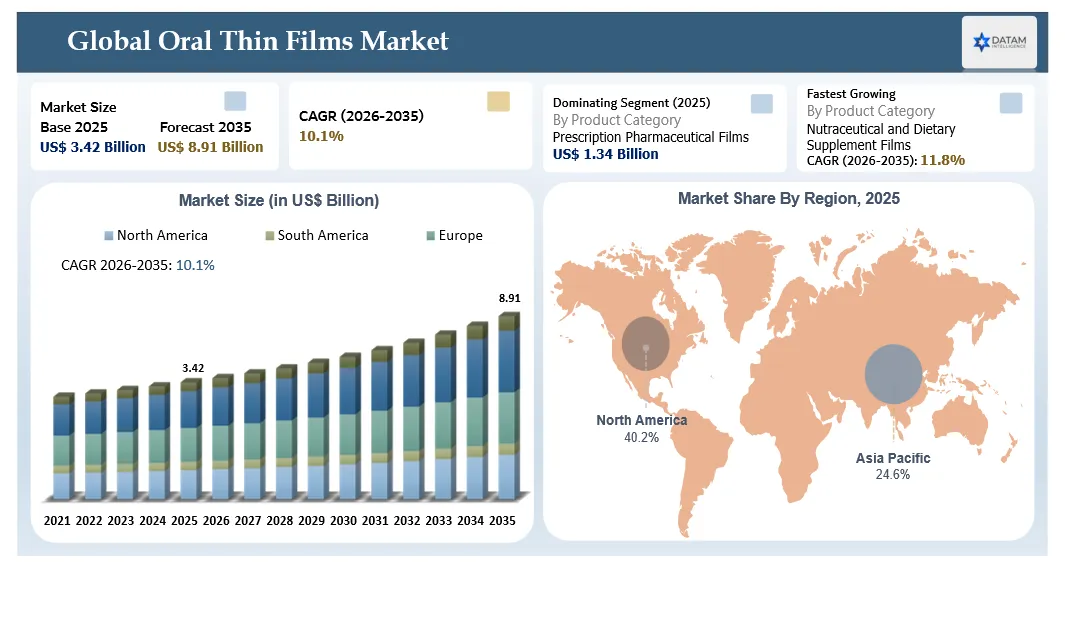
Prescription pharmaceutical films currently represent the largest value pool because they combine regulated dosing, specialist commercialization and premium pricing. Products in opioid-dependence treatment, seizure rescue, migraine, nausea, allergy and central nervous system indications have demonstrated the platform’s ability to support clinically differentiated administration. Nutraceutical and wellness films are expanding faster from a smaller base as brands introduce vitamin, sleep, energy, oral-care and functional products through e-commerce and retail channels.
Market growth through 2035 will depend on formulation performance and manufacturing economics. Successful products require uniform drug distribution, acceptable taste, adequate mechanical strength, rapid or controlled disintegration, moisture protection and reproducible scale-up. The opportunity is strongest where the film solves a clear administration problem, improves adherence or enables discreet use. North America leads through approved products, specialty-pharmacy infrastructure and contract-development capability, while Asia-Pacific is expected to grow fastest as local manufacturers, supplement brands and e-commerce channels expand.
| Metric | 2025 | 2035 / Forecast |
| Market Size | US$ 3.42 Billion | US$ 8.91 Billion |
| CAGR | - | 10.1% (2026-2035) |
| Largest Region | North America | Maintains leadership |
| Fastest-Growing Region | Asia-Pacific | Highest forecast growth |
| Dominating Segment | Prescription Pharmaceutical Films | Strong regulated value pool |
| Fastest-Growing Segment | Nutraceutical and Dietary Supplement Films | Rapid channel expansion |
Oral Thin Films Market Key Takeaways
- Prescription pharmaceutical films hold the largest market value because regulated products support higher unit pricing, controlled distribution and recurring treatment demand.
- North America leads through established oral-film approvals, specialist prescribers, contract developers, reimbursement systems and direct-to-consumer wellness brands.
- Nutraceutical and dietary supplement films are expected to grow fastest as consumers adopt portable formats for vitamins, sleep, energy, hydration and functional wellness.
- Fast-dissolving films remain the largest technology format because they are easy to administer, familiar to consumers and compatible with many low-dose active ingredients.
- Taste masking, moisture sensitivity, dose loading and film uniformity remain central technical constraints that can determine commercial success before clinical differentiation is evaluated.
- Pediatric, geriatric and dysphagia-focused development offers substantial white space because administration convenience can create a measurable adherence advantage.
- E-commerce is accelerating product discovery for wellness films, but regulatory scrutiny of claims, ingredient status and dose consistency will separate durable brands from short-lived launches.
- Future leadership will depend on clinically relevant differentiation, scalable coating and drying, robust unit-dose packaging, defensible intellectual property and channel-specific launch execution.
Oral Thin Films Industry Trends and Strategic Insights
- The market is shifting from novelty breath strips toward therapeutically purposeful films that solve swallowing, onset, portability or adherence problems.
- Formulators are investing in improved taste masking, multilayer structures, nanoparticle dispersions and permeability-enhancing approaches to broaden the range of actives that can be delivered.
- Contract development and manufacturing organizations are becoming strategic because film formulation, coating, drying, slitting and pouching require specialized process knowledge.
- Consumer-health brands are using films to create premium line extensions with lower shipping weight, portion control and visually distinctive packaging.
- Unit-dose barrier packaging is gaining importance because humidity and oxygen can alter film texture, disintegration, potency and shelf life.
- Pharmaceutical companies are evaluating life-cycle management opportunities where oral films can extend brands, improve patient experience or address subpopulations underserved by tablets and liquids.
Oral Thin Films Market Scope
| Metrics | Details |
| 2025 Market Size | US$ 3.42 Billion |
| 2035 Projected Market Size | US$ 8.91 Billion |
| CAGR (2026-2035) | 10.1% |
| Largest Market | North America |
| Fastest Growing Market | Asia-Pacific |
| By Product Category | Prescription, OTC, Nutraceutical, Oral-Care and Other Functional Films |
| By Film Type | Fast-Dissolving, Sublingual, Buccal, Controlled-Release and Multilayer Films |
| By Active Ingredient | Small Molecules, Vitamins and Minerals, Botanicals, Peptides and Combinations |
| By Application | CNS, Pain and Rescue, Nausea, Allergy, Oral Care, Vitamins, Sleep and Wellness |
| By Distribution Channel | Hospital and Specialty Pharmacy, Retail, Mass Retail, E-Commerce and Clinical Channels |
| By End User | Adults, Pediatric, Geriatric, Dysphagia Patients and Wellness Consumers |
| Report Insights Covered | Market Size, Share, Growth, Competitive Landscape and Country-Level Opportunity |
Why does this report matter in 2026?
The year 2026 is an important planning point for the Oral Thin Films market because the category is moving into a more disciplined phase. Pharmaceutical developers are seeking differentiated drug-delivery formats that can improve administration without requiring highly complex devices, while consumer-health brands are testing film formats across sleep, vitamins, energy and oral care. At the same time, buyers are becoming more selective. A product must demonstrate dose consistency, acceptable sensory performance, stability and a clear use case rather than relying on novelty alone.
The report matters because oral thin films are not one homogeneous category. Commercial economics differ sharply between prescription products, over-the-counter medicines, nutraceutical strips and breath or oral-care films. The study separates regulated pharmaceutical value from high-volume consumer formats and assesses how film type, active ingredient, application and channel affect development cost, price, margin and market access. This helps companies identify which opportunities justify specialized formulation and packaging investment.
The timing is also important for partnership strategy. Many companies have strong actives or brands but lack film-development capability, while specialized manufacturers may have platform capacity without global commercial reach. Decisions made in 2026 on licensing, CDMO selection, packaging, e-commerce, clinical evidence and country sequencing can determine whether a product becomes a durable franchise or remains a niche line extension.
Oral Thin Films Market White Space & Investment Opportunities
- Pediatric and geriatric medicines offer white space where swallowing difficulty and caregiver administration create a clear need for water-free dosage forms.
- Rescue and episodic therapies can benefit from portable administration, rapid disintegration and discreet use outside hospitals or homes.
- Multilayer films create opportunities to separate incompatible ingredients, stage release, improve taste masking or combine active and barrier functions.
- Nutraceutical films can expand in sleep, energy, micronutrients, oral probiotics and women’s health when dosing and claims are supported by credible evidence.
- Localized buccal and oral-care films offer potential in mucosal care, dental applications, breath management and sustained contact with the oral cavity.
- Contract manufacturing, analytical testing and high-barrier pouching remain investable enabling segments because many brands lack internal film-processing capability.
Oral Thin Films Future Market Transformation
The market is expected to transform from a collection of niche products into a broader drug-delivery and consumer-health platform. Fast-dissolving films will continue to lead, but growth will increasingly come from sublingual, buccal, controlled-release and multilayer systems. Better polymer combinations, permeation science and taste-masking technologies can expand dose capacity and improve patient experience. This will allow developers to evaluate active ingredients previously considered unsuitable for films.
Commercial models will also become more segmented. Prescription films will rely on clinical differentiation, regulatory approval, payer evidence and specialty distribution. Consumer products will depend on brand credibility, repeat purchase, formulation transparency, social commerce and retail placement. CDMOs will play a central role across both models by offering feasibility studies, pilot coating, analytical development, stability, scale-up and unit-dose packaging.
By 2035, leading platforms are likely to combine formulation libraries, digital process controls, high-barrier packaging and modular manufacturing. Companies may use data from disintegration testing, sensory panels, stability models and consumer feedback to shorten development cycles. Stronger links between active-ingredient suppliers, film manufacturers, packaging converters and brand owners will create integrated commercialization ecosystems.
Oral Thin Films Market Buyer Decision-Making Criteria
Pharmaceutical buyers prioritize dose uniformity, bioavailability, onset, stability, safety, intellectual property and the ability to manufacture under current good manufacturing practice. Physicians and patients assess ease of use, taste, mouthfeel, packaging, administration time and whether the film provides a meaningful advantage over tablets, liquids, sprays or injectables. Payers evaluate clinical differentiation, adherence benefits and the possibility of reduced caregiver or healthcare-resource burden.
Consumer-health buyers place greater emphasis on ingredient familiarity, clean-label positioning, flavor, portability, price per serving and trust in the brand. Retailers assess shelf stability, packaging visibility, return rates and category incrementality. Across both pharmaceutical and wellness segments, products that balance sensory quality with evidence and consistent manufacturing will have the strongest repeat-purchase and adoption profile.
Oral Thin Films Market Economic & Investment Analysis
Oral thin films can create attractive economics when they increase product differentiation without requiring device-heavy administration. The value proposition is strongest for low-dose actives, premium therapeutic applications and consumer products with high repeat purchase. Development costs are influenced by polymer selection, taste masking, analytical validation, scale-up, stability and packaging. Unit economics depend on coating yield, drying efficiency, film utilization, slitting losses, pouch material and line speed.
Investment models should separate regulated pharmaceuticals from consumer-health films. Prescription programs require clinical and regulatory capital but may support premium pricing and longer product life cycles. Nutraceutical and oral-care films can reach market faster, although they face lower barriers to entry, more intense brand competition and higher customer-acquisition costs. Investors should assess whether a platform has proprietary formulation knowledge, reproducible manufacturing and the ability to serve multiple products rather than relying on one concept.
Commercial planning should distinguish technical feasibility from scalable profitability. A film that performs well at laboratory scale may experience coating variation, edge defects, sticking, brittle texture or packaging failures during scale-up. Companies should model pilot losses, validation batches, quality testing, high-barrier pouch costs and line utilization before setting price. Capacity partnerships can reduce capital intensity, but dependence on one specialized manufacturer creates supply risk.
Strategic value is highest for companies that combine formulation capability with regulatory knowledge, intellectual property and commercial relationships. A CDMO with validated production may attract licensing and development partnerships, while a brand owner with strong distribution may acquire or license film technology. Evidence infrastructure also matters. For prescription products, adherence and patient-preference data can strengthen reimbursement. For wellness products, transparent dosing and quality testing can support premium positioning and reduce regulatory risk.
Oral Thin Films Investment Trends in the Market
- Capital is moving toward specialized CDMOs that can provide formulation, pilot coating, clinical supply, commercial scale-up and unit-dose pouching under one quality system.
- Pharmaceutical companies are evaluating oral films as life-cycle management tools for established molecules where administration convenience can extend differentiation.
- Consumer-health investment is expanding in sleep, vitamin, energy and oral-care strips that can be sold through e-commerce and subscription models.
- Packaging investment is increasing in moisture- and oxygen-barrier materials, child-resistant formats and compact single-dose pouches.
- Formulation platforms using multilayer films, taste masking, nanoparticles and permeability enhancement are attracting partnership interest because they expand the usable active-ingredient range.
- Manufacturers are investing in process analytics, machine vision and digital batch control to improve thickness, content uniformity and yield at commercial scale.
Strategic Indicators for Oral Thin Films Market
High Regulation Impact
Prescription films are regulated as drug products and require validated formulation, manufacturing, stability, labeling and clinical evidence. Consumer films face different rules depending on whether they are foods, supplements, cosmetics, oral-care products or medicines. Classification affects permissible claims, ingredient status and quality expectations. Companies must define the regulatory pathway early because a change in intended use can alter development cost and launch timing.
High Investment Activity
Investment is concentrated in contract manufacturing, specialty formulation, consumer-health brands and film-enabled product extensions. Capital favors platforms with multiple commercial opportunities, validated manufacturing and defensible know-how. Single-product concepts face greater risk unless they address a clear clinical or consumer problem.
Supply Chain Disruption
The market depends on film-forming polymers, plasticizers, flavors, sweeteners, active ingredients and high-barrier packaging. A disruption in one qualified input can trigger reformulation or stability work. Pharmaceutical programs therefore require dual sourcing, change-control planning and sufficient inventory of critical excipients and pouch materials.
Pricing Volatility
Pricing varies from low-cost breath strips to premium prescription films. Consumer pricing is influenced by ingredient cost, serving count, packaging and customer-acquisition expense. Pharmaceutical pricing reflects clinical value, competition, reimbursement and specialty distribution. Raw-material and packaging inflation can materially affect margins because each unit requires individual handling and barrier protection.
Procurement Pressure
Buyers increasingly seek evidence of batch uniformity, stability, contaminant control, sensory acceptance and on-time supply. Pharmaceutical procurement also evaluates audit history, validation, capacity reservation and business continuity. Consumer brands look for lower minimum order quantities, rapid reformulation and packaging flexibility.
New Technology Adoption
Machine vision, in-line thickness measurement, digital coating controls, advanced taste masking and multilayer construction are improving consistency. Adoption is fastest where technology reduces scrap or enables higher dose loading. Validation and transferability remain important because process changes can alter film performance.
Regional Expansion Opportunity
North America remains the largest market, while Asia-Pacific offers the strongest growth through local manufacturing, supplement adoption and e-commerce. Europe provides opportunities in patient-friendly dosage forms but requires careful navigation of national reimbursement and product classification. Expansion depends on local partners, regulatory alignment and packaging suited to climate.
Pricing Intelligence
Commercial pricing should reflect benefit rather than film novelty. Prescription products need a value story around adherence, onset, portability or caregiver burden. Consumer products need clear serving economics, credible ingredients and repeat-purchase potential. Companies should benchmark price per dose against tablets, gummies, sprays and liquids.
AI Impact Analysis of Oral Thin Films Market
AI can support formulation by analyzing relationships among polymer composition, active load, plasticizer, drying conditions, disintegration, mechanical strength and sensory performance. Predictive models can reduce the number of laboratory iterations and identify formulations likely to remain stable under different humidity conditions. AI can also assist in patent landscape review, excipient screening and selection of taste-masking approaches.
In manufacturing, machine-vision systems can detect coating streaks, pinholes, edge defects and dimensional variation. Process data can be used to predict drift, optimize drying and reduce scrap. Consumer companies can use AI to analyze reviews, flavor preferences and repeat-purchase behavior, although clinical and regulatory decisions require transparent evidence and human oversight.
Disruption Analysis of Oral Thin Films Market
Oral films are disrupting conventional administration where they provide portability, water-free dosing or easier use for patients with swallowing difficulty. They can reduce dependence on liquids, which are bulky and may require measuring, and can differentiate molecules in crowded categories. The disruption is selective because high-dose compounds, moisture-sensitive ingredients and products with unpleasant taste may remain better suited to tablets, capsules or other routes.
Consumer-health films are also disrupting format competition by offering a compact alternative to gummies, powders and capsules. Their low shipping weight and single-dose packaging support direct-to-consumer sales, but the category must overcome skepticism about dose adequacy and efficacy. As evidence and manufacturing improve, films may capture premium niches rather than replacing all established formats.
Oral Thin Films Market BCG Matrix: Company Evaluation
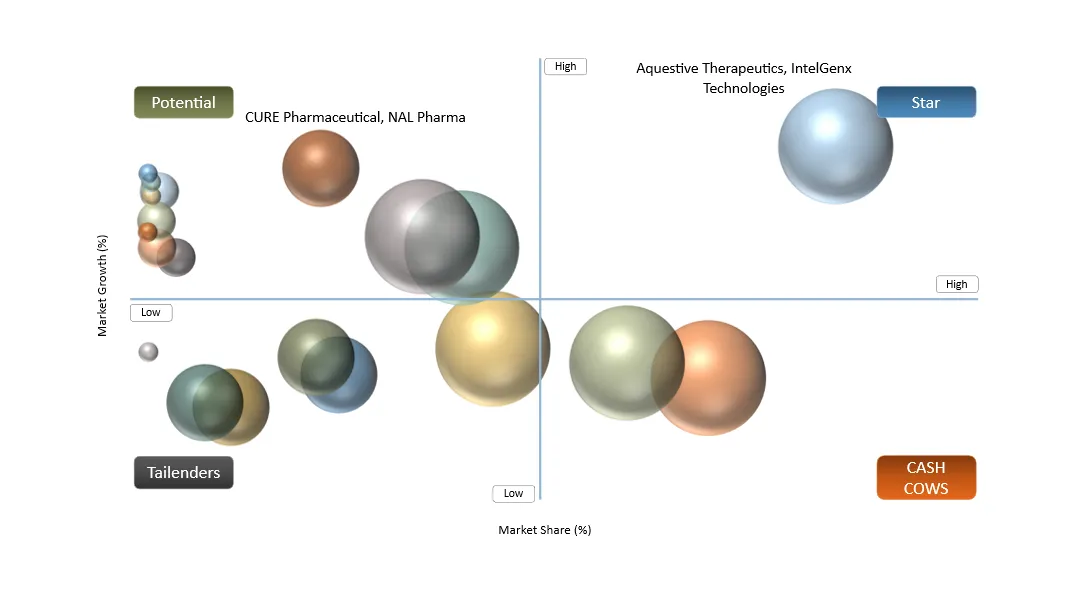
| BCG Category | Representative Companies | Strategic Interpretation |
| Stars | Aquestive Therapeutics, IntelGenx Technologies, ZIM Laboratories | Specialized film-development capability, established partnerships and exposure to high-growth pharmaceutical applications. |
| Potential | CURE Pharmaceutical, NAL Pharma, AdhexPharma, Tesa Labtec | Platform and manufacturing capabilities with growth dependent on commercial wins, scale-up and differentiation. |
| Cash Cows | Large pharmaceutical and consumer-health owners with established film products | Existing brands and distribution generate recurring value, although growth may be moderate in mature indications. |
| Tailenders | Small undifferentiated wellness-film brands | Low barriers to entry, weak evidence and limited manufacturing control create high churn and pricing pressure. |
Aquestive Therapeutics, IntelGenx Technologies and ZIM Laboratories are positioned as Stars because they combine specialized film expertise with pharmaceutical development, partnerships and commercial infrastructure. Potential players include technology and contract-manufacturing companies that can gain share through licensing, scale-up execution and new product wins. Large product owners may operate as Cash Cows where mature films provide recurring revenue. Tailenders are concentrated among short-lived consumer launches without proprietary formulation, strong quality systems or durable channel economics.
Oral Thin Films Market Dynamics
Driver Impact Analysis
| Driver | Growth Impact | Demand Concentration | Impacted Use Case | Strategic Impact |
| Demand for water-free dosing | High | Pediatric, geriatric and mobile consumers | Prescription and OTC films | Creates a clear administration advantage. |
| Growth of specialty drug delivery | High | CNS, rescue and adherence-focused products | Pharmaceutical films | Supports premium differentiated products. |
| Expansion of wellness formats | Medium-High | E-commerce and retail consumers | Nutraceutical films | Broadens category awareness and volume. |
| CDMO capability growth | Medium | Global developers and brands | Formulation and manufacturing | Reduces entry barriers for asset owners. |
Driver: Rising Demand for Patient-Friendly and Water-Free Dosage Forms
Patients who have difficulty swallowing tablets may benefit from films that can be placed in the mouth without water. The advantage is especially relevant in pediatrics, geriatrics, nausea, psychiatric treatment, travel and episodic conditions. A convenient format can reduce administration resistance and caregiver burden. Commercial value increases when the film also provides rapid onset, discreet use or easier dose supervision.
Restraint Impact Analysis
| Restraint | Drag on Growth | Primary Impact Area | Impacted Use Case | Strategic Impact |
| Dose-loading limits | High | Formulation feasibility | High-dose actives | Restricts addressable molecules. |
| Taste and mouthfeel challenges | High | Patient acceptance | Bitter or irritating actives | Can reduce adherence and repeat purchase. |
| Moisture and stability risk | Medium-High | Packaging and shelf life | All film categories | Raises barrier-packaging cost. |
| Scale-up and yield complexity | Medium-High | Manufacturing economics | Commercial production | Can delay launch and compress margins. |
Restraint: Dose-Loading, Taste-Masking and Stability Constraints
Film size and thickness limit how much active ingredient can be incorporated without compromising flexibility, disintegration or mouthfeel. Bitter, aromatic or irritating compounds require taste masking that may add complexity and bulk. Moisture can make films sticky or brittle, while oxygen and light can affect sensitive ingredients. These constraints increase development time and make packaging an essential part of the dosage form rather than a secondary component.
Oral Thin Films Market Segment Analysis
The global Oral Thin Films market is segmented based on Product Category, Film Type, Active Ingredient Class, Application, Distribution Channel, End User and region.
By Product Category
Prescription Pharmaceutical Films Will Continue to Lead Market Value
Prescription films will remain the largest category through 2035 because they combine regulated dosing, clinical differentiation and premium value. They are most competitive where swallowing difficulty, rapid administration, discretion or adherence provide a measurable advantage. Over-the-counter and nutraceutical films will grow faster in volume, but prescription products retain stronger revenue per unit and more defensible market positions.
By Film Type
Fast-Dissolving Oral Films Will Retain the Largest Share
Fast-dissolving films lead because they are simple to administer and compatible with many low-dose active ingredients. Sublingual and buccal films offer greater potential for systemic absorption and sustained contact, while controlled-release and multilayer films create advanced opportunities. Their adoption will depend on permeability, dose, manufacturing complexity and evidence of superiority over simpler formats.
By Active Ingredient Class
Small-Molecule Pharmaceuticals Will Remain Dominant
Small molecules dominate because they are better suited to the dose-loading and stability limits of films. Vitamins, minerals and botanicals are expanding through wellness channels, although some require high doses that challenge film size. Peptide and biologic films remain an emerging opportunity that depends on permeability enhancement, stabilization and clinically meaningful absorption.
By Application
Central Nervous System and Behavioral Health Will Hold the Largest Regulated Value Pool
CNS and behavioral-health applications benefit from supervised dosing, adherence support and ease of administration. Pain, migraine, seizure rescue and nausea provide additional opportunity where portable dosing and fast disintegration matter. Wellness applications will post rapid growth through sleep, vitamins and energy, but durable brands will need credible dosing and clear regulatory positioning.
By Distribution Channel
E-Commerce and Direct-to-Consumer Will Record the Fastest Growth
E-commerce enables education, sampling, subscriptions and rapid product testing for nutraceutical and oral-care films. Hospital and specialty pharmacy remain central for prescription products, while retail pharmacy supports OTC formats. Channel strategy must reflect product classification, counseling needs, reimbursement and the cost of acquiring repeat customers.
By End User
Adults Will Remain the Largest Group While Pediatric and Geriatric Use Expands
Adults account for the largest market because most prescription and wellness products target adult users. Pediatric and geriatric segments offer strong growth where swallowing difficulty creates clear benefit. Patients with dysphagia or special administration needs represent a strategically important population that may justify dedicated clinical evidence and provider education.
Oral Thin Films Market Geographical Penetration
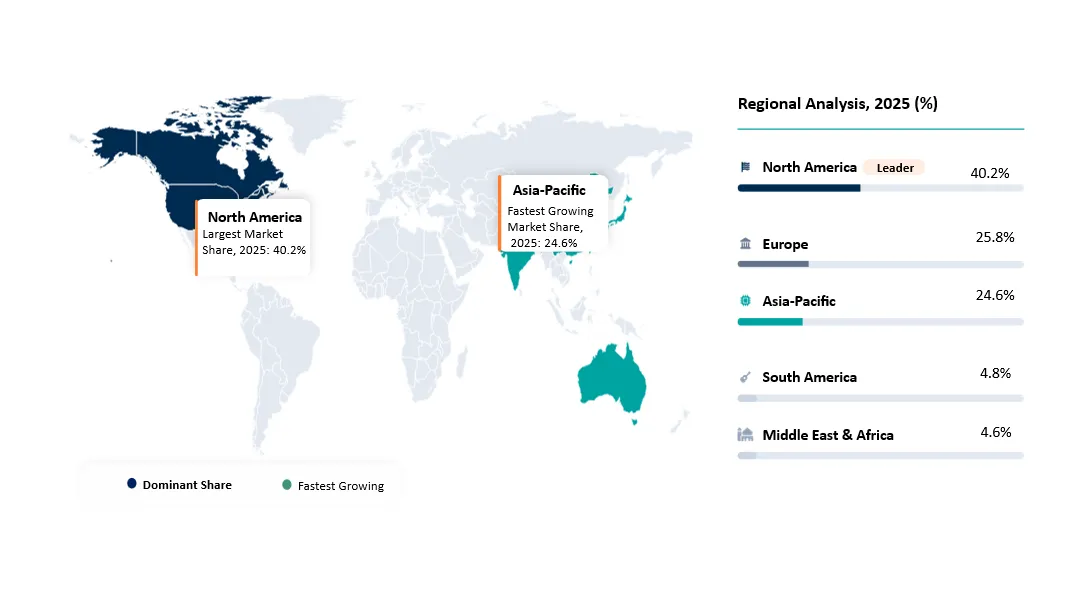
| Region | 2025 Share | Growth Position | Primary Market Characteristics |
| North America | 40.2% | Largest | Approved products, specialty pharmacy, strong CDMO and DTC ecosystems |
| Europe | 25.8% | Established | Patient-friendly dosage demand and regulated consumer-health markets |
| Asia-Pacific | 24.6% | Fastest Growing | Manufacturing scale, e-commerce and expanding pharmaceutical development |
| South America | 4.8% | Emerging | Retail pharmacy growth and imported specialty products |
| Middle East & Africa | 4.6% | Selective Growth | Gulf premium demand and concentrated specialist access |
Latin America Market Outlook
Brazil is the largest opportunity in South America through its retail-pharmacy network, large supplement market and growing e-commerce sector. Imported prescription films and locally marketed wellness products can gain traction, although price sensitivity and regulatory timelines constrain rapid expansion.
Trends include pharmacy-led vitamins, oral-care products and low-unit-count trial packs. Local manufacturing or packaging partnerships can improve affordability. Companies should plan for climate-resistant packaging, Portuguese and Spanish labeling and differentiated distributor strategies across the region.
North America Oral Thin Films Market Trends
Growth trends include online sales of supplement strips, interest in senior-friendly dosage forms and greater scrutiny of ingredient claims. Canadian and U.S companies use the market as a development and commercialization bridge, but successful launches require compliance with natural-health or drug pathways and packaging suitable for wide seasonal humidity changes.
Canada benefits from close integration with North American pharmaceutical supply chains and a regulated natural-health-product market. Demand is strongest for imported prescription products, consumer wellness films and contract-development partnerships. Provincial reimbursement and bilingual labeling can influence launch sequencing.
Europe Oral Thin Films Market Trends
Europe offers a developed consumer-health channel, strong online retail and clinical interest in medicines that reduce administration burden. Prescription uptake depends on health-technology assessment, formulary positioning and evidence that convenience translates into better outcomes.
Wellness-film growth is being supported by sleep, vitamin and oral-care products, although advertising and claims receive close attention. The market is moving toward transparent labeling, lower-sugar alternatives to gummies and products designed for travel or discreet use.
France, Italy and Spain provide meaningful opportunities through retail pharmacy, consumer wellness and aging populations. Prescription demand is more selective because national reimbursement systems require evidence and pricing discipline.
Regional trends include pharmacy-led supplement sales, interest in oral-care and vitamin films, and partnerships with local distributors. Flavor preferences, language-specific packaging and consumer education are important. Southern European climate conditions also increase the need for moisture-resistant packaging and validated shelf life.
U.S. Oral Thin Films Market Landscape
The U.S. is the largest national market because it combines approved prescription films, specialty-pharmacy distribution, strong intellectual-property activity and a large direct-to-consumer wellness sector. The country has established commercial examples in opioid-dependence treatment, seizure rescue and other specialty indications, creating familiarity among regulators, prescribers and manufacturers.
Current trends include greater use of films for life-cycle management, investment in pediatric and rescue applications, and growth of sleep, vitamin and energy strips online. Contract manufacturers are expanding development services, while brand owners are placing more emphasis on child-resistant packaging, stability and substantiated claims. Competition is shifting toward products with a clear clinical or sensory advantage rather than novelty alone.
Germany Oral Thin Films Market Outlook
Germany is a leading European market through its pharmaceutical manufacturing base, hospital networks and emphasis on patient-friendly dosage forms. The market supports prescription and OTC opportunities, although reimbursement and evidence requirements can slow broad adoption.
Trends include interest in pediatric administration, decentralized manufacturing partnerships and environmentally efficient packaging. Buyers increasingly require strong comparative evidence against tablets, oral liquids and sprays. Germany also offers partnership potential with excipient, equipment and packaging specialists serving the wider European market.
Japan Oral Thin Films Market Trends
Japan is attractive because of its aging population, high quality expectations and established use of patient-friendly dosage forms. The market values compact packaging, dose precision and products suited to older adults or consumers seeking discreet administration.
Trends include pharmaceutical development for geriatric use, premium wellness strips and advanced packaging. Local clinical evidence, sensory optimization and partnerships with Japanese manufacturers are important. Buyers expect excellent film texture, low residue and reliable performance under humid conditions.
China Oral Thin Films Market Outlook
China is an emerging high-growth market supported by pharmaceutical manufacturing, e-commerce and expanding consumer interest in novel wellness formats. Domestic companies can scale rapidly, although quality consistency and regulatory classification remain decisive.
Key trends include growth of vitamin, breath, sleep and energy films through social commerce, investment in local coating equipment and increased patent activity. Pharmaceutical opportunity will expand as domestic developers seek differentiated dosage forms. Market leaders will need strong quality systems and evidence to separate themselves from low-cost novelty products.
India Oral Thin Films Market Trends
India has strong formulation and contract-manufacturing capability, making it important both as a production base and a demand market. Local companies are developing prescription, nutraceutical and oral-care films for domestic and export use.
Trends include export-oriented CDMO investment, affordable supplement strips and use of films for pediatric or adherence-focused medicines. Cost remains important, but buyers increasingly value validated manufacturing, international regulatory readiness and high-barrier packaging. India can become a major supply hub if companies maintain consistency at scale.
South Korea and Australia Market Trends
South Korea offers strong consumer acceptance of innovative wellness formats and advanced packaging, while Australia provides a regulated supplement market with high online penetration. Both markets support premium positioning when ingredient quality and claims are credible.
Trends include beauty-from-within, sleep, energy and micronutrient strips, along with pharmacy and direct-to-consumer distribution. Companies must adapt flavors, labeling and evidence to local expectations. Partnerships with established wellness retailers can accelerate adoption.
Middle East and Africa Market Outlook
The region offers selective demand concentrated in the UAE, Saudi Arabia, Israel, South Africa and major urban centers. Gulf markets support premium consumer-health products, while Israel has relevant drug-delivery and technology capabilities. Broader access remains limited by affordability and fragmented distribution.
Trends include premium vitamin and wellness strips, pharmacy modernization, cross-border e-commerce and interest in convenient formats for travel. Local registration, halal considerations, heat-resistant packaging and distributor quality are important. Africa’s opportunity is longer term and will depend on affordable products and stronger pharmaceutical distribution.
Regional Strategic Trends Summary
- North America is moving toward clinically differentiated prescription films and evidence-backed direct-to-consumer wellness products.
- Europe is emphasizing regulatory clarity, pharmacy distribution, pediatric and geriatric usability and sustainable packaging.
- Asia-Pacific is combining manufacturing scale with rapid e-commerce adoption, making it the primary region for new capacity and format experimentation.
- South America offers growth through retail pharmacies and local partnerships, but affordability and climate-resistant packaging remain important.
- Middle East and Africa show concentrated premium demand, with expansion tied to distributor capability, local registration and product stability.
Oral Thin Films Market Competitive Landscape
- Competition is divided between specialized film-platform companies, pharmaceutical product owners, contract manufacturers, consumer-health brands and packaging suppliers.
- Aquestive Therapeutics, IntelGenx Technologies, ZIM Laboratories and other specialists compete through formulation know-how, intellectual property, clinical programs and manufacturing capability.
- Large pharmaceutical companies participate through owned or licensed products and can scale commercialization through established regulatory, payer and sales infrastructure.
- Consumer-health competition is more fragmented, with rapid product entry in sleep, vitamins, energy and oral care. Brand trust, sensory quality and repeat purchase are decisive.
- Partnerships are common because active owners, technology firms, CDMOs and distributors often control different parts of the value chain.
- Competitive advantage increasingly depends on scale-up yield, packaging reliability, regulatory execution and the ability to demonstrate meaningful benefit over tablets, gummies, liquids or sprays.
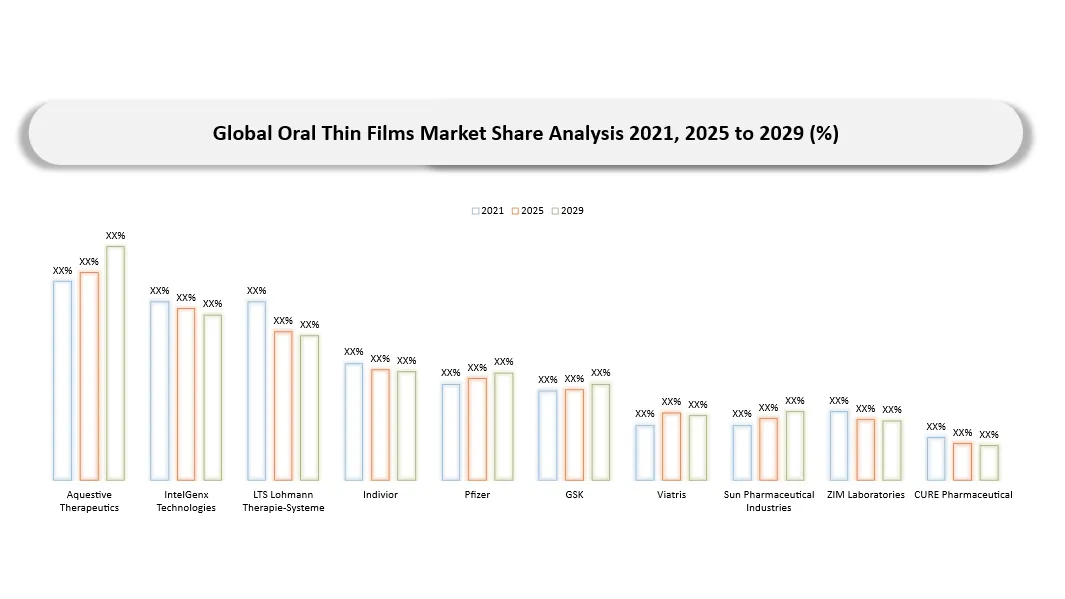
Market share will remain uneven by category. Prescription films support relatively concentrated competition because development and approval create barriers. Wellness films can become crowded quickly, but many products fail to achieve repeat purchase. Companies that combine validated formulation, reliable manufacturing and channel strength can build durable positions across several active ingredients and geographies.
Key Companies of Oral Thin Films Market
- Aquestive Therapeutics
- IntelGenx Technologies
- CURE Pharmaceutical
- ZIM Laboratories
- LTS Lohmann Therapie-Systeme
- Indivior
- Sumitomo Pharma America
- NAL Pharma
- AdhexPharma
- Tesa Labtec
- Tapemark
- DK Livkon
- Livkon Pharmaceuticals
- Pfizer
- GSK
- Viatris
- Novartis
- Johnson & Johnson
- Sun Pharma
- Collegium Pharmaceutical
Oral Thin Films Market Major Pain Points
- Limited dose loading for high-dose active ingredients.
- Taste masking and mouthfeel challenges.
- Moisture sensitivity and dependence on high-barrier packaging.
- Scale-up variability in coating, drying, slitting and content uniformity.
- Higher unit cost than conventional high-volume tablets.
- Uncertain reimbursement when convenience is the primary differentiation.
- Regulatory ambiguity for some supplement and wellness claims.
- Low repeat purchase for novelty-led consumer products.
Oral Thin Films Market Recent Developments
- 2025-2026: Specialized oral-film developers continued to expand licensing discussions around rescue therapy, allergy, CNS and pediatric administration opportunities.
- 2025-2026: Contract manufacturers increased emphasis on integrated formulation, pilot manufacturing, clinical supply and commercial pouching services.
- 2025-2026: Consumer-health brands broadened film launches across sleep, vitamins, energy and oral care through e-commerce and subscription channels.
- 2025-2026: Manufacturers increased use of machine vision and in-line process controls to improve film thickness, defect detection and yield.
- 2025-2026: Packaging development focused on moisture barriers, child resistance, portability and reduced material use per dose.
Analyst View / Opinion on Oral Thin Films Market
The Oral Thin Films market is entering a durable expansion phase, but growth will be selective. The strongest products will solve a specific administration problem or create a clear consumer benefit. Films that merely reproduce a tablet or gummy without better convenience, onset, sensory quality or adherence will struggle to justify premium pricing. Pharmaceutical companies should prioritize low-dose actives, rescue use, pediatric and geriatric needs and molecules where route or onset creates differentiation.
- Prescription films will remain the revenue anchor, while nutraceutical films provide the fastest volume growth and experimentation.
- CDMO and packaging capabilities are strategic bottlenecks, making partnerships and capacity access central to launch planning.
- Asia-Pacific will gain importance as both a manufacturing base and demand market, particularly in India, China, Japan and South Korea.
- Clinical evidence, sensory quality and manufacturing consistency will become more important as the novelty of the format declines.
- Companies should build portfolios around a reusable film platform rather than depend on one isolated active ingredient.
- Long-term leadership will depend on the ability to integrate formulation, regulatory execution, scale-up, packaging and channel strategy.
Oral Thin Films Market Target Audience
| Industry | Who Should Buy This Report? | Reason to Buy This Report |
| Pharmaceuticals & Biotechnology | Drug-delivery, portfolio, clinical and business-development teams | Assess molecules, indications, licensing and launch potential. |
| CDMOs and Technology Providers | Formulation leaders, manufacturing executives and platform owners | Evaluate demand, capacity, partnerships and technology gaps. |
| Consumer Health & Supplements | Brand owners, innovation teams and e-commerce leaders | Identify growth categories, channels and product-positioning opportunities. |
| Packaging and Materials | Polymer, excipient, pouch and equipment suppliers | Understand technical demand and qualification priorities. |
| Healthcare Providers | Pharmacists, physicians, dentists and hospital buyers | Track dosage-form evolution and patient-use cases. |
| Investors & Consulting | Private equity, venture capital and strategy consultants | Assess market size, competition and investment white spaces. |
| Government & Regulators | Drug, supplement and public-health authorities | Understand classification, quality and access implications. |
Why Choose DATAM?
- Data-driven insights combining product-level sizing, channel economics, formulation feasibility and country-level opportunity.
- Post-purchase analyst consultations for licensing, CDMO selection, market entry and custom modeling.
- Annual report updates covering approvals, launches, partnerships, manufacturing expansions and competitive changes.
- Specialized focus on emerging markets, enabling technologies and commercialization pathways.
- Actionable analysis connecting formulation science with pricing, packaging, distribution and buyer behavior.
What DATAM Uniquely Provides
- Ten-year forecasts across product category, film type, active ingredient, application, channel, end user and region.
- Separate analysis of prescription, OTC, nutraceutical and oral-care film economics.
- Buyer-focused assessment of taste, dose loading, stability, packaging and manufacturing scale-up.
- Country-level views linking regulation, channel structure, manufacturing and adoption.
- Strategic recommendations for partnerships, capacity, portfolio prioritization and market entry.



























































