


Prefilled Auto Injectors Market Size and Overview
The global Prefilled Auto Injectors market reached approximately US$ 2.39 billion in 2025 and is expected to reach about US$ 8.63 billion by 2035, expanding at an estimated CAGR of 13.7% during 2026-2035. The forecast reflects continued conversion of biologic therapies from clinic-based injection to home self-administration, rapid growth of biosimilars, wider use of large-volume platforms and increasing adoption of device-enabled differentiation by pharmaceutical manufacturers.
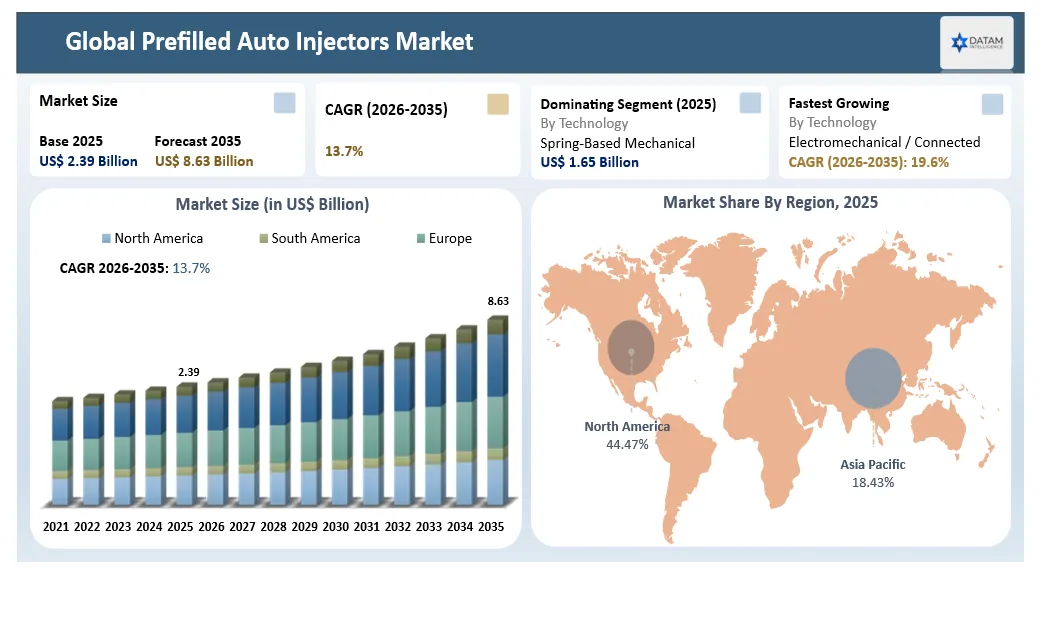
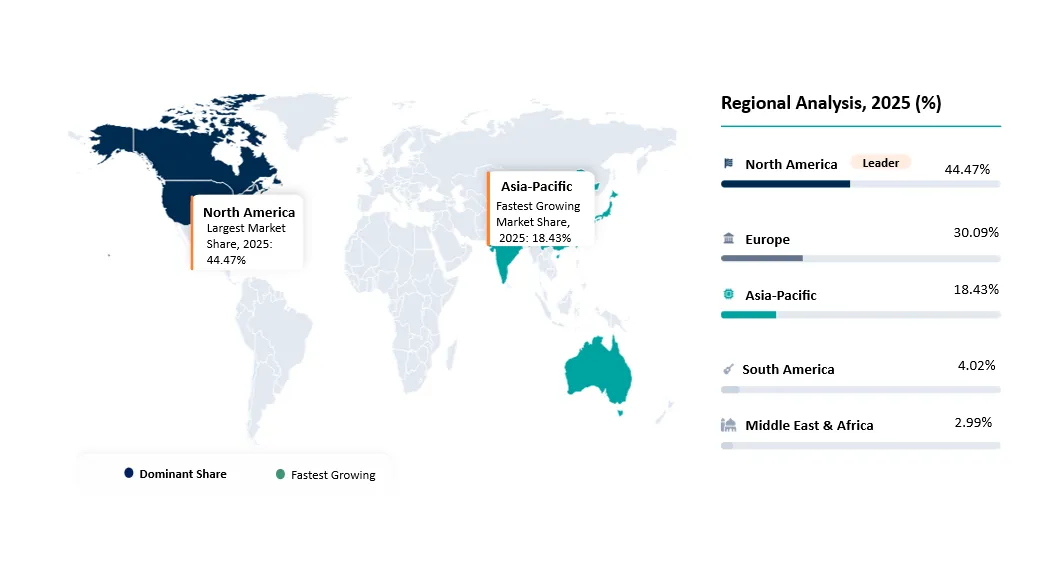
North America is the largest market due to high biologic spending, specialty-pharmacy infrastructure, early adoption of self-injection and a dense ecosystem of combination-product developers. Asia-Pacific is expected to grow fastest as biologics manufacturing expands, biosimilars gain share, regulatory pathways mature and device manufacturing capacity increases in Japan, China, South Korea, India and Singapore.
The industry is evolving from a narrow focus on 1 mL disposable autoinjectors toward a broader platform landscape that supports 2.25 mL and larger volumes, higher viscosity formulations, connected adherence features and simplified clinical-to-commercial transfer. Device suppliers with scalable manufacturing, validated platform data, strong primary-container compatibility and the ability to support multiple dose volumes are gaining strategic importance.
Prefilled Auto Injectors Market Scope
| Metrics | Details |
| 2025 Market Size | US$ 2.39 Billion |
| 2035 Projected Market Size | US$ 8.63 Billion |
| CAGR (2026-2035) | 13.7% |
| Largest Market | North America |
| Fastest Growing Market | Asia-Pacific |
| By Product Type | Disposable; Reusable with Prefilled Primary Containers |
| By Dose Volume | Up to 1 mL; 1-2.25 mL; Above 2.25 mL |
| By Container Type | Prefilled Syringe-Based; Cartridge-Based; Integrated Reservoir / Other |
| By Technology | Spring-Based Mechanical; Electromechanical / Connected; Gas-Driven and Other |
| By Molecule Type | Biologics & Biosimilars; Small Molecules & Emergency Medicines |
| By Indication | Autoimmune; Diabetes/Obesity; Anaphylaxis; Neurology; Oncology; Others |
| By End User | Homecare; Hospitals & Clinics; Specialty / Ambulatory Centers |
| By Distribution Channel | Hospital; Retail; Specialty; Online; Direct / Limited Distribution |
| Report Insights Covered | Market Size, Share, Growth, Ecosystem, Competitive Landscape, Public Company Performance and Country-Level Opportunity |
Prefilled Auto Injectors Market Key Takeaways
- Biologics and biosimilars represent the largest demand pool because chronic autoimmune and metabolic therapies increasingly rely on patient self-injection.
- North America remains the largest commercial market, while Asia-Pacific is expected to record the fastest growth through increased biologic manufacturing and rising self-administration adoption.
- Large-volume autoinjectors above 2.25 mL are among the fastest-growing device categories as developers reformulate high-dose biologics for subcutaneous use.
- Combination-product development cycles create high switching costs, which strengthens the position of device platforms selected early in clinical development.
- Growth in GLP-1 and metabolic therapies is increasing demand for primary containers, high-quality elastomer components and automated high-volume assembly.
- Human-factors validation, dose visibility, audible/tactile feedback and simplified activation remain critical purchasing criteria for pharmaceutical partners.
- Digital connectivity is becoming more relevant for specialty therapies where adherence support and therapy data can improve outcomes and payer evidence.
- Capacity expansion and dual sourcing are now strategic priorities because device, syringe and component shortages can directly delay drug launches.
Prefilled Auto Injectors Industry Trends and Strategic Insights
- Platform standardization is accelerating because pharmaceutical companies prefer configurable devices that can be reused across molecules, strengths and geographic launches.
- The market is moving toward 2.25 mL, 5 mL and other large-volume systems to enable subcutaneous administration of medicines previously delivered by infusion.
- Primary-container compatibility is becoming a major competitive differentiator as device companies work with syringe and cartridge suppliers to minimize breakage, silicone sensitivity and injection-force variability.
- Pharma-device partnerships are increasingly signed before pivotal trials so that human-factors work, stability testing and commercial industrialization can progress in parallel.
- Sustainability is driving interest in lower-material designs, reusable drive units and recycling approaches, although drug-contact safety and regulatory validation limit rapid redesign.
Why does this report matter in 2026?
The year 2026 is an important inflection point for prefilled autoinjectors because high-volume biologic demand is accelerating at the same time that drug developers are widening the set of molecules intended for at-home administration. Public device suppliers are investing in capacity, new large-volume platforms and primary-container technologies, while biologic and GLP-1 growth is increasing pressure on validated component supply. This makes platform selection, manufacturing readiness and dual sourcing central commercial questions rather than engineering details.
The report is particularly relevant for pharmaceutical companies preparing launches between 2027 and 2032. Device qualification, stability, human-factors studies and assembly scale-up can take several years, and switching after registration is expensive. Competitive intelligence on volume capability, platform maturity, device supplier capacity and ecosystem partnerships therefore directly affects launch risk and lifecycle-management strategy.
Prefilled Auto Injectors Market White Space & Investment Opportunities
Large-volume autoinjectors, connected adherence platforms, reusable drive units, devices optimized for high-viscosity biologics, pediatric and elderly-friendly designs, and regional assembly capacity represent major white spaces. Investment is also attractive in needle systems, low-friction primary containers, elastomer components, siliconization alternatives and automated combination-product assembly.
Prefilled Auto Injectors Future Market Transformation
The market will shift from device-by-device development toward configurable delivery ecosystems. Pharmaceutical companies will increasingly expect device suppliers to offer clinical-stage samples, human-factors support, validated primary-container options, commercial automation and lifecycle extensions within a single platform family. Large-volume subcutaneous delivery will blur the boundary between autoinjectors and wearable injectors.
Prefilled Auto Injectors Market Buyer Decision-Making Criteria
Pharmaceutical buyers prioritize proven reliability, dose accuracy, container compatibility, injection time, viscosity capability, supply assurance, regulatory documentation, human-factors evidence and scalability. Total lifecycle cost matters more than unit price because redesigns, stability failures or assembly delays can postpone a high-value drug launch.
Prefilled Auto Injectors Market Economic & Investment Analysis
The market benefits from structurally rising biologic volumes and long device qualification cycles that can support durable supplier relationships. Economics are influenced by tooling, automation, molding capacity, primary-container sourcing and the degree of customization. Large-volume devices command higher development and component value but also require more extensive validation and manufacturing investment.
Prefilled Auto Injectors Investment Trends in the Market
Capital is moving toward high-capacity molding and assembly, 2.25 mL and larger platforms, U.S. and European capacity localization, biologic-ready primary containers and integrated clinical-to-commercial services. Investors are favoring platforms that can support multiple therapeutic areas and reuse manufacturing assets across customer programs.
Strategic Indicators For Prefilled Auto Injectors Market
High Regulation Impact
Combination products require coordinated drug-device evidence, design controls, human-factors validation, risk management and post-market surveillance. Changes in a device after registration can trigger additional regulatory work and comparability requirements.
High Investment Activity
Manufacturers are expanding automation, molding, cleanroom assembly and high-value container capacity to support biologics and large-volume delivery.
Supply Chain Disruption
Dependence on precision springs, molded components, needles, elastomers and prefilled syringes creates exposure to qualification delays and capacity shortages. Dual sourcing is difficult because components are often locked into regulatory filings.
Pricing Volatility
Device pricing is relatively stable compared with commodities, but resin, energy, labor and specialized component costs can influence contract economics. Custom programs carry higher engineering and tooling charges.
Procurement Pressure
Pharma buyers seek multi-year capacity commitments, quality agreements, redundancy and transparent ramp-up plans. Supplier financial health and geographic manufacturing footprint are increasingly part of sourcing decisions.
New Technology Adoption
Large-volume mechanical systems, connected add-ons, reusable drives, automatic needle insertion and digital adherence features are expanding the addressable market.
Regional Expansion Opportunity
Asia-Pacific offers strong growth in biosimilars and biologics, while North America and Europe remain critical for premium combination-product launches and early platform adoption.
Government Policy Support
Policies encouraging home-based care and biosimilar access indirectly support self-injection, while regulators are emphasizing human factors, device robustness and lifecycle management.
Pricing Intelligence
Validated standard platforms generally achieve lower development cost and faster transfer than custom devices. Large-volume and connected systems command higher device value because of complexity and lower installed manufacturing scale.
Disruption Analysis of Prefilled Auto Injectors Market
The largest disruption is the migration of complex biologics from IV infusion to subcutaneous self-administration. This changes the value chain by increasing the importance of device engineering, primary-container performance and patient usability. Large-volume autoinjectors can shift products that previously required on-body injectors or clinic visits into a simpler handheld format, potentially changing device category boundaries.
A second disruption comes from platform economics. Pharmaceutical companies increasingly prefer proven, modular platforms rather than fully custom devices, which favors suppliers with broad platform families, pre-validated components and automated assembly solutions. This shortens development timelines but also raises entry barriers for new device companies without established quality systems and manufacturing scale.
Prefilled Auto Injectors Market BCG Matrix: Company Evaluation
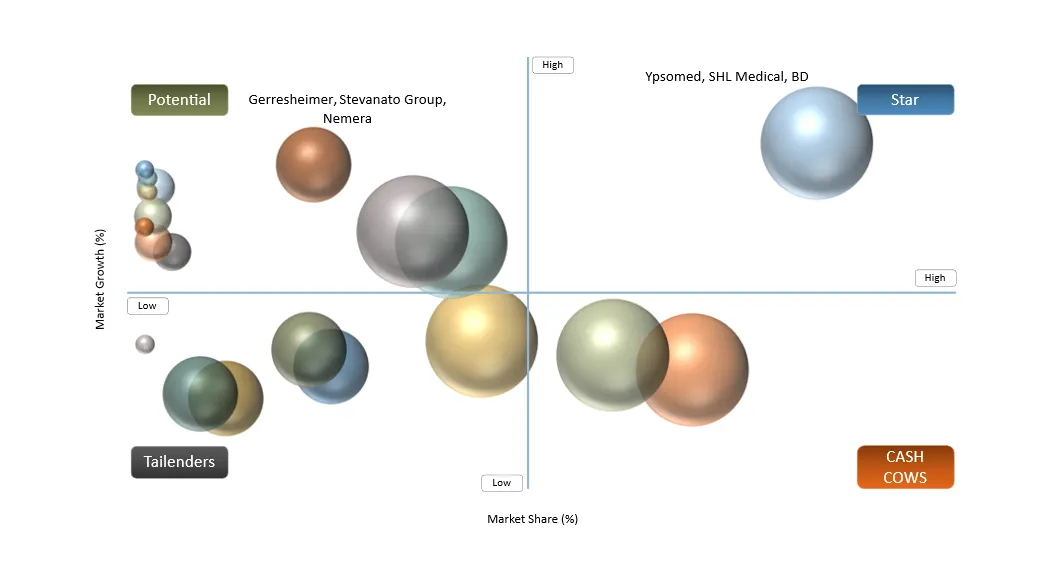
STAR
Ypsomed, SHL Medical, BD, West Pharmaceutical Services and SCHOTT Pharma occupy strong strategic positions through established platforms, primary-container scale, high-value delivery technologies or broad pharma relationships. Their growth is supported by biologics, biosimilars, GLP-1 therapies and increasing demand for large-volume delivery.
POTENTIAL
Gerresheimer, Stevanato Group, Nemera, Owen Mumford, Aptar and specialized platform developers represent high-potential participants. Their ability to expand share will depend on large-volume technology, integrated services, manufacturing scale and the number of customer programs progressing from clinical development into commercial launch.
Market Ecosystem Table
| Value Chain Sector | Representative Companies / Organizations | Role |
| Polymer & Engineering Materials | BASF, SABIC, Covestro, Celanese, DuPont | Medical-grade polymers, engineered resins, specialty materials |
| Primary Containers | BD, SCHOTT Pharma, Gerresheimer, Stevanato Group, West/Daikyo | Prefilled syringes, cartridges, polymer containers |
| Elastomer & Closure Components | West Pharmaceutical Services, Datwyler, Aptar Stelmi | Plungers, stoppers, seals and closure systems |
| Needles & Cannula Components | Terumo, Nipro, B. Braun, specialized needle suppliers | Injection needles, safety and insertion components |
| Autoinjector Platforms | Ypsomed, SHL Medical, Owen Mumford, Nemera, Haselmeier, Gerresheimer | Disposable, reusable and large-volume autoinjectors |
| Device Engineering / CDMO | Phillips-Medisize, Jabil, Flex, Celestica, Team Consulting | Design transfer, tooling, molding, assembly and industrialization |
| Fill-Finish & Drug Product Manufacturing | Vetter, Catalent, PCI Pharma Services, Lonza, Thermo Fisher Scientific | Sterile filling, device assembly and packaging |
| Pharmaceutical & Biotech Customers | AbbVie, Amgen, Eli Lilly, Novo Nordisk, Sanofi, Biogen, UCB, Regeneron | Drug-device combination products and lifecycle management |
| Specialty Distribution | McKesson, Cencora, Cardinal Health, specialty pharmacies | Patient access, specialty pharmacy and distribution |
| Regulatory / Standards | FDA, EMA, ISO, IEC, national competent authorities | Combination-product regulation, human factors and device standards |
Prefilled Auto Injectors Market Dynamics
Driver Impact Analysis
| Driver | Market Growth Impact | Demand Concentration | Impacted Use Case | Strategic Impact |
| Shift of biologics to home self-administration | High | North America and Europe | Autoimmune and metabolic therapies | Expands device conversion and supports multi-year platform demand |
| Biosimilar expansion | High | Global specialty markets | Rheumatology and immunology | Creates new launch programs and pressure for cost-efficient standard platforms |
| Large-volume subcutaneous formulations | High | Specialty biologics | 2.25 mL and >2.25 mL injections | Accelerates demand for next-generation high-force and large-volume systems |
| Aging and chronic disease burden | Medium-High | Developed and emerging markets | Long-term self-administration | Increases preference for simple, low-force and accessible devices |
Driver: Growing Shift Toward Home Self-Administration
Biologic developers are increasingly designing products for home use to reduce infusion-center burden, improve convenience and extend commercial differentiation. Prefilled autoinjectors simplify dose preparation and needle handling, which supports adherence and broadens the population that can self-administer. The trend is strongest in chronic autoimmune and metabolic diseases where repeated injection creates a strong incentive for a patient-friendly device.
Restraint Impact Analysis
| Restraint | Drag on Market Growth | Primary Impact Area | Impacted Use Case | Strategic Impact |
| Complex combination-product validation | High | Development timeline | Human factors, stability, design verification | Raises switching costs and delays programs if device selection occurs late |
| Long component qualification cycles | High | Supply chain | Syringes, elastomers, springs and molded parts | Limits rapid second sourcing and requires early capacity planning |
| High capital cost of automated assembly | Medium-High | Manufacturing | Commercial-scale production | Favors large suppliers and platform standardization |
| Device-related complaints and recalls | Medium-High | Post-market quality | Home self-injection | Can materially affect brand trust and regulatory burden |
Restraint: Combination-Product Complexity and Long Validation Cycles
Autoinjectors are not easily interchangeable once a drug-device combination has entered pivotal development. Human-factors validation, container compatibility, injection performance and stability are all linked to the selected device. A late design change can trigger new studies and delay filing, which makes early platform selection essential but also slows adoption of newer device technologies.
Prefilled Auto Injectors Market Segment Analysis
The global Prefilled Auto Injectors market is segmented based on Product Type, Dose Volume, Container Type, Technology, Molecule Type, Indication, End User, Distribution Channel and region.
By Product Type
Disposable Prefilled Auto Injectors Will Remain the Largest Segment
Disposable systems lead because they are simple for patients, avoid cleaning and cross-use risks, and integrate naturally with single-dose biologic packaging. Reusable systems can reduce material use and lower recurring device cost when the drug is supplied in interchangeable cartridges or prefilled primary containers, but they require more complex user training and lifecycle management.
By Dose Volume
Above 2.25 mL Will Record the Fastest Growth
Large-volume devices are expanding as higher-dose biologics are reformulated for subcutaneous administration. The key engineering challenges include injection time, force, viscosity, needle size and patient comfort. Platforms capable of 5 mL or more can open opportunities that previously required infusion or wearable delivery.
By Container Type
Prefilled Syringe-Based Systems Will Continue to Lead
Prefilled syringes have a large installed manufacturing base and are widely understood by regulators and pharma companies. Cartridge-based designs are gaining interest where reusable or variable-dose systems are preferred, while integrated reservoirs remain more specialized.
By Technology
Spring-Based Mechanical Systems Will Retain the Largest Share
Mechanical spring-driven devices dominate because of simplicity, robustness and low electronic complexity. Connected and electromechanical systems are expected to grow faster where dose confirmation, adherence data or variable injection profiles create clinical value.
By Molecule Type
Biologics and Biosimilars Will Dominate Demand
Biologics generate the largest device opportunity because of chronic dosing, premium drug value and the shift from IV to SC delivery. Biosimilar launches also create demand for new device configurations and cost-efficient platform standardization.
By Indication
Autoimmune and Metabolic Therapies Will Drive High-Volume Demand
Autoimmune therapies established the modern autoinjector category, while obesity and metabolic drugs are rapidly increasing device volumes. Anaphylaxis remains a strategically important emergency-use category with distinct reliability and shelf-life requirements.
By End User
Homecare and Self-Administration Will Control Market Growth
The core value proposition of the prefilled autoinjector is to move reliable injection from trained healthcare professionals to patients and caregivers. Growth in telehealth, specialty pharmacy and home-based chronic care strengthens this channel.
By Distribution Channel
Specialty and Retail Pharmacies Will Gain Strategic Importance
Specialty pharmacies are central for biologic access, training, prior authorization and adherence support, while retail and online channels are more relevant for widely distributed emergency and chronic products. Limited distribution remains common for high-cost specialty medicines.
Prefilled Auto Injectors Market Geographical Penetration
U.S. Prefilled Auto Injectors Market Landscape
The U.S. is the largest national market due to specialty drug spending, biologic approvals, home self-administration and strong device-development infrastructure. Demand is supported by autoimmune biologics, GLP-1 therapies, anaphylaxis products and growing use of biosimilars. Regulatory expectations for human factors and combination products create high barriers but also favor experienced platform suppliers.
Germany Prefilled Auto Injectors Market Outlook
Germany combines a major pharmaceutical manufacturing base with strong uptake of biologics and biosimilars. Device suppliers benefit from proximity to European pharma companies, primary-container manufacturers and precision manufacturing. Reimbursement pressure encourages standard platform use and lifecycle cost optimization.
Japan Prefilled Auto Injectors Market Trends
Japan offers high-value demand in biologics, diabetes and autoimmune diseases, supported by strong device engineering and domestic primary-container capabilities. Device ergonomics, reliability and compact form factors are important, while local regulatory requirements influence launch sequencing.
China Prefilled Auto Injectors Market Outlook
China is moving from imported specialty devices toward greater local production and adoption. Growth is driven by domestic biologics, biosimilars, obesity therapies and expansion of self-administration. Local assembly and price-optimized platforms can materially improve competitiveness.
India Prefilled Auto Injectors Market Outlook
India is an emerging opportunity through biosimilar manufacturing, contract development and growing specialty-pharma demand. Cost sensitivity remains high, favoring standardized mechanical devices and local manufacturing partnerships.
Middle East and Africa Prefilled Auto Injectors Market Outlook
The region remains smaller but is expanding through diabetes, obesity, allergy and specialty biologic care. Gulf markets offer the strongest near-term opportunity, while broader adoption depends on reimbursement, cold-chain infrastructure and patient training.
Prefilled Auto Injectors Market Competitive Landscape
- Competition is concentrated among established device-platform companies, primary-container suppliers and integrated drug-delivery specialists with validated manufacturing and long-standing pharma relationships.
- Ypsomed and SHL Medical are prominent platform specialists, while BD, West, SCHOTT Pharma, Gerresheimer and Stevanato Group control strategically important primary-container and delivery capabilities.
- Large-volume autoinjectors are a key competitive frontier because they expand the number of biologics that can migrate from infusion or wearable systems to handheld self-injection.
- Commercial differentiation increasingly depends on platform breadth, clinical-stage availability, container flexibility, human-factors support, manufacturing scalability and geographic redundancy.
- Partnerships between device developers, syringe suppliers and fill-finish companies are becoming more important as pharmaceutical companies seek end-to-end risk reduction.
Q1-Q2 2026 Public Company Performance Comparison
| Public Company | 2026 Reporting Period | Performance | Growth Drivers | Prefilled Autoinjector Relevance |
| Ypsomed Holding AG | FY2025/26 results published May 2026; Q1 FY2026/27 operational update July 2026 | Core business grew 20% in FY2025/26; commercial autoinjector sales grew 33.6%; 14 new customer projects secured in Q1 FY2026/27 | Large-volume YpsoMate demand, biosimilar launches, new indications, Clear-to-Clinic and capacity expansion | Direct, high |
| Becton, Dickinson and Company | Q2 FY2026 ended Mar. 31, 2026 | Q2 revenue US$4.714bn, +5.2% reported; BioPharma Systems revenue US$590m, +2.5% reported; biologic prefillable solutions grew double digits | GLP-1 delivery products, biologic prefillable solutions, global pharma relationships and syringe scale | Direct, high through prefillable systems |
| West Pharmaceutical Services | Q2 2026 ended Jun. 30, 2026 | Net sales US$872.3m, +13.8%; HVP Delivery Devices US$131.2m, +29.6%; HVP Components +19.4% | Biologics, Annex 1 upgrades, GLP-1 elastomers, high-value delivery devices and premium containment | Direct, high |
| SCHOTT Pharma | H1 FY2026 ended Mar. 31, 2026 | Revenue EUR488.1m, +2.3% constant currency; HVS share 56%; DCS +8.3% CC while DDS -5.4% CC | Strong prefillable glass syringe demand for GLP-1, sterile cartridges, specialty vials and high-value solutions | Direct, high through prefillable syringes and cartridges |
| Terumo Corporation | FY ended Mar. 31, 2026; Q1 FY2026/27 scheduled Aug. 7, 2026 | FY revenue JPY1,131.9bn, +9.2%; operating profit JPY176.3bn, +11.8% | Global device demand, injection/primary-container capabilities and broader medtech growth | Moderate, relevant through injection systems and components |
Interpretation: the comparison uses the most current public disclosures available through early August 2026. Company-wide results should not be interpreted as pure prefilled-autoinjector revenue. Ypsomed provides the most direct commercial-autoinjector growth signal, while West, BD and SCHOTT Pharma provide strong evidence from delivery devices, prefillable systems and high-value primary-container demand.
Key Companies
- Ypsomed Holding AG
- SHL Medical
- Becton, Dickinson and Company
- West Pharmaceutical Services, Inc.
- SCHOTT Pharma AG & Co. KGaA
- Gerresheimer AG
- Owen Mumford Ltd.
- Nemera
- Haselmeier
- Stevanato Group
- Terumo Corporation
- Phillips-Medisize
- AptarGroup
- Eli Lilly and Company
- Novo Nordisk
Company Profiles
Ypsomed Holding AG
Ypsomed is a leading pure-play injection systems company with a broad autoinjector platform portfolio including YpsoMate variants for standard and large volumes. Its 2026 growth is supported by strong commercial autoinjector sales, a record flow of customer projects and capacity expansion in Europe and the United States. The company is strategically positioned around platform standardization, clinical-to-commercial transfer and high-volume manufacturing.
Becton, Dickinson and Company
BD participates through prefillable syringe systems, drug delivery components and broader medication delivery capabilities. Its BioPharma Systems business benefits from biologic and GLP-1 demand. BD’s competitive advantage lies in global scale, pharma relationships and the ability to integrate primary-container performance with downstream device development.
West Pharmaceutical Services, Inc.
West supplies high-value elastomer components, primary-container technologies and delivery devices. Strong 2026 growth in high-value delivery devices and biologic-focused components demonstrates direct exposure to injectable drug growth. Its position is reinforced by premium containment, component science and extensive relationships with injectable drug manufacturers.
SCHOTT Pharma AG & Co. KGaA
SCHOTT Pharma provides prefillable glass and polymer syringes, cartridges and other high-value drug containment systems. Growth in sterile cartridges and prefillable glass syringes, including demand linked to GLP-1 products, supports its role in the autoinjector ecosystem. The company is investing in specialized high-value solutions and capacity across multiple regions.
Gerresheimer AG
Gerresheimer provides syringes, cartridges, injection systems and medical devices for pharmaceutical customers. Its broad primary packaging and delivery portfolio enables integrated programs from container selection to device industrialization. Expansion in Asia and medical-device capabilities supports long-term participation in self-injection growth.
SHL Medical
SHL Medical is one of the largest specialist autoinjector developers and manufacturers, with a broad platform portfolio used by global pharmaceutical companies. Its focus includes high-volume devices, customizable platforms and large-scale manufacturing. The company is particularly relevant where pharmaceutical customers seek integrated development and commercial supply.
Owen Mumford Ltd
Owen Mumford develops autoinjectors and injection systems with emphasis on usability, safety and platform flexibility. The company competes through reusable and disposable designs, human-factors expertise and partnerships with pharma and biotech companies.
Nemera
Nemera supplies drug-delivery devices across parenteral, inhalation and other routes. Its autoinjector and injection-device capabilities are supported by design, engineering and manufacturing services. The company is positioned as a development partner for pharmaceutical lifecycle programs.
Haselmeier
Haselmeier develops pens, autoinjectors and other self-injection devices. The company emphasizes platform engineering, dose delivery and patient usability. Its relevance is strongest in combination-product programs requiring customized engineering around established delivery concepts.
Stevanato Group
Stevanato Group combines primary drug containers, engineering systems and drug-delivery technologies. This vertical integration can reduce compatibility risk and supports pharma customers seeking coordinated container, device and automation solutions.
Terumo Corporation
Terumo has extensive expertise in needles, syringes and injection technologies. Its broader medtech scale, manufacturing precision and primary-container know-how make it an important enabling company in the self-injection ecosystem even where the final autoinjector may be supplied by another specialist.
Phillips-Medisize
Phillips-Medisize, a Molex company, provides device design, development, tooling, molding and manufacturing services. It supports pharmaceutical clients that require industrialization of drug-delivery systems and can serve as a bridge between device concept and commercial production.
AptarGroup
Aptar participates in injectable delivery through elastomeric components, closures, safety systems and drug-delivery technologies. Its material science and global manufacturing footprint support high-value pharma applications.
Eli Lilly and Company
Eli Lilly is a major end-market driver through injectable metabolic, diabetes and immunology products. Its scale in GLP-1 and chronic therapies increases demand for prefilled injection systems, capacity and user-friendly self-administration formats.
Novo Nordisk
Novo Nordisk is a leading injectable therapy company in diabetes and obesity. Its high-volume drug-device business shapes demand for primary containers, injection devices and automated assembly, even though much of its portfolio uses pens rather than traditional single-dose autoinjectors.
Prefilled Auto Injectors Market Major Pain Points
- Long device qualification and regulatory timelines.
- Limited ability to change suppliers after pivotal development.
- High-viscosity and large-volume injection performance challenges.
- Need for reliable global capacity across syringes, elastomers, needles and molded parts.
- Human-factors complexity across elderly, pediatric and dexterity-limited users.
- Device complaints, misfires and incomplete injections can create disproportionate brand risk.
- High capital requirements for automated assembly and quality inspection.
- Sustainability pressure conflicts with single-use combination-product safety and validation requirements.
Prefilled Auto Injectors Market Recent Developments
- July 2026: Ypsomed reported a strong start to FY2026/27 with 14 new customer projects, citing demand for large-volume YpsoMate platforms, biosimilar launches and new therapeutic indications.
- July 2026: West Pharmaceutical Services reported Q2 2026 net sales of US$ 872.3 million, with high-value delivery devices increasing 29.6% year over year and biologics and GLP-1-related demand supporting growth.
- July 2026: Gerresheimer started operations at a new plant in Zhenjiang Dagang, China, strengthening its regional capacity for pharma and medical-device solutions.
- May 2026: SCHOTT Pharma reported H1 FY2026 revenue of EUR 488.1 million and highlighted continued strong demand for prefillable glass syringes, especially for GLP-1 therapies.
- May 2026: BD reported Q2 FY2026 revenue of US$ 4.714 billion; BioPharma Systems noted double-digit growth in prefillable solutions for biologic drugs, led by GLP-1 delivery products.
Analyst View / Opinion on Prefilled Auto Injectors Market
- The prefilled autoinjector market is moving into a structurally higher-growth phase as biologic volume, biosimilar competition and home administration expand simultaneously.
- Large-volume devices are the most strategically important technology transition because they extend autoinjector use into therapies that previously required infusion, wearable delivery or multiple injections.
- Platform suppliers with clinical-stage support, primary-container partnerships and automated commercial capacity will capture a disproportionate share of future programs.
- Pharmaceutical companies should treat device selection as a portfolio decision. Reusing a validated platform across molecules and regions can reduce development cost and improve supply leverage.
- Primary-container and elastomer suppliers remain as strategically important as final device manufacturers because injection force, container breakage, silicone interactions and closure integrity can determine device success.
- By 2035, leading suppliers are likely to compete as integrated delivery ecosystems rather than standalone device vendors, combining platforms, containers, manufacturing, regulatory support and digital services.
Prefilled Auto Injectors Market Target Audience
| Industry | Who Should Buy This Report? | Reason to Buy This Report |
| Pharmaceuticals & Biotechnology | Drug-device teams, formulation leaders, lifecycle management, sourcing and business development | Select device platforms, benchmark suppliers and plan launch capacity. |
| Drug Delivery Devices | Autoinjector developers, engineering companies and contract manufacturers | Assess platform trends, volume opportunities and competitive positioning. |
| Primary Packaging | Syringe, cartridge, elastomer and needle suppliers | Forecast demand from biologics and large-volume self-injection. |
| Fill-Finish / CDMO | Sterile fill-finish companies and assembly partners | Identify combination-product manufacturing and assembly opportunities. |
| Specialty Pharmacy | Specialty distributors, pharmacies and patient-support providers | Understand channel growth, training needs and therapy migration to the home. |
| Investors & Consulting | Private equity, public-market investors, consultants and strategy teams | Evaluate growth platforms, capacity investment, partnerships and M&A. |
| Regulatory & Quality | Regulatory affairs, human-factors and quality leaders | Track combination-product requirements and lifecycle risk. |
Why Choose DATAM?
- Data-driven insights combining device platform analysis, market sizing, therapeutic demand, company performance and country-level opportunity.
- Post-purchase analyst consultations for platform selection, supplier benchmarking, market entry and partnership strategy.
- Annual updates covering new device launches, pharma-device partnerships, capacity additions, regulatory developments and competitive shifts.
- Specialized focus on high-growth delivery technologies including large-volume and high-viscosity self-injection.
- Actionable analysis connecting drug development trends with device qualification, supply-chain readiness and commercial manufacturing.
What DATAM Uniquely Provides
- Ten-year forecasts across eight segmentation dimensions and five global regions.
- Market ecosystem mapping from materials and primary containers through autoinjector platforms, fill-finish, pharma customers and specialty distribution.
- Public-company Q1-Q2 2026 performance comparison tied specifically to autoinjector growth drivers.
- Strategic analysis of large-volume, biologic, biosimilar and GLP-1 delivery opportunities.
- Buyer-focused assessment of device selection, validation, supply assurance and lifecycle economics.





























































