


Multi omics Market Size & Growth
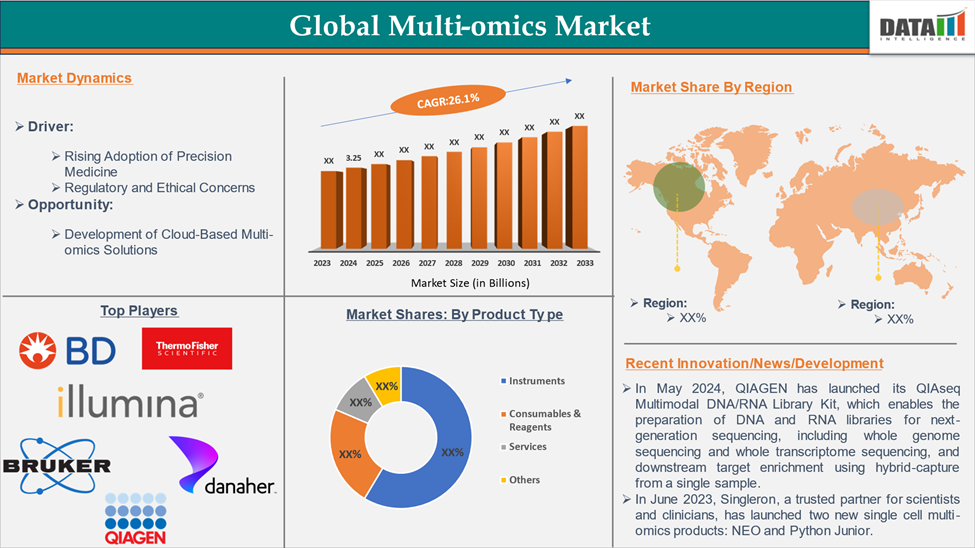
The Global Multi-omics Market reached US$ 4.10 billion in 2025 and is expected to reach US$ 33.25 billion by 2033, growing at a CAGR of 26.1% during the forecast period 2026-2033.
Multiomics is a multidisciplinary approach that integrates various omics technologies, aiding in the discovery of biomarkers, understanding disease mechanisms, and advancing personalized medicine by analyzing data from various molecular layers.
The global multiomics market is experiencing significant growth due to precision medicine adoption, drug discovery research, and sequencing technologies. Key drivers include demand for integrated biological data analysis, government funding, and healthcare and biotechnology applications. North America leads the market due to strong research infrastructure, while Asia-Pacific is emerging as a lucrative region. Major players like Thermo Fisher Scientific, Illumina, and QIAGEN are driving innovation in this field.
Executive Summary
For more details on this report – Request for Sample
Multi omics Market Dynamics: Drivers & Restraints
Rising Adoption of Precision Medicine
The global multiomics market is driven by the growing focus on precision medicine, which allows for a deeper understanding of individual genetic, proteomic, and metabolic profiles. Governments and healthcare organizations are investing heavily in multiomics research to develop personalized therapies for complex diseases like cancer and neurological disorders. The integration of artificial intelligence and bioinformatics accelerates drug discovery and patient-specific treatment strategies.
For instance, in January 2025, Enhanc3D Genomics, a pioneer in 3D genomics technology, launched a suite of integrated multi-omics solutions to enhance drug discovery precision. The solutions, based on the company's proprietary 3D genomics platform, provide partners with a comprehensive end-to-end solution to support decision-making throughout the drug discovery and development process.
Data Complexity and Integration
The global multiomics market faces challenges due to data complexity and integration, as it generates vast heterogeneous data from genomics, transcriptomics, proteomics, and metabolomics. This requires advanced computational tools for meaningful interpretation, standardization across platforms, and interoperability between databases. Ensuring data accuracy, reproducibility, and scalability requires high-performance computing and sophisticated algorithms, which limits accessibility for smaller research organizations and clinical applications.
Multi omics Market Segmentation Analysis
The global multi-omics market is segmented based on product & service, technology, application, end-user, and region.
Product & Service:
The instruments from the product & service segment are expected to dominate the multi-omics market with the highest market share.
Multiomics instruments, including NGS platforms, mass spectrometers, and microarrays, are specialized lab equipment used in various omics fields for precise detection, quantification, and characterization of biological molecules, enabling high-throughput data generation and drug development.
Instruments are vital in the global multiomics market, enabling precise analysis of biological molecules in genomics, transcriptomics, proteomics, and metabolomics. Advanced sequencing platforms, mass spectrometers, chromatography systems, and imaging technologies generate high-resolution data, facilitating molecular profiling, biomarker discovery, and disease mechanism studies. Continuous innovations in automation, miniaturization, and high-throughput analysis improve efficiency and accessibility, making multiomics technologies more accessible for research institutes, biotechnology companies, and clinical laboratories.
For instance, in June 2024, Mission Bio launched the Tapestri Single-cell Multiple Myeloma Multiomics Solution, a product suite designed to revolutionize multiple myeloma research and therapeutic development. The suite offers comprehensive insights into disease evolution and biology at the single-cell level, enabling researchers and drug developers to understand therapy resistance and disease relapse at the subclonal level. This new product suite will enhance the understanding of disease progression and treatment resistance.
Multi omics Geographical Share
North America is expected to hold a significant position in the multi-omics market with the highest market share
North America leads the global multi-omics market due to its significant product launches, robust research infrastructure, government funding, and key industry players. The region's biotechnology and pharmaceutical sectors invest in multi-omics technologies for drug discovery, precision medicine, and clinical diagnostics. Advanced sequencing platforms, bioinformatics tools, and AI-driven analytics enhance research capabilities.
For instance, in September 2024, The Translational Genomics Research Institute (TGen), part of the City of Hope, launched the Center for Spatial Multi-Omics (COSMO), a service center aimed at transforming biomedical research through spatial biology. COSMO offers services to visualize and map molecular data at the single-cell level within tissues, preserving important cellular environments and structures for histological analysis. Advanced technologies enable researchers to examine thousands of RNA targets in detail.
Moreover, partnerships and collaborations between academic institutions and biotech firms accelerate innovation which indeed helps the region to grow during the forecast period. For instance, in January 2024, Thermo Fisher Scientific Inc. and Akoya Biosciences signed a license and distribution agreement to provide a comprehensive solution for spatial multi-omics workflows, simplifying the whole-slide, multi-omics imaging process and examining protein and RNA, crucial for cancer research fields.
Furthermore, in January 2024, BD partnered with Hamilton Company to create robotics-compatible and automated reagent kits for large-scale single-cell multi-omics experiments, aiming to standardize and minimize human error.
Multi omics Market Global Players
The major global players in the multi-omics market include BD (Becton, Dickinson, and Company), Thermo Fisher Scientific Inc., Illumina, Inc., Danaher Corporation, Bruker Corporation, QIAGEN N.V, Agilent Technologies, Inc., Genedata, Shimadzu Corporation, and Element Biosciences among others.
Key Developments in Multi omics Market
June 2026: Illumina launched the StrataMap Spatial Solution, an end-to-end spatial whole-transcriptome research platform offering single-cell resolution, a 7.5 cm² capture area and whole-transcriptome profiling. The solution integrates with Illumina Connected Multiomics to combine spatial transcriptomic data with genomic, epigenetic and proteomic datasets.
- April 2026: Illumina launched DRAGEN v4.5, expanding multiomic analysis through structural-variant calling and improved small-variant accuracy for its 5-base solution. The release also introduced machine-learning-driven somatic analysis and strengthened scalable multiomic pipelines for large biological studies.
- January 2026: Illumina launched Connected Multiomics, a cloud-based platform integrating genomics, transcriptomics, proteomics and epigenomics data in a unified analysis environment. The platform combines interactive visualization, DRAGEN secondary analysis and AI-enabled variant interpretation to simplify large-scale multiomic research.
- January 2026: Illumina completed its acquisition of SomaLogic, expanding its proteomics capabilities and strengthening its multiomics portfolio. The integration combines SomaScan proteomics with Illumina’s NGS ecosystem, DRAGEN software and Connected Multiomics platform to support scalable protein analysis and multiomic discovery.
Multi omics Market Scope
| Metrics | Details | |
| CAGR | 26.1% | |
| Market Size Available for Years | 2022-2033 | |
| Estimation Forecast Period | 2025-2033 | |
| Revenue Units | Value (US$ Bn) | |
| Segments Covered | Product & Service | Instruments, Consumables & Reagents, Services |
| Technology | Genomics, Transcriptomics, Proteomics, Metabolomics, Epigenomics | |
| Application | Drug Discovery & Development, Precision Medicine, Clinical Diagnostics, Biotechnology & Industrial Applications | |
| End-User | Pharmaceutical & Biotechnology Companies, Research Institutes & Academic Centers, Hospitals & Clinics, CROs & CDMOs | |
| Regions Covered | North America, Europe, Asia-Pacific, Latin America, and Middle East & Africa | |
Why Choose DataM?
Technological Innovations: Explores advancements in multi-omics technologies, including genomics, transcriptomics, proteomics, metabolomics, epigenomics, single-cell multi-omics, and spatial multi-omics platforms, alongside sequencing, imaging, microfluidic, and computational approaches that enable integrated analysis of multiple molecular layers.
Product Performance & Market Positioning: Evaluates multi-omics platforms, assays, analytical solutions, and workflows based on critical parameters such as throughput, resolution, sensitivity, accuracy, multiplexing capability, number of integrated omics layers, data integration capabilities, workflow compatibility, and scalability, highlighting how technology providers differentiate through comprehensive molecular profiling and advanced computational analysis.
Real-World Evidence: Highlights the application of multi-omics across biomedical research, cancer biology, drug discovery, precision medicine, cell biology, and translational research, including single-cell and spatial approaches that enable researchers to characterize cellular states, molecular interactions, regulatory mechanisms, tissue architecture, and disease-associated molecular signatures.
Market Updates & Industry Changes: Tracks key developments such as advances in single-cell and spatial multi-omics, integration of genomic, transcriptomic, epigenomic, proteomic, and metabolomic datasets, development of computational data-integration methods, increasing movement toward clinical translation, and the emergence of AI-supported approaches for interpreting complex multi-omics datasets. Recent research highlights the industry's shift from data generation toward standardized, clinically implementable multi-omics workflows.
Competitive Strategies: Analyzes how leading companies and technology providers expand through platform development, integrated multi-omics workflows, software and cloud-based data-analysis solutions, strategic collaborations, technology commercialization, and improvements in throughput and multimodal data integration. For example, Illumina's Connected Multiomics provides a cloud-based environment for exploring, visualizing, and interpreting multiple omics modalities.
Pricing & Market Access: Explains pricing and market-access considerations across sequencing and assay technologies, single-cell and spatial platforms, sample preparation, analytical software, computational infrastructure, and integrated multi-omics workflows, with costs influenced by the number of omics layers analyzed, throughput, assay complexity, sequencing or imaging requirements, computational requirements, and scale of deployment.
Market Entry & Expansion: Identifies opportunities arising from growing demand for integrated molecular profiling, advances in single-cell and spatial analysis, precision medicine, translational research, cancer research, drug discovery, and clinical implementation. It also evaluates expansion strategies centered on scalable workflows, improved interoperability, computational integration, standardized processes, and partnerships that can accelerate the transition of multi-omics from research applications toward broader clinical use.
The global multi-omics market report delivers a detailed analysis with 70 key tables, more than 65 visually impactful figures and 159 pages of expert insights, providing a complete view of the market landscape.
Target Audience
- Pharmaceutical & Biotechnology Companies
- Genomics & Molecular Diagnostics Companies
- Academic & Research Institutions
- Clinical Research Organizations (CROs)
- Contract Research & Laboratory Service Providers
- Multi-omics Platform & Technology Providers
- Sequencing & Laboratory Equipment Manufacturers
- Bioinformatics & Computational Biology Companies




























































