


Biomarker Discovery Market Size
The global biomarker discovery market size reached US$ 22.16 billion in 2025 and is expected to reach US$ 68.25 billion by 2035, growing at a CAGR of 11.9% during the forecast period 2026-2035.
Biomarker discovery is being revolutionized by rapid advancements in measurement technologies, including mass spectrometry, next-generation sequencing, and high-throughput screening. These technologies allow for the accurate identification, quantification, and validation of molecular signatures across proteomics, metabolomics, and genomics. These technologies speed up the creation and analysis of data by offering increased sensitivity, precision, and reproducibility. Reliable biomarkers are needed to customize treatments based on patient profiles, and the need for precision medicine and companion diagnostics is increasing at the same time. Biomarkers are essential to individualized healthcare because they can be used to predict drug response, track the course of a disease, and improve therapy results.
Biomarker Discovery Market Key Takeaways
- North America accounted for 48.5% of global revenue in 2025, supported by advanced biotechnology infrastructure, regulatory approvals, and significant investments in precision medicine.
- Consumables represented the leading product category with a 55.5% market share in 2025 due to recurring demand for reagents, assay kits, antibodies, and laboratory supplies.
- Genomics remained the largest technology segment, contributing 35.3% of revenue in 2025 as next-generation sequencing continues to become a standard tool for biomarker research.
- Asia-Pacific is expected to deliver the fastest regional expansion, supported by increasing government funding, expanding genomic research, and improving diagnostic infrastructure.
- Multi-omics integration and AI-powered bioinformatics platforms are improving biomarker validation efficiency and shortening drug development timelines.
- Leading industry participants continue expanding their capabilities through acquisitions, strategic collaborations, and product innovation to strengthen comprehensive biomarker discovery portfolios.
Biomarker Discovery Market Scope
| Metrics | Details |
| Market Size (2025) | US$ 22.16 Billion |
| Market Size (2035) | US$ 68.25 Billion |
| CAGR (2026-2035) | 11.90% |
| Historic Years | 2023-2024 |
| Base Year | 2025 |
| Forecast Period | 2026-2035 |
| Segments Covered | Product Type, Technology, Application, End User, Region |
| Leading Region | North America |
| Fastest Growing Region | Asia-Pacific |
For More Details, Request for Sample
Biomarker Discovery Market Dynamics
Drivers: Wider adoption of multi-omics and integrative approaches are accelerating the growth of the biomarker discovery market
The broader use of integrative and multi-omics methods is facilitating a more comprehensive understanding of disease biology, which is speeding up the search for biomarkers. By merging data from transcriptomics, metabolomics, proteomics, and genomes, scientists can find biomarkers spanning several molecular layers with greater precision and clinical significance. Single-omics investigations frequently fail to reveal intricate biological relationships, but the integration of these datasets, aided by sophisticated bioinformatics and artificial intelligence techniques, does.
Additionally, continuous multi-omics research and development is propelling technical innovation, increasing analytical precision, and broadening the spectrum of observable biomolecular fingerprints, all of which are contributing to the adoption of biomarker discoveries. For instance, in February 2025, Metabolon introduced advanced multi-omics biomarker discovery capabilities within its Integrated Bioinformatics Platform, featuring predictive modeling, latent factor analysis, and pathway enrichment tools, enhancing data integration and accelerating breakthroughs in precision medicine and therapeutic development. analysis using public tools like Reactome and sophisticated multi-omics data visualization resources.
Restraints: High cost of advanced platforms, consumables, and tests are hampering the growth of the biomarker discovery market
The high cost of advanced platforms, consumables, and tests is hampering the growth of the biomarker discovery market by limiting accessibility and scalability. Mass spectrometry, single-cell analysis, and next-generation sequencing are examples of technologies that demand a large initial investment, specialized infrastructure, and knowledgeable staff.
Additionally, operational costs are greatly increased by ongoing expenditures for reagents, assay kits, and data analysis software. Adopting state-of-the-art biomarker discovery technologies is challenging for new biotech companies and smaller research institutes due to these budgetary constraints.
For more details on this report, see Request for Sample
Biomarker Discovery Market, Segmentation Analysis
The global biomarker discovery market is segmented based on product type, technology, application, end user and region
By Product Type: The consumables segment from product type is dominating the biomarker discovery market with a 55.5% share in 2024
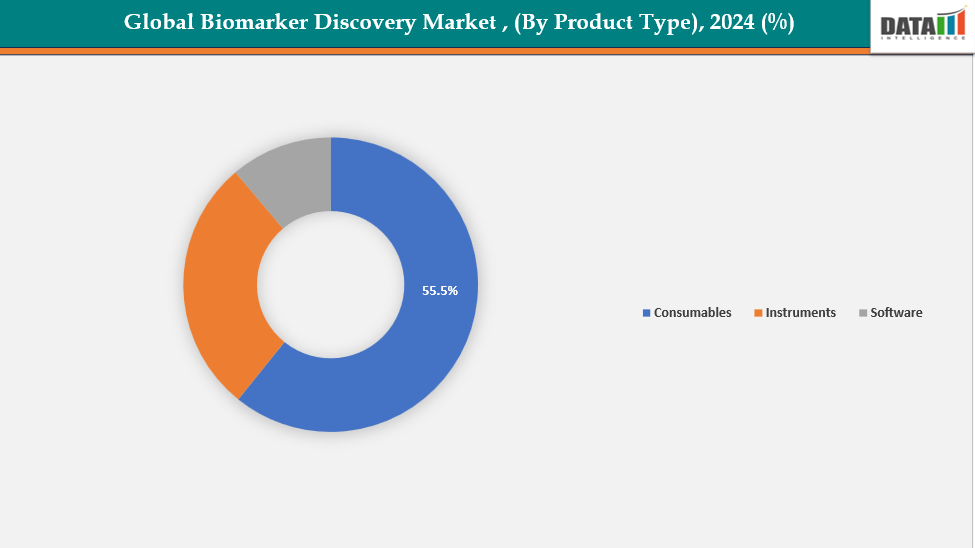
The consumables segment dominates the biomarker discovery market due to its essential and recurring role in research and diagnostic workflows. Every stage of the experiment, from sample preparation to validation, depends on consumables like reagents, assay kits, antibodies, and microplates, which fuel ongoing demand. Consumable use is becoming much more common as biomarker research in genomes, proteomics, and metabolomics grows. Consumables produce consistent, recurring revenue streams as opposed to instruments, which are one-time investments.
Additionally, ongoing product innovations by key players like Thermo Fisher Scientific, Merck KGaA, QIAGEN, and Bio-Rad Laboratories enhance assay precision and sensitivity, further boosting adoption.
By Technology: The genomics segment form technology is dominating the biomarker discovery market with a 35.3% share in 2025
The genomics segment leads the biomarker discovery market because of its crucial function in comprehending molecular illness mechanisms. Genetic variants, mutations, and single nucleotide polymorphisms (SNPs) linked to diseases can be quickly and accurately identified thanks to genomic technology, especially whole-genome analysis and next-generation sequencing (NGS). Finding predictive, diagnostic, and prognostic biomarkers requires this knowledge.
Additionally, genomic applications in oncology, neurology, and infectious illnesses have increased due to ongoing advancements, falling sequencing costs, and the emergence of precision medicine. For instance, in August 2024, Illumina achieved FDA approval for its TruSight Oncology Comprehensive test, a groundbreaking genomic-based IVD for precision oncology. This 500+ gene assay, featuring two companion diagnostics, enables comprehensive genomic profiling across cancers, enhancing biomarker discovery and accelerating targeted therapy matching for personalized cancer treatment
Biomarker Discovery Market, Geographical Analysis
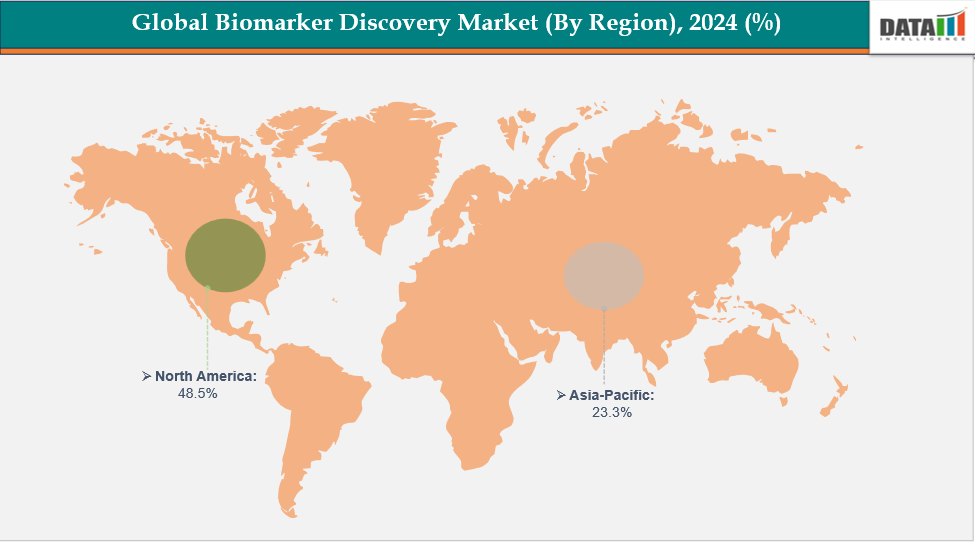
North America is dominating the global biomarker discovery market with a 48.5% in 2025
North America is projected to lead the global biomarker discovery market due to its advanced healthcare infrastructure, strong biotechnology presence, and high adoption of omics-based and molecular diagnostic technologies. Regional market domination and innovation are further fueled by growing investments in precision medicine and an increase in the need for quick, multiplex testing options.
In the USA, the biomarker discovery market is driven by rising research and development investments, advancements in multi-omics technologies, growing adoption of precision medicine for targeted diagnostics and therapeutics, and regulatory support and approvals.
For instance, in May 2025, Fujirebio received FDA 510(k) clearance for its Lumipulse G pTau 217/β-Amyloid 1-42 Plasma Ratio test, the first FDA-approved blood-based IVD for Alzheimer’s disease. This breakthrough enabled accurate, noninvasive assessment of amyloid pathology, advancing early diagnosis and biomarker-based detection of cognitive decline.
Europe is the second region after North America which is expected to dominate the global biomarker discovery market with a 34.5% in 2025
Europe’s biomarker discovery market is expanding due to strong healthcare infrastructure, high disease awareness, and broad access to diagnostic facilities. Biomarker validation, translational research, and precision medicine improvements throughout the region are accelerated by strategic partnerships among biotechnology businesses, research institutes, and healthcare organizations.
Germany’s biomarker discovery market is growing rapidly, driven by advanced healthcare infrastructure, strong regulatory frameworks, and active research collaborations. Precision medicine is being advanced and market growth is being reinforced nationwide through strategic acquisitions, partnerships, and industry-academic alliances that are stimulating innovation, increasing biomarker capacities, and speeding up translational research.
For instance, in July 2025, Alden Scientific acquired Oncimmune Germany GmbH, strengthening its global position in multi-omic research and precision medicine. The acquisition integrated Oncimmune’s ImmunoINSIGHTS biomarker discovery platform, enhancing Alden’s capabilities in immunodiagnostics, autoantibody profiling, and AI-driven precision health innovation.
The Asia Pacific region is the fastest-growing region in the global with a CAGR of 7.7% in 2025
The Asia-Pacific including Japan, China, India, and South Korea, is expanding rapidly due to rising disease burden, strong government support, and growing R&D investments. Early detection, precision medicine, and biomarker-based innovation are being propelled throughout the area by developments in omics technology, scholarly partnerships, and enhanced diagnostic infrastructure.
China’s biomarker discovery market is expanding rapidly, driven by strong government support, rising disease burden, and advanced R&D capabilities. Biomarker validation, clinical acceptance, and overall market growth are being accelerated nationwide by frequent NMPA approvals, expanding biopharma partnerships, and higher investment in precision medicine and omics research. For instance, in September 2024, Amoy Diagnostics received NMPA approval for its AmoyDx Pan Lung Cancer PCR Panel, enabling precise detection of EGFR, ALK, ROS1, and METex14 mutations in non-small cell lung cancer patients, strengthening China’s precision oncology and biomarker-based diagnostic capabilities.
Biomarker Discovery Market Competitive Landscape
Top companies in the biomarker discovery market include Thermo Fisher Scientific Inc., Illumina, Inc., Agilent Technologies, Inc., Bio-Rad Laboratories, Inc., Merck KGaA, Hoffmann-La Roche Ltd, Abcam Limited, Olink, SomaLogic, and BD, among others.
Thermo Fisher Scientific Inc.: Thermo Fisher Scientific is a global leader in biomarker discovery, supplying instruments (e.g., orbitrap high-resolution mass spectrometers), reagents, sample preparation kits, and bioinformatics/LIMS solutions for multi-omic workflows. It offers end-to-end discovery & validation services in genomics, proteomics, transcriptomics, and protein biomarker analysis, enabling high sensitivity and throughput. Acquisitions like Intrinsic Bioprobes have expanded its quantitative proteomics and immuno-enrichment capabilities.
Biomarker Discovery Market Key Developments
June 2026: Thermo Fisher Scientific expanded its biomarker discovery portfolio by introducing advanced multi-omics and mass spectrometry solutions, enabling faster identification and validation of disease biomarkers for precision medicine and drug development.
May 2026: QIAGEN strengthened its biomarker discovery capabilities by enhancing its next-generation sequencing (NGS) and bioinformatics platforms, supporting more accurate genomic biomarker identification for oncology and companion diagnostics.
April 2026: Illumina advanced its genomics portfolio with enhanced sequencing technologies and AI-powered data analysis tools, accelerating biomarker discovery for cancer, rare diseases, and personalized medicine applications.
March 2026: Agilent Technologies expanded its biomarker research solutions by introducing high-sensitivity liquid chromatography and mass spectrometry workflows, improving proteomic and metabolomic biomarker discovery for clinical research.
February 2026: Bio-Rad Laboratories enhanced its biomarker discovery platform by expanding digital PCR and multiplex assay technologies, enabling highly sensitive biomarker detection and supporting translational research and precision diagnostics.
Report Benefits
This report supports strategic planning by providing detailed insights into market size, growth projections, technology trends, competitive positioning, product segmentation, and regional opportunities. Manufacturers can evaluate commercialization strategies, investors can identify high-growth technology segments, procurement teams can assess supplier positioning, and pharmaceutical organizations can better understand biomarker adoption across drug development pipelines.
Target Audience
- Pharmaceutical Companies
- Biotechnology Companies
- Molecular Diagnostic Developers
- Medical Device Manufacturers
- Contract Research Organizations
- Academic and Research Institutes
- Hospitals and Diagnostic Laboratories
- Healthcare Investors
- Venture Capital Firms
- Bioinformatics Solution Providers
- Procurement and Supply Chain Teams
- Corporate Strategy and Business Development Teams
Conclusion
The biomarker discovery market is positioned for sustained expansion as precision medicine, companion diagnostics, and multi-omics research become increasingly integrated into healthcare and pharmaceutical development. Continued advances in genomics, proteomics, artificial intelligence, and bioinformatics are improving the speed and reliability of biomarker identification while creating new commercial opportunities across research and clinical settings.
Although high technology costs remain a consideration, ongoing product innovation, regulatory support, strategic partnerships, and expanding precision medicine programs are expected to maintain strong investment momentum through 2035. Organizations capable of delivering integrated biomarker discovery platforms, advanced analytical capabilities, and scalable research solutions will be well positioned to capitalize on the growing demand for personalized healthcare and next-generation diagnostics.


























































