


Memristor Market Overview
Growth in this market is being driven by increasing demand for energy-efficient memory technologies across consumer electronics, edge computing, and AI hardware. Memristors offer compact, low-power solutions capable of storing and processing data simultaneously, which is essential for real time learning and adaptive systems. Their ability to replicate synaptic behaviour makes them particularly valuable in neuromorphic computing, where traditional memory architectures fall short in speed and scalability.
Another key factor is the surge in research and development focused on next-generation computing platforms. Institutions and companies are investing in memristor based designs to overcome limitations in conventional semiconductor technologies. As data-intensive applications expand from autonomous vehicles to intelligent sensors memristors provide a pathway to faster, more efficient memory integration, positioning them as a cornerstone of future digital infrastructure.
Global Memristor Market Industry Trends and Strategic Insights
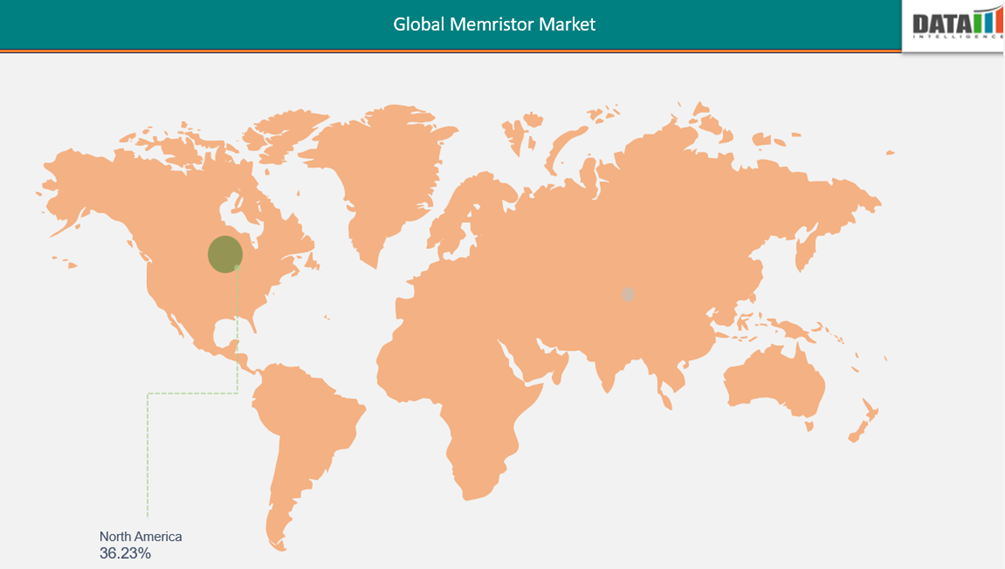
- The North America region leads the global memristor market, capturing the largest revenue share of 36.23 %.
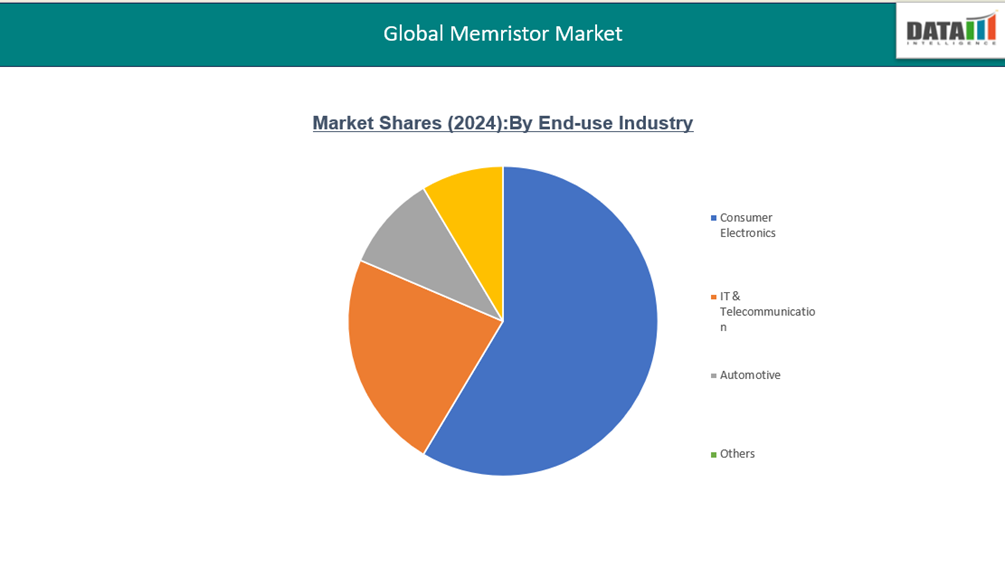
- By end-use industry, the consumer electronics dominates the largest share in the global memristor market.
Market Size and Future Outlook
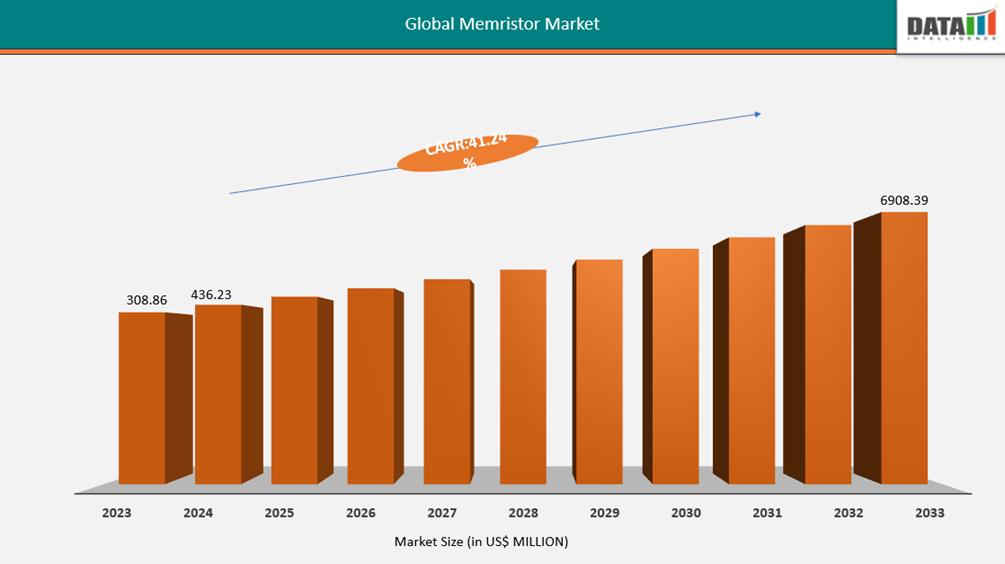
- 2025 Market Size: US$ 616.12 million
- 2033 Projected Market Size: US$ 9,757.65 million
- CAGR (2025-2032): 41.24%
- Largest Market: North America
- Fastest Market: Asia Pacific
Source: DataM Intelligence
Key Takeaways
- The growing demand for energy-efficient memory technologies for artificial intelligence (AI), neuromorphic computing, edge computing, and next-generation electronics is emerging as a key industry trend, with memristor technology gaining attention for its ability to combine data storage and processing while reducing power consumption.
- Asia-Pacific maintains a leading position due to its extensive semiconductor manufacturing ecosystem, increasing investments in advanced electronics, strong government support for AI innovation, and expanding research activities in neuromorphic computing and resistive memory technologies.
- North America is projected to record significant growth as increasing investments in AI hardware, advanced semiconductor research, data-intensive computing infrastructure, and next-generation memory architectures continue to accelerate commercialization opportunities for memristor-based solutions.
- The rising need to overcome the limitations of conventional memory technologies, including power consumption, processing bottlenecks, and data-transfer inefficiencies, is becoming a major factor driving research, development, and adoption of memristor technologies across multiple industries.
- The growing use of memristors in AI accelerators, neuromorphic processors, edge devices, Internet of Things (IoT) systems, and in-memory computing applications is increasing demand for high-speed, non-volatile, and energy-efficient memory solutions capable of supporting advanced computing workloads.
- Industry participants are increasingly evaluating investments based on technological scalability, semiconductor integration capabilities, energy-efficiency performance, intellectual property strength, and commercialization potential rather than relying solely on conventional memory market positioning.
- Rising investments in semiconductor manufacturing, AI infrastructure, neuromorphic computing research, edge intelligence platforms, and next-generation computing architectures are creating significant opportunities for memristor developers, semiconductor companies, and advanced materials suppliers worldwide.
Memristor Market Scope
| Metrics | Details |
By Product Type
| Molecular & ionic thin-film, Spin-based, Oxide-based, Polymer-based
|
| By Application | AI Accelerators, Neuromorphic Computing, Edge Devices, IoT, Others |
| By End-use Industry | Consumer Electronics, IT & Telecommunication, Automotive, Healthcare, Others
|
| By Region | North America, South America, Europe, Asia-Pacific, Middle East and Africa |
| Report Insights Covered | Competitive Landscape Analysis, Company Profile Analysis, Market Size, Share, Growth |
Memristor Market Dynamics
Memristors Power the Future of Intelligent AI Systems
Growing interest in artificial intelligence is boosting the need for faster, energy efficient memory systems. Memristors meet this demand by enabling real time learning and low power data processing, making them ideal for next-generation AI hardware. Their ability to mimic neural behavior allows systems to adapt and respond dynamically, improving performance in edge computing and autonomous applications. This positions memristors as a key component in the evolution of intelligent, scalable technologies.
In 2025, researchers at the Korea Advanced Institute of Science and Technology (KAIST) developed a brain-on a chip using memristor technology. This chip mimics synaptic behavior, allowing it to learn and adapt like human neurons. It processes and stores data simultaneously, making it highly energy efficient and suitable for advanced artificial intelligence (AI) systems. The innovation marks a step toward the concept of technological singularity where AI could match or surpass human intelligence.
Manufacturing Challenges Limit Memristor Market Expansion
Manufacturing complexity is a key restraint in the memristor market. Producing memristors at scale requires precise control over materials and nanoscale fabrication, which can lead to inconsistent performance and high defect rates. Integrating them into existing semiconductor processes also poses challenges, slowing down commercialization and increasing production costs. These hurdles limit widespread adoption despite strong interest from AI and computing sectors.
Memristor Market Segmentation Analysis
The global memristor market is segmented based on product type, application, end-use industry and region.
Source: DataM Intelligence
Consumer Electronics Drive Memristor Market Leadership
Dominance of consumer electronics in the memristor market is largely attributed to the sector’s continuous push for compact, high-speed, and low-power memory solutions. Devices like smartphones, smartwatches, and home automation systems require components that can handle rapid data processing without draining battery life. Memristors, with their ability to combine storage and computation in a single unit, meet these demands efficiently.
For instance, in 2024, Samsung unveiled the HBM3E 12H chip its highest-capacity AI memory to date-offering 36GB per stack and 1.2TB/s bandwidth. While not used directly in consumer electronics due to its power and cost, it drives smarter AI features in phones, laptops, and smart devices by powering cloud-based AI training and inference. Its innovations also influence future consumer-grade memory design, paving the way for more efficient and capable devices.
Smart Infrastructure Drives Memristor Adoption in Telecom
IT and telecommunication sector is a rapidly growing segment in the memristor market, driven by the need for faster data transmission, real-time processing, and energy-efficient infrastructure. Memristors support in-memory computing and neuromorphic architectures, which are increasingly vital for managing complex network traffic and enabling intelligent edge devices. Their ability to reduce latency and power consumption makes them ideal for telecom applications such as 5G base stations, AI-enhanced routing, and data center optimization
For instance, in June 2025, researchers from Peking University and the Chinese Institute for Brain Research unveiled a memristor-based sorting system that enhances AI efficiency. Published in Nature Electronics, it delivers 7.7× faster throughput, 160× better energy efficiency, and 32× improved memory use advancing intelligent computing through sort-in-memory architecture.
Memristor Market Geographical Penetration
Source: DataM Intelligence
Semiconductor Drives North American Memristor Growth
North America holds the largest share in the global memristor market due to its robust semiconductor ecosystem, early adoption of neuromorphic computing, and strong alignment with AI-driven innovation. The region benefits from a concentration of leading chipmakers, research institutions, and venture-backed startups focused on next-generation memory technologies.
U.S Memristor Market Insights
The United States plays a pivotal role in the global memristor market, driven by its advanced semiconductor infrastructure, strong research capabilities, and early adoption of neuromorphic technologies. Home to leading innovators and tech giants, the U.S. fosters a dynamic ecosystem where startups, universities, and national labs collaborate on next-generation memory solutions.
For instance, in 2024, researchers at the University of Southern California made a notable advance in memristor technology by improving its precision and energy efficiency. Their work bridges analog and digital computing, allowing faster data processing with lower power consumption. This development supports real-time learning in AI systems and strengthens the potential of memristors in neuromorphic hardware, edge devices, and next-generation intelligent applications.
Canada Memristor Market Growth
Canada contributes to North America's memristor momentum through its growing emphasis on quantum computing, AI research, and sustainable electronics. Institutions like the University of Toronto and the University of Waterloo are active in neuromorphic and memory-centric computing research. Government-backed initiatives supporting clean tech and advanced manufacturing also create fertile ground for memristor innovation.
For instance, he International Conference on Memristor Research (ICMR), held on June 19–20, 2025, in Toronto, brought together global experts to share advances in memristor technology and neuromorphic computing. The event helped elevate Canada’s profile in the field by showcasing local innovation, fostering research partnerships, and supporting growth in the national memristor market.
Asia-Pacific Leads the Global Memristor Market Driven by Industrial Growth and Infrastructure
Asia-Pacific region is rapidly emerging as a key player in the global memristor market, driven by its expansive semiconductor manufacturing base, rising demand for AI-enabled devices, and strong government support for advanced electronics. Countries like South Korea, Japan, Taiwan, and China are investing heavily in neuromorphic research and next-generation memory technologies.
China Memristor Market Growth
China plays a significant role in advancing memristor technology, backed by its national push for semiconductor independence and AI leadership. Major Chinese universities and research centers are actively developing brain-inspired computing platforms, while domestic companies invest in resistive memory integration for edge devices and smart infrastructure.
For instance, in 2023, China unveiled the first fully integrated memristor computing-in-memory chip. Designed for efficient on-chip learning and low energy use, it marked a major step toward advanced AI hardware and strengthened China’s position in global semiconductor innovation.
India Memristor Market Growth
India is gradually building momentum in the memristor space through increased focus on AI research, semiconductor self-reliance, and academic collaboration. Institutions such as IITs and IISc are exploring neuromorphic computing and resistive memory technologies, while government initiatives like “Digital India” and “India Semiconductor Mission” aim to strengthen domestic capabilities.
For instance, in 2025, Researchers at IISc Bangalore developed a revolutionary computing prototype using memristor technology that mimics brain-like learning, enabling real-time, energy-efficient rephrasing of news content.
Memristor Market Sustainability Analysis
Memristor technology offers notable sustainability benefits by reducing energy consumption in data processing and storage. Unlike traditional memory systems, memristors combine computation and memory in a single unit, minimizing data transfer and lowering power usage. Their compact design and potential for long-term durability also support efficient hardware scaling, making them suitable for eco-conscious AI and edge computing applications. As demand for low-power electronics grows, memristors contribute to greener, more sustainable digital infrastructure.
Memristor Market Competitive Landscape
- The global memristor market is highly competitive, driven by a mix of global and regional players striving for technological efficiency and cost leadership.
- Key players include, 4DS Memory Limited, Fujitsu Ltd., Honeywell International Inc., IBM Corporation, Intel Corporation, Micron Technologies, Inc., Samsung Group, SK HYNIX Inc., Toshiba Corporation, Western Digital Corporation
Why Choose DataM?
- Technological Innovations: Explores advancements in memristor technologies, including oxide-based resistive switching devices, conductive bridge RAM (CBRAM), phase-change and ferroelectric memory integration, analog in-memory computing architectures, neuromorphic computing hardware, AI accelerator integration, and low-power non-volatile memory solutions, enabling faster data processing, ultra-low energy consumption, higher storage density, and next-generation computing capabilities.
- Product Performance & Market Positioning: Evaluates how different companies develop memristor solutions based on critical performance parameters such as switching speed, endurance, retention time, power efficiency, scalability, resistance-state stability, fabrication compatibility with CMOS processes, and support for AI and edge computing workloads, highlighting how leading players differentiate through innovation, reliability, and advanced semiconductor integration.
- Real-World Evidence: Highlights the adoption of memristor technologies across artificial intelligence accelerators, neuromorphic computing systems, high-performance computing, embedded memory applications, edge AI devices, IoT platforms, and advanced research programs, demonstrating benefits such as reduced latency, lower power consumption, improved computational efficiency, and enhanced data storage performance.
- Market Updates & Industry Changes: Tracks key developments such as new memristor product launches, semiconductor R&D breakthroughs, advancements in resistive random-access memory (ReRAM), neuromorphic processor development, strategic research collaborations, pilot manufacturing initiatives, and investments in AI hardware innovation across North America, Europe, and Asia-Pacific, supporting the evolution of next-generation memory and computing technologies.
- Competitive Strategies: Analyzes how leading companies strengthen their market position through semiconductor innovation, strategic collaborations with research institutions, AI hardware partnerships, intellectual property development, advanced fabrication processes, and investments in next-generation memory architectures to address growing demand for energy-efficient computing, AI acceleration, and high-density data storage.
- Pricing & Market Access: Explains pricing variations based on device architecture, material composition, manufacturing complexity, memory density, performance specifications, production scale, and integration requirements, along with market access through semiconductor manufacturers, integrated device manufacturers (IDMs), foundries, research organizations, OEM partnerships, and advanced electronics supply chains.
- Market Entry & Expansion: Identifies growth opportunities driven by increasing demand for AI hardware, neuromorphic computing, edge intelligence, high-performance computing, and low-power memory technologies, while outlining strategies such as technology commercialization, strategic R&D partnerships, semiconductor manufacturing expansion, IP licensing, and customized memory solutions for emerging computing applications.
Target Audience
- Semiconductor Manufacturers
- Integrated Device Manufacturers (IDMs)
- Foundries & Wafer Fabrication Companies
- AI Hardware & Accelerator Developers
- Neuromorphic Computing Technology Providers
- Memory Device Manufacturers (ReRAM & Emerging Memory)
- Consumer Electronics Manufacturers
- Automotive Electronics & ADAS Developers





























































