


Edge AI Processor Market Size and Overview
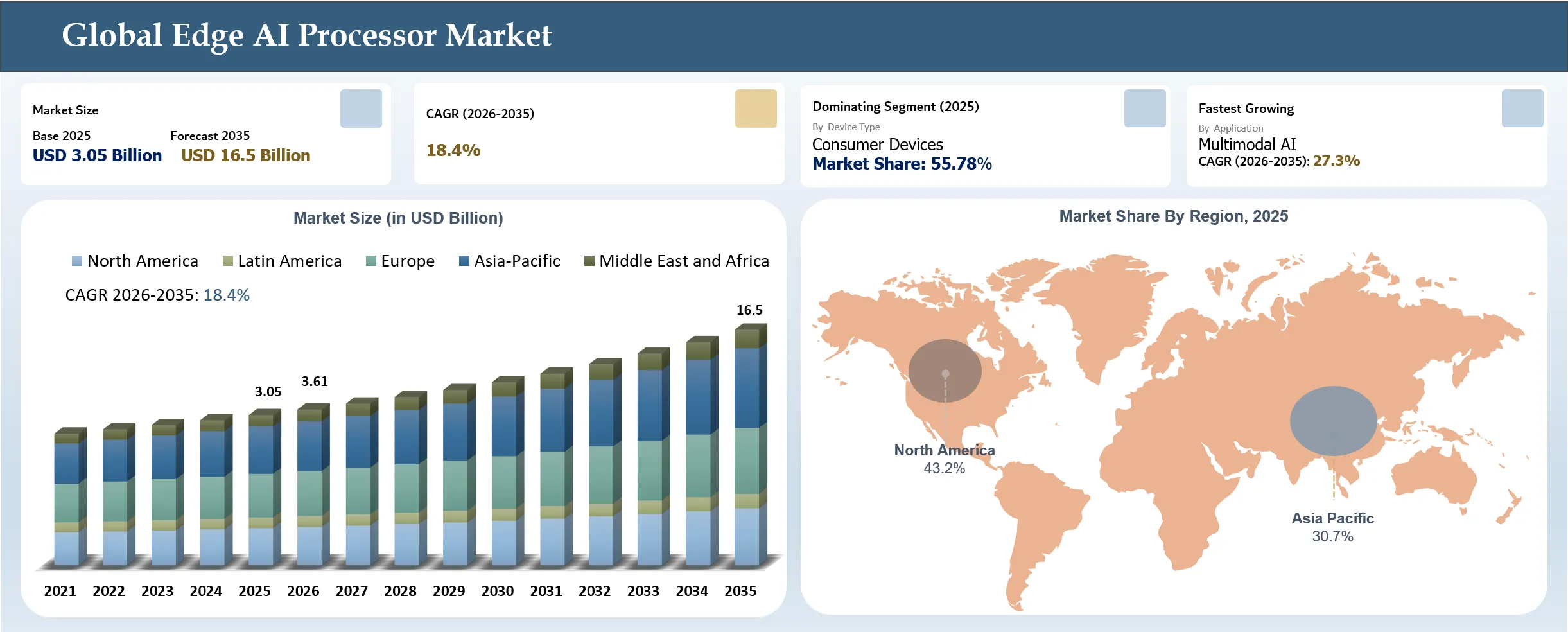
The global edge AI processor market reached USD 3.05 billion in 2025 and is expected to reach USD 16.5 billion by 2035, growing with a CAGR of 18.4% during the forecast period 2026-2035. The market is experiencing robust growth driven by the increasing need for real-time data processing, reduced latency, and improved operational efficiency across various industries. Edge AI processors enable the execution of AI algorithms directly on devices, thereby reducing the dependency on cloud data processing and improving response times for critical applications. The market is expanding rapidly due to the proliferation of Internet of Things (IoT) devices, the rise of Industry 4.0, and advancements in artificial intelligence (AI) and edge computing technologies.
Companies such as Intel and Advantech are leading the charge with advanced solutions designed to meet the growing needs of edge applications. For instance, in February 2025, Intel's Core Ultra processors, launched at CES 2025, enhanced AI inference and computing at the edge. Building on advancements like Arrow Lake and Raptor Lake Refresh, they offer improved performance and energy efficiency for applications in intelligent video, healthcare, and education. These processors enable faster data processing, highlighting the growing demand for high-performance, energy-efficient Edge AI solutions.
White-Space Opportunities for Edge AI Processor Investment and Technology Expansion
In February 2026, Axelera AI secured more than USD 250 million in Series C funding, led by Innovation Industries, with participation from new investors BlackRock and SiteGround Capital, alongside existing investors including Bitfury, CDP Venture Capital, European Innovation Council Fund, SFPIM, Invest-NL, Samsung Catalyst Fund, and Verve Investments.
The investment represents the largest investment in an EU AI semiconductor company and brings Axelera AI’s cumulative funding to more than USD 450 million in equity, grants, and venture debt since 2021. The highest investment focus is on edge-first AI inference hardware and processor manufacturing, with the capital being directed toward scaling manufacturing, expanding the customer-success organization and Partner Accelerator Network, and advancing software tools and SDKs for AI inference.
The funding creates opportunities across the Edge AI Processor ecosystem, particularly in AI inference processors, embedded AI hardware, robotics, computer vision, industrial AI, defense and public-safety systems, autonomous machines, smart retail, telecommunications, and edge-AI software. Axelera AI is the primary beneficiary, using the funding to scale processor manufacturing and strengthen its Metis and Europa platforms, while semiconductor manufacturing and advanced chip-production opportunities can benefit companies such as TSMC, Samsung Electronics, GlobalFoundries, and UMC.
In the AI processor and accelerator segment, companies including Hailo, SiMa.ai, Edge Impulse, Kneron, Ambarella, and BrainChip can benefit from increasing demand for low-power inference solutions, while NVIDIA, Qualcomm, Intel, and AMD can participate in broader edge-computing deployments through AI-enabled processors, accelerators, and platforms.
Edge AI Processor Market Key Takeaways
- North America led the global market in 2025 with a dominant 43.2% market share. This position is driven by a heavy presence of semiconductor and AI technology giants.
- Consumer devices accounted for the largest device-type market share at 55.78% in 2025. Growth is propelled by widespread integration of AI processors in smartphones, wearables, and personal computing devices.
- Demand for AI-enabled smartphones and PCs contributes a 27% impact on overall market growth. This is driving semiconductor manufacturers to embed dedicated NPUs into application processors.
- Rapidus Corporation secured JPY 267.6 billion (USD 1.7 billion) in Japanese government and private funding in February 2026. This includes JPY 100 billion (USD 644.8 million) from the Information-Technology Promotion Agency.
Edge AI Processor Market Scope
| Metrics | Details | |
| 2025 Market Size | USD 3.05 Billion | |
| 2035 Projected Market Size | USD 16.5 Billion | |
| CAGR (2026-2035) | 18.4% | |
| Largest Market | North America | |
| Fastest Growing Market | Asia-Pacific | |
| By Type | Central Processing Unit (CPU), Graphics Processing Unit (GPU), Application-Specific Integrated Circuit (ASIC), Neural Processing Units (NPUs), Field-Programmable Gate Arrays (FPGAs), Others | |
| By Device Type | Consumer Devices, Enterprise Devices | |
| By Application | Automotive and Transportation, Healthcare, Consumer Electronics, Retail and E-commerce, Agriculture, Energy and Utilities, Telecommunications, Others | |
| By Region | North America | U.S., Canada, Mexico |
| Europe | Germany, UK, France, Spain, Italy, Poland, Netherlands, Switzerland | |
| Asia-Pacific | China, India, Japan, Australia, South Korea, Indonesia, Malaysia | |
| Latin America | Brazil, Argentina | |
| Middle East and Africa | UAE, Saudi Arabia, South Africa, Israel, Türkiye | |
| Report Insights Covered | Competitive Landscape Analysis, Company Profile Analysis, Market Size, Share, Growth | |
Edge AI Processor Market BCG Matrix: Company Evaluation
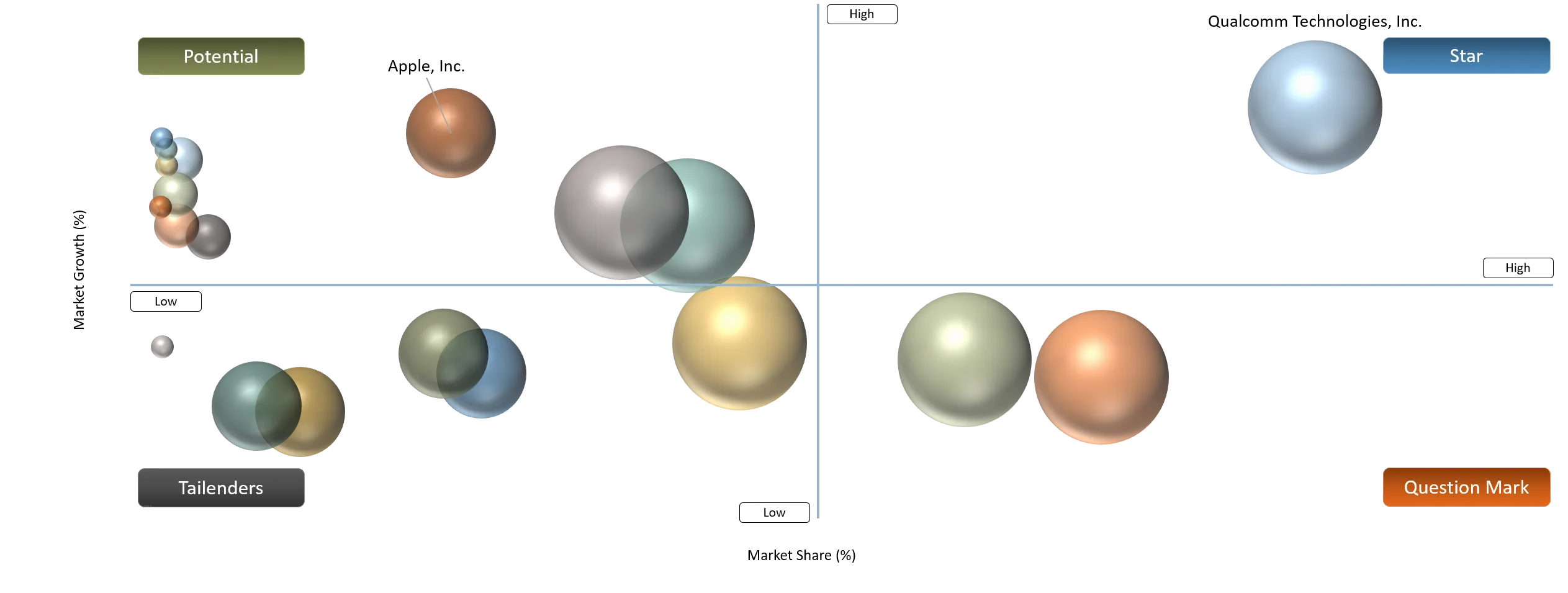
Stars include Qualcomm Technologies, Inc., NVIDIA Corporation, Intel Corporation, and MediaTek Inc. These companies have strong positions in Edge AI processors and are expanding capabilities across on-device AI, AI PCs, automotive, IoT, robotics, and industrial edge applications. Question Marks include Samsung Electronics, Advanced Micro Devices, Inc., and Huawei Technologies Co., Ltd. These companies have significant technological capabilities and are increasing their focus on AI-enabled processors, but their positions specifically within the broader Edge AI Processor market vary by application and geographic ecosystem.
Potential includes Apple, Inc. and Micron Technology, Inc. Apple has substantial on-device AI capabilities through its silicon ecosystem, while Micron benefits from the increasing memory requirements associated with AI-enabled edge devices; however, their positions are less directly comparable with companies whose primary competitive focus is Edge AI processing platforms. Tailenders include General Vision, Inc. Its neuromorphic/AI processor technologies have relevance to low-power edge inference, but its commercial scale and breadth of deployment are narrower than the larger processor ecosystems represented by Qualcomm, NVIDIA, Intel, MediaTek, AMD, Samsung, Apple and Huawei.
Edge AI Processor Market Dynamics
Driver Impact Analysis
| Driver | Market Growth Impact (%) | Demand Concentration | Impacted Use Case | Strategic Impact |
Rapid adoption of on-device generative AI is driving demand for higher-performance NPUs and AI accelerators capable of running generative AI workloads locally on edge devices. | 30% | Smartphones, AI PCs, wearables, and consumer electronics; strongest in North America and Asia-Pacific | On-device GenAI, local LLMs, multimodal AI, voice assistants, image generation | Accelerates development of higher-TOPS NPUs and AI accelerators with greater memory bandwidth and power efficiency. |
Growing deployment of AI-enabled smartphones and PCs is increasing demand for processors with integrated NPUs optimized for local AI inference. | 27% | Smartphones and PCs, particularly premium and AI-enabled devices across North America, China, South Korea, Japan, and Europe | AI smartphones, AI PCs, intelligent cameras, personal assistants, productivity applications | Encourages semiconductor manufacturers to integrate dedicated NPUs directly into application processors and PC platforms. |
Increasing demand for low-latency AI processing is driving the shift of inference workloads from cloud platforms toward processors located directly on edge devices. | 23% | Automotive, industrial automation, robotics, smart cameras, and enterprise IoT | Real-time computer vision, autonomous systems, robotics, industrial monitoring, predictive maintenance | Supports migration from cloud-centric inference toward localized processing and increases demand for high-performance edge accelerators. |
Rising demand for energy-efficient AI computing is encouraging the adoption of specialized NPUs and heterogeneous processor architectures for edge inference. | 20% | Battery-powered devices, IoT, wearables, automotive electronics, and industrial edge systems | Low-power AI inference, smart sensors, wearables, autonomous devices, embedded AI | Drives innovation in low-power NPUs, heterogeneous architectures, advanced semiconductor nodes, and AI-specific accelerators. |
Rapid adoption of on-device generative AI is driving demand for higher-performance NPUs and AI accelerators capable of running generative AI workloads locally on edge devices
The rapid adoption of on-device generative AI and the need for high-performing NPUs and accelerators is increasing due to the execution of AI workloads on smartphones in real time. The trend is making chip makers develop semiconductors with enhanced nodes and AI architecture designs that offer better inference efficiency while still being power efficient. The development is especially important in premium smartphones that are being designed with AI processing capabilities that run generative AI functions without depending on cloud computing.
The launch highlights the accelerating integration of advanced nodes for semiconductors and NPUs in mobile chipsets to cater to the rising complexity of the generative AI workload in the devices. In September 2026, according to Reuters, MediaTek launched its first mobile chip, the Dimensity 9600 Pro, made with TSMC's 2-nanometre technology, in addition to the Dimensity 9600M, which employs the 3-nanometre process technology of TSMC. The Dimensity 9600 Pro features an in-built neural processing unit (NPU) that is aimed at enabling innovative generative AI processes on smartphones, and MediaTek stated in its report that it has made its operation 51% better than the earlier models before the AI application begins the process.
Edge AI Processor Market Segment Analysis
The global edge AI processor market is segmented based on type, device type, application, and region.
Adoption of Edge AI Processors in Consumer Devices Driving High-Volume Demand
The consumer devices segment remains the dominant device type in the edge AI processor market, with a market share of 55.78% in 2025. The reason behind this is that there is an ever-increasing adoption of AI capabilities within devices such as phones, tablets, smartwatches, smart glasses, and others, which makes the use of on-device processing more efficient in terms of speed, cloud dependency, and privacy. In June 2025, Apple rolled out Apple Intelligence to iPhone, iPad, Mac, Apple Watch, and Apple Vision Pro, with many AI models executing directly on the device via Apple silicon and Neural Engine.
The increasing integration of NPUs in consumer computing devices is fast making way for the move towards AI workloads that are highly local and powerful. In January 2026, Qualcomm Technologies, Inc. announced that its latest Snapdragon X2 Elite and X2 Plus CPUs offer up to 85 TOPS of AI processing capability via their NPUs, enabling high-end on-device AI capabilities such as agents and Copilot+. Qualcomm also noted that the new all-in-one desktop computers utilizing Snapdragon X CPUs allow for as much as 45 TOPS of on-device AI capabilities, and the Snapdragon X2 Elite CPUs come with up to 20% reduced power consumption compared to their predecessor. The company also cited IDC's prediction of an 11% increase in small form factor and all-in-one desktop PCs over the next four years.
Edge AI Processor Market Geographical Penetration
Rapid Expansion of AI Computing and Edge Ecosystems in North America
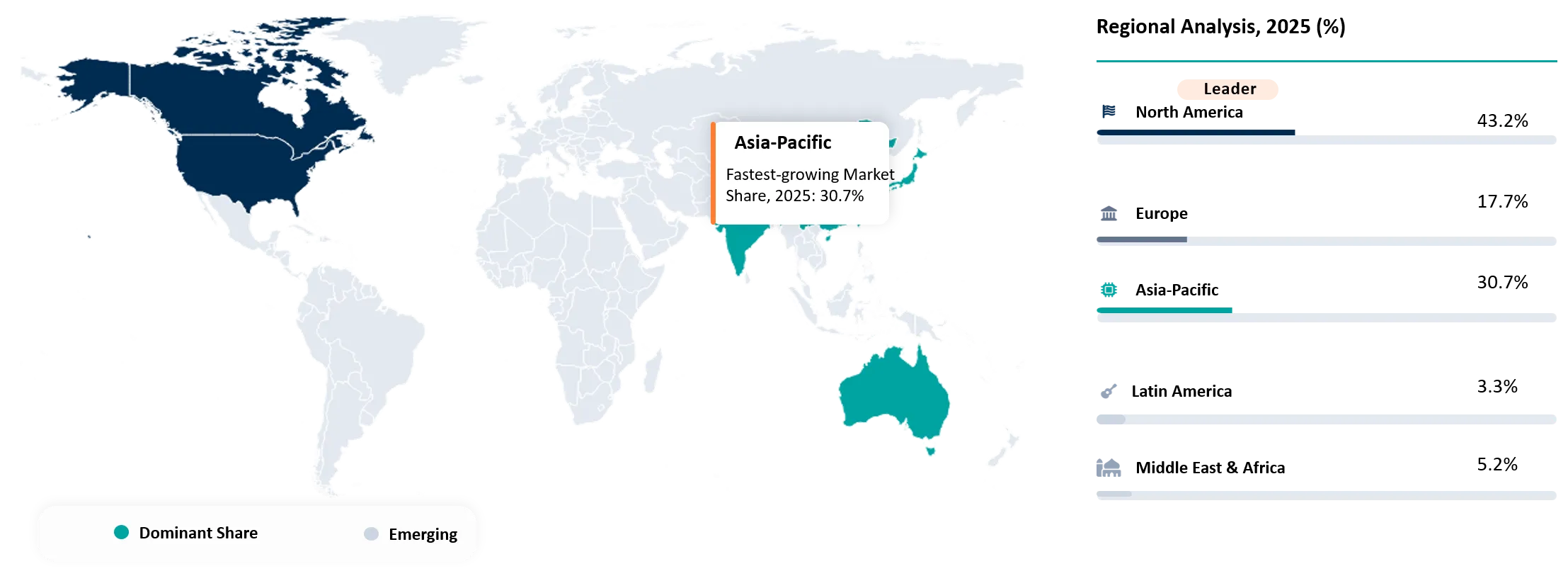
North America region dominates the edge AI processors market, with a market share of 43.2% in 2025. The dominance of North America is because of its large number of leading players in the semiconductor industry, AI technology, cloud computing, and other technologies. Companies such as NVIDIA, Intel, Qualcomm, and AMD are playing a significant role in advancing the technology through the development of processors comprising CPU, GPU, and NPU capabilities.
The acquisition strengthens the integration of high-performance, energy-efficient AI inference capabilities into automotive, industrial, and IoT edge devices. In February 2025, NXP Semiconductors N.V., a Netherlands-based semiconductor company, announced the acquisition of Kinara, Inc., a U.S.-based AI chip startup, for USD 307 million in cash. Kinara develops energy-efficient, programmable neural processing units (NPUs), including the Ara-2, which delivers up to 40 TOPS of AI inference performance for edge applications. The acquisition, completed in October 2025, strengthens NXP’s intelligent-edge portfolio by integrating Kinara’s AI hardware and software with its existing automotive, industrial, and IoT processing solutions, supporting applications such as computer vision, generative AI, and embedded AI inference.
U.S. Edge AI Processor Market Trends
The U.S. holds a dominant position in the North American edge AI processor market due to a vibrant ecosystem of AI chip design, semiconductor, cloud, PC, and edge computing firms. The U.S. enjoys the presence of major processor makers including NVIDIA, Intel, Qualcomm, and AMD that are making significant strides in AI acceleration through PCs, robots, industrial machinery, autonomous vehicles, and other edge computing platforms.
The acquisition strengthens on-device AI processing and low-power intelligent-edge computing by combining Alif’s AI-enabled processors with Analog Devices’ sensing and signal-processing technologies. In September 2026, Analog Devices, Inc. (ADI), a U.S.-based semiconductor company, agreed to acquire Alif Semiconductor, a U.S.-based AI semiconductor company, California, for USD 1.35 billion in cash, with up to USD 200 million in additional contingent consideration. Alif develops low-power AI-native microcontrollers and fusion processors that integrate AI computing, sensing, connectivity, security, and real-time processing for consumer and industrial applications.
Canada Edge AI Processor Market Outlook
Canada is emerging as an important country in the North American edge AI processor market, supported by its existing AI research environment, its sovereign computing capabilities, and AI commercialization. Canada is building the necessary infrastructure for AI workloads development and deployment, including edge and inference processing.
The acquisition strengthens STMicroelectronics’ Edge AI capabilities by integrating AI model optimization technologies with its low-power semiconductor portfolio. In April 2025, STMicroelectronics N.V., a Switzerland-based semiconductor manufacturer, acquired Deeplite, a Canada-based artificial-intelligence software company, with the acquisition making Deeplite a wholly owned subsidiary of STMicroelectronics. Financial terms were not disclosed. Deeplite had raised approximately USD 6.47 million from Canadian investors and developed AI model optimization, quantization, and compression technologies that make neural networks smaller, faster, and more energy-efficient for edge devices.
Rapid Expansion of AI Semiconductor Manufacturing and On-Device AI Adoption in Asia-Pacific
The Asia-Pacific is the fastest-growing region in the edge AI processors market, accounting for 30.7% market share in 2025. The region benefits from its concentration of semiconductor manufacturing, consumer-electronics production, foundries, memory suppliers, and AI-chip developers across China, Taiwan, South Korea, and Japan. The combination of strong electronics manufacturing and rising demand for smartphones, AI PCs, wearables, robotics, and intelligent industrial equipment is supporting the deployment of processors capable of performing AI inference locally.
The acquisition strengthens Asia-Pacific’s semiconductor design ecosystem by expanding advanced ASIC and SoC development capabilities for Edge AI and other high-performance applications. In June 2026, QBit Semiconductor Ltd., a Taiwan-based semiconductor and SoC design company, acquired a 60% controlling stake in SinChip Technology Pte. Ltd., a Singapore-based semiconductor design-services company. SinChip specializes in IC logic verification, physical design, and advanced technology adoption, with approximately 130 engineers and experience across 3nm, 5nm, and 7nm process technologies.
Japan Edge AI Processor Market Trends
Japan is a significant country in the Asia-Pacific edge AI processor market, supported by its established semiconductor ecosystem, strong automotive and industrial electronics base, and growing investment in specialized AI processing technologies. Japanese semiconductor companies are increasingly developing low-power processors and AI accelerators for robotics, smart factories, automotive systems, healthcare, and other edge applications.
The investment strengthens Japan’s advanced semiconductor manufacturing ecosystem and expands domestic capabilities for next-generation chip production. In February 2026, Rapidus Corporation, a Japan-based advanced semiconductor manufacturer, secured JPY 267.6 billion (USD 1.7 billion) in new funding from the Japanese government and private-sector companies. The funding included JPY 100 billion (USD 644.8 million) from the Information-Technology Promotion Agency (IPA) and JPY 167.6 billion (USD 1.08 billion) from 32 private companies, including Canon, Fujitsu, NTT, SoftBank, Sony Group, and the Development Bank of Japan.
Edge AI Processor Market Competitive Landscape
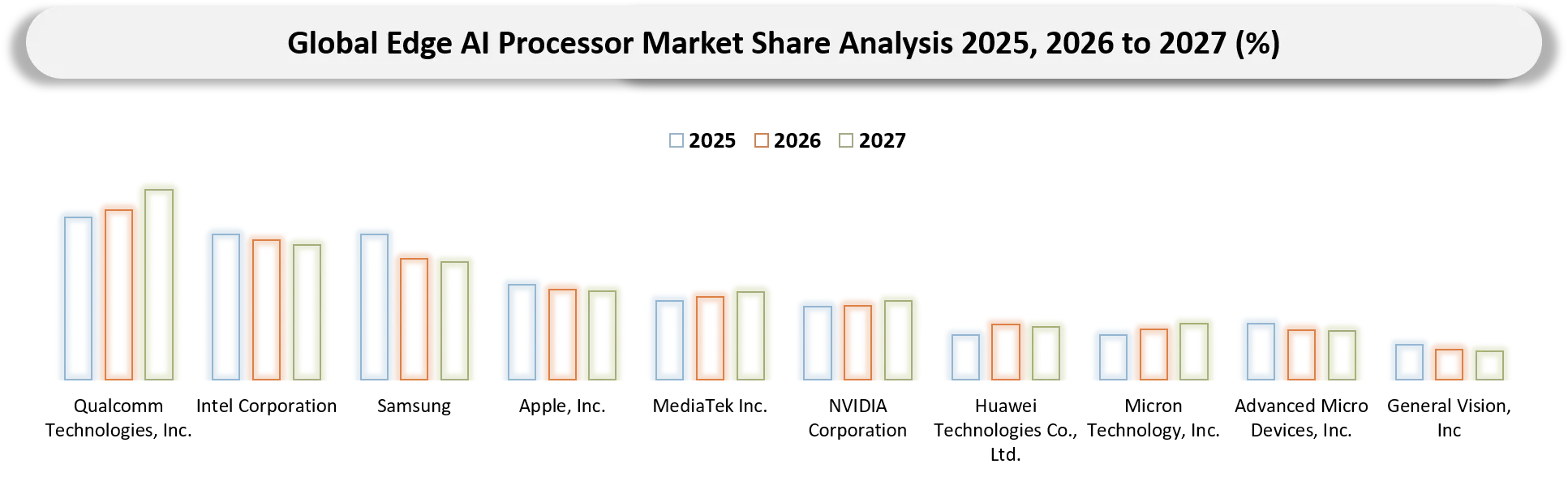
- The edge AI processor market is characterized by three major participant groups: mobile and consumer AI processor developers, high-performance and embedded edge-computing providers, and integrated semiconductor companies. Qualcomm Technologies, Inc., MediaTek Inc., Samsung, Apple, Inc., and Huawei Technologies Co., Ltd. are strongly positioned across smartphone, tablet, PC, wearable, and other on-device AI platforms; NVIDIA Corporation, Intel Corporation, and Advanced Micro Devices, Inc. focus extensively on GPU-, CPU-, and accelerator-based edge computing for PCs, robotics, industrial automation, and physical AI; while Micron Technology, Inc. supports the ecosystem through high-performance memory technologies and General Vision, Inc. specializes in neuromorphic AI processors and edge inference. It is creating an ecosystem-driven competitive landscape in which AI compute performance, NPU/accelerator efficiency, power consumption, software ecosystems, device integration, and processor commercialization are key competitive factors.
- Key players include: Qualcomm Technologies, Inc. (United States); Intel Corporation (United States); Samsung (South Korea); Apple, Inc. (United States); MediaTek Inc. (Taiwan); NVIDIA Corporation (United States); Huawei Technologies Co., Ltd. (China); Micron Technology, Inc. (United States); Advanced Micro Devices, Inc. (United States); and General Vision, Inc. (United States).
Key Developments
- September 2026: Axelera AI, a Netherlands-based fabless AI semiconductor company, launched its second-generation Europa AI processing chip and signed multiple contracts to supply chips to AI factories.
- February 2025: EnCharge AI, a U.S.-based fabless AI semiconductor company, raised more than USD 100 million in Series B funding, bringing its total funding to more than USD 144 million.
- March 2025: MemryX Inc., a U.S.-based fabless semiconductor company, raised USD 44 million in funding to accelerate the commercialization of its Edge AI semiconductor technology.
- July 2025: Ambiq Micro, Inc., a U.S.-based semiconductor company, announced plans for an initial public offering (IPO) to raise USD 85 million by offering 3.4 million shares at an expected price of USD 22-USD 25 per share.
- July 2026: Microchip Technology Inc., a U.S.-based semiconductor company, signed a definitive agreement to acquire Hailo, an Israel-based semiconductor company specializing in Edge AI processors and vision SoCs; financial terms were not disclosed.
- November 2025: BrainChip Holdings Ltd., an Australia-based semiconductor and AI technology company, unveiled its AKD1500 Edge AI co-processor at Embedded World North America.
- January 2026: Ambiq Micro, Inc., a U.S.-based semiconductor company, unveiled Atomiq, an ultra-low-power NPU-based SoC built on its proprietary SPOT technology platform.
Key Procurement Priorities and Buyer Evaluation Criteria
- Organizations investing in the Edge AI Processor Market increasingly select suppliers based on their ability to provide high-performance, energy-efficient processors capable of delivering AI inference locally with low latency, while supporting scalable deployment across consumer, enterprise, automotive, healthcare, and industrial edge devices.
- The procurement decision-making process is increasingly influenced by the shift toward on-device AI, real-time inference, heterogeneous computing architectures, dedicated NPUs/AI accelerators, and AI-enabled connected devices, which require processors that balance computational performance, power efficiency, memory bandwidth, and thermal constraints.
- Buyers consider factors such as AI performance and TOPS, power consumption, performance-per-watt, latency, processor architecture, memory bandwidth, thermal efficiency, reliability, security features, software compatibility, and lifecycle support when selecting an Edge AI processor supplier.
Why Choose DataM?
- Technological Innovations: Explores advancements in Edge AI processor technologies, including dedicated NPUs, AI accelerators, heterogeneous architectures, low-power processors, and advanced chip designs, enabling faster on-device inference, reduced latency, improved energy efficiency, and compact form factors across AI-enabled devices.
- Product Performance & Market Positioning: Evaluates how different players differentiate Edge AI processors based on AI compute performance, TOPS, performance-per-watt, memory bandwidth, latency, thermal efficiency, processor architecture, and software compatibility, highlighting competitive positioning across consumer electronics, automotive, industrial, healthcare, and telecommunications applications.
- Real-World Evidence: Highlights the deployment of Edge AI processors in smartphones, PCs, automotive systems, smart cameras, robotics, healthcare devices, industrial equipment, and other connected devices, demonstrating benefits such as real-time AI inference, reduced dependence on cloud processing, improved responsiveness, enhanced privacy, and optimized power consumption.
- Market Updates & Industry Changes: Tracks key developments such as new NPU and AI accelerator launches, semiconductor investments, processor architecture upgrades, AI-enabled device deployments, manufacturing expansions, and regional semiconductor initiatives across North America, Asia-Pacific, and Europe, supporting the development of distributed AI computing ecosystems.
- Competitive Strategies: Analyzes how leading companies expand their Edge AI processor portfolios through processor innovation, dedicated AI accelerators, software ecosystem development, strategic partnerships, acquisitions, and integration with device platforms to address growing demand for on-device and real-time AI workloads.
- Pricing & Market Access: Explains pricing variations based on processor architecture, AI compute capability, power efficiency, memory configuration, integration level, manufacturing technology, and application requirements, along with access through semiconductor manufacturers, fabless chip designers, foundries, device OEMs, and technology partners.
- Market Entry & Expansion: Identifies growth opportunities driven by on-device AI, autonomous vehicles, AI PCs, smartphones, robotics, industrial automation, smart healthcare, telecommunications, and intelligent consumer devices, while outlining strategies such as regional manufacturing expansion, processor specialization, software ecosystem development, and strategic technology partnerships to scale across global markets.
Target Audience
- Edge AI Processor Manufacturers and Semiconductor Companies
- Consumer Electronics Manufacturers
- Automotive OEMs and Tier-1 Suppliers
- Industrial Automation and Robotics Companies
- Healthcare Technology Providers
- Telecommunications and Networking Companies
- Retail, Smart-City and Surveillance Solution Providers



























































