


AI Accelerator Chip Market Overview
AI Accelerator Chips are powering the next wave of AI innovation. As demand for generative AI, AI data centers, and high-performance computing surges, which companies will dominate this multi-billion-dollar market? Growth the trends, opportunities, and competitive strategies driving growth.
Global governments are making unprecedented investments to secure AI hardware leadership, positioning AI accelerator chips as a cornerstone of future digital economies. In 2025, the US awarded US$ 458 million to SK hynix through the CHIPS and Science Act to establish advanced HBM memory manufacturing and R&D in Indiana, while Samsung secured a US$ 4.74 billion grant for semiconductor fabrication in Texas. China’s Phase III National Integrated Circuit Fund committed ¥344 billion (US$ 47.5 billion) to AI chip and semiconductor advancements. These large-scale public funding programs are expanding manufacturing capacity, reducing foreign dependency, and driving innovation pipelines across AI-specific chip architectures.
AI Accelerator Chip Market Strategic Key Takeaways
- Asia-Pacific accounted for approximately 41.2% of the AI Accelerator Chip Market in 2025 and is expected to register the fastest CAGR through 2035. The region’s growth is being driven by aggressive investments in AI infrastructure, rapid expansion of hyperscale data centers, government-backed semiconductor initiatives, and increasing adoption of generative AI across China, Japan, South Korea, India, and Southeast Asia.
- North America held around 38.5% market share in 2025, supported by the presence of leading AI chip developers, cloud service providers, and technology companies. Large-scale investments in AI training clusters, high-performance computing (HPC), and enterprise AI deployment continue to strengthen regional demand for advanced accelerator chips.
- The competitive landscape is shifting from traditional GPU dominance toward a broader ecosystem of specialized AI accelerators. Custom AI chips, tensor processing units (TPUs), neural processing units (NPUs), and application-specific integrated circuits (ASICs) are gaining traction as organizations seek higher performance and lower power consumption for AI workloads.
- Generative AI is becoming the primary catalyst for accelerator chip demand. The rapid growth of large language models (LLMs), multimodal AI systems, AI copilots, and autonomous AI agents is significantly increasing computing requirements across cloud and enterprise environments.
- Hyperscale cloud providers are increasingly developing proprietary AI accelerators to reduce dependence on third-party suppliers and optimize AI infrastructure costs. Custom silicon strategies are becoming a key competitive differentiator among cloud platforms.
- Energy efficiency has emerged as a critical purchasing criterion. As AI training and inference workloads consume substantial electricity, organizations are prioritizing accelerator architectures that deliver greater performance per watt while reducing total cost of ownership.
- AI accelerator deployment is expanding beyond cloud data centers into edge computing environments. Industries such as automotive, healthcare, manufacturing, telecommunications, retail, and robotics are adopting AI chips for real-time inference, computer vision, predictive analytics, and autonomous decision-making applications.
- Supply chain resilience and semiconductor sovereignty have become strategic priorities. Governments across the United States, Europe, China, Japan, South Korea, and India are investing heavily in domestic semiconductor manufacturing and advanced packaging capabilities to secure AI chip supply.
AI Accelerator Chip Market Trend
A defining trend is the alignment of national industrial policy with AI edge and cloud hardware innovation. The US Department of Commerce has already disbursed over US$ 19 billion of the CHIPS for America program’s funding to accelerate AI chip ecosystem growth. China’s “Big Fund” Phase III is targeting cutting-edge fabrication nodes to capture a greater share of AI accelerator chip production.
Samsung’s Texas expansion is projected to create 12,000 construction jobs and 3,500 manufacturing roles, demonstrating AI chipmaking’s direct economic impact. SK hynix’s Indiana facility, integrated with Purdue University’s R&D network, will boost HBM supply for high-performance AI workloads. This synchronized push shows that government-backed AI chip manufacturing hubs are becoming the new global competitive battleground.
AI Accelerator Chip Market Scope
| Metrics | Details |
| By Processing Type | Cloud, Edge |
| By Chip Type | Graphics Processing Unit (GPU), Application-Specific Integrated Circuit (ASIC), Field-Programmable Gate Array (FPGA), Central Processing Unit (CPU), Others |
| By Technology | Natural Language Processing (NLP), Computer Vision, Network Security, Others |
| By End-User | Consumer Electronics, Automotive, Healthcare, IT & Telecom, Retail, Others |
| By Region | North America, South America, Europe, Asia-Pacific and Middle East and Africa |
| Report Insights Covered | Competitive Landscape Analysis, Company Profile Analysis, Market Size, Share, Growth |
Explore the Future of the AI Accelerator Chip Market
Get a comprehensive sample report covering AI accelerator chip market trends, technology advancements, competitive landscape, application insights and growth opportunities. Request your sample today to understand the factors shaping the next generation of AI computing infrastructure. Request Sample Report Today!
AI Accelerator Chip Market Dynamics
Rising Integration of AI Accelerator Chips in Edge Devices for Real-Time Processing
The integration of AI accelerator chips into edge devices is revolutionizing real-time data processing. For instance, the US Department of Energy's Fermilab has developed real-time edge AI systems that enhance the efficiency of particle accelerators by processing data locally, reducing latency and improving operational accuracy . Similarly, MIT researchers have introduced a photonic processor capable of performing deep learning tasks at the speed of light, enabling edge devices to analyze data in real-time with minimal energy consumption . These advancements underscore the growing reliance on edge AI accelerators to meet the demands of time-sensitive applications across various sectors.
Supply Chain Vulnerabilities in Advanced Semiconductor Manufacturing Nodes
The global semiconductor supply chain faces significant vulnerabilities, particularly in advanced manufacturing nodes. The Organization for Economic Co-operation and Development (OECD) reports that the top five semiconductor-producing economies account for approximately three-quarters of global semiconductor value added. This high concentration means that disruptions in any of these key regions can have widespread effects on global supply. Additionally, the semiconductor industry is highly upstream, meaning that any disruptions can impact a broad range of industries that rely on semiconductors, including information and communications technology (ICT), electronics, and automotive sectors.
Why does this report matter in 2026?
In 2026, the Carbon AI Accelerator Chip Market is being shaped by rapidly increasing AI workloads, demand for energy-efficient computing and the expansion of AI infrastructure across data centers, edge systems and enterprise applications. As conventional computing architectures face growing performance and power constraints, specialized AI accelerators are gaining importance for high-performance inference, training and workload optimization.
The report helps technology manufacturers, semiconductor companies, system integrators and infrastructure providers assess the most attractive chip architectures, application areas and regional demand centers. It also evaluates how generative AI, edge computing, autonomous systems, robotics, advanced analytics and data-center expansion are influencing accelerator requirements and deployment models.
Competitive advantage increasingly depends on processing efficiency, memory bandwidth, thermal performance, software compatibility, scalability and ecosystem support. The report therefore examines chip demand alongside architecture innovation, manufacturing capabilities, application adoption and strategic developments across the AI semiconductor value chain.
Carbon AI Accelerator Chip Market White Space & Investment Opportunities
- Develop energy-efficient AI accelerator architectures designed for high-density data centers and power-constrained computing environments.
- Expand specialized accelerator solutions for generative AI inference, machine learning, robotics, autonomous systems and edge computing.
- Invest in advanced packaging, high-bandwidth memory integration and chiplet architectures to improve AI processing performance and scalability.
- Build software and developer ecosystems that simplify accelerator deployment across cloud, enterprise and edge AI workloads.
- Develop application-specific AI accelerator platforms for healthcare, automotive, industrial automation, telecommunications and financial services.
- Expand regional AI semiconductor manufacturing, testing and packaging capabilities to strengthen supply-chain resilience and reduce dependence on concentrated production networks.
Carbon AI Accelerator Chip Future Market Transformation
The market is expected to move beyond general-purpose computing toward increasingly specialized architectures optimized for AI workloads. Accelerator designs will focus on improving performance per watt, reducing latency and supporting larger AI models while managing power and thermal constraints. This transition will create opportunities across processors, memory, interconnects, advanced packaging and AI software ecosystems.
Edge AI will become an important growth pathway as enterprises seek real-time processing with lower latency and reduced dependence on centralized cloud infrastructure. Automotive systems, industrial equipment, smart devices, robotics and connected infrastructure will increasingly require local AI processing capabilities, supporting demand for compact and energy-efficient accelerator designs.
The competitive landscape will increasingly extend beyond chip performance. Software compatibility, developer tools, model optimization, system integration and access to manufacturing capacity will influence adoption. Companies capable of combining accelerator hardware with robust software ecosystems and scalable deployment support can strengthen their position across rapidly evolving AI workloads.
Carbon AI Accelerator Chip Market Buyer Decision-Making Criteria
Buyers evaluate AI accelerator chips based on computing performance, energy efficiency, memory bandwidth, latency, thermal requirements, scalability and compatibility with existing AI frameworks. Total cost of ownership is becoming increasingly important as power consumption and infrastructure requirements represent significant costs for large-scale AI deployments.
For data-center applications, buyers also assess rack density, cooling requirements, interconnect performance, reliability and integration with existing servers and networking infrastructure. Enterprise and edge customers may place greater emphasis on deployment flexibility, form factor, security, inference performance and software compatibility.
Procurement decisions increasingly involve hardware engineering, AI development, infrastructure, cybersecurity and financial teams. Suppliers that demonstrate measurable performance improvements, reliable supply, software support and long-term roadmap visibility can gain stronger adoption in competitive AI computing environments.
Carbon AI Accelerator Chip Market Economic & Investment Analysis
The Carbon AI Accelerator Chip Market benefits from structural demand for AI computing across cloud infrastructure, enterprise systems, automotive platforms, industrial automation and consumer technologies. While semiconductor development requires significant upfront investment in architecture, fabrication and software ecosystems, successful accelerator platforms can address multiple high-growth AI applications.
Investment is increasingly directed toward advanced semiconductor design, fabrication capacity, high-bandwidth memory, advanced packaging, testing infrastructure and AI software. The expansion of AI data centers is also creating downstream opportunities for accelerator boards, servers, networking components, power systems and thermal-management technologies.
Energy efficiency represents another major investment theme. As AI workloads become more computationally intensive, reducing power consumption per inference or training operation can improve data-center economics. Accelerator providers that deliver higher performance per watt while maintaining software compatibility can capture value across both new infrastructure deployments and system upgrades.
Carbon AI Accelerator Chip Investment Trends in the Market
- Investment in next-generation AI accelerator architectures focused on higher performance per watt and lower inference latency.
- Expansion of advanced packaging, chiplet integration and high-bandwidth memory capabilities for AI computing platforms.
- Growth in AI data-center infrastructure investment, supporting demand for accelerator-based servers, networking and cooling systems.
- Increasing development of edge AI accelerators for autonomous vehicles, robotics, industrial automation and smart devices.
- Greater investment in AI software ecosystems, compiler technologies, model optimization and developer tools to accelerate hardware adoption.
Strategic Indicators For AI Accelerator Chip Market
High Regulation Impact
The AI Accelerator Chip Market is increasingly influenced by semiconductor export controls, advanced-computing regulations, data-center energy standards, cybersecurity requirements and technology trade policies. Restrictions on high-performance AI chips and advanced manufacturing equipment can influence product availability, regional sales strategies and supply-chain planning. Regulatory developments are also encouraging manufacturers to strengthen compliance, traceability and regional production capabilities.
High Investment Activity
Investment is expanding across AI accelerator design, advanced semiconductor manufacturing, high-bandwidth memory, advanced packaging, chiplet architectures and data-center infrastructure. Semiconductor companies, cloud providers and technology firms are allocating significant capital toward next-generation AI computing platforms. Investments in domestic semiconductor manufacturing and specialized AI hardware are also creating opportunities across the broader accelerator ecosystem.
Supply Chain Disruption
The market depends on advanced foundries, high-bandwidth memory, semiconductor packaging, substrates, interconnects and specialized manufacturing equipment. Capacity constraints or disruptions affecting leading-edge fabrication and advanced packaging can influence accelerator availability and delivery schedules. Companies are increasingly pursuing multi-source strategies, capacity reservations, regional manufacturing and stronger inventory planning to improve supply resilience.
Pricing Volatility
AI accelerator pricing is influenced by computing performance, process node, memory capacity, packaging complexity, interconnect technology and production scale. High-end accelerators command premium pricing because of advanced architectures and limited manufacturing capacity, while competition among accelerator designs can create pricing pressure in selected segments. Changes in memory, wafer and packaging costs can also affect overall platform economics.
Procurement Pressure
AI infrastructure operators increasingly evaluate accelerators based on performance per watt, total cost of ownership, software compatibility, memory bandwidth, scalability and availability. Procurement decisions are moving beyond chip-level specifications toward complete computing platforms that include processors, networking, memory, cooling and software ecosystems. Compatibility with existing AI frameworks and deployment environments remains a major purchasing consideration.
New Technology Adoption
Next-generation architectures such as chiplets, advanced packaging, high-bandwidth memory, optical interconnects, heterogeneous computing and specialized inference accelerators are reshaping the market. AI workloads are also driving demand for accelerators optimized for training, inference and edge computing. Improvements in performance efficiency and memory bandwidth are becoming critical differentiators as model complexity increases.
Regional Expansion Opportunity
North America remains a major AI accelerator market due to hyperscale data centers, cloud infrastructure and AI development. Asia-Pacific offers strong opportunities through semiconductor manufacturing, electronics production and expanding AI infrastructure, particularly across China, Taiwan, South Korea, Japan and Southeast Asia. Europe is strengthening AI computing capabilities through data-center investment, semiconductor initiatives and sovereign AI infrastructure programs.
Government Policy Support
Government initiatives supporting semiconductor manufacturing, AI infrastructure and domestic technology capabilities are creating new opportunities for accelerator development and production. Semiconductor incentives, strategic computing programs and investments in AI research are encouraging regional ecosystem development. Policies promoting advanced chip manufacturing and supply-chain resilience can further support capacity expansion and technology localization.
Pricing Intelligence
AI accelerator pricing varies significantly according to architecture, computing performance, memory configuration, manufacturing process, packaging technology and deployment requirements. High-performance data-center accelerators typically carry premium pricing, while inference-focused and edge accelerators address more cost-sensitive workloads. Platform-level pricing can also include networking, memory, software, cooling and system integration.
Enterprise and hyperscale customers increasingly consider total cost of ownership rather than chip acquisition price alone. Energy consumption, utilization rates, software optimization, deployment speed and accelerator lifespan influence overall economics. Large-volume procurement agreements, cloud partnerships and integrated platform contracts can provide pricing advantages, while differentiated architectures and software ecosystems can support stronger margins.
AI Accelerator Chip Market Segment Analysis
The global AI accelerator chip market is segmented based on processing type, chip type, technology, end-user and region.
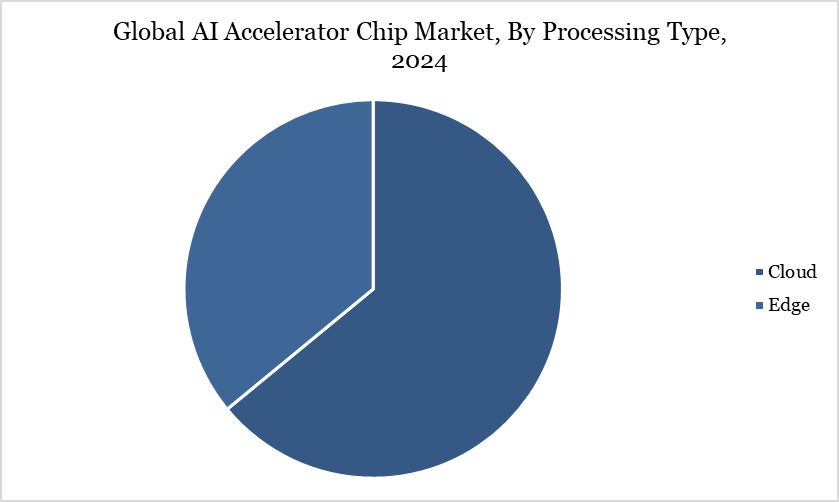
Cloud Segment Driving AI Accelerator Chip Market
The cloud processing segment is the primary driver of growth in the global AI accelerator chip market. In 2024, it accounted for approximately 55% of the market revenue. This dominance is attributed to the increasing demand for high-performance computing capabilities required to support AI workloads in data centers. Hyperscale cloud providers such as Google, Amazon Web Services (AWS), and Microsoft are at the forefront of this trend, investing heavily in AI infrastructure to meet the needs of AI-driven applications. For instance, Cisco reported receiving over US$2 billion in AI infrastructure orders in fiscal 2025, more than double its initial expectations, driven by increased investments from major cloud providers.
AI Accelerator Chip Market Geographical Share
North America Drives the Global AI Accelerator Chip Market
North America led the global AI accelerator chip market with a substantial revenue share of approximately 30% in 2024. The United States, in particular, is at the forefront of this sector, driven by robust investments from both government and private entities. The U.S. Department of Energy (DOE) has been instrumental in advancing AI chip technologies.
For instance, in December 2024, the DOE announced a US$ 285 million award to establish a CHIPS Manufacturing USA Institute, aiming to bolster domestic semiconductor manufacturing capabilities. Additionally, the DOE has allocated $68 million to support 11 multi-institution projects focused on developing AI models for scientific research
Major deployment hubs include:
- Silicon Valley
- Austin
- Seattle
- Phoenix
- Santa Clara
Asia-Pacific AI Accelerator Chip Market
Asia-Pacific is expected to register the fastest CAGR during the forecast period.
China leads regional expansion through aggressive investments in AI semiconductor development, data center infrastructure, and government-backed AI initiatives.
Japan, South Korea, and Taiwan are rapidly strengthening their AI chip ecosystems through advanced semiconductor manufacturing capabilities and strategic investments.
India represents a major future growth opportunity due to:
- Expansion of AI data centers
- Government semiconductor incentive programs
- Growing AI startup ecosystem
- Increasing enterprise AI adoption
Europe AI Accelerator Chip Market
Europe is witnessing growing adoption supported by increasing investments in AI sovereignty, high-performance computing infrastructure, and semiconductor innovation.
Germany, France, and the United Kingdom are leading AI accelerator deployment across manufacturing, automotive, healthcare, and research sectors.
The Netherlands and Ireland are emerging as important markets due to expanding cloud infrastructure and semiconductor investments.
Latin America AI Accelerator Chip Market Outlook
Latin America is gradually increasing AI infrastructure investments as enterprises accelerate digital transformation and cloud adoption.
Brazil, Mexico, and Chile are emerging as key markets driven by growing demand for AI-powered analytics, financial services, and enterprise automation applications.
Middle East & Africa AI Accelerator Chip Market Outlook
The Middle East & Africa region is expected to create significant long-term opportunities through national AI strategies, smart city projects, and digital economy initiatives.
The UAE and Saudi Arabia are actively investing in AI data centers, sovereign AI platforms, and advanced computing infrastructure, positioning themselves as regional AI innovation hubs.
South Africa is also witnessing increased adoption of AI technologies across financial services, telecommunications, and public sector applications.
Technological Advancement Analysis
The global AI accelerator chip market is experiencing significant technological advancements, driven by both private sector innovation and public sector initiatives. Companies like Intel and AMD are at the forefront, with Intel's Gaudi 3 chip offering 40% improved power efficiency and 50% faster inference speeds compared to its predecessor, the H100 GPU. Similarly, AMD's MI450 chip is poised to challenge Nvidia's dominance with its upcoming MI400 series, particularly the MI450, marking AMD's first rack-scale AI server platform.
The advancements are complemented by government-backed initiatives such as the US CHIPS and Science Act, which provides US$ 50 billion to bolster semiconductor research and manufacturing, aiming to enhance the nation's position in AI hardware development. Additionally, the US Department of Energy's AI testbeds are facilitating the exploration of novel hardware, software, and algorithms to accelerate AI capabilities. These combined efforts are propelling the AI accelerator chip market toward more efficient, powerful, and scalable solutions, meeting the growing demands of AI applications across various sectors.
AI Accelerator Chip Market Competitive Landscape
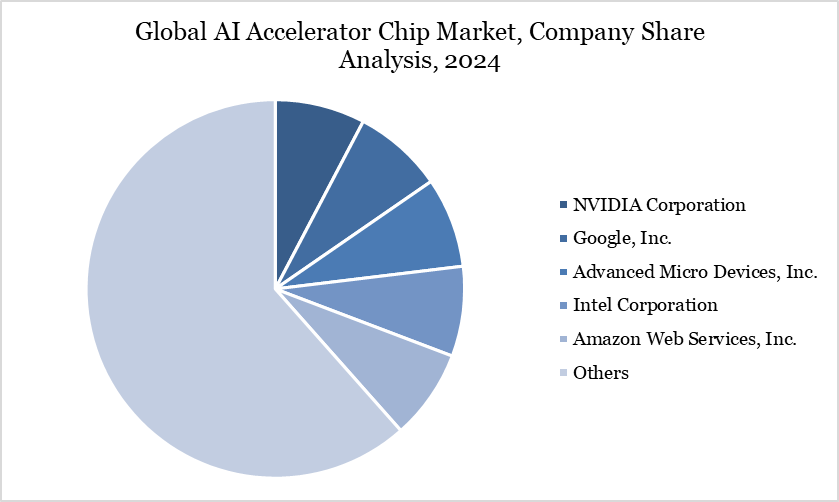
The major global players in the market include NVIDIA Corporation, Google Inc., Advanced Micro Devices Inc., Intel Corporation, Amazon Web Services Inc., Huawei Technologies Co. Ltd., Cerebras Systems Inc., Graphcore Limited, Qualcomm Incorporated, and SambaNova Systems Inc.
AI Accelerator Chip Market Key Developments: Latest Innovations, Partnerships and Industry Updates
- In August 2026, AMD strengthened its AI inference capabilities through the acquisition of Taalas, a semiconductor startup focused on AI-optimized silicon technology designed to reduce compute and memory bottlenecks. The acquisition expands AMD’s AI accelerator roadmap and supports its efforts to compete in high-performance inference markets.
- On June 24, 2026, Qualcomm announced the acquisition of Modular, an AI software platform company, to strengthen its AI developer ecosystem and accelerate adoption of Qualcomm AI solutions across edge, cloud and data center environments. The acquisition supports Qualcomm’s strategy to improve software-hardware integration for AI accelerator deployments.
- On June 24, 2026, OpenAI and Broadcom unveiled “Jalapeño,” an LLM-optimized custom AI accelerator designed specifically for large-scale inference workloads. The chip represents OpenAI’s move toward developing a full-stack AI infrastructure strategy by combining model expertise with semiconductor design capabilities. The accelerator is planned as part of a multi-generation compute platform aimed at improving AI performance efficiency and reducing dependence on third-party hardware suppliers.
- On April 27, 2026, Cadence Design Systems raised its annual revenue forecast following strong demand for AI chip design tools, driven by increasing investments from major technology companies such as NVIDIA, Google, and Amazon. The company also completed the acquisition of Hexagon AB’s design and engineering division, strengthening its capabilities in AI-driven chip development and simulation technologies.
- On April 1, 2026, reports indicated that Chinese AI chipmakers significantly expanded their market presence, capturing around 41% of the domestic AI accelerator server market, intensifying competition against global leaders like NVIDIA. This shift reflects growing regional innovation and supply chain diversification in the AI accelerator ecosystem.
- On June 12, 2025, Advanced Micro Devices unveiled its next-generation AI accelerator platform and open AI ecosystem strategy, introducing scalable rack-level infrastructure designed to compete with leading GPU-based AI systems and support large-scale generative AI workloads.
- On October 27, 2025, Qualcomm Technologies announced the launch of new AI accelerator chips (AI200 and AI250 series) targeting data center applications, marking its strategic entry into the high-performance AI infrastructure market and intensifying competition with established players.
- On September 18, 2025, NVIDIA announced a $5 billion strategic investment in Intel Corporation to co-develop advanced AI computing platforms integrating CPUs and GPUs. This collaboration represents a significant industry consolidation move aimed at accelerating next-generation AI accelerator architectures.
- On August 2025, Advanced Micro Devices expanded its AI capabilities through acquisitions of AI software and compiler startups, including Brium, and by onboarding engineering talent from Untether AI. These moves enhance AMD’s AI accelerator performance optimization and strengthen its competitive position in inference and data center markets.
- On April 2025, Tenstorrent introduced its Blackhole series AI accelerators featuring advanced RISC-V architecture and high-performance tensor processing capabilities, targeting next-generation AI workloads and data center applications.
AI Accelerator Chip Market Related Reports
The AI Accelerator Chip Market is closely connected to broader advancements in artificial intelligence infrastructure, high-performance computing, cloud data centers, and next-generation semiconductor technologies. As enterprises accelerate AI adoption and demand greater computing efficiency, specialized accelerator chips are becoming critical for training, inference, and real-time AI workloads. Explore the following related reports for deeper insights into the technologies shaping the future of AI computing.
- Photonic AI accelerators market are emerging as a transformative technology for next-generation artificial intelligence systems by leveraging light-based computing to achieve higher processing speeds and lower energy consumption. As AI models become increasingly complex, photonic architectures are gaining attention for their ability to overcome the performance and power limitations of conventional electronic processors, enabling faster and more efficient AI workloads.
- Data center accelerators market play a crucial role in optimizing AI training, machine learning, deep learning, analytics, and high-performance computing applications. With hyperscale cloud providers and enterprises investing heavily in AI infrastructure, accelerator technologies such as GPUs, TPUs, FPGAs, and custom AI processors are becoming essential for improving computational efficiency, reducing latency, and supporting large-scale AI deployments.
- AI training chip market are specifically designed to handle the intensive computational requirements of training advanced neural networks and foundation models. The growing adoption of generative AI, large language models (LLMs), and enterprise AI applications is driving demand for high-performance training processors that deliver enhanced parallel processing capabilities, memory bandwidth, and scalability across data center environments.
- Quantum chip market represent the next frontier in computing innovation, enabling quantum systems to perform complex calculations beyond the capabilities of classical processors. Advances in superconducting, trapped-ion, photonic, and other quantum architectures are accelerating research and commercial development, creating new opportunities for optimization, cryptography, materials science, and future AI computing applications.




























































