


Green Steel Market Size and Overview
The global green steel market reached USD 2.67 billion in 2025 and is expected to reach USD 18,686 billion by 2035, growing at a CAGR of 142.3% during the forecast period 2026-2035. The market is gaining momentum as steelmakers accelerate the transition from conventional coal-intensive production toward hydrogen-based direct reduced iron (H2-DRI), electric arc furnaces (EAFs), renewable energy, and other lower carbon manufacturing processes. The Ministry of Steel of India indicated that there were 58 steel companies that had been certified green-steel manufacturers up to December 31, 2025, having produced 9.1 million tons of green steel.
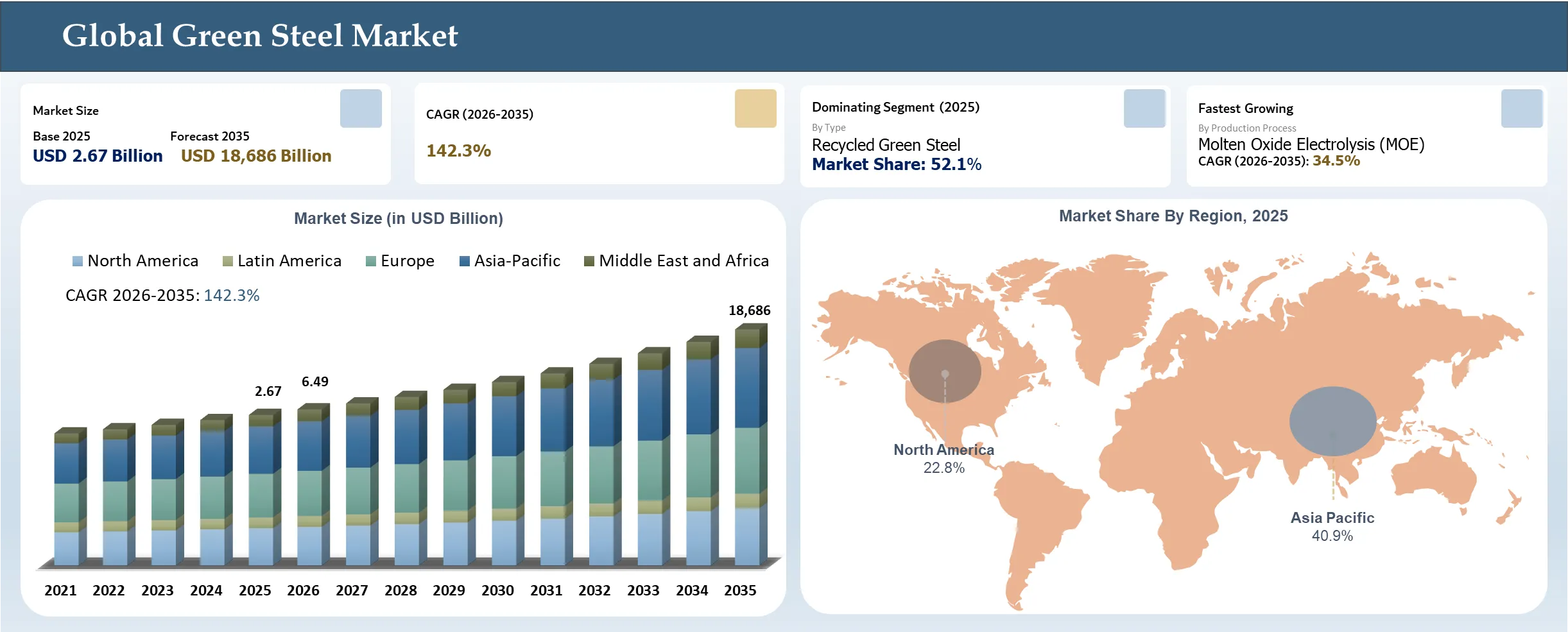
In January 2025, the European steel industry is experiencing a significant shift towards electric arc furnaces (EAFs), as 60%-70% of the steel produced in Europe currently employs the blast furnace process but is transitioning towards low-carbon EAF production. Furthermore, the European carbon premium for steel fell from highs in 2024 of Eur140/mt to Eur50/mt in November 2024, driven by lower conventional steel prices and reduced buyer willingness to pay a premium.
White-Space Opportunities for Green Steel through Green Iron Investment and Low-Emission Steelmaking
In February 2025, the Australian Government established the A$1 billion (USD 700 million) Green Iron Investment Fund to accelerate green iron manufacturing and associated supply chains, with the highest identified investment area being the transformation of the Whyalla Steelworks, receiving up to A$500 million (USD 351 million) to support its transition toward lower-emissions iron and steel production.
The remaining at least A$500 million (USD 351 million) is available for existing facilities and greenfield projects across Australia, creating investment opportunities in green iron production, value-added iron ore processing, green steel manufacturing, renewable-energy integration, and technologies supporting the energy transition.
The wider Whyalla support package separately includes A$100 million (USD 70 million) for immediate on-ground assistance, A$384 million (USD 268.45 million) to stabilise steelworks operations, and A$1.9 billion (USD 1.33 billion) for the future investment and infrastructure upgrades, while the government also announced A$750 million (USD 524.4 million ) through the Future Made in Australia Innovation Fund for new low-emissions technologies, pilot and demonstration projects, and commercial-scale green metals production.
The funding is expected to create significant procurement and project-development opportunities across the green iron and green steel value chain, benefiting companies involved in steelmaking, iron ore processing, renewable energy, hydrogen, electric smelting, and low-emissions technologies.
BlueScope, BHP, Rio Tinto, Woodside Energy, and Mitsui Iron Ore Development are positioned to benefit from the development of low-emissions ironmaking technologies and associated green-steel projects, while Fortescue is positioned in green-iron production through its hydrogen-based and electric-smelting initiatives.
Green Steel Market Strategic Takeaways
- Asia-Pacific secured the largest regional market share at 40.9% in 2025 while also maintaining its status as the fastest-growing region. In India, JSW Steel initiated work on the Rayalaseema project featuring a 1 MTPA electric arc furnace targeted for FY2028–29.
- Recycled green steel led the market product segment in 2025 by capturing a dominant share of 52.1%. Scrap-EAF production paths recorded a CO₂ intensity of 0.69 tonnes per tonne of crude steel compared to 2.34 tonnes for BF-BOF methods.
- Xuan Thien Group broke ground on its green steel complex in Vietnam with an investment of VND 98,000 billion (USD 3.8 billion). The facility is designed to support a planned output capacity of 9.5 million tonnes of steel annually.
- Australia established the A$1 billion (USD 700 million) Green Iron Investment Fund to accelerate green iron manufacturing. Out of this fund, up to A$500 million (USD 351 million) was allocated specifically to transform the Whyalla Steelworks.
Green Steel Market Industry Trends and Strategic Insight
- EAF deployment is becoming a central investment priority, particularly for producers seeking to replace ageing blast-furnace assets with more flexible, lower-emission production infrastructure.
- Green steel projects are increasingly being integrated with renewable-power and hydrogen ecosystems, making access to competitively priced clean electricity a strategic determinant of plant location and operating economics.
- Certification and taxonomy frameworks are becoming strategically important, allowing producers and buyers to distinguish genuinely lower-emission steel from conventional steel marketed through broad sustainability claims.
- Strategic emphasis is shifting from announcing capacity to reaching final investment decisions and commercial operation, making project bankability, infrastructure readiness, customer commitments, and policy certainty increasingly important competitive differentiators.
- International policy coordination is becoming increasingly important because fragmented definitions, standards, carbon-accounting methodologies, and trade rules can limit cross-border commercialization of low-emission steel.
Green Steel Market Scope
| Metrics | Details | |
| 2025 Market Size | USD 2.67 Billion | |
| 2035 Projected Market Size | USD 18,686 Billion | |
| CAGR (2026-2035) | 142.3% | |
| Largest Market | Asia-Pacific | |
| Fastest Growing Market | Asia-Pacific | |
| By Type | Hydrogen-Based Green Steel, Electrolysis-Based Green Steel, Biomass-Based Green Steel, Recycled Green Steel | |
| By Production Process | Electric Arc Furnace (EAF), Molten Oxide Electrolysis (MOE) | |
| By End User | Building & Construction, Automotive, Electronics, Industrial Equipment, Metal Products, Others | |
| By Region | North America | U.S., Canada, Mexico |
| Europe | Germany, UK, France, Spain, Italy, Poland, Netherlands, Switzerland | |
| Asia-Pacific | China, India, Japan, Australia, South Korea, Indonesia, Malaysia | |
| Latin America | Brazil, Argentina | |
| Middle East and Africa | UAE, Saudi Arabia, South Africa, Israel, Türkiye | |
| Report Insights Covered | Competitive Landscape Analysis, Company Profile Analysis, Market Size, Share, Growth | |
Green Steel Market Disruption Analysis
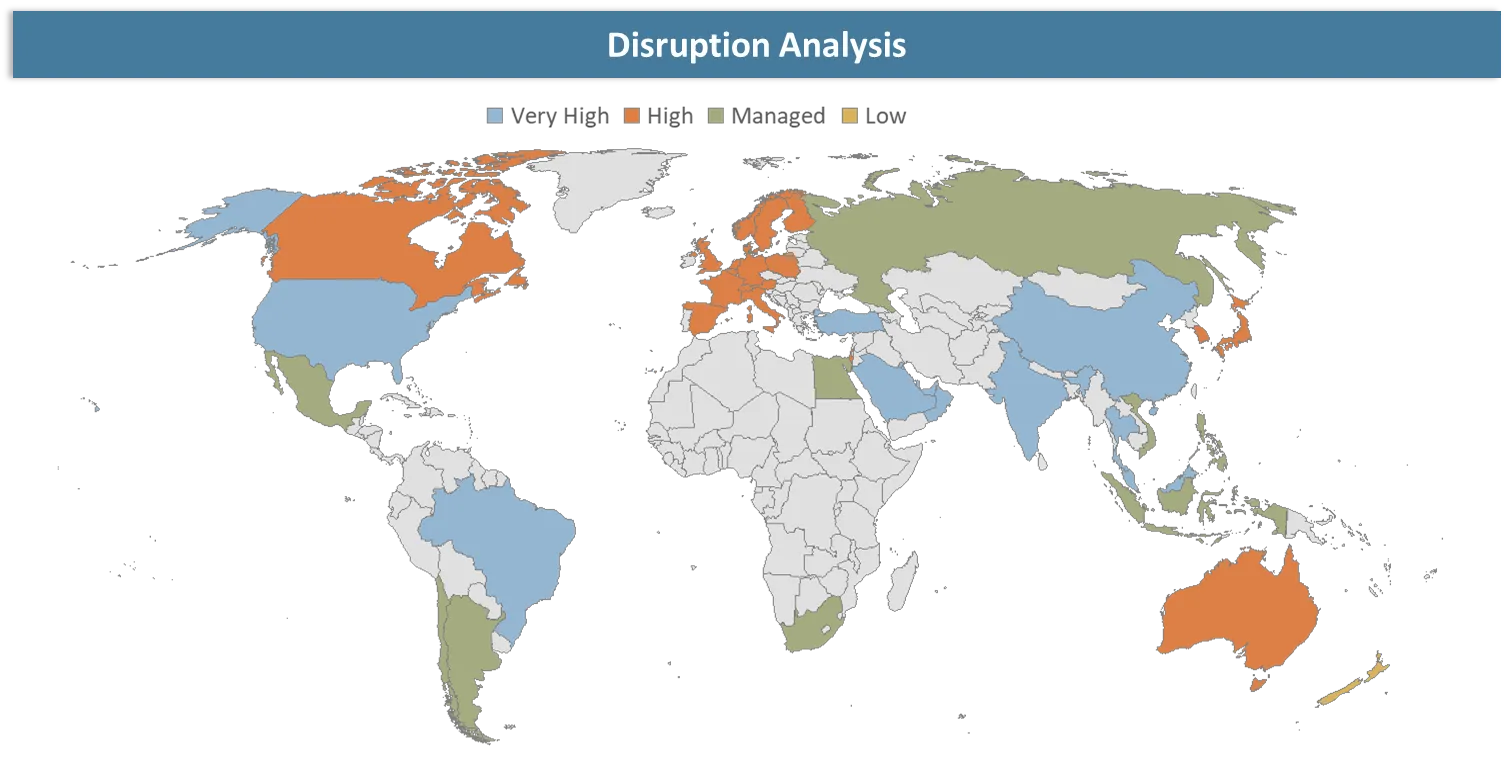
Rapid Deployment of Electric Arc Furnaces Reshaping Green Steel Production
The disruption in the green steel market is primarily associated with the rapid adoption of electric arc furnaces (EAFs) as steelmakers transition away from conventional blast-furnace-based production. The EAFs have been bringing about changes to the traditional mode of producing steel through the use of blast furnaces as the industry shifts towards using electric arc furnaces. The use of EAFs allows for the more efficient use of scrap steel as well as offering an alternative route of production with low-carbon electricity. In essence, the shift towards an EAF production process is breaking the domination of traditional coal-based steelmaking processes and promoting the use of more flexible and less-polluting production processes.
Also, the expansion of EAFs is disrupting the entire steel production value chain through the increasing significance of low-carbon electricity, the availability of scrap metal, grid infrastructure, and investments in replacement capacities. In February 2026, ArcelorMittal announced an investment of €1.3 billion (USD 1.55 billion) to develop a less emission-producing electric furnace at its Dunkirk plant in France, which would replace its current blast furnace facility. The electric furnace facility was expected to produce 2 million tons of steel per year and emit three times less carbon per tonne compared to the existing blast furnaces; the production was set to start in 2029 and would be supplied with a long-term low-carbon electricity contract from EDF.
Green Steel Market BCG Matrix: Company Evaluation
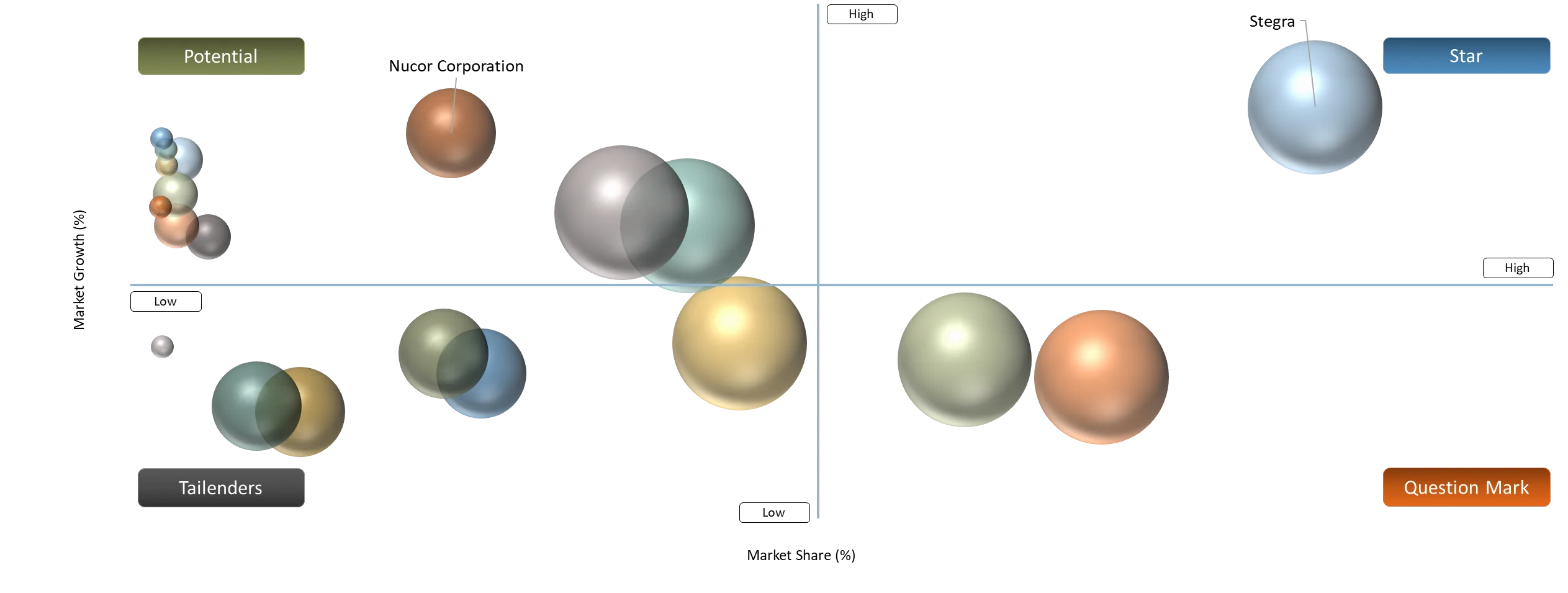
Stars include Stegra, SSAB, Tata Steel Ltd., and ArcelorMittal because they combine strong steel-industry positions with advanced green-steel commercialisation and large-scale investment in low-emission production routes. Question Marks include Boston Metal, Salzgitter AG, Voestalpine, and Nippon Steel Corporation, as these companies possess substantial technological capabilities and established steelmaking positions but are still scaling or commercialising specific green-steel pathways.
Potential includes Nucor Corporation and JFE Steel Corporation, which have strong foundations for the transition toward lower-emission steel but have comparatively greater exposure to conventional production structures or are still expanding their green-steel commercialisation. Tailenders are not assigned to any of the ten companies provided, because each has a meaningful technology, investment, or commercialisation strategy related to green steel.
Green Steel Market Dynamics
Driver Impact Analysis
| Driver | Market Growth Impact (%) | Demand Concentration | Impacted Use Case | Strategic Impact |
Expansion of green hydrogen production is driving the adoption of hydrogen-based direct reduced iron (H₂-DRI) steelmaking. | 30% | Europe, North America, Asia Pacific; primarily primary steelmaking and hydrogen-intensive industrial clusters | H₂-DRI production, fossil-free ironmaking, low-emission flat steel | Accelerates the transition from coal-based ironmaking toward hydrogen-based production and increases demand for integrated hydrogen, renewable power, DRI, and EAF infrastructure. |
Growing demand for low-carbon steel from automotive, construction, and manufacturing industries is accelerating green steel adoption. | 27% | Automotive and construction supply chains, followed by machinery and industrial manufacturing | Low-carbon automotive components, construction steel, industrial equipment | Creates downstream demand for certified low-emission steel and strengthens the business case for long-term green-steel procurement and offtake agreements. |
Increasing government incentives, carbon-pricing mechanisms, and low-emission steel procurement policies are supporting market development. | 23% | Europe, North America, Japan, South Korea, China, and India | Public infrastructure, government procurement, regulated industrial production | Reduces commercialisation barriers, creates lead markets, and improves investment visibility for low-emission steel production projects. |
Growing corporate commitments and long-term offtake agreements for near-zero-emission steel are creating stronger market demand. | 20% | Automotive, construction, renewable-energy equipment, and multinational industrial supply chains | Long-term green-steel procurement, automotive manufacturing, infrastructure projects | Improves revenue visibility for producers, supports project financing and FIDs, and enables customers to reduce embedded supply-chain emissions. |
Expansion of green hydrogen production is driving the adoption of hydrogen-based direct reduced iron (H₂-DRI) steelmaking
The expansion of lower-emission hydrogen production technology continues to bolster the business case for hydrogen-based direct reduced iron (H₂-DRI) as a route to carbon reduction in the production of steel. The accessibility of renewable hydrogen continues to improve with more electrolysers being deployed, making it possible for steel manufacturers to adopt hydrogen-based reduction processes in place of high-emission ironmaking processes. It is especially important for green steel projects to have an accessible source of low-emission hydrogen.
In parallel, policy measures supporting the hydrogen supply and low-emissions steel demand are reinforcing the business environment for H₂-DRI. In January 2026, according to the International Energy Agency (IEA), the total sum of the publicly available funds through the latest hydrogen policy announcements is USD 41 billion, and about 25% of these funds have been spent on the projects, where the funding for supply is almost 1.5 times more than for demand. The European Commission suggested low-emissions steel quotas for public procurement and car and van steels, while 13 countries among EU member states completed the directive transposition into their national legislation by early June 2026, which resulted in the emergence of a need for more than 575 ktpa of low-emissions hydrogen.
Green Steel Market Segment Analysis
The global green steel market is segmented based on type, production process, end user, and region.
Recycled Green Steel Driving Dominance Through Scrap-Based Circular Steelmaking
Recycled green steel holds the dominant position in the green steel market, with a market share of 52.1% in 2025. The reason behind the growing demand for recycled green steel is that steel manufacturers are opting for recycled scrap for use in EAFs to emit fewer greenhouse gases. Using recycled steel not only helps in closing the loop, but also minimizes the dependency on primary iron ores and coal-intensive iron manufacturing. The increasing utilisation of scrap-EAF processes, therefore, makes the case for recycled green steel even stronger within automotive, construction, and industrial sectors.
In parallel, in February 2026, the World Steel Association (worldsteel) reported that the scrap-EAF route recorded CO₂ emissions intensity of 0.69 tonnes per tonne of crude steel in 2024, compared with 2.34 tonnes per tonne for BF-BOF, while its energy intensity was 9.84 GJ per tonne versus 23.88 GJ per tonne for BF-BOF. The data collected in 2025 covered 959.5 million tonnes of crude steel, representing 51% of global crude steel production. The findings reinforce the strategic importance of scrap-based production as steelmakers pursue lower-emission and more resource-efficient steelmaking pathways.
Green Steel Market Geographical Penetration
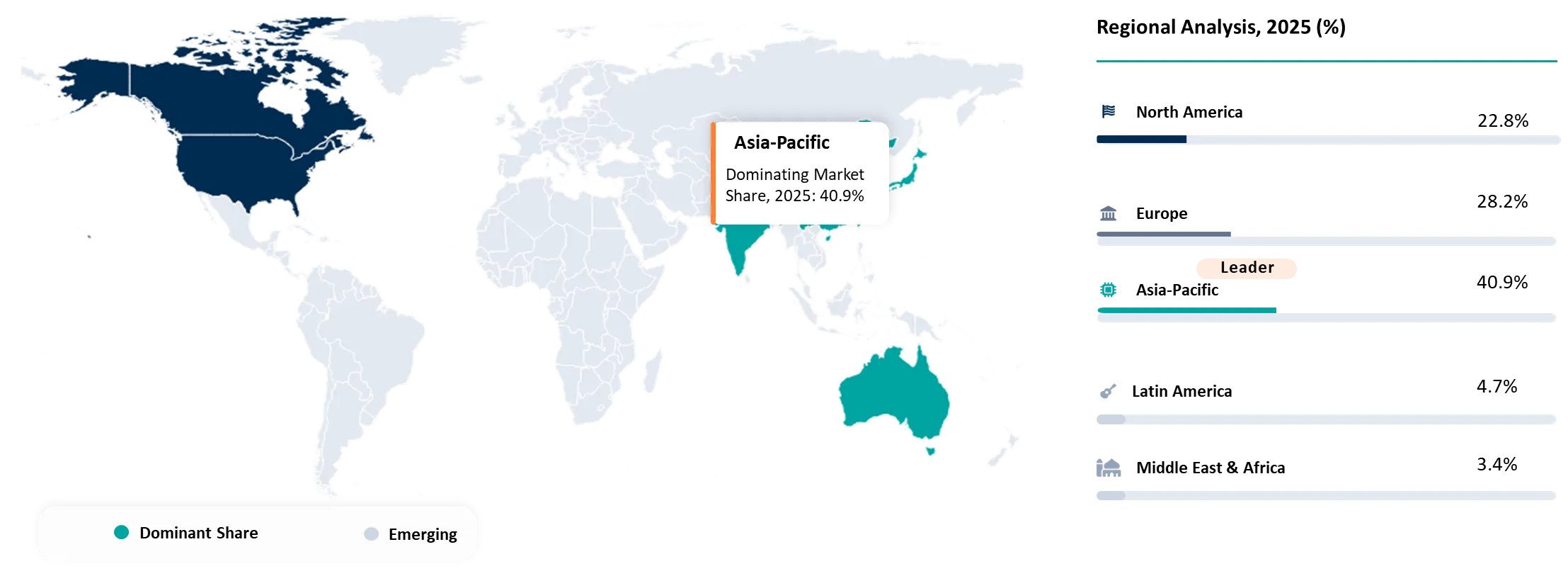
Asia-Pacific Leadership in Green Steel Production and Decarbonization Investment
The Asia-Pacific region dominates the green steel market, with a market share of 40.9% in 2025, supported by its extensive steel production base, expanding industrial demand, and accelerating investments in EAF technology, hydrogen-based direct reduction, scrap utilisation, and renewable-energy integration. The region's combination of established steelmakers, growing low-carbon technology deployment, supportive industrial policies, and large downstream automotive and construction industries is strengthening its position as the leading market for green steel.
EAF-based steelmaking is emerging as a key pathway for reducing emissions and increasing the use of recycled inputs in India’s steel industry. In July 2026, JSW Steel Limited, an India-based major private-sector steel producer, began work on its Rayalaseema Steel Project in Andhra Pradesh (India), featuring a 1 million tonnes per annum (MTPA) electric arc furnace (EAF) and structural mill, with commissioning targeted for FY2028–29. The project is aligned with JSW Steel’s green-steel strategy because EAF-based steelmaking enables scrap-based production and lower-emission steel manufacturing.
China Green Steel Market Trends
China is expanding international R&D collaboration to accelerate the development of low-carbon steelmaking technologies and green-metal solutions. In December 2025, HBIS Group Co., Ltd., a China-based state-owned steel producer, and the University of Belgrade (Serbia), a public research university, inaugurated the China-Serbia Joint Laboratory for Green Steel Manufacturing in Shijiazhuang, Hebei, China.
The national-level international science and technology cooperation platform focuses on green and low-carbon steel manufacturing, hydrogen metallurgy, green-steel product development, and emissions-reduction technologies. The laboratory had already launched 7 research projects, with the partners establishing 14,000 m² of dedicated research facilities equipped with 57 major pieces of equipment.
Japan Green Steel Market Outlook
Japan’s steel industry is strengthening low-carbon steel adoption through integrated energy, carbon-accounting, and supply-chain solutions. In December 2025, Tokyo Gas Co., Ltd., a Japan-based major energy utility, and Marubeni-Itochu Steel Inc., a Japan-based steel trading and distribution company, launched a service to support steel and processing manufacturers in developing and commercializing low-carbon steel products.
The initiative provides non-fossil electricity, carbon-offset city gas, carbon credits, carbon-footprint (CFP) calculation, and third-party verification support, with WinFirst Co., Ltd. (Japan), a steel trading company, becoming the first customer. WinFirst plans to introduce low-carbon steel manufactured from steel scrap using electric furnaces, with commercial sales targeted for May 2026.
North America’s Green Steel Capacity Expansion and Low-Carbon Technology Deployment
North America is one of the major regions in the green steel market is supported by the region’s established EAF-based steelmaking infrastructure, strong availability of steel scrap, expanding renewable-energy integration, and increasing demand for lower-emission materials from automotive, construction, and industrial manufacturers. The region is also benefiting from policy-driven investment in domestic steel production and decarbonization, while established producers are upgrading existing facilities and developing new low-emission production routes.
U.S. steel producers are expanding low-carbon product portfolios by combining EAF-based production with renewable energy and alternative carbon inputs. In October 2025, Steel Dynamics, Inc. (SDI), a U.S.-based major industrial metals and steel producer, launched its BIOEDGE and EDGE lower-embodied-carbon steel products, produced exclusively using electric arc furnace (EAF) technology. The products use certified renewable-energy or emission-free nuclear-energy certificates to reduce Scope 2 emissions, while BIOEDGE additionally replaces anthracite with renewable biocarbon to reduce Scope 1 emissions.
SDI Biocarbon Solutions, a U.S.-based renewable-biocarbon joint venture 75% owned by Steel Dynamics and 25% by Aymium (United States), is expected to produce 228,000 metric tons of biocarbon annually for the steelmaking process.
U.S. Green Steel Market Trends
The U.S. holds a dominant position in the North American green steel market due to its established electric arc furnace (EAF) infrastructure, extensive scrap-based steelmaking ecosystem, availability of renewable and low-carbon electricity, and increasing investment in industrial decarbonization technologies. The country's large EAF production base provides an existing platform for integrating cleaner electricity, recycled scrap, low-carbon DRI, and other emerging technologies without requiring a complete transition from conventional steelmaking infrastructure.
U.S. renewable-energy infrastructure is creating new demand for certified near-zero-emissions steel and accelerating low-carbon material adoption. In September 2025, SSAB AB, a Sweden-based steel producer, announced that its SSAB Zero near-zero-emissions steel, produced using hydrogen-reduced iron from HYBRIT technology, would be supplied to GE Vernova Inc., a U.S.-based energy technology and wind-turbine manufacturer, for use in onshore wind towers across the U.S. The steel is produced at SSAB’s Montpelier, Iowa facility using recycled scrap, fossil-free electricity, biocoal, and renewable natural gas, and has met the International Energy Agency (IEA) near-zero steel and First Movers Coalition thresholds.
Green Steel Market Competitive Landscape
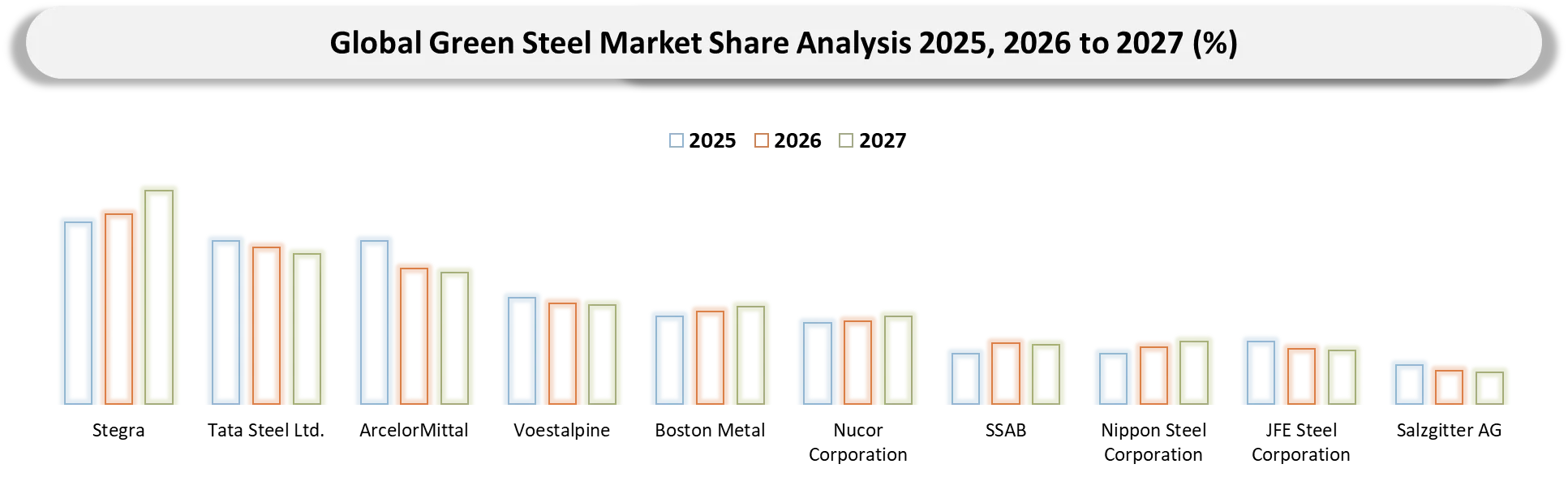
- The market is characterized by four key participant groups: large integrated steelmakers, EAF-focused producers, green-steel technology developers, and early-stage low-carbon steel specialists. ArcelorMittal, Tata Steel, Nippon Steel Corporation, JFE Steel Corporation, Salzgitter AG, SSAB, and voestalpine are leveraging established steelmaking assets while transitioning toward EAF, hydrogen-based DRI, renewable electricity, and other low-emission routes. Nucor Corporation benefits from its predominantly EAF-based production model, while Stegra and Boston Metal are focused more directly on next-generation green iron and steel technologies. The competitive landscape is therefore increasingly shaped by production scale, access to low-carbon electricity and hydrogen, scrap/DRI availability, technology commercialization, and the ability to secure long-term customer offtake agreements.
- Key players include Stegra (Sweden), Tata Steel Ltd. (India), ArcelorMittal (Luxembourg), voestalpine (Austria), Boston Metal (United States), Nucor Corporation (United States), SSAB (Sweden), Nippon Steel Corporation (Japan), JFE Steel Corporation (Japan), and Salzgitter AG (Germany).
Key Developments
- October 2025: BHP Group Limited, an Australia-based global mining company, and POSCO Holdings Inc., a South Korea-based major steel producer, signed an agreement to advance hydrogen-based low-emissions ironmaking at POSCO’s Pohang steelworks in South Korea.
- June 2025: Xuan Thien Group, a Vietnam-based privately owned diversified industrial group, officially broke ground on its Xuan Thien Nam Dinh Green Steel Complex in Nam Dinh Province, Vietnam, with total investment of approximately VND 98,000 billion (USD 3.8 billion) and planned production capacity of 9.5 million tonnes of steel per year.
- October 2025: Kingspan Group, an Ireland-based global building-materials and building-envelope solutions company, signed a memorandum of understanding with Meranti Green Steel, a Singapore-based green-steel development company, to support the procurement and adoption of green steel across the Asia-Pacific region.
- October 2025: ACME Group, an India-based clean-energy and green-technology company, announced plans to invest approximately ₹5,000 crore (USD 521.1 million) in a 1.2 million tonnes per annum (MTPA) green HBI and DRI facility designed to supply low-emission iron feedstock for steelmaking.
- March 2025: Nippon Steel Corporation, a Japan-based major integrated steel producer, outlined its Green Transformation (GX) strategy covering large-scale electric arc furnaces (EAFs), hydrogen direct reduction, hydrogen-based blast-furnace reduction, CCUS, and GX Steel commercialisation.
- June 2025: PT Krakatau Steel (Persero) Tbk, an Indonesia-based state-owned steel producer, through its infrastructure subsidiary PT Krakatau Sarana Infrastruktur, allocated more than 500 hectares in Cilegon, Banten, to support a planned investment by Delong Steel Group and its Indonesian subsidiary PT Dexin Steel Indonesia (Indonesia), a steel joint venture.
Key Procurement Priorities and Buyer Evaluation Criteria
- Organisations procuring green steel increasingly prioritise suppliers capable of delivering low- and near-zero-emission steel with transparent carbon-intensity data, reliable quality, and sufficient production capacity for long-term industrial requirements.
- Procurement decisions are increasingly influenced by carbon-reduction targets, emissions regulations, green-public procurement requirements, and corporate net-zero commitments, encouraging buyers to establish long-term offtake agreements with producers using EAF, hydrogen-based DRI, recycled scrap, and renewable energy.
- Buyers evaluate suppliers based on CO₂ emissions intensity, green-steel certification, traceability of raw materials and energy sources, product quality, production consistency, and the proportion of renewable electricity or low-carbon hydrogen used in production.
Why Choose DataM?
- Technology & Production Innovation: Explores advancements in green-steel production technologies including electric arc furnaces (EAF), hydrogen-based direct reduced iron (H₂-DRI), molten oxide electrolysis (MOE), renewable-energy integration, and advanced scrap processing, highlighting their role in reducing dependence on coal-intensive steelmaking.
- Product Performance & Market Positioning: Evaluates how green-steel producers differentiate through carbon-intensity reductions, steel quality, production consistency, recycled-content levels, energy efficiency, and scalability, while assessing their positioning across automotive, construction, industrial equipment, and metal-product applications.
- Real-World Evidence: Highlights commercial deployment of low-emission steelmaking across automotive manufacturing, construction, infrastructure, industrial equipment, and renewable-energy supply chains, demonstrating how green steel can reduce embedded emissions while maintaining required metallurgical performance.
- Market Updates & Industry Changes: Tracks EAF commissioning, hydrogen-DRI projects, green-steel certification, renewable-power integration, capacity expansions, government incentives, and strategic investments across Europe, Asia-Pacific, and North America, providing visibility into the transition from conventional to lower-emission steel production.
- Competitive Strategies: Analyses how leading companies such as Stegra, Tata Steel, ArcelorMittal, SSAB, Nucor, Nippon Steel, JFE Steel, voestalpine, Boston Metal, and Salzgitter pursue competitiveness through technology development, production modernisation, strategic partnerships, renewable-energy sourcing, and long-term green-steel offtake agreements.
- Pricing & Market Access: Assesses green-steel pricing according to production technology, hydrogen and electricity costs, scrap availability, carbon-intensity reductions, certification requirements, and production scale, while examining market access through direct offtake agreements, industrial procurement programs, and low-carbon steel certification schemes.
- Market Entry & Expansion: Identifies growth opportunities arising from automotive decarbonization, sustainable construction, infrastructure procurement, renewable-energy equipment, carbon-pricing mechanisms, and corporate net-zero commitments, while evaluating strategies such as regional EAF deployment, hydrogen supply integration, scrap sourcing, technology partnerships, and low-carbon production hubs.
Target Audience 2026
- Steel Producers & Manufacturers
- Automotive Manufacturers
- Construction & Infrastructure Companies
- Iron Ore, Scrap & Raw-Material Suppliers
- Hydrogen & Renewable Energy Companies
- Industrial Equipment Manufacturers
- Steel Technology & Equipment Providers





























































