


Germany Digital Health Market Size
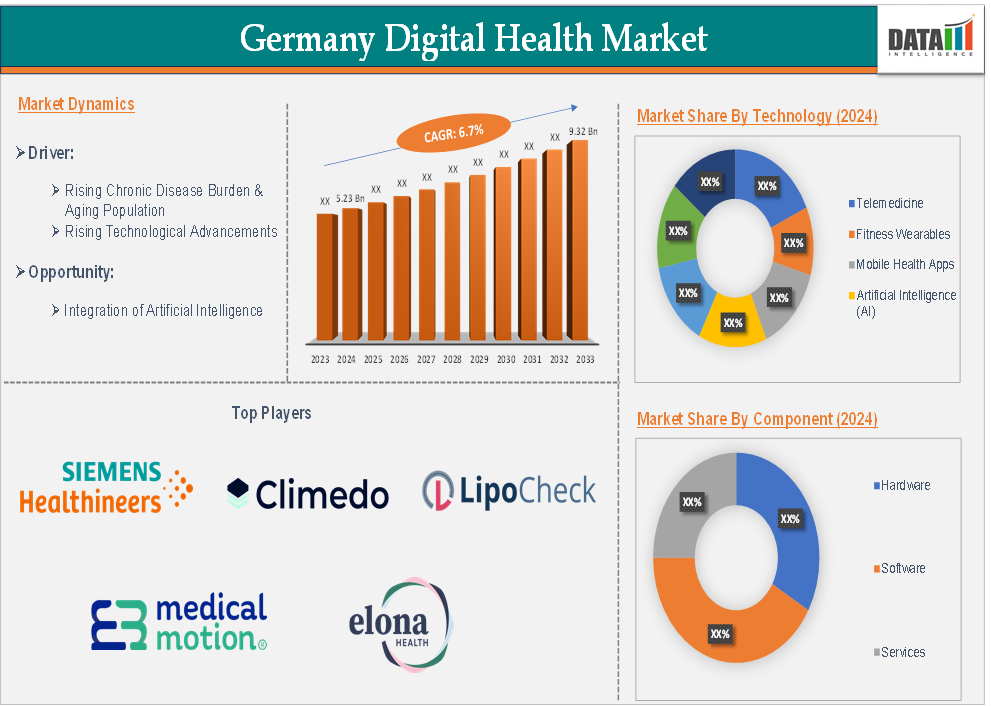
The Germany digital health market size reached US$5.58 billion in 2025 and is expected to reach US$ 9.32 billion by 2033, growing at a CAGR of 6.7% during the forecast period of 2026-2033.
Digital Health refers to the integration of digital technologies into healthcare systems to improve the delivery of health services, enhance patient outcomes, increase operational efficiency, and provide more personalized care. It encompasses a wide range of solutions, tools, and innovations that leverage information technology, communication systems, and digital devices to support health and wellness, as well as to manage and treat diseases.
Germany Digital Health Market Key Takeaways
- Germany’s digital health market is entering a scale-up phase. The market reached US$5.58 billion in 2025 and is projected to reach US$ 9.32 billion by 2033, reflecting sustained adoption of digital healthcare technologies.
- Digital health is becoming more integrated into Germany’s healthcare ecosystem. Growing use of telemedicine, digital therapeutics, electronic health solutions, remote monitoring and connected healthcare platforms is strengthening digital delivery across care settings.
- Telemedicine and remote care are gaining strategic importance. Increasing demand for convenient consultations, remote patient monitoring and digitally enabled chronic disease management is supporting wider adoption among providers and patients.
- Germany’s regulatory environment is shaping market development. Initiatives such as DiGA (Digital Health Applications) are creating pathways for approved digital health applications to enter routine healthcare and reimbursement structures.
- AI and data-driven healthcare are becoming key technology catalysts. Artificial intelligence, predictive analytics and healthcare data platforms are supporting clinical decision-making, patient monitoring, workflow optimization and personalized care.
- Interoperability is moving to the center of digital health strategy. Integration between electronic health records, hospitals, physicians, pharmacies, insurers and digital applications is increasingly important for creating connected patient journeys.electronic health records, hospitals, physicians, pharmacies, insurers and digital applications is increasingly
- Data security and privacy remain critical adoption factors. Germany’s strict data-protection requirements make cybersecurity, secure health-data management and regulatory compliance essential for digital health technology providers.
- Healthcare providers are prioritizing efficiency alongside patient outcomes. Digital solutions are increasingly evaluated for their ability to reduce administrative workloads, improve care coordination, optimize resource utilization and enhance patient engagement.
- An aging population is creating additional demand for digital care solutions. Remote monitoring, chronic disease management and home-based digital healthcare technologies can support Germany’s growing need for accessible and continuous care.
- The market is shifting from experimentation toward broader healthcare integration. As digital health technologies demonstrate clinical and economic value, adoption is increasingly moving beyond standalone applications toward integrated platforms and connected care ecosystems.
Germany Digital Health Market Scope
| Metrics | Details | |
| CAGR | 6.7% | |
| Market Size Available for Years | 2025-2033 | |
| Estimation Forecast Period | 2026-2033 | |
| Revenue Units | Value (US$ Mn) | |
| Segments Covered | Technology | Telemedicine, Fitness Wearables, Mobile Health Apps, Artificial Intelligence (AI), Health Analytics, Health Information Technology, and Others |
| Component | Hardware, Software, and Services | |
| Application | Remote Monitoring, Chronic Disease Management, Personalized Medicine, Hospital Administration Software, Clinical Workflow Software, Patient Engagement & Education, Mental Health, Fitness & Wellness, Emergency & Critical Care, and Others | |
| End-User | Healthcare Providers, Healthcare Consumers, and Others | |
Germany Digital Health Market Executive Summary
For more details on this report, Request for Sample
Germany Digital Health Market Dynamics: Drivers & Restraints
Rising chronic disease burden & aging population are driving the Germany digital health market growth
By 2050, 30% of Germany’s population is expected to be over 65, leading to a higher demand for elderly care, remote monitoring, and telemedicine. Digital health startups provide remote monitoring solutions for elderly patients, thereby reducing hospital visits and enabling them to receive care from the comfort of their own homes. Wearables like Fitbit & Apple Watch are used to track vital signs in elderly patients, helping to detect early warning signs of conditions like cardiovascular disease or diabetes.
Over 35% of Germans suffer from chronic diseases, including diabetes, cardiovascular disease, and respiratory disorders. Germany has over 8.5 billion diabetics, and the number is expected to rise due to aging and lifestyle factors. Digital therapeutics like mySugr are being prescribed to help patients manage their conditions. Cardiovascular diseases account for 40% of all deaths in Germany, making remote heart monitoring solutions crucial. For instance, CardioSecur, a German startup, provides smart ECG technology, allowing heart patients to track their heart health via smartphone-based monitoring.
The aging population and chronic disease burden are major growth drivers of Germany’s digital health market, pushing the adoption of telemedicine, AI-driven diagnostics, wearables, and remote monitoring solutions. With government support, reimbursement policies, and increased investments in digital health startups, Germany is set to become a leader in digital healthcare transformation.
Data privacy and security concerns are hampering the growth of the market
While Germany digital health market is expanding rapidly, data privacy and security concerns pose significant challenges that slow its growth. Germany has some of the strictest data protection regulations, which, while ensuring patient privacy, also create barriers for digital health innovation and adoption. Germany’s General Data Protection Regulation (GDPR), along with the German Data Protection Act (BDSG), imposes strict rules on how health data should be collected, stored, shared, and used.
Healthcare data is highly sensitive, and any data breach can result in severe legal and financial consequences as well as loss of trust from patients. Cybersecurity concerns remain a major barrier to the widespread adoption of digital health technologies in Germany. Patient trust is crucial in digital health. If patients are not confident that their sensitive health information is secure, they are likely to resist using digital health solutions. Even slight lapses in data security or privacy can lead to significant damage to a company's reputation and patient base.
Germany Digital Health Market Segment Analysis
The Germany digital health market is segmented based on technology, component, application, and end-user.
Technology:
The mobile health apps from the technology segment are expected to dominate the Germany digital health market with the highest market share
Germany has one of the highest smartphone penetration rates in Europe, with over 80% of the population owning smartphones. This creates a massive user base for mobile health apps, making them easily accessible to a large number of people. As of 2023, over 68 billion Germans were using smartphones, making mobile health apps a feasible and popular solution for healthcare management.
Germany is facing a rising burden of chronic diseases like diabetes, hypertension, and cardiovascular diseases. Mobile health apps are playing a pivotal role in enabling patients to monitor and manage these conditions daily. For instance, apps like BlueLoop and MySugr are widely used to help patients track glucose levels, monitor insulin doses, and provide personalized recommendations. These apps improve patient engagement and adherence to treatment protocols.
Germany Digital Health Market Major Germany Players
The major Germany players in the digital health market include Siemens Healthineers AG, Abbott, Climedo Health GmbH, LipoCheck GmbH, medicalmotion GmbH, mementor DE GmbH, Elona Health GmbH, kaia health software GmbH, and GAIA AG, among others.
Germany Digital Health Market Recent Developments
- July 2026 – Germany advances digital health and healthcare data legislation
The German Federal Cabinet approved the draft Act on Data and Digital Innovation in Healthcare (GeDIG), aimed at improving the use of health data for healthcare, research and innovation. The legislation also proposes new AI-supported functions within electronic patient records (ePA), including easier interpretation of medical findings and personalized health information. - July 2026 – Germany strengthens electronic patient record adoption
The TI-Atlas 2026 reported that Germany's electronic patient record (ePA) is becoming increasingly established in healthcare delivery, with digital applications generating greater practical benefits for healthcare providers and patients. The study analyzed responses from around 5,000 healthcare facilities and 1,400 insured individuals. - July 2026 – Germany improves telematics infrastructure stability
The TI-Atlas 2026 highlighted the TI-Gateway as an important development for improving the stability of Germany's telematics infrastructure. Greater infrastructure reliability is supporting wider adoption of ePA, electronic medication plans and other connected healthcare applications. - June 2026 – Germany strengthens its position as a digital health hub
Germany Trade & Invest highlighted the country's growing position as one of Europe's leading digital healthcare innovation hubs, supported by the Digital Act (DigiG) and a regulatory environment encouraging digital health applications and investment. - June 2026 – Digital therapeutics continue expanding in Germany
Germany's established reimbursement framework for approved digital health applications continues to support growth in digital therapeutics, including applications addressing conditions such as diabetes, depression and back pain. This strengthens the country's role as an early adopter of reimbursed digital health solutions. - April 2026 – Germany launches TI-Atlas 2026 digital health assessment
gematik launched the 2026 TI-Atlas survey to assess the state of healthcare digitalization across Germany, with particular focus on ePA utilization, telematics infrastructure stability, artificial intelligence, digital medication processes and electronic referrals. - 2026 – Germany advances TI 2.0 for connected healthcare
Germany continued developing TI 2.0, introducing more flexible and hardware-independent access to digital healthcare services. The Proof of Patient Presence (PoPP) service is designed to enable access to ePA and other telematics applications during settings such as home visits without requiring the physical health card. - February 2026 – Germany updates its national digitalisation strategy for healthcare
The Federal Ministry of Health advanced its Digitalisation Strategy for Health and Care, incorporating developments in artificial intelligence, the European Health Data Space (EHDS), electronic patient records and health-data utilization. The strategy positions digitalisation as a central pillar of Germany's healthcare transformation. - 2026 – Germany prepares AI-enabled features for electronic patient records
Under the proposed GeDIG framework, health insurers could expand ePA services with AI-supported interpretation of medical findings, personalized medication information, preventive-care recommendations and health-planning tools, creating additional opportunities for healthcare AI providers. - 2026 – Germany moves toward broader digital primary-care access
Proposed digital healthcare reforms include integrating the ePA app with services such as electronic referrals, digital appointment coordination and digital initial needs assessment, creating a more connected digital entry point into primary care.
Why Purchase the Report?
- Pipeline & Innovations: Reviews ongoing clinical trials, product pipelines, and forecasts upcoming advancements in medical Procedures and pharmaceuticals.
- Product Performance & Market Positioning: Analyze product performance, market positioning, and growth potential to optimize strategies.
- Real-World Evidence: Integrates patient feedback and data into product development for improved outcomes.
- Physician Preferences & Health System Impact: Examines healthcare provider behaviors and the impact of health system mergers on adoption strategies.
- Market Updates & Industry Changes: This covers recent regulatory changes, new policies, and emerging technologies.
- Competitive Strategies: Analyze competitor strategies, market share, and emerging players.
- Pricing & Market Access: Reviews pricing models, reimbursement trends, and market access strategies.
- Market Entry & Expansion: Identifies optimal strategies for entering new markets and partnerships.
- Supply Chain Optimization: Assesses supply chain risks and distribution strategies for efficient product delivery.
- Sustainability & Regulatory Impact: Focuses on eco-friendly practices and evolving regulations in healthcare.
- Post-market Surveillance: Uses post-market data to enhance product safety and access.
- Pharmacoeconomics & Value-Based Pricing: Analyzes the shift to value-based pricing and data-driven decision-making in R&D.
The Germany Digital Health market report delivers a detailed analysis with 39 key tables, more than 41 visually impactful figures, and 148 pages of expert insights, providing a complete view of the market landscape.
Target Audience
- Manufacturers: Pharmaceutical, Medical Device, Biotech Companies, Contract Manufacturers, Distributors, Hospitals.
- Regulatory & Policy: Compliance Officers, Government, Health Economists, Market Access Specialists.
- Technology & Innovation: AI/Robotics Providers, R&D Professionals, Clinical Trial Managers, Pharmacovigilance Experts.
- Investors: Healthcare Investors, Venture Fund Investors, Pharma Marketing & Sales.
- Consulting & Advisory: Healthcare Consultants, Industry Associations, Analysts.
- Supply Chain: Distribution and Supply Chain Managers.
- Consumers & Advocacy: Patients, Advocacy Groups, Insurance Companies.
- Academic & Research: Academic Institutions.
Suggestions for Related Report
For more Healthcare IT-related reports, please click here



























































