


Gas Chromatography Systems Market Overview
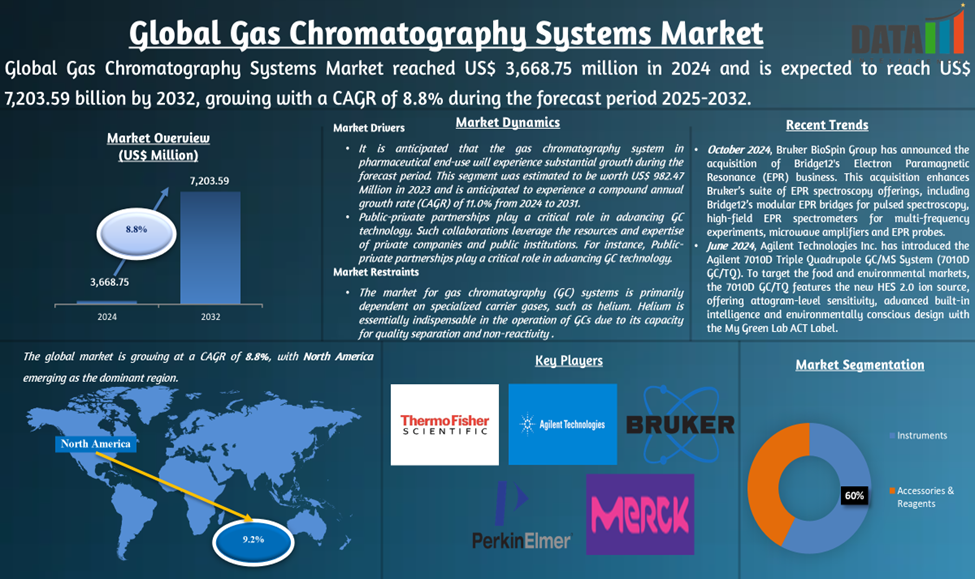
Global Gas Chromatography Systems Market reached US$ 3,991.60 million in 2025 and is expected to reach US$ 7,837.90 million by 2033, growing with a CAGR of 8.8% during the forecast period 2026-2033, according to DataM intelligence report.
The growth is driven by advancements in chromatography technologies, increased applications across industries, and strong governmental regulations for environmental monitoring and food safety. One of the most significant sectors for the application of gas chromatography (GC) in the pharmaceutical industry is drug development and quality control procedures. The pharmaceutical sector in India is expected to transform, with a size of approximately US$65 billion by 2024, increasing to US$130 billion by 2030 and then rapidly increasing to US$450 billion by 2047, according to the India Brand Equity Foundation (IBEF), as per our research.
Currently, it is estimated that the Indian pharmaceutical industry is worth US$50 billion, with a contribution of over US$25 billion from exports alone. This underscores the necessity of employing sophisticated techniques, such as gas chromatography, to comply with a variety of health-related regulations during the drug manufacturing process, as it provides space for expansion. In reality, the environmental and food safety concerns in these regions have significantly impacted efforts to develop and implement gas chromatography in North America and European markets, in addition to the medical and pharmaceutical sectors.
Additionally, these governments have acknowledged the necessity of employing these methods to resolve concerns regarding food safety and environmental pollution. For example, the Canada Foundation for Innovation (CFI), the research funding body of Integrated Canada, has invested approximately $9 million in the development of the requisite infrastructure, which includes facilitating gas chromatography-mass spectrometry (GC-MS) research.
Gas Chromatography Systems Market Industry Trends and Strategic Insight
The growing focus on food safety, pharmaceutical quality control, environmental monitoring, and forensic testing is driving demand for advanced gas chromatography systems. Laboratories are increasingly adopting high-performance GC platforms to deliver accurate and reliable analytical results.
Laboratories are upgrading to automated and high-throughput gas chromatography systems to improve productivity, reduce manual intervention, and accelerate sample analysis across research and industrial applications.
The gas chromatography systems market is evolving through the integration of AI-powered data analysis, digital laboratory workflows, and cloud connectivity, enabling real-time monitoring, predictive maintenance, and enhanced laboratory efficiency.
Increasing regulatory requirements from agencies such as the FDA, EPA, and ISO are encouraging investments in advanced gas chromatography technologies that ensure compliance, traceability, and analytical precision.
Rising applications in petrochemicals, environmental testing, biotechnology, clinical diagnostics, and life sciences are creating new growth opportunities, while continuous innovations in detectors, software, and hyphenated GC-MS systems are expanding the market's capabilities.
Gas Chromatography Systems Market Executive Summary
Gas Chromatography Systems Market Scope
| Metrics | Details |
| CAGR | 8.8% |
| Size Available for Years | 2025-2033 |
| Forecast Period | 2026-2033 |
| Data Availability | Value (US$) |
| Segments Covered | Product Type, Sample Type, End-User and Region |
| Regions Covered | North America, Europe, Asia-Pacific, South America and Middle East & Africa (MEA). |
| Fastest Growing Region | Asia-Pacific |
| Largest Region | North America |
| Report Insights Covered | Competitive Landscape Analysis, Company Profile Analysis, Market Size, Share, Growth, Demand, Recent Developments, Mergers and Acquisitions, New Product Launches, Growth Strategies, Revenue Analysis, Porter’s Analysis, Pricing Analysis, Regulatory Analysis, Supply-Chain Analysis and Other key Insights. |
Gas Chromatography Systems Market Dynamics
Significant Applications in Healthcare and Pharmaceutical Sector
Ongoing technological advancements and the formation of strategic collaborations within the industry. The diverse applications of GC systems are also a contributing factor to their growth. These applications encompass forensic sciences, environmental testing, pharmaceuticals, chemicals, and food safety. The continuous influx of demand for the existing and developing economies markets is ensured by the diverse usability. The gas chromatography market is well-positioned for future growth, as it is characterized by sustainability and regulatory compliance, in addition to the introduction of new products.
It is anticipated that the gas chromatography system in pharmaceuticals end-use will experience substantial growth during the forecast period. This segment was estimated to be worth US$982.47 million in 2023 and is anticipated to experience a compound annual growth rate (CAGR) of 11.0% from 2024 to 2031. The primary reason for the expansion of this market is the growing necessity for the implementation of effective analytical methods in the processes of regulatory drug registration, quality control, and drug development.
Rising Regional and Global Collaborations
Governments worldwide have recognized the value of chromatography technologies in addressing challenges in healthcare, environmental sustainability and food safety. The Canadian government has invested in the Business Innovation Initiative, which supports companies like Natrix Separations in developing advanced single-use chromatography products for biopharmaceutical manufacturing.
The investments promote the commercialization of cutting-edge GC technologies, facilitating the development of precision instruments and increasing adoption. Similarly, the European Union actively funds collaborative research projects through programs like Horizon Europe, focusing on improving analytical instruments, including GC systems, to meet stringent environmental and food safety regulations.
Furthermore, Public-private partnerships play a critical role in advancing GC technology. Such collaborations leverage the resources and expertise of private companies and public institutions. For instance, Public-private partnerships play a critical role in advancing GC technology. Such collaborations leverage the resources and expertise of private companies and public institutions. For instance, the Environmental Protection Agency (EPA) works closely with GC manufacturers to enhance instruments used in air and water quality monitoring. This partnership ensures regulatory compliance while fostering innovation in instrument design.
High Dependency on Specialized Carrier Gases
The market for gas chromatography (GC) systems is primarily dependent on specialized carrier gases, such as helium. Helium is essentially indispensable in the operation of GCs due to its capacity for quality separation and non-reactivity. However, there is a global helium "crisis" that renders it significantly more expensive and difficult to obtain. The utilization of a biosystem was influenced by the rise in the cost and supply of helium. The US Department of Energy (DOE) has reported that GC has been rendered expensive and inaccessible for use in both medical and research applications.
Additionally, the global scarcity of helium necessitates the use of carrier gases, such as hydrogen or nitrogen, which are regarded as inferior. According to the National Institute of Standards and Technology (NIST), hydrogen is less expensive; however, it is also more flammable, which poses a risk. These complications increase the costs of operations and maintenance for laboratories and industries, necessitating the implementation of additional safety measures and facilities.
Gas Chromatography Systems Market White Space & Investment Opportunities
- AI-powered chromatography software remains a major white space as laboratories seek faster data interpretation, automated peak identification, and predictive analytics.
- Portable and field-deployable gas chromatography systems offer significant growth potential for environmental monitoring, defense, food safety, and emergency response applications.
- High-throughput automated sample preparation presents investment opportunities by reducing manual workflows and improving laboratory productivity.
- Green gas chromatography technologies, including low-energy instruments and eco-friendly carrier gas alternatives, are gaining traction as laboratories pursue sustainability goals.
- Cloud-connected and remote laboratory management platforms can improve instrument monitoring, data sharing, and compliance across multi-site laboratories.
- Emerging markets in Asia-Pacific, Latin America, and the Middle East offer expansion opportunities due to increasing pharmaceutical manufacturing and environmental testing investments.
- Specialized GC-MS solutions for PFAS analysis, cannabis testing, metabolomics, and clinical diagnostics represent high-value growth segments.
Gas Chromatography Systems Market Future Market Transformation
The Gas Chromatography Systems Market is expected to evolve from a conventional laboratory instrument market into an AI-enabled, automated analytical platform. Future systems will integrate artificial intelligence, cloud-based laboratory management, robotics, and advanced GC-MS technologies to deliver faster, more accurate, and highly reproducible analytical results.
Automation and digitalization will transform laboratory operations by enabling remote instrument monitoring, predictive maintenance, automated sample preparation, and real-time data analytics. Laboratories will increasingly adopt connected chromatography platforms to improve operational efficiency, reduce human error, and streamline regulatory compliance.
By 2035, market leaders are expected to differentiate themselves through AI-driven analytics, sustainable instrument design, cloud connectivity, high-throughput automation, and application-specific GC solutions for pharmaceuticals, environmental testing, food safety, petrochemicals, and life sciences. Service capabilities, software ecosystems, and digital laboratory integration will become key competitive advantages alongside instrument performance.
Gas Chromatography Systems Market Buyer Decision-Making Criteria
Laboratories prioritize analytical accuracy, sensitivity, reproducibility, and fast analysis time when selecting gas chromatography systems. Buyers also evaluate detector performance, automation capabilities, GC-MS compatibility, software functionality, ease of maintenance, and sample throughput to maximize laboratory efficiency.
Procurement teams increasingly assess regulatory compliance, instrument reliability, total cost of ownership, service support, and digital connectivity. Long-term purchasing decisions depend on application versatility, operational costs, software upgrades, preventive maintenance, and vendor technical support rather than instrument price alone.
Gas Chromatography Systems Market Economic & Investment Analysis
Investment in the Gas Chromatography Systems Market is accelerating due to growing demand from pharmaceuticals, environmental testing, food safety, petrochemicals, and forensic laboratories. Market growth is supported by stricter regulatory requirements, laboratory automation, and increasing adoption of AI-powered analytical solutions.
Capital is primarily directed toward GC-MS innovation, automated sample preparation, cloud-connected laboratory platforms, advanced detectors, and digital chromatography software. Manufacturers that combine high-performance instrumentation with AI-enabled analytics, strong service networks, and regulatory expertise are expected to gain a competitive advantage.
While the market offers recurring revenue through instrument upgrades, software subscriptions, maintenance contracts, and consumables, investment risks include high capital costs, rapid technological advancements, and extended procurement cycles in regulated industries. Companies with scalable product portfolios and global service capabilities are better positioned for long-term growth.
Gas Chromatography Systems Market Investment Trends
- AI-powered chromatography software is attracting investment to automate data analysis and improve laboratory productivity.
- GC-MS and high-resolution analytical platforms continue to receive funding for pharmaceutical, environmental, and forensic applications.
- Laboratory automation and robotic sample preparation are expanding to increase throughput and reduce manual errors.
- Cloud-enabled laboratory management systems are improving remote monitoring, predictive maintenance, and data integration.
- Portable and compact gas chromatography systems are gaining investment for field testing, environmental monitoring, and industrial process analysis.
- Strategic partnerships and acquisitions are strengthening product portfolios, analytical capabilities, and global distribution networks.
Gas Chromatography Systems Market Segment Analysis
The global gas chromatography systems market is segmented based on product type, sample type, end-user, and region.
Adoption of Advanced Detectors Fuels the Demand of Gas Chromatography Systems Instruments
The Instruments segment of the Gas Chromatography (GC) Systems Market experienced a healthy increase in valuation, rising from $1.77M in 2022 to $1.92M in 2023.
The instruments segment is poised for steady growth, driven by technological advancements, regulatory requirements and increasing demand across sectors including pharmaceuticals, food safety and environmental monitoring. Key factors include the adoption of advanced detectors, integration with automation software and the miniaturization of portable units.
For instance, in May 2024, Agilent Technologies launched the 8850 Gas Chromatograph (GC) System, a compact single-channel GC that blends the legacy of the 6850 GC with the advanced capabilities of the 8890 GC. Designed for efficiency and intelligence, the 8850 GC is tailored to meet the needs of modern labs in energy, chemicals, food and pharmaceuticals, offering up to 30% reduced energy consumption. It addresses key challenges such as maximizing productivity within limited bench space and aligning operations with sustainability goals by enhancing instrument uptime and operational efficiency.
Gas Chromatography Systems Market Geographical Share
Rising Demand for Accurate Chemical Analysis in North America
Gas Chromatography (GC) Systems Market in North America experienced a significant increase in its valuation, growing from $1.21M in 2022 to $1.32M in 2023.
North America gas chromatography market is witnessing consistent expansion, primarily fueled by innovations in analytical methodologies and a rising demand for accurate chemical analysis across various sectors. Critical areas, including medicines, environmental monitoring, food and drinks, and chemicals, are driving the increasing demand for gas chromatography equipment. Technological developments, including miniaturization, automation, and the integration of artificial intelligence (AI) for data processing, are boosting the capabilities and efficiency of gas chromatography systems, further expanding their market presence.
Gas chromatography has found significant application in the oil and gas industry, where it plays a key role in assuring the quality and uniformity of chemical analysis. In recent years, North America's total crude oil output attained 46,233,753 Terajoules (TJ), reflecting a 66% increase from 2000, as reported by the International Energy Agency (IEA). The rise of the oil and gas sector is directly fostering the growth of the gas chromatography market, as these systems are essential for analyzing the composition of hydrocarbons and other gases.
Strategic Indicators for Gas Chromatography Systems Market
High Regulation Impact
Stringent regulations from the FDA, EPA, USP, ISO, and other regulatory agencies are increasing demand for high-precision gas chromatography systems used in pharmaceutical, environmental, food safety, and forensic testing.
High Investment Activity
Investment is accelerating in AI-enabled gas chromatography, GC-MS platforms, laboratory automation, cloud-based data management, and high-throughput analytical systems to improve laboratory productivity and compliance.
Supply Chain Disruption
Supply chains remain influenced by semiconductor availability, precision optical components, detectors, electronic modules, and specialty gases, encouraging manufacturers to diversify suppliers and regional production.
Pricing Volatility
Instrument pricing is affected by detector type, GC-MS integration, automation features, software capabilities, and after-sales service, while buyers increasingly evaluate total cost of ownership rather than purchase price alone.
Procurement Pressure
Laboratories prioritize analytical accuracy, regulatory compliance, service support, instrument reliability, software integration, and application flexibility when selecting chromatography systems.
New Technology Adoption
Growing adoption of AI-powered analytics, automated sample preparation, cloud-connected laboratories, portable GC systems, and next-generation GC-MS technologies is transforming analytical workflows.
Regional Expansion Opportunity
Asia-Pacific offers the strongest growth potential due to expanding pharmaceutical manufacturing, food testing laboratories, and environmental monitoring investments, while North America and Europe remain technology leaders.
Government Policy Support
Government initiatives supporting food safety, environmental protection, pharmaceutical quality assurance, and laboratory modernization continue to drive investment in advanced gas chromatography systems.
Pricing Intelligence
Manufacturers are increasingly competing through software innovation, automation, service contracts, digital laboratory integration, and application-specific solutions, creating value beyond instrument pricing alone.
Gas Chromatography Systems Market Major Players
The major global players in the market include Thermo Fisher Scientific Inc., Agilent Technologies Inc., Bruker Corporation, PerkinElmer, Inc., Merck KGAA, Shimadzu Corporation, Waters Corporation, Emerson Electric Co., SCION Instruments and Danaher Corporation.
Gas Chromatography Systems Market Sustainable Analysis
Gas chromatography plays a crucial role in environmental sustainability by ensuring the precise identification and quantification of contaminants. Its accuracy and versatility render it essential for assessing ecological well-being and adhering to changing requirements These cutting-edge instruments address evolving industry needs across pharmaceuticals, food safety and environmental monitoring. With a focus on productivity and sustainability, the market is poised for sustained growth across diverse applications.
The demand for gas chromatography is especially prominent in areas prioritizing healthcare improvements. The National Cancer Center of Japan estimated more than 1 million new cancer cases in 2022, highlighting the increasing demand for accurate analytical methods in oncology research. In Saudi Arabia, the Vision 2030 project has catalyzed investments in healthcare, biotechnology and environmental sustainability.
Gas Chromatography Systems Market Recent Developments
- On April 22, 2026, global developments in analytical instrumentation highlighted increasing adoption of advanced gas chromatography systems across pharmaceutical, environmental, and food safety laboratories. The industry is witnessing strong demand for automated GC platforms integrated with AI-enabled analytics, high-sensitivity detectors, and sustainable laboratory technologies, particularly across North America, Europe, and Asia-Pacific.
- On March 19, 2026, industry forecasts projected significant expansion of the global gas chromatography systems market, driven by rising investments in laboratory modernization, stringent regulatory standards, and growing demand for high-precision analytical testing. Increasing integration of automation, digital workflows, and advanced detector technologies is accelerating adoption across industrial and research applications.
- On February 10, 2026, industry discussions among chromatography professionals highlighted strong market preference for advanced GC-MS systems from leading manufacturers such as Agilent Technologies and Thermo Fisher Scientific. Laboratories emphasized growing demand for reliable, high-throughput gas chromatography platforms with enhanced software integration, automation capabilities, and long-term service support.
- On January 28, 2026, market reports indicated that the North America gas chromatography market is expected to witness substantial growth through 2033, supported by expanding pharmaceutical R&D, stricter environmental regulations, and increasing demand for petrochemical and food safety testing. Major companies including Shimadzu Corporation, PerkinElmer, and Waters Corporation continue investing in advanced GC technologies and consumables.
- On December 15, 2025, laboratory industry reviews highlighted growing innovation in benchtop gas chromatographs, focusing on compact system design, remote diagnostics, automation, and energy-efficient operation. Manufacturers increasingly introduced user-friendly GC platforms designed to improve laboratory productivity while supporting green chemistry initiatives.
- On October 2025, advancements in compact and sustainable gas chromatography systems accelerated as laboratories adopted next-generation benchtop instruments with lower energy consumption and improved analytical performance. Industry participants focused on reducing helium dependency and improving detector sensitivity to support environmental and industrial testing applications.
- On July 2025, leading chromatography technology providers expanded collaborations and product development initiatives aimed at enhancing GC-MS performance, digital integration, and automated workflow management. Companies continued investing in smart laboratory solutions to improve operational efficiency and analytical accuracy across regulated industries.
- On March 2025, Shimadzu Corporation acquired Activated Research Company’s catalyst microreactor product line, including Jetanizer and Polyarc technologies, to strengthen gas chromatography sensitivity and reduce helium dependence. The acquisition supports the company’s strategy to enhance analytical performance and sustainability in chromatography systems
Why Choose DataM?
Technological Innovations: Explores advancements in gas chromatography systems, including AI-powered chromatography software, automated sample preparation, high-throughput GC platforms, GC-MS integration, enhanced detectors (FID, TCD, ECD, MS), and digital laboratory solutions. The analysis highlights how these innovations improve analytical accuracy, sensitivity, workflow efficiency, and regulatory compliance across pharmaceutical, environmental, food safety, and petrochemical laboratories.
Product Performance & Market Positioning: Evaluates how leading companies differentiate their gas chromatography systems through analytical precision, detection sensitivity, automation, software capabilities, ease of operation, and compatibility with GC-MS workflows. The report analyzes the competitive positioning of Agilent Technologies, Thermo Fisher Scientific, Shimadzu Corporation, PerkinElmer, LECO Corporation, Restek Corporation, Scion Instruments, Dani Instruments, Merck KGaA, and GL Sciences.
Real-World Evidence: Highlights the adoption of gas chromatography systems across pharmaceutical quality control, environmental monitoring, food & beverage testing, forensic science, petrochemical analysis, biotechnology, and clinical research, demonstrating their critical role in identifying volatile organic compounds (VOCs), contaminants, residual solvents, and complex chemical mixtures.
Market Updates & Industry Changes: Tracks key developments, including new GC and GC-MS product launches, AI-enabled chromatography software, laboratory automation initiatives, regulatory updates, sustainability-focused analytical technologies, and strategic investments by major manufacturers across North America, Europe, and Asia-Pacific.
Competitive Strategies: Analyzes how leading companies strengthen their market position through product innovation, AI-driven analytical software, strategic collaborations, laboratory automation, acquisitions, expanded service networks, and investments in next-generation gas chromatography and GC-MS technologies.
Pricing & Market Access: Explains market dynamics based on instrument configuration, detector technology, automation features, software integration, maintenance requirements, and application-specific solutions. The report evaluates market access across pharmaceutical, environmental, food safety, petrochemical, and research laboratories worldwide.
Market Entry & Expansion: Identifies growth opportunities driven by increasing demand for pharmaceutical testing, environmental regulations, food safety standards, forensic investigations, and industrial quality control. The analysis outlines expansion strategies including regional distribution partnerships, product portfolio expansion, laboratory digitization, and investment in advanced analytical technologies.
Why Purchase the Report?
- To visualize the global gas chromatography systems market segmentation based on product type, sample type, end-user, & region.
- Identify commercial opportunities by analyzing trends and co-development.
- Excel data sheet with numerous data points at the gas chromatography systems market level for all segments.
- PDF report consists of a comprehensive analysis after exhaustive qualitative interviews and an in-depth study.
- Product mapping available as excel consisting of key products of all the major players.
The global gas chromatography systems market report would provide approximately 62 tables, 55 figures and 205 pages.
Target Audience
- Manufacturers/ Buyers
- Industry Investors/Investment Bankers
- Research Professionals
- Emerging Companies





























































