


Expectorant Drugs Market Size & Overview
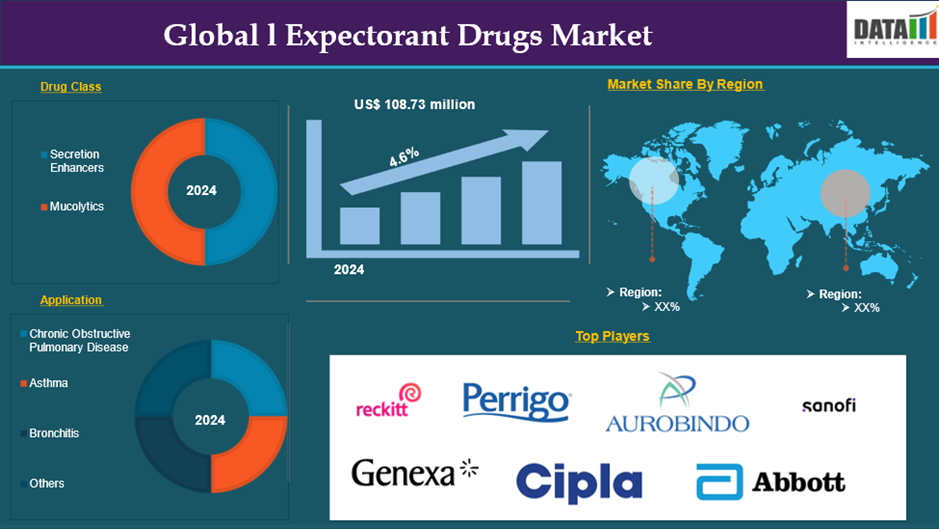
The Global Expectorant Drugs Market size was at US$ 113.73 million in 2025 and is expected to reach US$ 156.15 million by 2033, growing at a CAGR of 4.6% during the forecast period 2026-2033.
The global expectorant drugs market encompasses the segment of the pharmaceutical industry dedicated to medications that facilitate the expulsion of mucus from the respiratory tract. These drugs are primarily utilized to alleviate symptoms associated with respiratory conditions such as bronchitis, asthma, and chronic obstructive pulmonary disease (COPD) by promoting mucus clearance and easing cough and congestion. Expectorants enhance bronchial secretions or reduce mucus viscosity, making it easier for patients to cough up phlegm. A common active ingredient in these medications is guaifenesin, known for its effectiveness in thinning mucus.
The global expectorant drugs market plays a vital role in respiratory healthcare by providing effective treatments that enhance breathing comfort for patients suffering from various respiratory ailments. Ongoing innovations in drug formulations and delivery mechanisms, along with a growing emphasis on early intervention and preventive healthcare practices, are anticipated to further drive market expansion in the coming years.These factors have driven the global expectorant drugs market expansion.
Explore the Future of the Expectorant Drugs Market
Get a comprehensive sample report covering Expectorant Drugs Market trends, product developments, competitive landscape, application insights, and growth opportunities. Request your sample today to understand the key factors shaping the future of the expectorant drugs industry. Request Sample Report Today!
Expectorant Drugs Market Key Takeaways
- The growing demand for effective symptomatic relief from cough and respiratory congestion is emerging as a key market trend, with manufacturers focusing on expectorant formulations that help loosen mucus and support easier clearance of respiratory secretions across over-the-counter and prescription applications.
- North America maintains a significant position in the global expectorant drugs market, supported by established healthcare infrastructure, strong consumer awareness of cough and cold treatments, and the widespread availability of over-the-counter respiratory medications.
- Asia-Pacific is projected to record substantial growth, driven by its large and growing population, increasing incidence of respiratory conditions, expanding healthcare access, and rising consumer demand for readily available cough and cold medicines.
- The increasing prevalence of respiratory disorders and seasonal respiratory infections is becoming a major factor driving demand for expectorant drugs, particularly formulations containing active ingredients designed to reduce mucus viscosity and facilitate mucus clearance.
- Growing preference for convenient oral dosage forms, including syrups, tablets, capsules, and combination formulations, is supporting product development as consumers increasingly seek accessible and easy-to-administer treatments for cough associated with mucus production.
- Industry participants are increasingly focusing on formulation innovation, product differentiation, regulatory compliance, brand development, and distribution expansion to strengthen their position in the competitive expectorant drugs market.
- Rising healthcare expenditure, expanding pharmaceutical distribution networks, increasing availability of over-the-counter medications, and continued demand for symptomatic respiratory treatments are creating opportunities for pharmaceutical manufacturers to expand expectorant drug offerings across emerging and developed markets.
Expectorant Drugs Market Dynamics: Drivers & Restraints
Rising Prevalence of Respiratory Disorders
The rising prevalence of respiratory disorders is significantly driving the growth of the global expectorant drugs market and is expected to drive throughout the market forecast period.The increasing incidence of chronic respiratory diseases, such as chronic obstructive pulmonary disease (COPD), asthma, and bronchitis, significantly drives growth in the global expectorant drugs market. This trend underscores a growing public health concern, as millions of individuals are affected by these conditions worldwide.
According to the Centers for Disease Control and Prevention (CDC) data in 2023, chronic respiratory diseases rank among the leading causes of morbidity and mortality globally. The burden of these diseases is reflected in healthcare utilization patterns. COPD is noted in about 4.2% of visits to office-based physicians, indicating that it is a common reason for seeking medical attention. Furthermore, there were over 791,000 visits to emergency departments where COPD was the primary diagnosis, underscoring the acute exacerbations many patients experience.
Patients suffering from conditions like COPD and asthma often experience symptoms such as cough and congestion due to excessive mucus production. Expectorant medications are crucial in managing these symptoms by promoting mucus clearance from the airways, thereby improving patient comfort and quality of life.
Furthermorew, key players in the industry innovative launches sthat would drive this global expectorant drugs market.For instance, in November 2023, Mucinex, a brand under Reckitt, launched the "Flip the Script" campaign to raise awareness about the misuse of antibiotics, particularly concerning their application in treating cold and flu symptoms. This initiative aims to inform consumers about the risks associated with inappropriate antibiotic use, which significantly contributes to antibiotic resistance a pressing public health issue.All these factors demand the global expectorant drugs market.
Moreover, the rising demand for the research and development advancements contributes to the global expectorant drugs market expansion.
Stringent Regulatory Compliance
The stringent regulatory compliance will hinder the growth of the global expectorant drugs market.One of the primary challenges in the expectorant drugs market is navigating the complex regulatory landscape. Stringent approval processes established by health authorities can delay the development, manufacturing, and commercialization of expectorant medications. Companies are required to invest substantial resources to ensure compliance with evolving regulations, which can prolong market entry timelines and increase costs.
Meeting rigorous regulatory requirements, including safety assessments and efficacy validations, poses significant hurdles for manufacturers. The need for continuous adaptation to changing standards can lead to delays in product approvals and hinder the timely introduction of new expectorant drugs.Thus, the above factors could be limiting the global expectorant drugs market's potential growth.
Expectorant Drugs Market Segmentation Analysis
The global expectorant drugs market is segmented based on drug class, route of administration, application, end-user, and region.
Increasing Demand for Mucus-Clearing Therapies Supports the Expectorant Drug Class Segment
The drug class segment comprises different expectorant formulations used to facilitate mucus clearance and relieve productive cough associated with respiratory conditions. Expectorant therapies are primarily used to loosen and thin respiratory secretions, supporting easier expectoration and symptomatic relief. The segment is supported by continued demand for over-the-counter and prescription respiratory therapies for conditions associated with excessive mucus production.
Oral Administration Remains a Key Route for Expectorant Drug Delivery
Based on route of administration, the market is segmented into oral and other administration routes, depending on the formulation and therapeutic application. Oral expectorant formulations, including syrups, tablets, capsules, and other dosage forms, are widely used because of their convenient administration and availability across prescription and non-prescription respiratory care settings. Continued demand for convenient cough-relief formulations supports the use of oral expectorant products.
Rising Burden of Respiratory Conditions Supports the Application Segment
Based on application, expectorant drugs are used for respiratory conditions associated with productive cough and excessive mucus or respiratory secretions. Their applications include conditions such as acute bronchitis, chronic bronchitis, the common cold, respiratory tract infections, and other conditions involving mucus accumulation. Increasing prevalence of respiratory illnesses and continued demand for symptomatic treatment contribute to the application of expectorant therapies.
Broad Availability Across Healthcare Settings Supports the End-User Segment
Based on end-user, the expectorant drugs market is segmented across hospitals, clinics, pharmacies and drug stores, homecare settings, and other healthcare settings. Pharmacies and drug stores represent an important distribution and access point for expectorant products, particularly for over-the-counter cough and cold medications. Hospitals and clinics also use expectorant therapies as part of symptomatic management for patients with respiratory conditions, while homecare settings support continued use of non-prescription respiratory treatments.
Expectorant Drugs Regional Market Analysis
North America Expectorant Drugs Market
North America represents an important market for expectorant medicines, supported by established OTC pharmaceutical distribution networks, consumer access to cough-and-cold products, and the presence of recognized guaifenesin-based formulations.
In the United States, official drug labeling identifies guaifenesin as an expectorant used to loosen phlegm and thin bronchial secretions, while products are available in immediate-release and extended-release formulations.
The regional market is characterized by:
Strong OTC pharmaceutical availability
Established cough-and-cold product portfolios
Demand for convenient oral dosage forms
Standalone and combination respiratory products
Continued emphasis on consumer safety and product labeling
Canada also has an established regulatory framework for nonprescription oral adult expectorant products containing guaifenesin. Health Canada's labeling standard recognizes guaifenesin as an expectorant and permits several immediate-release oral dosage forms and oral liquid formulations.
Major demand areas include:
OTC Cough and Cold Medicines
Respiratory Symptom Management
Retail Pharmacies
E-Commerce and Online Pharmacies
Hospital and Healthcare Channels
Asia-Pacific Expectorant Drugs Market
Asia-Pacific represents a significant opportunity for expectorant drug manufacturers because of its large population, substantial pharmaceutical manufacturing base, diverse healthcare systems, and continuing respiratory disease burden.
WHO respiratory-virus surveillance has documented influenza activity across parts of Southern, South-East, and Western Asia, illustrating the continuing presence of respiratory infections that can generate demand for symptomatic respiratory treatments.
The regional market is supported by:
Large patient and consumer populations
Expansion of pharmaceutical manufacturing
Increasing availability of OTC medicines in several markets
Growth of pharmacy and digital-health distribution channels
Continuing demand for cough and cold symptom-relief products
India represents an important pharmaceutical manufacturing and consumption market, while China, Japan, South Korea, and Southeast Asian countries provide additional opportunities across OTC and prescription-oriented respiratory medicine channels.
Japan and Australia have established regulatory frameworks for guaifenesin-containing medicines. Australia's TGA monograph recognizes guaifenesin as an expectorant for symptomatic relief of congested chests and coughs associated with the common cold.
Key opportunity areas include:
Guaifenesin-based formulations
Oral liquid and syrup products
Tablets and capsules
Combination cough-and-cold medicines
Consumer healthcare products
Pharmacy and retail distribution
Europe Expectorant Drugs Market
Europe represents a mature pharmaceutical market characterized by established regulatory systems, strong pharmacy networks, and increasing attention to the safe and appropriate use of cough and cold medicines.
The European market is influenced by:
Established OTC and pharmacy distribution channels
Regulatory oversight of medicinal products
Demand for symptomatic respiratory treatments
Product safety and age-specific labeling requirements
Increasing emphasis on responsible self-care
The United Kingdom provides a clear example of regulatory attention toward cough and cold medicines. The MHRA has established safety advice covering OTC cough and cold medicines for children under 12, including products containing expectorants such as guaifenesin.
The European market is increasingly focused on:
Product safety
Evidence-based labeling
Appropriate pediatric use
Convenient dosage forms
Combination-product compliance
Pharmacist-supported consumer care
Latin America Expectorant Drugs Market
Latin America offers opportunities for expectorant drug manufacturers through its established pharmaceutical and consumer-health markets, broad pharmacy networks, and continuing demand for medicines used for cough and cold symptoms.
Respiratory infections remain an important source of seasonal healthcare demand, while access to OTC medicines and pharmacy-based healthcare services supports the availability of symptomatic respiratory products. WHO surveillance has reported influenza activity across parts of Central America, the Caribbean, and South America during seasonal periods.
Countries such as Brazil and Mexico represent important pharmaceutical markets in the region, while other Latin American countries provide opportunities through pharmacy, retail, and healthcare distribution networks.
Key opportunity areas include:
OTC cough and cold medicines
Guaifenesin-based products
Oral liquids and syrups
Combination respiratory formulations
Pharmacy-based distribution
Consumer healthcare products
Middle East & Africa Expectorant Drugs Market
The Middle East & Africa region presents opportunities for expectorant drug manufacturers because of continuing healthcare requirements, respiratory disease burdens, expanding pharmaceutical distribution networks, and increasing access to medicines.
Respiratory health remains an important public-health consideration globally, with WHO identifying respiratory infections and chronic respiratory diseases among major contributors to lung-related morbidity and healthcare needs.
Expectorant Drugs Market Major Global Players
The major global players in the expectorant drugs market include Reckitt Benckiser Group plc., Perrigo Company plc, Aurobindo Pharma, Sanofi, Genexa Inc., Cipla., Abbott, Marksans Pharma Ltd., and Granules India Limited. among others.
Key Developments in the Expectorant Drugs Market
- July 2026: Reckitt launched Mucinex 12HR Cold & Fever, a new category-focused cold-and-flu innovation within its Mucinex portfolio. The product was introduced ahead of the seasonal period, reinforcing the company’s focus on extended-duration, multi-symptom respiratory relief.
- May 2026: GlaxoSmithKline expanded its respiratory portfolio with enhanced expectorant and mucolytic drug combinations targeting chronic cough, COPD-related mucus buildup, and post-infectious respiratory congestion across global markets.
- April 2026: Sanofi advanced R&D programs focused on next-generation cough and expectorant formulations with improved mucus clearance efficiency and reduced side-effect profiles for long-term respiratory care.
- March 2026: Reckitt Benckiser strengthened its over-the-counter (OTC) cough and cold product line with new expectorant-based syrups and fast-acting formulations aimed at expanding retail respiratory care demand.
- February 2026: Johnson & Johnson enhanced its respiratory therapy segment through improved expectorant drug combinations integrated into multi-symptom cold and flu relief formulations for broader patient adoption.
- January 2026: AstraZeneca expanded clinical research into airway clearance therapies supporting expectorant mechanisms aimed at improving outcomes in asthma, bronchitis, and chronic respiratory conditions.
Expectorant Drugs Market Scope
| Metrics | Details | |
| CAGR | 4.6% | |
| Market Size Available for Years | 2025-2033 | |
| Estimation Forecast Period | 2026-2033 | |
| Revenue Units | Value (US$ Mn) | |
| Segments Covered | Drug Class | Secretion Enhancers, Mucolytics |
| Route of Administration | Oral, Injectable, Inhalation | |
| Application | Chronic Obstructive Pulmonary Disease, Asthma, Bronchitis, Others | |
| End-User | Hospital Pharmacies, Retail Pharmacies, Online Pharmacies | |
| Regions Covered | North America, Europe, Asia-Pacific, South America, and Middle East & Africa | |
Why Choose DataM?
- Therapeutic & Formulation Innovations: Explores advancements in expectorant drug formulations, including guaifenesin-based immediate-release and extended-release tablets, capsules, syrups, and combination formulations designed to loosen phlegm, thin bronchial secretions, and support more productive coughs.
- Product Performance & Market Positioning: Evaluates expectorant drugs based on critical parameters such as active ingredient concentration, onset and duration of action, dosage form, mucus-loosening performance, dosing convenience, tolerability, and suitability for different patient populations, highlighting how manufacturers differentiate products through extended-release formulations, convenient dosing, and targeted symptom relief.
- Real-World Evidence: Highlights the use of expectorant medications for temporary relief of chest congestion and mucus-associated cough, with guaifenesin products formulated to loosen phlegm and thin bronchial secretions, helping facilitate mucus clearance from the respiratory tract.
- Market Updates & Industry Changes: Tracks developments in expectorant drug formulations, OTC product launches, extended-release dosage technologies, combination cough and cold products, regulatory and labeling changes, and evolving consumer demand for convenient respiratory symptom-relief medications across major pharmaceutical markets.
- Competitive Strategies: Analyzes how pharmaceutical companies compete through formulation improvements, product-line extensions, extended-release technologies, combination therapies, brand development, regulatory strategies, distribution expansion, and broader OTC respiratory-care portfolios to strengthen their position in the expectorant drugs market.
- Pricing & Market Access: Examines pricing variations according to active ingredient concentration, dosage form, formulation technology, pack size, branded versus generic positioning, and distribution channel, alongside market access through pharmacies, drugstores, hospitals, healthcare providers, supermarkets, and online pharmaceutical platforms.
- Market Entry & Expansion: Identifies opportunities arising from demand for effective symptomatic management of mucus-producing coughs and chest congestion, while evaluating strategies such as generic and branded product development, differentiated formulations, extended-release products, regional distribution partnerships, OTC channel expansion, and portfolio diversification. Official drug labeling confirms guaifenesin's established expectorant use for loosening phlegm and thinning bronchial secretions.
The global expectorant drugs market report delivers a detailed analysis with 60+ key tables, more than 50 visually impactful figures, and 176 pages of expert insights, providing a complete view of the market landscape.
Target Audience
- Pharmaceutical & Biopharmaceutical Companies
- Expectorant Drug Manufacturers
- OTC Cough & Cold Drug Manufacturers
- Generic Drug Manufacturers
- Contract Development & Manufacturing Organizations (CDMOs)
- Drug Formulation & Drug Delivery Companies
- Healthcare Providers & Respiratory Care Professionals




























































