


Digital Therapeutics in Mental Health Market Size
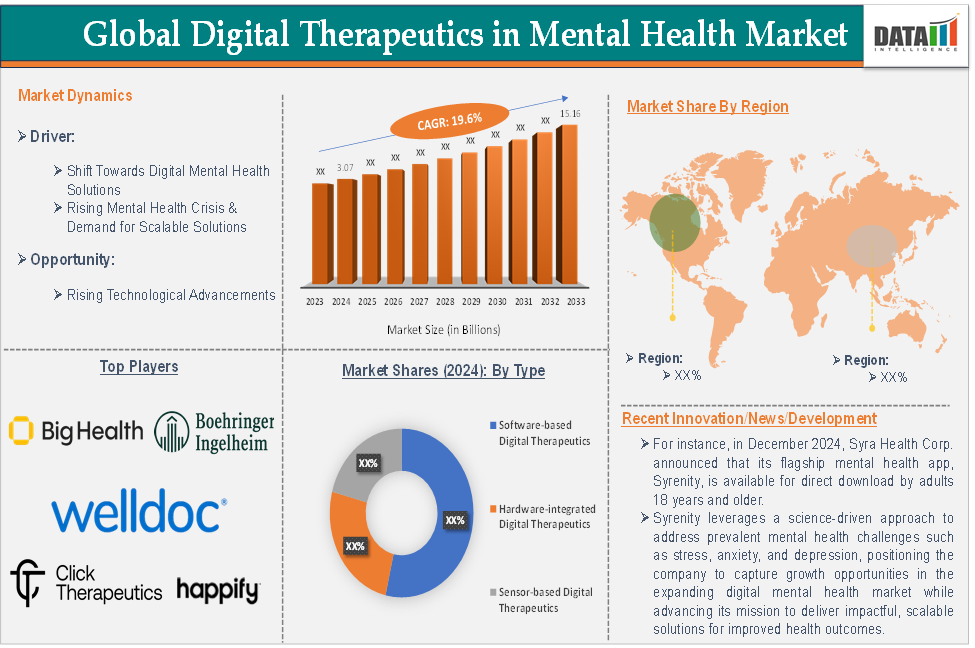
The global Digital Therapeutics in Mental Health Market reached US$ 3.67 billion in 2025 and is expected to reach US$ 27.00 billion by 2035, growing at a CAGR of 19.6% during the forecast period 2026-2035.
Digital therapeutics in mental health refers to evidence-based, software-driven therapeutic interventions designed to prevent, manage, or treat mental health disorders through digital technology. These solutions deliver personalized, clinically validated treatments via mobile apps, web-based platforms, AI-driven tools, virtual reality (VR), wearables, and connected devices to improve mental health outcomes. Unlike general wellness or mental health apps, digital therapeutics solutions undergo rigorous clinical validation, regulatory approvals, and real-world evidence trials to ensure efficacy and safety in treating conditions such as depression, anxiety, schizophrenia, substance use disorders, and other mental disorders.
Digital Therapeutics in Mental Health Market Key Takeaways
- The market is forecast to grow from US$ 3.67 billion in 2025 to US$ 27.00 billion by 2035, reflecting sustained investment in digital behavioral healthcare.
- Software-based digital therapeutics represent the largest revenue-generating segment due to their scalability, personalization, and continuous patient engagement capabilities.
- North America maintains market leadership owing to mature healthcare infrastructure, widespread smartphone penetration, favorable investment activity, and expanding reimbursement initiatives.
- Hybrid care models integrating clinicians with software-based therapeutic platforms are becoming a preferred treatment approach across healthcare systems.
- Regulatory agencies are increasingly developing reimbursement pathways that improve commercialization opportunities for clinically validated digital therapeutics.
- Venture capital investment and partnerships between healthcare providers and technology companies continue to accelerate product innovation and market expansion.
Digital Therapeutics in Mental Health Market Scope
| Metrics | Details |
| Market Size (2025) | US$ 3.67 Billion |
| Market Size (2035) | US$ 27.00 Billion |
| CAGR (2026-2035) | 19.60% |
| Historic Years | 2023-2024 |
| Base Year | 2025 |
| Forecast Period | 2026-2035 |
| Segments Covered | Type, Application, Region |
| Leading Region | North America |
| Fastest Growing Region | Asia-Pacific |
Market Executive Summary
Digital Therapeutics in Mental Health Market Dynamics: Drivers & Restraints
The shift towards digital mental health solutions is significantly driving the digital therapeutics in the mental health market growth
The growing recognition of mental health issues, alongside the shortage of mental health professionals, is leading to an increased reliance on digital mental health solutions. These platforms provide a scalable way to address the rising demand for mental health services, particularly for populations that may not have easy access to traditional in-person therapy. As the demand for digital mental health solutions rises, the market players are focusing on the development of digital therapeutics for the treatment of mental disorders.
Digital therapeutics solutions are built on evidence-based methodologies such as Cognitive Behavioral Therapy (CBT), Mindfulness-based Stress Reduction (MBSR), and Behavioral Activation (BA). These proven therapeutic models are delivered through apps and online platforms, offering patients an accessible, yet scientifically validated, way to manage and treat mental health conditions.
Data privacy & cybersecurity concerns hampering the market growth
Data privacy and cybersecurity concerns pose significant barriers to the growth of digital therapeutics in the mental health market, primarily due to the sensitive nature of mental health data and the increasing risks associated with cyberattacks and data breaches. The reliance on personalized data for treatment, along with the adoption of digital tools, raises security concerns among users, healthcare providers, and regulators.
With the increasing use of mobile apps and cloud storage to manage health-related data, digital mental health platforms are becoming prime targets for cyberattacks. A data breach could lead to identity theft, fraud, or reputational damage to the companies involved, causing a loss of consumer confidence and halting further adoption.
Digital Therapeutics in Mental Health Market Segment Analysis
The global digital therapeutics in mental health market is segmented based on type, application, and region
Type:
The software-based digital therapeutics segment is expected to dominate the digital therapeutics in mental health market with the highest market share
Software-based solutions, including mobile apps, online platforms, and AI-driven interventions, have rapidly gained popularity because they can be widely adopted and personalized to serve a large number of patients with mental health conditions. Software-based solutions are highly scalable, meaning they can serve large numbers of users simultaneously without requiring extensive physical infrastructure. These solutions are available 24/7, making mental health support more accessible for users around the globe. Thus, software solutions, especially mental health apps, are gaining traction.
Magellan Health, Inc., a leader in behavioral health and related services, launched a Teen Mental Wellbeing app to support the mental and emotional well-being of teenagers and young adults ages 13-22. Powered by BeMe Health's advanced digital health platform, the app helps promote self-understanding, builds resilience, and supports the journey to mental well-being through science-backed digital tools and evidence-based approaches.
Talkspace, a leading online behavioral health care company, announced it will join forces with FitOn, the No. 1 fitness app and digital health and wellness platform, to provide a holistic mental health and fitness solution to employers, and showcase the power of bringing together physical and mental fitness into an everyday setting. Employers and organizations can now turn to Talkspace for its comprehensive suite of mental health services, including its core virtual therapy offering, and have the option to add FitOn within the same engagement.
Digital Therapeutics in Mental Health Market Geographical Share
North America is expected to hold a significant position in the global digital therapeutics in mental health market with the highest market share
North America, particularly the U.S., has one of the most advanced healthcare systems globally. This includes widespread internet access, high smartphone penetration, and a tech-savvy population, all of which facilitate the adoption of digital health solutions, including digital therapeutics. The region has one of the highest adoption rates of smartphones and health-focused apps, which is a key factor in the dominance of software-based digital therapeutics in mental health.
North America is home to a large number of venture capital firms and private investors, and insurers who are actively funding and insuring digital health startups. This influx of investment has accelerated the growth of the digital therapeutics market in mental health by enabling research and development, clinical trials, and scaling of innovative solutions.
Key Developments
- February 2026: Orexo AB solidified its market leadership in the behavioral health sector by continuing the deployment and integration of its proprietary digital therapeutics platforms, MODIA and Deprexis. These platforms provide specialized, clinically validated digital interventions specifically engineered to address complex symptoms associated with depression and anxiety disorders.
- December 2025: Industry leaders accelerated the adoption of hybrid care models that combine traditional clinical practice with software-driven digital therapeutics to improve patient outcomes. This shift focused on embedding evidence-based interventions directly into mainstream healthcare workflows to tackle global resource limitations and improve the accessibility of mental health services.
- November 2025: Regulatory bodies and health systems worldwide increased their emphasis on establishing formalized reimbursement pathways for digital mental health applications, mirroring existing frameworks like Germany’s DiGA. This institutional push was designed to standardize the evaluation of digital therapeutics, ensuring that smartphone and computer-based treatments meet rigorous clinical efficacy benchmarks before integration into national health insurance coverage.
Digital Therapeutics in Mental Health Market Key players
Top companies in the digital therapeutics in mental health market include BigHealth, Click Therapeutics, Inc., Welldoc, Inc., 2Morrow Inc., Mindscapes, Calm.com, Inc., MoodMission Pty Ltd, Boehringer Ingelheim Pharmaceuticals, Inc., Headspace Inc., and Happify, Inc., among others.
Why Purchase the Report?
- Pipeline & Innovations: Reviews ongoing clinical trials, product pipelines, and forecasts upcoming advancements in medical devices and pharmaceuticals.
- Product Performance & Market Positioning: Analyzes product performance, market positioning, and growth potential to optimize strategies.
- Real-World Evidence: Integrates patient feedback and data into product development for improved outcomes.
- Physician Preferences & Health System Impact: Examines healthcare provider behaviors and the impact of health system mergers on adoption strategies.
- Market Updates & Industry Changes: Covers recent regulatory changes, new policies, and emerging technologies.
- Competitive Strategies: Analyzes competitor strategies, market share, and emerging players.
- Pricing & Market Access: Reviews pricing models, reimbursement trends, and market access strategies.
- Market Entry & Expansion: Identifies optimal strategies for entering new markets and partnerships.
- Regional Growth & Investment: Highlights high-growth regions and investment opportunities.
- Supply Chain Optimization: Assesses supply chain risks and distribution strategies for efficient product delivery.
- Sustainability & Regulatory Impact: Focuses on eco-friendly practices and evolving regulations in healthcare.
- Post-market Surveillance: Uses post-market data to enhance product safety and access.
- Pharmacoeconomics & Value-Based Pricing: Analyzes the shift to value-based pricing and data-driven decision-making in R&D.
The global digital therapeutics in mental health market report delivers a detailed analysis with 54 key tables, more than 48 visually impactful figures, and 148 pages of expert insights, providing a complete view of the market landscape.
Target Audience
- Manufacturers: Pharmaceutical, Medical Device, Biotech Companies, Contract Manufacturers, Distributors, Hospitals.
- Regulatory & Policy: Compliance Officers, Government, Health Economists, Market Access Specialists.
- Technology & Innovation: AI/Robotics Providers, R&D Professionals, Clinical Trial Managers, Pharmacovigilance Experts.
- Investors: Healthcare Investors, Venture Fund Investors, Pharma Marketing & Sales.
- Consulting & Advisory: Healthcare Consultants, Industry Associations, Analysts.
- Supply Chain: Distribution and Supply Chain Managers.
- Consumers & Advocacy: Patients, Advocacy Groups, Insurance Companies.
- Academic & Research: Academic Institutions.
Industry Impact Assessment
Increasing regulatory recognition, stronger reimbursement pathways, and wider acceptance of hybrid healthcare delivery models are improving commercial viability for digital therapeutics. At the same time, cybersecurity, privacy protection, and regulatory compliance remain essential priorities for technology providers seeking long-term market success.
Benefits of This Report
The report supports pharmaceutical companies, healthcare providers, technology developers, investors, procurement teams, and strategy professionals by delivering detailed analysis of market trends, competitive positioning, regulatory developments, pricing strategies, reimbursement evolution, investment opportunities, product innovation, and regional growth prospects. It also evaluates pipeline developments, real-world evidence, physician adoption patterns, supply chain considerations, and commercialization strategies across the digital therapeutics ecosystem.
Analyst Conclusion
The Digital Therapeutics in Mental Health Market is positioned for substantial long-term expansion as healthcare systems increasingly embrace software-based therapeutic interventions to address rising mental health needs. Strong clinical validation, supportive reimbursement initiatives, AI-driven personalization, and growing integration with traditional healthcare services will continue driving adoption through 2035. Organizations that prioritize regulatory compliance, cybersecurity, evidence-based product development, and strategic healthcare partnerships will be best positioned to capitalize on this rapidly expanding market while meeting the growing demand for accessible, scalable, and clinically effective mental healthcare solutions.





























































