


Data Center UPS Market Size and Overview
The global data center UPS market reached US$ 8.82 billion in 2025 and is expected to reach US$ 17.96 billion by 2035, growing with a CAGR of 7.3% during the forecast period 2026-2035.
In 2026, data center operators are no longer buying uninterruptible power supply systems as backup equipment. They are investing in power continuity platforms that directly influence uptime guarantees, AI workload performance and long-term operating costs. As rack densities increase and downtime penalties escalate, UPS systems have moved into the center of infrastructure decision-making.
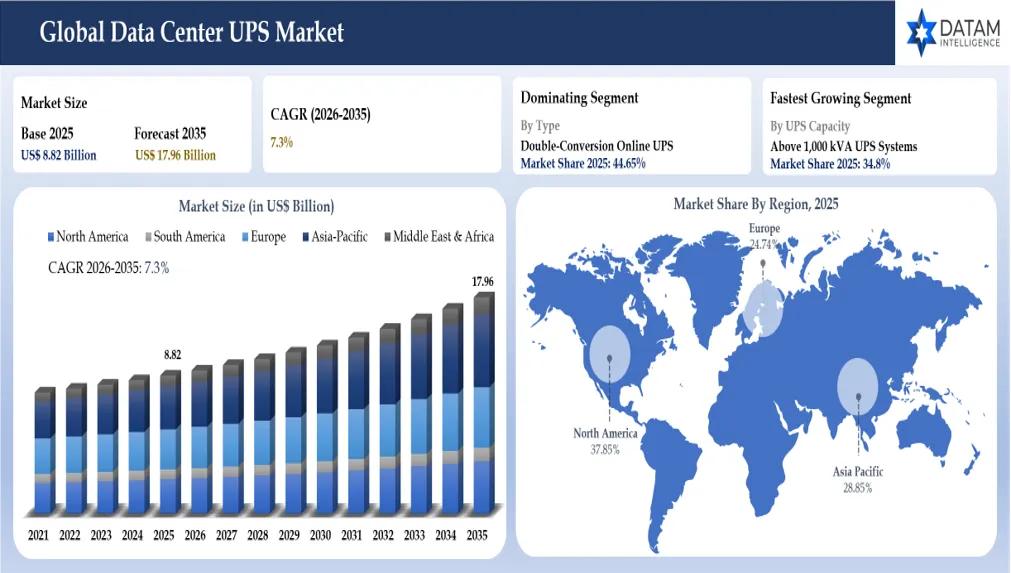
What is changing now is the nature of demand. AI clusters, cloud platforms and edge deployments are increasing power density, making UPS systems essential for both resilience and energy optimization. Procurement teams are evaluating UPS architectures based on scalability, battery technology and lifecycle ROI rather than upfront cost alone.
Data Center UPS Market Key Takeaways
- Market expansion is tied to AI infrastructure: Increasing GPU density is pushing UPS capacity requirements beyond traditional enterprise benchmarks.
- Asia-Pacific is the growth engine: Rapid expansion of cloud and colocation infrastructure is accelerating UPS deployment across China, India and Southeast Asia.
- Modular UPS systems are becoming the preferred architecture due to scalability and lower upfront capital investment.
- Lithium-ion batteries are reshaping total cost of ownership, offering longer life cycles and reduced maintenance compared to VRLA systems.
- Online UPS systems dominate critical workloads, ensuring uninterrupted power for high-risk applications such as BFSI, telecom and healthcare.
- Energy efficiency is now a financial metric, not just a sustainability goal, as operators seek to reduce operating expenses.
- Edge computing is expanding deployment models, increasing demand for compact and distributed UPS systems.
Data Center UPS Industry Trends and Strategic Insights
- The demand for UPS units with greater power density is driven by the rise in AI workloads with the growth in GPU clusters.
- Modular UPS units are becoming more prevalent, allowing incremental addition of capacities without affecting N+1 or 2N redundancy within the data centers.
- Lithium-ion batteries are making gains due to small footprint, increased longevity and reduced maintenance compared to VRLA batteries.
- The monitoring of the battery condition in real time, as well as the load, efficiency and predictive maintenance data, is common practice nowadays in the field of digital UPS systems.
- The use of prefabricated UPS systems is spreading, which allows installing standardized power systems quickly and effectively into AI and hyperscale data centers.
Data Center UPS Market Scope
| Metrics | Details | |
| 2025 Market Size | US$ 8.82 Billion | |
| 2035 Projected Market Size | US$ 17.96 Billion | |
| CAGR (2026-2035) | 7.3% | |
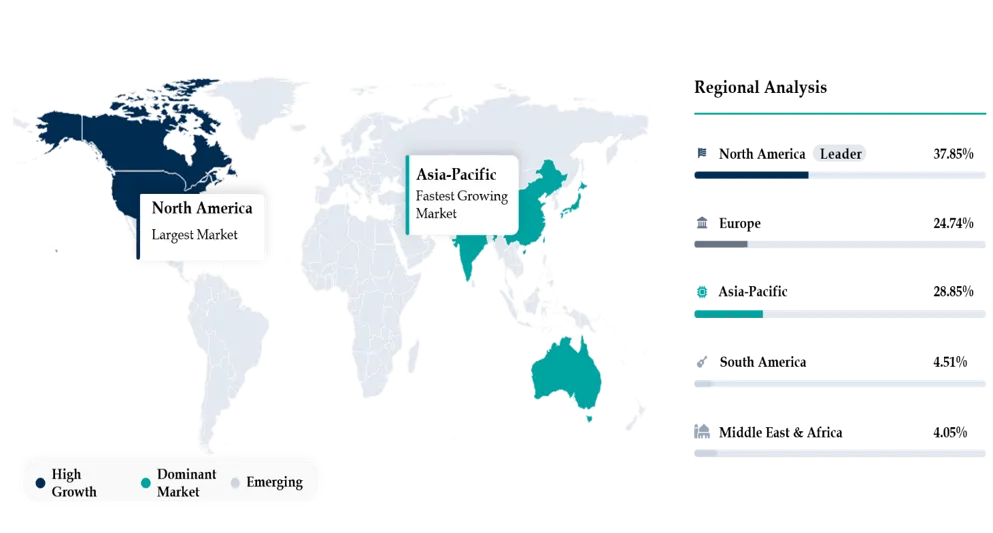
| Largest Market | North America | |
| Fastest Growing Market | Asia-Pacific | |
| By Type | Standby UPS, Line-Interactive UPS and Double-Conversion Online UPS | |
| By Size of Data Center | Small Data Centers (Up to 1 MW), Medium Data Centers (1–5 MW) and Large Data Centers (Above 5 MW) | |
| By End-User | Manufacturing Sector, Information Technology, Financial Institutions and Government Institutions | |
| By UPS Capacity | Up to 100 kVA, 101–500 kVA, 501–1,000 kVA and Above 1,000 kVA | |
| By Battery Technology | VRLA Batteries, Lithium-Ion Batteries, Nickel-Cadmium Batteries and Other Battery Technologies | |
| By Deployment | On-Premises Data Centers, Colocation Data Centers, Cloud Data Centers and Edge Data Centers | |
| By Region | North America | U.S., Canada, Mexico |
| Europe | Germany, UK, Russia, France, Spain, Italy, Poland | |
| Asia-Pacific | China, India, Japan, Australia, South Korea, Indonesia, Malaysia, Singapore, Vietnam, Thailand, Philippines, Taiwan | |
| South America | Brazil, Argentina | |
| Middle East and Africa | UAE, Saudi Arabia, South Africa, Israel, Turkiye, Nigeria | |
| Report Insights Covered | Competitive Landscape Analysis, Company Profile Analysis, Market Size, Share, Growth | |
Why does this report matter in 2026?
Data center UPS market is turning into an important investment segment in 2026 due to the impact of AI workloads, denser GPU clusters and rapid data center infrastructure growth that is making any power disruption costly. AI-driven data centers are demanding much denser rack configuration as compared to the typical enterprise setting, which implies a requirement for denser, more responsive, scalable and efficient UPS systems. These factors are driving purchase decisions away from traditional backup power and towards UPS systems that utilize a modular design, lithium-ion batteries, intelligent power management and larger three-phase capacities that can handle fluctuating loads.
The report is important due to the fact that there is a balance between uptime requirements and increasing power usage along with infrastructure costs for data center operators. The losses that come from UPS systems influence the efficiency of operations, while the battery type affects the size, life cycle, maintenance and cost of ownership of the facility. In 2026, looking at standby, line-interactive and double-conversion online UPS technologies in relation to capacity options, battery options, data center sizes and use cases can help determine which UPS technology options present economic and operational benefits in each specific situation. This makes the market highly relevant to UPS vendors, hyperscalers and colocation facilities, tech companies, infrastructure investors and organizations that need AI-ready data center capacity.
Data Center UPS Market White Space & Investment Opportunities
- There are investment opportunities available in the field of high capacity modular UPS systems which have greater than 1000 kVA because of the rising need for scalable architecture of power protection which can grow together with rising loads without changing the whole UPS system.
- Increasing the use of lithium-ion UPS battery systems provides a profitable venture, especially for companies providing battery management solutions which incorporate high-density power, safety, thermal monitoring and predictive maintenance capabilities, in view of the nature of current data centers.
- There is great white space in UPS systems powered by AI which are able to deal with fast load changes due to GPU clusters. UPS systems with fast transient performance, high overload tolerance, better efficiency on partial load conditions and load management can meet such needs.
- The edge and distributed data center is another investment area, since small-scale centers need small-scale UPS solutions with remote management capabilities, reduced maintenance effort and flexible battery options. Standardized UPS systems that can be remotely controlled by suppliers will help to overcome difficulties related to the management of multiple small sites.
- UPS digitalization and lifecycle services such as remote diagnostics, battery health analytics, predictive maintenance, energy optimization and DCIM integration present numerous opportunities. Repeat service and software models can not only generate extra revenue for UPS manufacturers, but also help data center operators to minimize downtime, decrease maintenance costs and prevent battery failures.
Data Center UPS Future Market Transformation
The data center UPS market would see a move away from legacy power-backup solutions towards intelligent high-density power resilience systems due to the rise in load fluctuation in data centers driven by AI and accelerated computing. Future UPS deployments would see the use of lithium-ion batteries, modular power bricks, increased capacity three-phase solutions, intelligent battery management and predictive maintenance in order to facilitate quick expansion while minimizing space and cost of ownership. There would also be closer integration between UPS systems and DCIM as well as energy management platforms to help users analyze power quality, battery management, load optimization and power efficiency. This shift will benefit suppliers who can provide scalable UPS capability, improved performance at partial loading, quicker installation and better power management for hyperscale, colocation and edge data centers.
Data Center UPS Market Buyer Decision-Making Criteria
As organizations continue to measure UPS systems by their capability to accommodate high-density and dynamic AI workloads with uptime, efficiency, scalability and consistent costs, buyers are no longer interested only in nameplate capacity but rather in how UPS systems behave during fast-changing loads and when operating at partial capacity as well as when expanding capacity in the future. Battery properties are becoming critical too, especially when comparing lithium-ion batteries with VRLA, in terms of space requirements, cooling, maintenance frequency, monitoring and overall lifetime costs. Interoperability with power management and data center infrastructure management systems may be decisive for suppliers in hyperscale and colocation facilities.
Major Buyer Decision-Making Criteria
- UPS Efficiency and Energy Losses
- Power Capacity and Scalability
- Load-Step and Transient Response
- Redundancy and Fault-Tolerance Architecture
- Battery Technology and Runtime
- Lithium-Ion vs. VRLA Lifecycle Economics
- Power Density and Physical Footprint
- Modular Expansion Capability
- Battery Monitoring and Predictive Maintenance
- Integration with DCIM and Energy-Management Systems
- Total Cost of Ownership
- Vendor Service Network and Maintenance Support
- Replacement Parts Availability
- Deployment and Commissioning Time
- Compliance with Data Center Reliability and Electrical Standards
Data Center UPS Market Economic & Investment Analysis
Macroeconomic trends such as digital transformation, cloud adoption and AI deployment are sustaining capital inflows into data center infrastructure. Hyperscale operators and colocation providers continue to invest heavily in power systems to ensure uptime and meet service-level agreements.
Investment is increasingly directed toward:
- Modular UPS deployments
- Lithium-ion battery integration
- Energy-efficient power architectures
- Edge data center infrastructure
Return on investment is being evaluated based on uptime improvement, reduced maintenance and energy savings rather than just capital cost. However, economic risks include supply chain disruptions and fluctuating component costs.
Data Center UPS Investment Trends in the Market
- Investments are moving towards modular UPS solutions with high capacity greater than 1,000 kVA due to the growth in hyperscale, cloud, colocation and AI-oriented data centers which are becoming multi-megawatt data centers. The focus for investors and operators is on the scalable UPS system where capacity can be increased gradually without compromising N+1 or 2N redundancy.
- Investments are being made in UPS systems based on lithium-ion batteries due to the efforts by data center operators to minimize battery room area, maintenance costs and battery replacements. Investors are also investing in battery management and monitoring systems.
- The investment in AI-ready UPS solutions is growing due to the high density that is achieved using GPU clusters and the dynamic nature of the loads that they impose on power equipment. Suppliers are working on UPS solutions with increased transient performance, power density, partial loading efficiency and smart load management dedicated to AI-based data center architectures.
- In addition to traditional forms of investment, there is an emerging trend toward investing in preassembled power infrastructures that include UPSs, batteries, switchgears and power distribution units. Such systems can help save time on installation and deployment and thus are highly desirable in the hyperscale and colocation space.
- Capital is transitioning to digital UPS systems management and lifecycles services. Services involve remote monitoring, predictive battery analytics, DCIM integration, energy optimization and condition-based maintenance. This technology helped to create opportunities for receiving recurring revenues from software and services provided to clients as well as provide operators with the ability to decrease uptime, maintenance costs and energy losses of big UPS system fleets.
Strategic Indicators for Data Center UPS Market
High Regulation Impact
Regulatory demands are starting to impact data center UPS procurement because UPS systems have to comply with rigorous standards concerning electrical safety, power quality, efficiency, battery safety and electromagnetic interference, while providing support to the continuous operations of critical IT loads. Regulatory and standard compliance concerning UPS systems’ efficiency, harmonic distortion, power factor, battery installation, thermal safety, fire protection and electrical redundancy can have a direct impact on the design and operational cost of such systems. The increasing use of lithium-ion batteries will make more important the need for battery safety and energy storage, especially for hyperscale and colocation data centers. With the increase in the capacity of data centers, the issue of compliance may play an essential role in such aspects as equipment choice, certification, installation setup, commissioning period and cost throughout the product's life cycle.
High Investment Activity
Investments within the data center UPS market are being made due to the increasing number of hyperscale, colocation, cloud and AI-specific data center construction projects. High IT loading density of these data centers means that there should be developed solutions that will have a greater ability to protect and manage the increasing number of loads. In 2026, investments will increasingly focus on solutions that include large modular UPS systems, lithium-ion batteries, smart power management and redundant solutions capable of gradual increase in capacity without major changes in the structure of the data center's infrastructure. There will also be investments in AI-ready facilities with denser racks, which require a UPS system that can provide increased capabilities for power protection.
Supply Chain Disruption
The data center UPS market is susceptible to supply chain disruptions since the production of UPS requires the availability of power semiconductors, IGBTs, capacitors, transformers, switchgear, control electronics, batteries and other power conversion components to come together. Disruptions in lead times for the procurement of semiconductors and electrical components may impact the manufacturing and commissioning of the units, while disruptions in lithium-ion batteries and battery management components may have an effect on the delivery timelines of new higher density UPS units. The large-scale development of data centers is vulnerable in that UPS systems need to be delivered and put into operation in accordance with carefully coordinated schedules. As a result, suppliers have been trying to source their components more locally and diversify their suppliers to mitigate risks of material shortages and geopolitical or logistical disruptions.
Pricing Volatility
Price volatility within the data center UPS market is being influenced by price fluctuations of copper, lithium, cobalt, batteries and other power electronics inputs. The IEA has stated that prices of base metals like copper and aluminum have risen by about one-third from January 2025 to April 2026 while the prices of lithium have more than doubled during the same time period. Copper is especially vital for the UPS electrical infrastructure in which the IEA has estimated that the contribution of copper within the cost of transformer and power cables is around 10-15%. At the battery level, the cost of an average lithium-ion battery pack has fallen by 8% in 2025 to reach US$108/kWh but the cost of lithium at the beginning of 2026 has risen to more than double its value from a year ago, thus exerting possible upward price pressure on the cost of lithium-ion batteries. These conflicting trends in costs are resulting in pricing uncertainties in respect of UPS equipment, battery systems and transformers as well as the associated electrical infrastructure needed for large data centers.
Procurement Pressure
The Procurement Pressure in the data center UPS market is increasing, as the buyers need to procure high-capacity UPS units, batteries, switchgears, transformers and power conversion equipment within a short window of time in the ever-condensed schedule for building data centers. UPS capacity needs to be considered along with the increasing density of the racks in the hyperscale and AI-driven installations, while the buyers are required to assess the efficiency at part loads, N+1/2N redundancy, battery chemistry, footprint, expandability and integration with DCIM tools. Lead time constraints associated with power electronics and electrical equipment have potential to limit commissioning and thus make delivery assurance, production capacity and cost equally significant along with price. It is due to these reasons that purchasers tend to give more importance to multi-year contracts, dual-sourcing strategy, UPS platform standardization, local service provision, spare parts and lifecycle cost warranties as opposed to price only.
New Technology Adoption
Data center UPS technology deployment is now moving to modular, high density and digitally-enabled UPS solutions that can support the AI and acceleration computing environment. New UPS systems are now adopting technologies such as lithium-ion batteries, battery management systems, silicon carbide (SiC) power semiconductors, efficient power conversion stages and predictive maintenance technology in order to boost power density and minimize energy loss. Modularity means that the UPS system can be upgraded as rack loads rise without needing to upgrade the entire system, while the digital aspect ensures that operators are able to monitor aspects like battery status, load status, power efficiency, temperature levels and UPS efficiency. UPS systems are evolving into managed power infrastructure owing to their integration with DCIM and energy management solutions, especially in hyperscale, colocation and AI-centric data centers.
Regional Expansion Opportunity
Data center UPS market expansion by region is seen to be most significant in the Asia Pacific, the Middle East and in rapidly developing data center hubs in Southeast Asia, with cloud computing, AI infrastructure and the development of additional hyperscale and colocation data center facilities increasing the need for power protection solutions. India, Southeast Asia, Saudi Arabia, the UAE and other areas seeing fast growth in digital infrastructure investment present a chance for UPS manufacturers to localize production, maintenance and battery management in proximity to developing data center clusters. In developed regions like North America and Western Europe, the focus is moving from construction of new sites to retrofitting UPS systems, increasing capacity, installing lithium-ion batteries and AI high-density data centers. The vendors who will be able to offer regional service capabilities, locally compliant hardware, modular capacity expansion and fast deployment capabilities stand to benefit the most.
Government Policy Support
Governments have policies that are backing up the data center UPS market by means of programs in digital infrastructure development, data center investment incentives, grid reliability and energy efficiency standards which promote development of resilient power systems. There are government policies in favor of increasing the data center capacities and development of cloud infrastructure in countries like India, Saudi Arabia, UAE, Singapore and US, which are providing support to the creation of data centers which use UPS systems. Energy efficiency and emission targets are increasing the demand for high efficiency UPS architecture, Li-Ion batteries, energy intelligence and management systems. Additionally, government-sponsored initiatives that focus on renewables and modernizing the grid have motivated data centers to enhance power quality control and connect their back-up systems to the overall energy network, which has opened doors for UPS manufacturers of energy-efficient and locally compliant power protection products.
Pricing Intelligence
The pricing intelligence in the data center UPS market is currently determined on the basis of UPS capacity, UPS topology, UPS redundancy level, battery design and required runtime, with standard unit pricing becoming irrelevant in lieu of benchmark pricing of UPS systems based on the configuration. In India, the 2025 CPWD Electrical Schedule of Rates specifies online modular UPS systems as ₹12.77 lakh for 100 kVA, ₹23.75 lakh for 200 kVA, ₹39.63 lakh for 300 kVA, ₹51.31 lakh for 400 kVA and ₹61.83 lakh for 500 kVA, offering a good reference point for large UPS capacity ratings. Central Public Works Department A 2025 Hyderabad procurement of two 100-kVA modular UPS systems with 12V/200Ah battery bank system had an estimated tender value of ₹41.32 lakh and was awarded at ₹36.36 lakh, demonstrating that batteries, installation, dismantling, testing and commissioning can make a considerable difference to the total project cost. tenders.infralens.in Thus, customers have started benchmarking prices per kVA basis, along with redundancy levels, runtime, modularity, installation scope, warranties and services.
| HS Code | Reporter | Trade Flow | 2025 Trade Value | Interpretation |
| 8504 | China | Exports | US$55 Billion | China is the leading exporter in the selected trade category, highlighting its strong manufacturing and export base for transformers, static converters and related power-conversion equipment used across data-center electrical infrastructure. |
| 8504 | Germany | Exports | US$13 Billion | Germany's substantial exports reflect its established power-electronics and electrical-equipment manufacturing base, supporting international supply of critical power-conversion equipment. |
| 8504 | United States | Imports | US$36 Billion | The high import value indicates strong U.S. demand for power-conversion equipment, consistent with large-scale investment in data centers, industrial facilities and critical electrical infrastructure. |
| 8504 | Germany | Imports | US$14 Billion | Germany's significant import value indicates an integrated international supply chain in which domestic manufacturers and data-center infrastructure projects rely on imported electrical and power-conversion equipment. |
Note: HS 8504 is a broad trade proxy covering electrical transformers, static converters and inductors; it does not isolate UPS systems. Therefore, these values should be interpreted as indicators of the power-conversion and electrical infrastructure supply chain relevant to the data center UPS market, rather than direct UPS trade values.
AI Impact Analysis of Data Center UPS Market
The basic characteristics of UPS technology are changing due to AI by causing the increase in rack power densities, more rapid changes in load and the increase in size of concentrated electrical loads in data centers. GPU clusters and accelerators may cause rapid changes in power consumption which result in the need for better UPS dynamic performance, higher power quality, overload tolerance and redundant capabilities. AI is creating an increased demand for high capacity three-phase UPS modules and UPS architectures which could scale up with more GPUs. AI also has an impact on UPS systems due to the focus on power density optimization, thermal alignment, load monitoring and predictive battery management, allowing users to be resilient without a proportional increase in infrastructure.
However, AI is also making huge changes to the way in which UPS equipment is managed and serviced. Through machine learning analysis, an AI system could monitor data collected by a UPS, like battery voltage, temperature, load conditions and power quality, to find unusual activity that would point to a potential failure and an impending power failure. The use of technology along with DCIM, building-management and energy-management platforms allows AI-based systems to improve load balancing, battery usage, maintenance planning and energy efficiency in several UPS systems. For UPS manufacturers, this implies a move from selling independent backup devices to developing integrated, software-based solutions for energy resilience where competitiveness largely relies on monitoring and predictive maintenance capabilities, interoperability and optimization of product life cycle.
Disruption Analysis of Data Center UPS Market
The data center UPS market is being transformed as there is a shift from traditional UPS implementations to scalable, modular and high density power architectures meant for AI and hyperscale applications. The traditional UPS designs, which have been based on fairly stable IT loads, are being increasingly threatened by load fluctuations driven by GPUs, higher rack densities and rapid scale-ups. This is driving greater usage of modular UPS blocks, lithium-ion batteries, energy-efficient power conversion methods and distributed power configurations enabling capacity increases in small increments without changing the infrastructure. This disruption is also leading to competition between the established players in the UPS market and upstarts in the power electronics market.
The second disruption that is happening is in the UPS operations and maintenance strategy. In order to lessen the reliance on pre-planned maintenance and manual assessment, real-time telemetry, remote diagnostics, battery-health analytics and predictive maintenance are being more applied in connected UPS systems. The integration of these systems with data center infrastructure management (DCIM) technologies and energy-managing platforms allows operators to oversee UPS capacity, battery usage, power quality and maintenance in tremendous premises. Hence, competitive advantage is specified with respect to advanced software capabilities rather than just UPS capacity and reliability of hardware parts.
Data Center UPS Market BCG Matrix: Company Evaluation
STAR
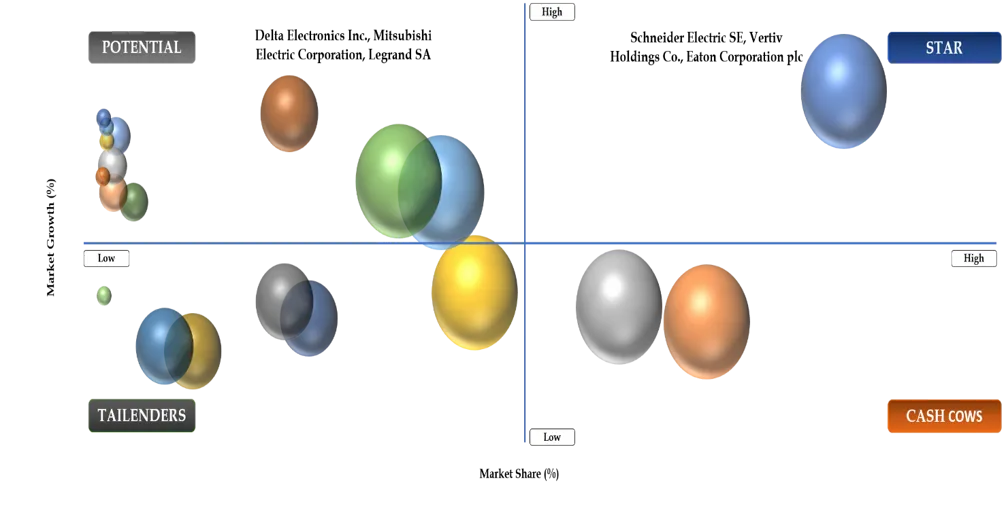
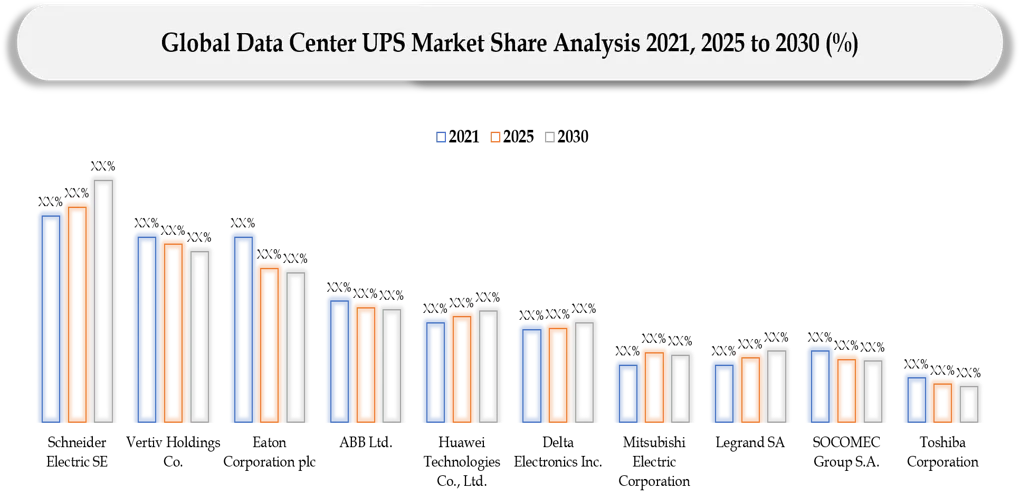
Companies like Schneider Electric SE, Vertiv Holdings Co., Eaton Corporation plc and Huawei Technologies Co., Ltd. have been classified as Stars since they possess good competitive positions along with presence in the areas of growth that are expanding the most rapidly in the data center UPS market such as Hyperscale, colocation data centers, AI-enabled data centers, modular UPS, Lithium-ion Battery systems and power-efficient architecture. Their extensive range of products, global service offerings, existing relations with major data center facility managers and further improvements in intelligent power management systems will help them gain an advantage in the growing market of power-efficient data centers.
POTENTIAL
Potential companies include Delta Electronics Inc., Mitsubishi Electric Corporation, Legrand SA, SOCOMEC Group S.A., Kehua Data Co., Ltd., KSTAR, Fuji Electric Co., Ltd. and Piller Power Systems GmbH that can build on their strengths to become stronger in their position with growing demand for energy-efficient, modular, large-scale capacity and custom-built UPS systems. These companies have an existing power electronics expertise base and UPS product range that can help them grow while increasing their penetration into hyperscale, colocation, artificial intelligence-based and new regional data center markets can make them more influential in the market. Expansion of manufacturing, service infrastructure, lithium-ion products and connectivity of UPS systems would certainly give them more competitive advantages.
Data Center UPS Market Dynamics
Driver Impact Analysis
| Driver | Market Growth Impact (%) | Demand Concentration | Impacted Use Case | Strategic Impact |
AI and High-Density Computing Expansion | 28% | Hyperscale and AI-focused data centers | GPU clusters and high-density AI racks | Drives demand for high-capacity, modular, high-efficiency UPS systems with rapid load-response capability |
Hyperscale and Cloud Data Center Expansion | 24% | Hyperscale cloud campuses and colocation facilities | Large-scale cloud and colocation deployments | Increases demand for scalable UPS capacity, N+1/2N redundancy and standardized power architectures |
Rising Data Center Power Reliability Requirements | 19% | Mission-critical and enterprise data centers | Continuous IT and network operations | Supports investment in double-conversion online UPS, redundant architectures and advanced power-quality management |
Adoption of Lithium-Ion and Intelligent UPS Technologies | 16% | New-build and high-density facilities | Space-constrained data centers and modernized UPS infrastructure | Reduces footprint and maintenance requirements while increasing demand for battery monitoring, predictive maintenance and digitally managed UPS systems |
Driver: AI and High-Density Data Center Expansion
The leading growth factor in the data center UPS market is the increasing adoption of AI servers, GPU clusters and dense computing systems, resulting in higher power consumption per rack and making electricity consumption highly dynamic. The data centers designed specifically for AI applications need UPS solutions that have high power density, fast transient capability, high conversion efficiency and scalable three-phase solutions to ensure immunity from voltage variations and short outages. Such requirements have prompted an increase in capital investments in modular UPS units, lithium-ion batteries and smart power systems that provide needed broadening of capabilities together with GPUs expansion without occupying unnecessary floor space and energy losses. The move to AI hyperscale and colocation data centers thus means an increase in the demand for UPS capacity and standards.
Restraint Impact Analysis
| Restraint | Drag on Market Growth (%) | Primary Impact Area | Impacted Use Case | Strategic Impact |
High Upfront Cost of High-Capacity UPS Systems | 22% | Capital expenditure | Hyperscale and large colocation data centers | Favors phased deployment, modular UPS architectures and lifecycle-based procurement |
High Battery Replacement and Lifecycle Costs | 18% | Battery economics and maintenance | Long-runtime backup systems and large mission-critical facilities | Accelerates adoption of lithium-ion batteries and intelligent battery monitoring |
Complexity of UPS Integration and Redundancy Design | 16% | Electrical infrastructure and commissioning | N+1 and 2N data-center architectures | Increases demand for standardized modular systems and integrated power-management solutions |
| Space and Thermal Constraints | 14% | Equipment footprint and cooling | High-density AI and GPU data centers | Drives demand for higher power-density UPS systems and compact battery configurations |
Restraint: High Capital and Lifecycle Cost of High-Capacity UPS Infrastructure
Higher capital expenditure and lifetime expenses continue to be a significant limitation since large data centers must have UPSs to go hand-in-hand with batteries, switchgears, distribution, monitoring systems, installation, commissioning and power path redundancy. The issue is more pronounced in the case of N+1 and 2N architecture, which calls for more UPS modules and additional battery power in order to achieve fault tolerance. Battery replacement, cooling, maintenance agreements and testing also add to the cost of ownership, even though lithium-ion solutions have higher upfront costs because of their higher life cycle and smaller size. This can lead to postponing UPS upgrades or adopting phased capacity expansions, especially for smaller companies, where the load justifies nothing more than a non-redundant system.
Data Center UPS Market Segment Analysis
The global data center UPS market is segmented based on the type, size of the data center, end-user, UPS capacity, battery technology, deployment and region.
By Type
Double-Conversion Online UPS Dominates the Market
Double-Conversion Online UPS emerged as the market leader for the data center UPS market with a dominant market share of 44.65% in 2025, it is extensively used at Tier III, Tier IV, hyperscale and colocation data centers. This technology transforms incoming AC power into DC and back to AC, thereby protecting the sensitive servers, GPUs and storage and networking devices from voltage changes as well as electrical disturbances. Thanks to its reliability, high density IT load support and other traits, double conversion systems have established themselves as the best choice for mission-critical data centers.
By UPS Capacity
Above 1,000 kVA UPS Systems Lead Capacity Growth
The above 1,000 KVA segment is a rapidly growing segment with an estimated annual growth rate of 8.5%. Demand is driven by large-scale artificial intelligence and hyperscale facilities that require megawatt-scale power backup, along with increased rack density and scalable N+1 or 2N redundancy. Furthermore, the trend towards larger quantities of GPU clusters is shifting the demand for UPS systems with high-capacity ratings that provide adequate electrical load capacity while allowing for phased expansion of the data centers and reduced complexity arising from deploying various smaller UPS systems.
Data Center UPS Market Geographical Penetration
U.S. Data Center UPS Market Landscape
The U.S. data center UPS market is undergoing changes due to the rise of hyperscale campus, AI-oriented data center operations and high-density colocation, especially in mature and developing clusters of data centers located in Virginia, Texas, Arizona, Georgia and Ohio. The rising number of GPUs makes operators look for more dense installations, resulting in the need for three-phase modular and highly efficient UPS systems with high capacity, as well as lithium-ion batteries. The U.S. market of data centers is paying more attention to the needs for N+1, 2N redundancy, fast deployment, power quality management, battery prediction and integration with DCIM software. As the timelines of connection to the grid and access to electricity become barriers for the operation of new facilities, the vendors providing scalable architectures, high power density and battery and energy management solutions acquire strategic importance.
Japan Data Center UPS Market Outlook
Data center UPS market in Japan has been driven by the development of hyperscale cloud infrastructures, artificial intelligence computing, colocation centers and edge data centers within the key digital centers in the country like Tokyo and Osaka. Higher electricity costs, land limitations, seismological risks and business continuity considerations have increased demand for efficient UPS systems with redundancy and quick response time. The implementation of modular three-phase UPS systems, lithium-ion batteries and advanced battery monitoring systems in data centers is becoming a trend to be followed due to their advantages in decreasing the footprint of the equipment, maintenance costs and lifecycle costs while accommodating the growing density of GPUs. Due to the well-developed manufacturing sector in Japan, there has been a trend towards the manufacturing systems solutions with advanced systems of electricity quality control, reliable UPS systems and the systems of maintenance.
China Data Center UPS Market Trends
The China data center UPS market will be fueled by the fast growth of hyperscale cloud centers, AI computing infrastructures, internet data centers and computing centers in regions in the context of digital-infrastructure development in the country. The demands will shift from large-scale three-phase and modular UPS systems to cope with power needs from GPU clusters and densified servers and to reduce the usage of electricity with higher efficiency and higher density designs of architectures in order to minimize power consumption and maximize space within the data center. China-based UPS manufacturers will strengthen their positions through local power electronics, the use of lithium-ion batteries, intelligence and rapid maintenance services which will put extra pressures on foreign vendors. The market will be shaped by the need for energy-efficient data centers and renewable-power utilization and thus provide opportunities for UPS with high conversion efficiency, battery management, power monitoring and deployability in hyperscale, colocation and edge data centers.
Data Center UPS Market Competitive Landscape
- The competition is based around high-capacity and modular UPS systems, with top players in the market distinguishing themselves by offering scalable three-phase systems, high power density and fast scalability of the capacity.
- The new requirements related to power densities due to AI applications are changing the competitiveness, focusing on UPS solutions that can efficiently handle GPU load changes, fast transient responses, high efficiency and robust performance in varying high-density loads.
- The incorporation of lithium-ion batteries into the system is emerging as a competitive differentiator because vendors compete by offering smaller size, longevity, lower maintenance, sophisticated battery management systems and lower total cost of ownership than VRLA-based batteries.
- The vendors are distinguished more than ever through digital power management, as top companies offer seamless UPS systems together with DCIM, energy management, remote monitoring, battery health analytics and predictive maintenance systems instead of traditional backup power devices.
- The capabilities of service and deployment speed play an ever more important role, as data center operators choose suppliers who can provide regional manufacturing capabilities, spare parts availability, commissioning experience, 24x7 service and the possibility to deliver UPS systems in line with the accelerated schedules of AI-based and hyperscale construction.
Public Company Q1-Q2 2026 Performance Comparison
Below is a comparative analysis of five firms that have direct exposure to the data center UPS market. These financial figures indicate the performance of the entire firm in Q1-Q2 of 2026 since the income generated through standalone data center UPSs is usually not disclosed separately. The performance factors are thus differentiate general corporate performance from specific UPS and data center infrastructure exposure.
| Company | Q1–Q2 2026 Performance | Data Center UPS Exposure | Key Performance Driver |
| Schneider Electric SE | US$24.7 Billion revenue | Direct exposure through modular, three-phase and high-efficiency UPS systems for hyperscale, colocation, AI and enterprise data centers | Record data-center demand, electrification investment, modular UPS adoption and energy-management solutions |
| Vertiv Holdings Co. | US$5.92 Billion revenue | Direct exposure through high-capacity and modular UPS systems, batteries and integrated critical-power infrastructure | AI-driven data-center expansion, higher rack densities, strong orders and accelerated deployment of critical infrastructure |
| Eaton Corporation plc | US$16.0 Billion revenue | Direct exposure through single-phase, three-phase and modular UPS systems integrated with data-center electrical infrastructure | Data-center momentum, strong Electrical segment orders and backlog and rising demand for critical-power infrastructure |
| ABB Ltd. | US$18.21 Billion revenue | Exposure through UPS, electrification, power distribution and automation solutions supporting mission-critical data centers | Strong electrification demand, data-center investment, record orders and increasing requirements for integrated power infrastructure |
| Delta Electronics Inc. | US$4.9 Billion revenue | Direct exposure through high-efficiency UPS, power electronics and integrated data-center power infrastructure | AI infrastructure expansion, power-efficiency requirements, high-density computing and demand for advanced power-management solutions |
Note: Company-level revenue should not be interpreted as data center UPS revenue unless separately disclosed. Financial periods and reporting currencies differ across companies because companies follow different fiscal calendars.
Key Companies of Data Center UPS Market
- Schneider Electric SE
- Vertiv Holdings Co.
- Eaton Corporation plc
- ABB Ltd.
- Huawei Technologies Co., Ltd.
- Delta Electronics Inc.
- Mitsubishi Electric Corporation
- Legrand SA
- SOCOMEC Group S.A.
- Toshiba Corporation
- Cyber Power Systems Inc.
- Riello Elettronica S.p.A. (Riello UPS)
- AEG Power Solutions BV
- Kohler Co.
- Piller Power Systems GmbH
- Kehua Data Co., Ltd.
- KSTAR
- Siemens AG
- Fuji Electric Co., Ltd.
- Borri S.p.A.
Company Profiles of Data Center UPS Market
Schneider Electric SE
Schneider Electric is among the leading companies in the industry of critical power and data center infrastructure, with an extensive portfolio of UPS solutions comprising modular, three-phase and high-efficiency UPS solutions for hyperscale, colocation, enterprise and edge data centers. The company’s data center power solution consists of UPS solutions, lithium-ion batteries, power distribution, DCIM, energy management and EcoStruxure technologies, which places Schneider Electric at an ideal position to handle increased power density due to AI and acceleration computing.
The competitive priorities include increasing the presence of high density, modular UPS systems, improving energy efficiency, implementing smart monitoring and predictive maintenance, developing lithium-ion battery systems and facilitating rapid capacity growth in AI-enabled and hyperscale data centers.
Vertiv Holdings Co.
Vertiv is one of the leading suppliers of critical digital infrastructure, where its UPS system caters to data centers facing increased rack density and varied AI computing loads. The company’s product line ranges from modular UPS to high-density UPS systems with power and thermal management, power distribution and monitoring and service options, which enable Vertiv to offer integrated power and thermal management solutions in large-scale data center settings.
The main competitive priorities of Vertiv include developing scalable UPS solutions for AI infrastructure, improving power efficiency, scaling up modular solutions, developing energy storage systems and batteries and offering standard solutions.
Eaton Corporation plc
Eaton is a diversified power management company, which also provides a wide array of data-center UPS solutions including single phase, three phase, modular and high capacity UPSs. Their corporate strategy focuses on the linkage between UPS equipment and intelligent power distribution, energy management, battery management and electrical infrastructure to enable the data centers to enhance their resilience and manage energy use.
Some of the company’s competitive priorities include the development of modular and highly efficient UPS solutions, supporting lithium-ion batteries, improving digital power management, scaling to high density data centers and using their electrical solutions portfolio to win integrated infrastructure projects.
ABB Ltd.
ABB is partcipating in the data center UPS market through the use of high-efficiency uninterruptible power solutions and the development of electrification technologies to support essential facilities. Its value proposition stems from the interconnectedness of UPS, switchgear, power distribution, automation and energy management systems as the demand for a well-coordinated electrical infrastructure in data centers continues to grow with the increase in computing density and intensification of AI activities.
The business goals focus on improving UPS efficiency and density of power density, promoting modular and scalable designs, employing smart monitoring and energy management systems, embracing advanced battery technologies and strengthening its presence in large electrification projects in data centers.
Huawei Technologies Co., Ltd.
The company is a leading provider of data center power infrastructure solutions that feature UPS systems developed for high-density computing and modular installation and intelligent power management. The Huawei FusionPower range and its related data center infrastructure solutions focus on small form factors, high efficiency, digital monitoring and the use of lithium-ion batteries, thereby placing the company in good position with respect to hyperscale and AI-focused data centers.
Competitive considerations involve growing the presence in AI-ready data centers, boosting UPS power efficiency and density, extending lithium-ion energy storage integration, enhancing intelligent power management and deploying across China and abroad.
Delta Electronics Inc.
Delta Electronics is a company that manufactures power electronics equipment and has an established presence in high-efficiency UPS systems for use in data centers. The products and services of the company involve UPS systems along with power supplies, energy management, thermal solutions and other related electrical infrastructure to address rising power density and efficiency needs of facilities.
The competitive strengths of the company involve developing more high-capacity and modular UPS systems, increasing efficiency of conversion, enabling AI and hyperscale data centers and utilizing their experience in power electronics to minimize energy consumption.
Data Center UPS Market Major Pain Points
- The expensive nature of high-capacity UPS systems is still a big hurdle for big data centers, where there is the need to install these UPS systems along with battery storage, switchgear, distribution, monitoring systems and other forms of power redundancy, increasing the cost of setting up the infrastructure.
- Rapidly changing AI workload is yet another significant hurdle for big data centers, as GPU-dependent workloads tend to produce unpredictable demand curves on the power system and demand better response, load management and overload capacity.
- There is the issue of battery replacement and management as well. VRLA batteries have shorter lifecycles and lithium-ion batteries, though more costly, have more demanding requirements when it comes to thermal monitoring and safety control systems.
- The complexity of N+1 and 2N redundant configurations grows with the growth of power capacity of data centers into multi-megawatts. The design, implementation, testing and commissioning of such systems may bring about problems of synchronization, load sharing, bypass configurations and maintenance without disruption of critical IT systems operation.
- Long lead times and deployment constraints may cause postponement of commissioning due to the need for components of large UPS systems, including power semiconductors, transformers, capacitors, switchgear, batteries and controls, which might be subject to supply limitations. Such problems will make it hard for UPS vendors and data center owners to coordinate equipment shipment and commissioning with fast-growing AI and hyperscale facilities.
Data Center UPS Market Recent Developments
- September 2026 - Vertiv made an agreement to acquire UtilityInnovation Group (UIG) at a price of around US$1.45 billion to enhance its competencies in microgrids control, generation orchestration, switchgear and behind-the-meter power architectures.
- September 2026 - Kehua expanded its AI data-center power offerings with the addition of the WisePTU comprehensive power and distribution system with the 1.2 MW MR33 modular UPS. It claims that it has reduced the footprint by 24%, with an architecture that helps to save on power-distribution losses.
- September 2026 - Schneider Electric launched AI-ready power products featuring pre-assembled power modules and power skids that use Galaxy VXL UPS with capacities up to 2 MW, 2.25 MW and 2.5 MW for hyperscale, neocloud and colocation data centers. The standardized solutions are optimized to facilitate the faster deployment of GPU-driven AI infrastructure.
- August 2026 - Vertiv introduced a 1.8 MW extension of its PowerUPS 9000 platform targeting AI and critical applications data centers in Asia-Pacific. The platform includes controls for handling fast load changes associated with AI, such as Battery Shield and Input Power Smoothing to mitigate the problems with batteries and input power fluctuation.
- August 2026 - Schneider Electric launched their latest APC Smart-UPS multi-chemistry platform that supports VRLA and lithium-ion batteries and enables upgrading the battery chemistry in the future without swapping out the UPS. This new generation platform offers up to 1.4× more power density and three times base runtime.
Analyst View / Opinion on Data Center UPS Market
- AI workloads are shifting UPS procurement toward high-density power architectures: The quick adoption of GPU servers is leading to higher power density and load dynamics on racks, thus making high power, modular and responsive UPS solutions more interesting than fixed-capacity designs.
- Modular UPS systems are likely to gain preference in new data-center projects: Users can expand their UPS capacity as they expand their IT capacity, thereby providing a phase-wise investment option while still keeping redundancy intact.
- Lithium-ion batteries will increasingly influence UPS technology selection: Though lithium-ion batteries have more expensive initial cost, small size, longevity, low maintenance needs and are suitable for intelligent battery management; hence, lithium-ion batteries are more fitting for high density and space-constricted data centers.
- UPS efficiency is becoming a direct operating-cost consideration: With the increase in electrical consumption by data centers as a result of the development in AI computing, there is an increased focus on efficient UPS, especially efficiency during partial load conditions where inefficiency of power conversion results in electricity losses in big data centers.
- Competitive advantage is shifting from UPS hardware toward integrated power management: Suppliers who can provide UPSs along with battery systems, power distribution, DCIM connectivity and monitoring among others have a competitive edge.
Target Audience of Data Center UPS Market
| INDUSTRY | WHO SHOULD BUY THIS REPORT? | REASON TO BUY THIS REPORT |
| Data Center Infrastructure | Data Center Operators and Developers | Assess UPS capacity requirements, redundancy configurations, battery technologies and power infrastructure investments for new and expanding facilities. |
| Cloud & Colocation Services | Cloud and Colocation Service Providers | Evaluate demand for high-density, modular and scalable UPS systems driven by hyperscale and AI workloads. |
| UPS & Power Electronics | UPS Manufacturers and Component Suppliers | Identify technology trends, capacity opportunities, competitive positioning and demand for lithium-ion and high-efficiency UPS solutions. |
| Telecommunications | Telecommunications Companies | Assess UPS requirements for network facilities, edge data centers and distributed digital infrastructure requiring continuous power protection. |
| Government & Public Sector | Government and Public Sector Organizations | Understand market development, critical-power requirements, energy-efficiency priorities and infrastructure investment opportunities. |
| Energy & Power Management | Energy and Power Management Firms | Identify opportunities in intelligent power management, battery monitoring, energy optimization and integration of UPS systems with broader electrical infrastructure. |
| Investment & Financial Services | Investors and Private Equity Firms | Evaluate market growth opportunities, competitive dynamics, technology adoption, regional expansion and investment potential across UPS and data-center infrastructure. |
Why Choose DATAM?
- Data-Driven insights: Dive into detailed analyses with granular insights such as pricing, market shares and value chain evaluations, enriched by interviews with industry leaders and disruptors.
- Post-Purchase Support and Expert Analyst Consultations: As a valued client, gain direct access to our expert analysts for personalized advice and strategic guidance, tailored to your specific needs and challenges.
- White Papers and Case Studies: Benefit quarterly from our in-depth studies related to your purchased titles, tailored to refine your operational and marketing strategies for maximum impact.
- Annual Updates on Purchased Reports: As an existing customer, enjoy the privilege of annual updates to your reports, ensuring you stay abreast of the latest market insights and technological advancements. Terms and conditions apply.
- Specialized Focus on Emerging Markets: DataM differentiates itself by delivering in-depth, specialized insights specifically for emerging markets, rather than offering generalized geographic overviews. The approach equips our clients with a nuanced understanding and actionable intelligence that are essential for navigating and succeeding in high-growth regions.
- Value of DataM Reports: Our reports offer specialized insights tailored to the latest trends and specific business inquiries. The personalized approach provides a deeper, strategic perspective, ensuring you receive the precise information necessary to make informed decisions. The insights complement and go beyond what is typically available in generic databases.
What DATAM Uniquely Provides
- DATAM delivers AI-enabled UPS demand mapping, which helps to measure how AI server technology, GPU clusters and increasing rack density affect capacity demands for UPS in various data center designs.
- DATAM delivers capacity-specific market intelligence of UPS solutions from Up to 100 kVA, 101–500 kVA, 501–1,000 kVA and Above 1,000 kVA, which allows one to understand in which ranges of capacity there is the most intense demand and investment opportunities.
- DATAM delivers benchmarking of battery technologies and lifecycles from VRLA, lithium-ion, nickel-cadmium and other battery technologies in relation to their footprint, cycle life, maintenance needs, run time and costs.
- DATAM offers deployment-based competitive intelligence analysis for on-premises, co-location, cloud and edge data center environments, focusing on the contrasts in terms of redundancies, scalability, power density and purchasing priorities.
- DATAM offers competitive positioning of suppliers based on critical-power requirements through comparative analysis of the best-in-class UPS providers on modular design, efficiency, high density, digital monitoring, battery management, coverage of services and scalability.




























































