


CRISPR-Based Diagnostics Market Size
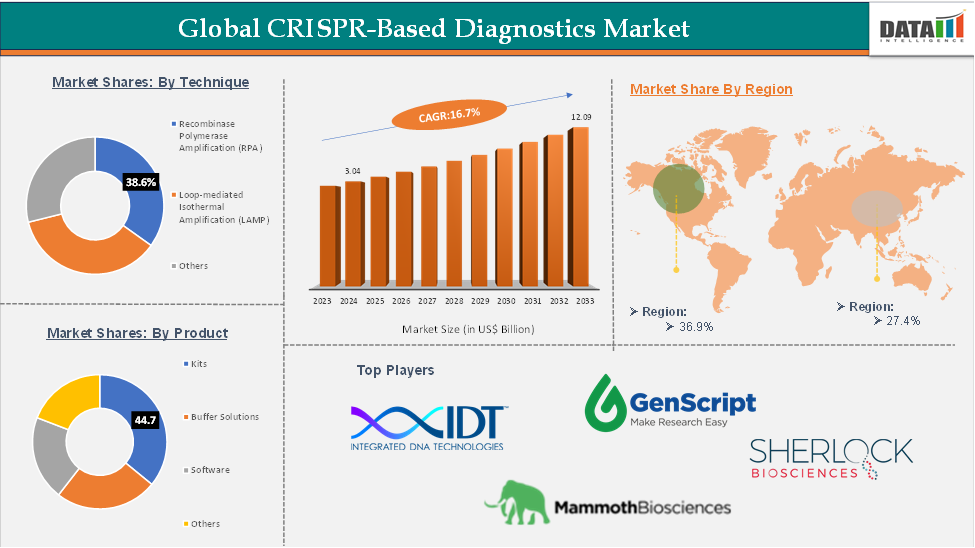
The CRISPR-Based Diagnostics Market will reach US$ 4.15 billion in 2026, up from US$ 3.56 billion in 2025, and is projected to reach US$ 18.00 billion by 2035, registering robust growth at a CAGR of 16.7% during the forecast period from 2026 to 2035.
CRISPR-based diagnostics have emerged as promising tools capable of revolutionizing the field of molecular diagnostics. CRISPR enzymes can be useful in biomedical applications to recognize biomarkers of infectious and non-infectious diseases, as well as cancer and many other diseases that involve a nucleic acid sequence.
Market growth is being driven by the rising global burden of infectious diseases such as tuberculosis, dengue, and emerging viral threats, alongside a growing prevalence of chronic and genetic conditions. The urgent need for accurate and timely diagnostics, especially highlighted during the COVID-19 pandemic, has accelerated interest and investment in CRISPR-based tools. Additionally, collaborations between biotech firms, academic institutions, and public health agencies are fueling innovation and expediting commercialization.
The market holds significant opportunities, particularly in point-of-care diagnostics, personalized medicine, and early detection of rare or antimicrobial-resistant diseases. Recent partnerships, such as those between Illumina and the Broad Institute and between CRISPRbits and Molbio Diagnostics, underscore the growing momentum and commercial interest in this space.
CRISPR-Based Diagnostics Market Executive Summary
For more details on this report - Request for Sample
CRISPR-Based Diagnostics Market Scope
| Metrics | Details | |
| CAGR | 16.7% | |
| Market Size Available for Years | 2022-2035 | |
| Estimation Forecast Period | 2025-2035 | |
| Revenue Units | Value (US$ Bn) | |
| Segments Covered | Technique | Recombinase Polymerase Amplification (RPA), Loop-mediated Isothermal Amplification (LAMP), Others |
| Product | Kits, Buffer Solutions, Software, Others | |
| Application | Infectious Diseases, Non-Infectious Diseases | |
| End User | Hospitals, Diagnostic Centers, Biotechnology Companies, Academic and Research Institutes, Others | |
| Regions Covered | North America, Europe, Asia-Pacific, South America, and the Middle East & Africa | |
Key Takeaways
- North America accounted for approximately 35-40% of the global CRISPR-Based Diagnostics Market share in 2025, driven by increasing investments supporting genomic medicine initiatives, expanding molecular diagnostics capabilities, and strong commercialization activities across biotechnology organizations.
- Recombinase Polymerase Amplification (RPA)-based technologies represented nearly 38-40% of total market revenue in 2025 owing to their compatibility with rapid point-of-care diagnostic applications and superior amplification efficiencies.
- Infectious disease applications contributed approximately 55-60% of overall market demand in 2025, supported by increasing requirements for rapid pathogen detection capabilities and growing global healthcare preparedness initiatives.
- More than 70% of newly announced clinical and translational research programs globally are focused on next-generation CRISPR-Cas technologies supporting multiplex diagnostics, precision medicine applications, and portable diagnostic platforms.
- Biotechnology and pharmaceutical organizations accounted for nearly 65-70% of total market investments in 2025, reflecting increasing expenditures across assay development technologies, manufacturing infrastructure expansions, and strategic commercialization initiatives.
- Point-of-care diagnostic applications are anticipated to contribute approximately 35-40% of future commercialization opportunities through 2033 owing to increasing demand for decentralized healthcare technologies and rapid molecular testing capabilities.
- Asia-Pacific is projected to register the fastest regional growth during the forecast period owing to expanding biotechnology infrastructure, increasing healthcare expenditures, and rising investments supporting genomic diagnostics innovations across emerging healthcare markets.
- Multiplex CRISPR diagnostic technologies are expected to account for approximately 30-35% of future product innovations globally, substantially strengthening early disease detection and personalized healthcare initiatives.
- More than 60% of strategic collaborations announced across the market involve molecular diagnostics development programs, clinical validation initiatives, and point-of-care diagnostic technologies highlighting the increasing importance of technological innovation worldwide.
CRISPR-Based Diagnostics Market Dynamics: Drivers & Restraints
Rising prevalence and incidence of infectious diseases are expected to drive the CRISPR-based diagnostics market
The development of rapid and sensitive diagnostic tools is critical for effective patient management and controlling the spread of infectious diseases. As the global burden of disease continues to rise, there is an urgent demand for faster, more accessible diagnostic methods. For instance, in 2024, the CDC reported at least 35 million flu cases, resulting in 400,000 hospitalizations and 25,000 deaths in a single season.
While current diagnostics are highly specific and sensitive, they often rely on time-consuming processes, expensive laboratory infrastructure, and trained personnel, limiting their usability in resource-limited settings, large-scale screenings, and during outbreaks.
Dengue threatens nearly half of the global population, with an estimated 100-400 million infections occurring each year. Dengue fever further emphasizes the importance of rapid diagnostics. Timely and accurate diagnosis is crucial for managing individual cases and preventing widespread transmission.
CRISPR-based diagnostic technologies are emerging as transformative tools. These systems offer rapid, highly specific, and sensitive detection, allowing healthcare providers to differentiate dengue from other similar illnesses and make prompt, informed decisions. Consequently, the increasing demand for efficient and accessible diagnostic solutions amid growing infectious disease threats is expected to drive significant growth in the CRISPR-based diagnostics market.
High costs of CRISPR-based diagnostic tools and systems
Developing, manufacturing, and scaling CRISPR diagnostic tools involve substantial investment in specialized reagents, advanced equipment, and skilled personnel. These factors drive up the overall cost of each test, making it less accessible, particularly in low- and middle-income countries or in resource-limited healthcare settings where affordability is a critical factor.
Moreover, although CRISPR technologies are often promoted as simpler alternatives to conventional molecular diagnostics, the initial setup costs, including the need for controlled environments and supporting infrastructure, can be a barrier to widespread adoption.
CRISPR-Based Diagnostics Market Regulatory Landscape and Diagnostic Approval Analysis
The CRISPR-Based Diagnostics Market operates within an evolving regulatory environment characterized by stringent quality assurance standards governing advanced molecular diagnostic technologies. Regulatory authorities worldwide continue emphasizing analytical validation requirements, clinical performance standards, and post-market surveillance initiatives supporting diagnostic product commercialization activities. Increasing regulatory support for innovative point-of-care diagnostic technologies addressing unmet clinical needs is anticipated to improve commercialization timelines across major healthcare markets. Additionally, evolving frameworks supporting precision medicine initiatives are expected to significantly influence future regulatory developments globally.
CRISPR-Based Diagnostics Market Manufacturing and Commercialization Landscape Analysis
Commercial manufacturing capabilities remain among the most significant determinants influencing successful market expansion across CRISPR-based diagnostics worldwide. Manufacturers are increasingly investing in scalable production technologies supporting assay kits, reagents, and integrated diagnostic platforms. Strategic collaborations involving biotechnology organizations and manufacturing partners continue accelerating commercialization initiatives across emerging diagnostic applications. Investments supporting manufacturing automation technologies and quality management systems are anticipated to substantially strengthen future supply capabilities globally.
CRISPR-Based Diagnostics Market Infectious Disease and Oncology Diagnostics Analysis
Infectious diseases currently represent one of the largest application segments across the CRISPR-based diagnostics market owing to increasing global healthcare requirements supporting rapid pathogen detection capabilities. Simultaneously, oncology applications are witnessing significant technological advancements involving biomarker detection technologies and precision oncology initiatives. Growing demand for early-stage disease identification and personalized diagnostic approaches is anticipated to substantially expand commercialization opportunities across both application segments throughout the forecast period.
CRISPR-Based Diagnostics Market Investment and Funding Landscape Analysis
Public and private sector investments supporting CRISPR-enabled diagnostic technologies continue creating attractive commercialization opportunities globally. Biotechnology companies, venture capital organizations, and strategic investors are increasingly allocating resources toward assay development technologies, clinical validation programs, and manufacturing infrastructure initiatives. Strategic funding activities supporting next-generation molecular diagnostics are expected to significantly accelerate technological innovations across the global market. Furthermore, increasing collaborations between academic institutions and commercial organizations are anticipated to strengthen future investment trends considerably.
CRISPR-Based Diagnostics Market Supply Chain and Laboratory Infrastructure Analysis
Supply chain resilience and laboratory infrastructure development continue representing critical factors influencing commercialization activities across CRISPR-based diagnostics worldwide. Manufacturers are increasingly investing in integrated supply chain capabilities supporting reagent manufacturing, quality control processes, and commercial-scale production initiatives. Growing demand for decentralized diagnostic technologies is anticipated to significantly strengthen laboratory infrastructure investments across both developed and emerging healthcare markets. Additionally, advancements involving automated diagnostic workflows are expected to improve operational efficiencies throughout the forecast period.
CRISPR-Based Diagnostics Market CRISPR Clinical and Translational Research Landscape Analysis
Clinical and translational research activities surrounding CRISPR-based diagnostics continue to expand rapidly owing to increasing demand for rapid, sensitive, and highly specific molecular diagnostic technologies. Pharmaceutical companies, biotechnology organizations, and academic institutions are actively developing next-generation CRISPR-based assays capable of addressing infectious diseases, oncology applications, and genetic disorders. Growing investments supporting translational medicine initiatives are accelerating the commercialization of innovative diagnostic platforms across major healthcare markets. Furthermore, increasing clinical validation studies evaluating CRISPR-enabled diagnostic technologies are anticipated to significantly strengthen market adoption throughout the forecast period.
CRISPR-Based Diagnostics Market Point-of-Care Diagnostics Analysis
Point-of-care applications represent one of the most promising commercialization opportunities across the CRISPR-based diagnostics ecosystem. The ability of CRISPR technologies to deliver rapid, accurate, and portable diagnostic capabilities significantly improves accessibility across decentralized healthcare environments. Growing demand for affordable molecular diagnostics suitable for resource-limited settings continues driving innovation activities worldwide. Advancements involving paper-based diagnostic platforms, microfluidic technologies, and portable biosensing systems are anticipated to substantially improve future commercialization prospects throughout the forecast period.
CRISPR-Based Diagnostics Market Segment Analysis
The global CRISPR-based diagnostics market is segmented based on technique, product, application, end user, and region.
Technique:
The recombinase polymerase amplification (RPA) segment is expected to hold 38.6% of the global CRISPR-based diagnostics market
The recombinase polymerase amplification (RPA) segment is poised to dominate the CRISPR-based diagnostics market due to its compatibility with point-of-care applications and its cost-effectiveness. RPA, an isothermal amplification technique, enables rapid nucleic acid amplification without the need for complex thermal cycling equipment, making it particularly suitable for resource-limited settings and large-scale screenings.
When combined with CRISPR-based systems, such as CRISPR/Cas12a, RPA enhances the sensitivity and specificity of diagnostics, allowing for the detection of low-abundance targets with high precision. Recent advancements underscore the growing adoption of RPA in CRISPR-based diagnostics. For instance, a study developed a CRISPR/Cas12a platform coupled with RPA for the rapid detection of antimicrobial-resistant genes in carbapenem-resistant Enterobacterales, demonstrating its potential for infectious disease diagnostics.
CRISPR-Based Diagnostics Market Geographical Analysis
North America is expected to hold 36.9% of the global CRISPR-based diagnostics market
In North America, the escalating prevalence of chronic diseases, genetic disorders, and infectious diseases has intensified the demand for innovative and efficient diagnostic methods. For instance, the Centers for Disease Control and Prevention (CDC) reported that in 2023, the United States experienced a significant rise in tuberculosis (TB) cases, with a total of 9,615 cases, a 16% increase from 2022 and the highest number reported in a decade. This surge underscores the urgent need for rapid and accurate diagnostic tools to manage and control such infectious diseases.
In response to this growing demand, there has been a notable increase in collaborations among government agencies, commercial enterprises, and academic institutions across the region. These partnerships are fostering innovation and accelerating the translation of research into practical applications.
For instance, in August 2024, Illumina announced a strategic partnership with the Broad Institute to develop new gene sequencing kits that enable large-scale sequencing using an innovative approach based on the Nobel Prize-winning CRISPR technology. In a separate collaboration involving the Broad Institute and Harvard University, Illumina will also focus on single-cell research sequencing. This initiative will utilize advanced technology from Fluent BioSciences to conduct cutting-edge experiments aimed at enhancing the precision and scalability of genomic research.
These technologies are particularly appealing to healthcare professionals seeking efficient solutions to combat the spread of infectious diseases. Collectively, the increasing incidence of diseases, coupled with strategic collaborations and the increased demand for rapid diagnostic solutions, is expected to drive significant growth in the CRISPR-based diagnostics market in North America during the forecast period.
CRISPR-Based Diagnostics Market Top Companies
The top companies in the CRISPR-based diagnostics market include OraSure Technologies, Inc., Mammoth Biosciences, Inc., Integrated DNA Technologies, GenScript, among others.
Key Developments in CRISPR-Based Diagnostics Market
- June 2026: OraSure Technologies, Inc. received U.S. FDA clearance for its Colli-Pee™ Dx urine collection kit for sexually transmitted infection testing, strengthening its molecular diagnostics portfolio and supporting decentralized diagnostic solutions.
- June 2026: Mammoth Biosciences, Inc. continued advancing its DETECTR® CRISPR diagnostic platform by expanding research efforts focused on highly sensitive and rapid nucleic acid detection technologies for multiple disease applications.
- May 2026: Integrated DNA Technologies (IDT) strengthened its CRISPR solutions portfolio by expanding genome editing and molecular diagnostic reagent offerings that support the development of next-generation CRISPR-based diagnostic assays.
- May 2026: GenScript Biotech Corporation enhanced its life sciences capabilities through continued investments in CRISPR technologies, synthetic biology, and nucleic acid products supporting molecular diagnostics research.
- April 2026: Mammoth Biosciences, Inc. showcased advancements in its proprietary MB-CasFire enzyme platform designed to improve the sensitivity, specificity, and robustness of CRISPR-based diagnostic applications.
- March 2026: Integrated DNA Technologies (IDT) continued expanding its custom CRISPR reagent manufacturing capabilities to support clinical research and diagnostic assay development worldwide.
- March 2026: GenScript Biotech Corporation advanced its gene synthesis and CRISPR technology platforms to accelerate innovation in precision diagnostics and genomic medicine applications.
- February 2026: OraSure Technologies, Inc. continued progressing its strategic initiatives in molecular diagnostics through investments in rapid and at-home testing technologies that complement CRISPR-based diagnostic applications.
Emerging Technologies Analysis
Emerging technologies involving artificial intelligence-enabled diagnostic platforms, multiplex CRISPR assays, smartphone-integrated biosensors, and advanced microfluidic systems are substantially transforming future market opportunities. Innovations supporting real-time disease detection capabilities and portable diagnostic technologies are expected to significantly improve patient outcomes worldwide. Furthermore, increasing integration between genomic medicine initiatives and CRISPR-based diagnostics is anticipated to strengthen commercialization prospects across personalized healthcare applications globally.
Future Market Trends (2026-2035)
The CRISPR-Based Diagnostics Market is expected to witness substantial growth throughout the forecast period driven by increasing demand for precision diagnostics, expanding infectious disease testing requirements, and continuous technological advancements across molecular diagnostic technologies. Future market expansion will be supported by innovations involving point-of-care diagnostics, multiplex testing platforms, and personalized medicine initiatives. Additionally, strategic investments supporting manufacturing capabilities, clinical validation activities, and regulatory advancements are anticipated to significantly influence future market dynamics across major healthcare economies.
Who Should Buy This Report?
This report is designed for biotechnology companies, molecular diagnostics manufacturers, pharmaceutical organizations, academic research institutions, Contract Research Organizations (CROs), healthcare technology providers, and strategic consulting firms seeking actionable insights into emerging CRISPR-based diagnostic technologies and commercialization opportunities. Institutional investors, venture capital organizations, and business development teams can leverage the report to evaluate investment trends, technological developments, and competitive dynamics shaping the global market. Furthermore, laboratory directors, healthcare providers, and regulatory stakeholders can utilize the report to support informed decisions related to product development initiatives, manufacturing expansion strategies, and long-term commercialization planning activities.
Why Should You Buy This Report?
This report provides comprehensive market intelligence on the CRISPR-Based Diagnostics Market by delivering valuable insights into technological advancements, clinical development trends, regulatory developments, and investment opportunities across major global markets. It enables stakeholders to identify high-growth opportunities across point-of-care diagnostics, precision medicine applications, and next-generation molecular diagnostic technologies while evaluating evolving market adoption patterns worldwide. Furthermore, the report supports strategic decision-making related to product innovation initiatives, manufacturing capacity expansion strategies, strategic partnerships, and market entry opportunities by providing in-depth analyses of competitive dynamics, regional growth opportunities, and future technological developments expected to shape the industry through 2035.
The global CRISPR-based diagnostics market report delivers a detailed analysis with 57 key tables, more than 46 visually impactful figures, and 168 pages of expert insights, providing a complete view of the market landscape.




























































