


Bispecific T-cell Engagers (BiTEs) Market Size & Industry Outlook
The Bispecific T-cell Engagers (BiTEs) Market will reach US$ 3.29 billion in 2026, up from US$ 2.63 billion in 2025, and is projected to reach US$ 24.69 billion by 2035, registering robust growth at a CAGR of 25.1% during the forecast period from 2026 to 2035.
The market is expanding rapidly, driven by the rising prevalence of hematologic and solid tumors, coupled with the increasing adoption of next-generation immuno-oncology therapies. BiTEs represent a major advancement in cancer treatment by directly engaging cytotoxic T cells to target tumor-associated antigens, resulting in high efficacy and lower off-target toxicity compared to traditional therapies.
Several factors are fueling this growth trajectory. The strong clinical success of approved products such as Blincyto® (Amgen) and the launch of next-generation BiTEs like tarlatamab (Imdelltra) have validated the therapeutic potential of this class, encouraging further R&D investments. Expanding clinical pipelines targeting novel antigens (e.g., DLL3, PSMA, HER2) and the development of half-life-extended BiTE formats are widening the applicability of the technology beyond hematologic cancers into solid tumors. Moreover, favorable regulatory support, increasing strategic collaborations between biotech firms and large pharmaceutical companies, and advancements in antibody engineering are accelerating product commercialization and manufacturing scalability.
Additionally, the growing focus on personalized medicine, rising cancer incidence worldwide, and improved reimbursement frameworks in major markets such as the U.S. and Europe are contributing to market momentum. As key players expand their pipelines and new entrants bring innovative BiTE constructs, the global market is expected to experience sustained double-digit growth, transforming the oncology therapeutics landscape over the forecast period.
Key Takeaways
- North America accounted for approximately 45-48% of the global Bispecific T-cell Engagers (BiTEs) Market share in 2025, driven by increasing regulatory approvals, robust oncology research investments, and the strong presence of leading pharmaceutical companies actively expanding their immuno-oncology portfolios.
- Hematologic malignancies represented nearly 55-60% of the total market revenue in 2025, making them the leading therapeutic application segment owing to the clinical success of BiTE therapies across acute lymphoblastic leukemia, multiple myeloma, and non-Hodgkin lymphoma treatment indications.
- CD3-based target antigens accounted for approximately 50-55% of total market demand in 2025, supported by their critical role in redirecting T-cell-mediated immune responses against cancer cells and their broad utilization across commercially approved and pipeline BiTE candidates.
- More than 70% of the global BiTE clinical pipeline is currently focused on next-generation immunotherapy platforms targeting both hematological malignancies and solid tumors, highlighting growing investments in advanced T-cell engager technologies.
- Pharmaceutical and biotechnology companies contributed nearly 65-70% of total market investments in 2025, reflecting increasing expenditures across clinical development programs, strategic licensing agreements, and next-generation antibody engineering technologies.
- Solid tumor applications are expected to register the fastest growth during the forecast period owing to increasing research activities involving HER2, EGFR, PSMA, DLL3, and other novel tumor-associated antigens designed to address unmet therapeutic needs across oncology markets.
- Asia-Pacific is projected to register the fastest regional growth through 2033, supported by expanding oncology healthcare infrastructure, increasing clinical trial activities, growing healthcare expenditures, and rising investments in biologics manufacturing capabilities across emerging economies.
- Combination therapeutic approaches integrating BiTE therapies with immune checkpoint inhibitors and targeted oncology treatments are anticipated to contribute approximately 30-35% of future pipeline developments by 2033, significantly expanding commercialization opportunities across precision oncology applications.
- More than 60% of newly announced strategic collaborations and licensing agreements within the BiTE ecosystem involve next-generation bispecific and multispecific antibody technologies, emphasizing the increasing importance of technological innovation across the global immunotherapy landscape.
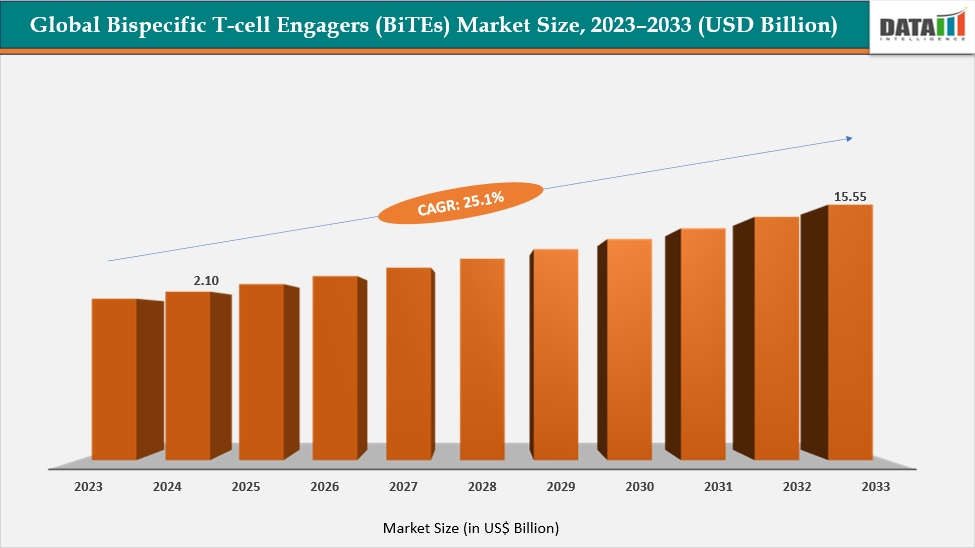
Bispecific T-cell Engagers (BiTEs) Market Scope
| Metrics | Details | |
| CAGR | 25.1% | |
| Market Size Available for Years | 2023-2033 | |
| Estimation Forecast Period | 2026-2033 | |
| Revenue Units | Value (US$ Bn) | |
| Segments Covered | Type | CD19, CD20, CD33, CD123, Others |
| Target Indication | Hematologic Malignancies, Solid Tumors | |
| Mechanism of Action | Dual Antibody-Based BiTEs, Single-Chain Variable Fragment (scFv)-Based BiTE, Next-Generation BiTEs (Half-life extended, trispecific, or modular BiTEs) | |
| End User | Hospitals, Specialty Cancer Clinics, Research and Academic Institutes, Biotechnology & Pharmaceutical Companies | |
| Regions Covered | North America, Europe, Asia-Pacific, South America and the Middle East & Africa | |
Bispecific T-cell Engagers (BiTEs) Market Dynamics
Drivers: The Rising Prevalence of Cancer Worldwide is significantly driving the Bispecific T-cell Engagers (BiTEs) market growth
The global burden of cancer is increasing at a marked pace, driven largely by population ageing, growth, and shifting exposure to risk factors. The numbers exclude non-melanoma skin cancers and reflect only the best available data. In addition to sheer case volume growth, the distribution is shifting: lower- and middle-income countries are expected to see the sharpest proportional increases, due to demographic transition and rising prevalence of traditional and lifestyle-related risk factors.
This escalation in cancer incidence presents a strong structural growth driver for therapies such as bispecific T-cell engagers (BiTEs). As more patients become eligible for cancer immunotherapies and as healthcare systems worldwide adapt to the rising volume and complexity of oncology cases, demand for innovative, effective treatments is set to grow significantly.
Restraints: High Development Costs and Complex Manufacturing are hampering the growth of the market
The development of bispecific T-cell engagers (BiTEs) is hindered by exceptionally high research, clinical, and manufacturing expenses. Structurally, these molecules are far more complex than conventional monoclonal antibodies: they often require dual-antigen binding domains, non-natural linkers, engineered heavy- and light-chain pairings, and rigorous analytical controls to ensure correct assembly and functional stability.
The manufacturing process thus becomes cost-intensive: mammalian cell culture systems, high-end bioreactors, multi-step purification (often chromatography and filtration), extensive purification of mispaired and aggregated species, and stringent regulatory chemistry/manufacturing/controls (CMC) frameworks. As one market analysis put it, bispecific antibody production often requires substantial investment and results in a substantially higher cost of goods compared to standard antibodies.
A concrete example is the first-in-class BiTE, Blinatumomab (brand name Blincyto), developed by Amgen. At launch, Amgen set the annual treatment list price at approximately US $178,000. The company explicitly cited “the complexity of developing, manufacturing, and reliably supplying innovative biologic medicines” as part of the justification for this pricing.
The high financial and operational burden associated with engineering, manufacturing, and commercializing BiTE therapies significantly restrains the growth of the market by increasing cost-risk, limiting scalability, and reducing the affordability of these advanced therapeutics.
For more details on this report - Request for Sample
Regulatory Landscape and Approval Pathway Analysis
The regulatory environment for Bispecific T-cell Engagers is influenced by evolving frameworks supporting innovative oncology therapeutics and advanced biologics. Regulatory agencies are increasingly encouraging accelerated development pathways for therapies addressing significant unmet medical needs.
Clinical evidence demonstrating improved efficacy, safety optimization, and patient benefit remains essential for successful regulatory approvals. Increasing focus on biomarker-driven therapies, long-term safety monitoring, and combination treatment evaluations is expected to influence future regulatory strategies across global markets.
Combination Therapy Analysis
Combination strategies represent a major opportunity for expanding the therapeutic potential of BiTE technologies. Pharmaceutical companies are evaluating combinations of BiTE therapies with immune checkpoint inhibitors, targeted therapies, chemotherapy, and other immunomodulatory agents.
These approaches aim to enhance immune activation, overcome tumor resistance mechanisms, and improve treatment outcomes across difficult-to-treat cancers. Growing research activities in combination immunotherapy are expected to create additional commercialization opportunities throughout the forecast period.
Intellectual Property and Patent Landscape Analysis
Innovation within the BiTE market is strongly supported by increasing intellectual property activities involving antibody engineering platforms, molecular formats, target selection technologies, and manufacturing processes.
Leading pharmaceutical and biotechnology companies are actively expanding patent portfolios to protect next-generation BiTE technologies and strengthen competitive positioning. Strategic licensing agreements, technology collaborations, and intellectual property acquisitions are expected to remain important factors influencing market competition.
BiTE Clinical Trial Landscape Analysis
Clinical development activities for Bispecific T-cell Engagers continue to expand rapidly as pharmaceutical and biotechnology companies explore their potential across hematologic malignancies and solid tumors. Current clinical research is focused on improving therapeutic efficacy, reducing treatment-related toxicities, and developing next-generation BiTE platforms with improved pharmacokinetic profiles. Early-generation BiTE therapies have demonstrated significant clinical value in blood cancers, encouraging broader investigation across multiple tumor types. Increasing Phase I, II, and III clinical studies evaluating novel targets, combination approaches, and optimized molecular designs are expected to accelerate commercialization opportunities throughout the forecast period.
Target Antigen and Biomarker Analysis
Target antigen selection remains a critical factor determining the clinical success of BiTE therapies. CD19-directed BiTE platforms currently represent a major commercial segment due to their established efficacy in B-cell malignancies. However, increasing research efforts are focused on expanding BiTE applications through emerging targets such as BCMA, CD20, CD33, CD123, DLL3, PSMA, and HER2.
Advancements in biomarker identification and molecular profiling technologies are enabling improved patient selection strategies and supporting personalized immunotherapy approaches. Future developments in antigen discovery and tumor-specific targeting are expected to expand BiTE applications beyond hematological cancers into challenging solid tumor indications.
Next-Generation BiTE Technology Analysis
The evolution of BiTE technologies is moving beyond conventional single-chain antibody formats toward advanced molecular designs with improved therapeutic performance. Next-generation platforms including half-life extended BiTEs, trispecific T-cell engagers, modular immune engagers, and dual-targeting constructs are being developed to overcome limitations associated with early-generation therapies.
These advanced platforms aim to improve treatment durability, enhance tumor targeting, reduce dosing frequency, and minimize immune-related adverse effects. Increasing investments in antibody engineering technologies are expected to significantly influence future innovation within the BiTE ecosystem.
Bispecific T-cell Engagers (BiTEs) Market, Segmentation Analysis
The global Bispecific T-cell Engagers (BiTEs) market is segmented based on type, by target indication, by mechanism of action, by end user, and by region.
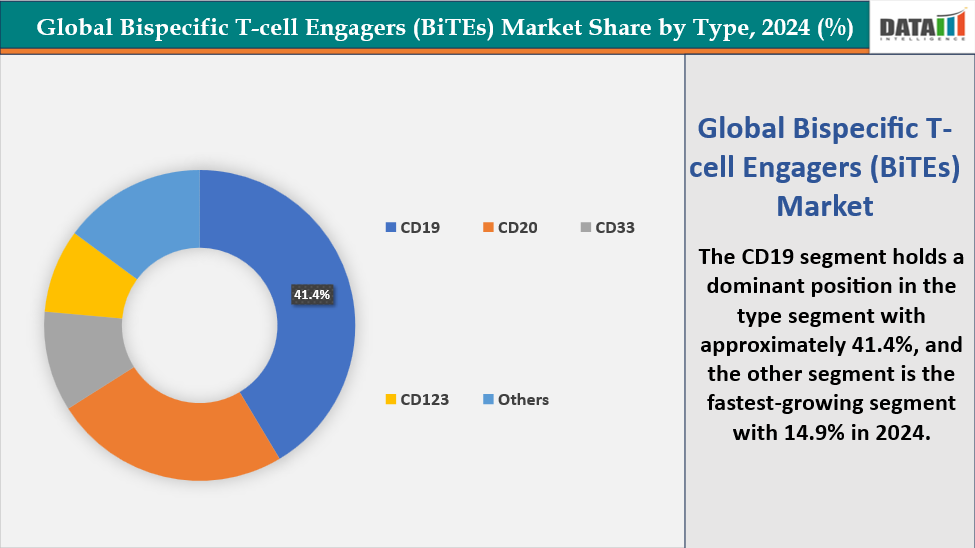
Type: The CD19 segment is dominating the Bispecific T-cell Engagers (BiTEs) market with a 41.4% share
Source- DataM Intelligence
The CD19 segment holds the largest share of 41.4% in the Bispecific T-cell Engagers (BiTEs) market in 2024, driven by its proven clinical efficacy and widespread adoption in treating B-cell malignancies, including acute lymphoblastic leukemia (ALL) and non-Hodgkin lymphoma (NHL). CD19 is a well-validated and consistently expressed antigen on B-cells, making it an ideal and reliable therapeutic target for T-cell redirecting therapies. The success of Amgen’s Blinatumomab (Blincyto®), the first FDA-approved BiTE targeting CD19 and CD3, has set a strong benchmark in this category, demonstrating high remission rates and durable responses in relapsed or refractory ALL patients. Furthermore, several pharmaceutical and biotech companies, including Regeneron, Genmab, and Johnson & Johnson, are actively developing next-generation CD19-directed bispecifics to enhance safety profiles and extend indications to broader hematologic malignancies. The extensive clinical pipeline, combined with robust efficacy data and established commercial infrastructure, reinforces CD19’s position as the dominant target in the global BiTEs market.
The Others segment is the fastest-growing in the Bispecific T-cell Engagers (BiTEs) market, with a 14.9% share
The Others segment, accounting for a 14.9% share in 2024, represents the fastest-growing category in the global Bispecific T-cell Engagers (BiTEs) market. This segment includes emerging targets such as BCMA, DLL3, PSMA, HER2, and EGFRvIII, which are expanding the therapeutic reach of BiTEs beyond hematologic malignancies into solid tumors and rare cancer types. The growing focus on these novel antigens stems from the unmet clinical need in treating aggressive and treatment-resistant cancers. Major pharmaceutical and biotech players, including Amgen, Regeneron, Roche, and Janssen Biotech, are investing heavily in R&D pipelines to develop BiTEs targeting these diverse antigens, aiming to improve tumor selectivity and minimize off-target toxicity. Additionally, advancements in next-generation BiTE engineering, such as half-life extension technologies and dual-targeting mechanisms, are enhancing therapeutic efficacy and expanding potential indications. As a result, the other segment is witnessing rapid clinical trial activity and strategic collaborations, positioning it as the most dynamic and promising growth area within the BiTEs market.
Bispecific T-cell Engagers (BiTEs) Market, Geographical Analysis
Source- DataM Intelligence
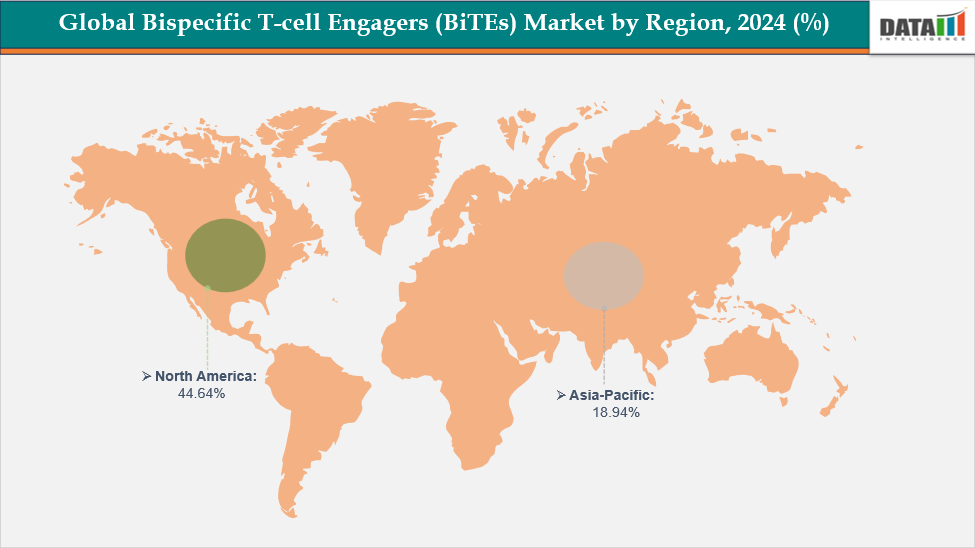
North America is expected to dominate the global Bispecific T-cell Engagers (BiTEs) market with a 44.64%
North America stands as the dominant region in the Bispecific T-cell Engagers (BiTEs) market, supported by its advanced biotechnology ecosystem, strong clinical infrastructure, and early adoption of innovative cancer immunotherapies. The region’s leadership is largely driven by the presence of major pharmaceutical and biotech companies such as Amgen, Regeneron Pharmaceuticals, Johnson & Johnson, and Pfizer, which are actively engaged in developing and commercializing BiTE-based therapies. The United States serves as the epicenter of BiTE research, with a high concentration of clinical trials, FDA approvals, and academic collaborations focused on next-generation bispecific antibody platforms. Moreover, favorable regulatory pathways, substantial healthcare expenditure, and robust reimbursement systems further facilitate rapid product development and commercialization. The rising incidence of hematologic cancers and growing patient awareness of advanced immunotherapies continue to sustain demand across the region. Collectively, these factors position North America as the leading and most mature market for Bispecific T-cell Engagers worldwide.
US Bispecific T-cell Engagers (BiTEs) Market Trends
The United States represents the largest and most advanced market for Bispecific T-cell Engagers (BiTEs), driven by rapid innovation in immuno-oncology, strong funding for cancer research, and early regulatory approvals. The U.S. Food and Drug Administration (FDA) has played a pivotal role in accelerating BiTE development through breakthrough therapy and orphan drug designations, enabling faster clinical translation of novel molecules. The success of Amgen’s Blinatumomab (Blincyto®), the first FDA-approved BiTE for relapsed or refractory acute lymphoblastic leukemia, established a strong commercial foundation for subsequent pipeline candidates targeting CD19, BCMA, and CD20 antigens.
Furthermore, an increasing number of clinical trials led by U.S.-based biotech firms and academic institutions are expanding BiTE applications to solid tumors, reflecting a shift toward broader oncology indications. The market also benefits from robust venture capital investment, strong intellectual property protection, and collaborations between pharmaceutical giants and emerging biotech startups. With a combination of scientific leadership, advanced healthcare infrastructure, and growing demand for targeted immunotherapies, the U.S. continues to set the global benchmark for BiTE innovation and commercialization.
The Europe region is the fastest-growing region in the global Bispecific T-cell Engagers (BiTEs) market, with a CAGR of 27.83%
Europe is emerging as the fastest-growing region in the global Bispecific T-cell Engagers (BiTEs) market, driven by expanding oncology research, strong government support for biologics development, and increasing participation in clinical trials. Countries such as Germany, the United Kingdom, France, and Switzerland are at the forefront of BiTE innovation, supported by world-class research institutions and a rapidly evolving biotech ecosystem. The European Medicines Agency (EMA) has shown growing openness to novel immunotherapy approvals, providing conditional marketing authorizations and accelerated assessment pathways for promising bispecific candidates.
Additionally, rising cancer prevalence across Europe, combined with growing adoption of targeted and personalized cancer therapies, is fueling market demand. Strategic collaborations between regional biotech firms and global pharmaceutical companies, such as partnerships involving Amgen, Roche, Genmab, and Novartis, are further stimulating product development and commercialization. As a result, Europe is witnessing a significant surge in R&D activity, regulatory approvals, and patient access to advanced immunotherapies, positioning it as the fastest-expanding BiTEs market worldwide.
Asia Pacific Bispecific T-cell Engagers (BiTEs) Market Trends
The Asia Pacific region is witnessing rapid growth in the Bispecific T-cell Engagers (BiTEs) market, driven by rising cancer incidence, expanding biotechnology capabilities, and increasing investment in immuno-oncology research. Countries such as China, Japan, South Korea, and India are strengthening their clinical and manufacturing infrastructure to support advanced biologic therapies. China, in particular, has emerged as a major innovation hub, with several domestic companies such as Innovent Biologics, Zai Lab, and Akeso Biopharma actively developing and commercializing BiTE-like bispecific antibodies for hematologic and solid tumor indications.
In Japan and South Korea, strong government initiatives supporting precision medicine and biotechnology R&D are further accelerating market adoption. Moreover, growing collaborations between global pharma leaders and regional biotech firms are facilitating technology transfer, clinical trial expansion, and faster regulatory approvals. Increasing healthcare expenditure, patient awareness, and demand for targeted therapies are reinforcing the region’s momentum. As a result, the Asia Pacific is becoming one of the most promising and strategically important markets for the future expansion of Bispecific T-cell Engager therapies.
Bispecific T-cell Engagers (BiTEs) Market Competitive Landscape
Top companies in the Bispecific T-cell Engagers (BiTEs) market include Amgen Inc., F. Hoffmann‑La Roche Ltd., Regeneron Pharmaceuticals, Inc., Genmab, MacroGenics, Inc., Xencor, Inc., Pfizer Inc., Johnson & Johnson, AbbVie Inc., Takeda Pharmaceutical Company Ltd., among others.
Investment and Licensing Deal Analysis
Increasing investments and strategic partnerships are accelerating the development of BiTE-based therapies worldwide. Pharmaceutical companies are actively pursuing licensing agreements, research collaborations, and acquisitions to strengthen oncology immunotherapy pipelines.
Investment activities are primarily focused on next-generation BiTE platforms, novel tumor targets, solid tumor applications, and manufacturing capabilities. Growing interest from biotechnology investors and strategic pharmaceutical partners highlights the long-term commercial potential of T-cell engager technologies.
Supply Chain and Commercial Manufacturing Analysis
The commercialization of BiTE therapies requires a robust supply chain involving antibody production, raw material sourcing, specialized manufacturing facilities, quality testing, and global distribution networks.
Companies are increasingly investing in manufacturing capacity expansion and supply chain optimization strategies to support increasing clinical and commercial demand. Development of localized manufacturing capabilities and advanced biologics production infrastructure is expected to improve supply reliability across major healthcare markets.
Competitive Pipeline Analysis
The BiTE pipeline continues to expand as companies develop therapies targeting new cancer antigens and explore improved molecular designs. Competition is increasing across CD19, BCMA, CD20, CD33, and solid tumor targets as organizations aim to achieve improved efficacy and safety outcomes.
Future competition is expected to be influenced by technological differentiation, clinical success rates, manufacturing scalability, and strategic partnerships. Companies developing next-generation BiTE platforms with improved patient outcomes are expected to gain stronger market positions.
Recent Developments in Bispecific T-cell Engagers (BiTEs) Market
- June 2026: Amgen Inc. continued advancing its BiTE® immunotherapy portfolio by expanding clinical development programs targeting hematologic malignancies and solid tumors, strengthening its leadership in T-cell engager technologies.
- June 2026: F. Hoffmann-La Roche Ltd. strengthened its bispecific antibody pipeline through ongoing clinical studies focused on next-generation T-cell engaging therapies for oncology applications.
- May 2026: Regeneron Pharmaceuticals, Inc. advanced its oncology research initiatives by expanding the development of CD3-based bispecific antibodies designed to enhance targeted immune responses against cancer cells.
- May 2026: Genmab A/S continued progressing its proprietary bispecific antibody technologies through investments in novel immuno-oncology programs targeting both hematological and solid tumors.
- April 2026: MacroGenics, Inc. strengthened its oncology portfolio by advancing clinical-stage bispecific antibody candidates designed to improve therapeutic efficacy and safety profiles in cancer treatment.
- April 2026: Xencor, Inc. expanded its XmAb® bispecific antibody platform by progressing multiple T-cell engager programs focused on precision immunotherapy applications in oncology.
- March 2026: Pfizer Inc. continued investing in next-generation bispecific antibody technologies and oncology collaborations supporting the development of innovative immune-engaging cancer therapeutics.
- March 2026: Johnson & Johnson advanced its oncology pipeline through continued development of targeted bispecific immunotherapies aimed at improving outcomes across multiple cancer indications.
- February 2026: Takeda Pharmaceutical Company Limited strengthened its immuno-oncology research capabilities through ongoing clinical development of novel bispecific therapeutic candidates targeting cancer-associated antigens.
Future Market Trends (2026-2035)
The Bispecific T-cell Engagers Market is expected to witness strong growth during the forecast period driven by increasing cancer incidence, advancements in immunotherapy technologies, and expanding clinical applications.
Future market expansion will be supported by next-generation BiTE platforms, increasing adoption in hematologic malignancies, growing research into solid tumor applications, and integration with personalized medicine approaches. Advancements in antibody engineering, manufacturing technologies, and combination therapies are expected to significantly influence the future direction of the global BiTE ecosystem.
Who Should Buy This Report?
This report is designed for pharmaceutical companies, biotechnology organizations, oncology drug developers, Contract Research Organizations (CROs), Contract Development and Manufacturing Organizations (CDMOs), healthcare investors, and research institutions seeking comprehensive insights into the evolving Bispecific T-cell Engagers market.
Pharmaceutical and biotechnology companies can utilize the report to evaluate pipeline opportunities, emerging therapeutic targets, clinical development trends, and competitive strategies. Investors and venture capital firms can leverage the report to assess market potential, investment opportunities, and technology innovation trends. Healthcare providers, academic researchers, and strategic consultants can use the report to understand future oncology treatment developments and commercialization opportunities.
Why Should You Buy This Report?
This report provides comprehensive market intelligence on the Bispecific T-cell Engagers (BiTEs) Market by analyzing technological advancements, clinical development trends, regulatory factors, competitive dynamics, and investment opportunities.
The report enables stakeholders to identify growth opportunities across hematologic malignancies, solid tumors, next-generation BiTE technologies, and emerging immunotherapy applications. It provides valuable insights into market segmentation, regional growth patterns, pipeline developments, manufacturing trends, and strategic initiatives undertaken by leading industry participants.
By supporting informed decisions related to partnerships, investments, clinical development strategies, manufacturing expansion, and market entry planning, this report serves as a valuable resource for organizations seeking to strengthen their position within the rapidly evolving cancer immunotherapy landscape.
The global Bispecific T-cell Engagers (BiTEs) market report delivers a detailed analysis with 70 key tables, more than 63 visually impactful figures, and 159 pages of expert insights, providing a complete view of the market landscape.
Suggestions for Related Report
For more pharmaceuticals-related reports, please click here


























































