


Bi-level Positive Airway Pressure Devices (BiPAP) Market Overview
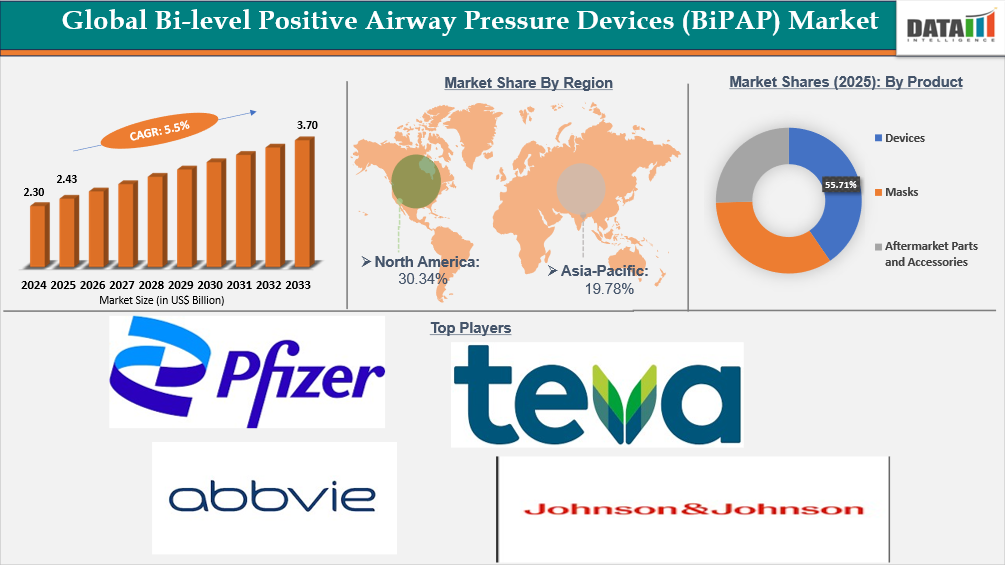
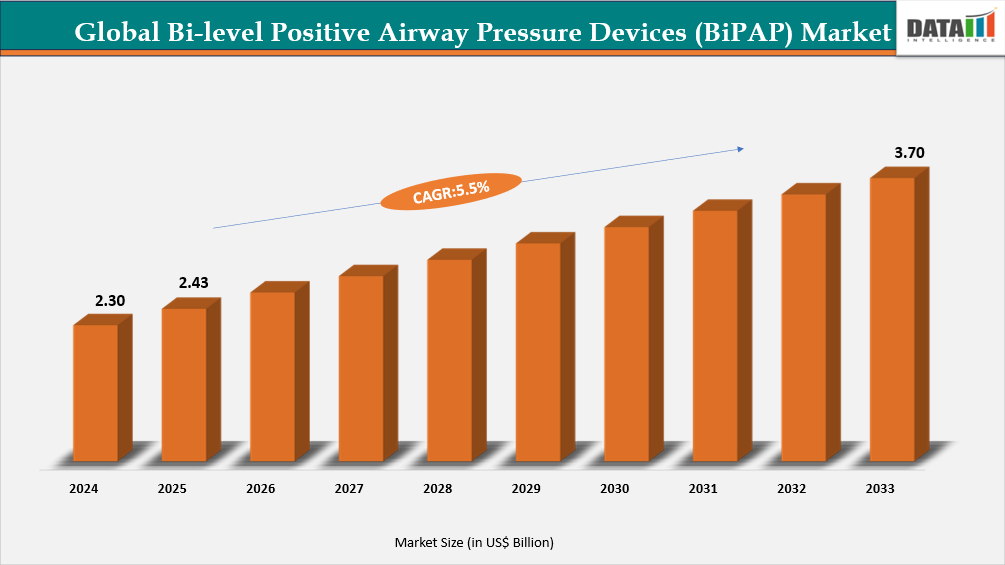
The global bi-level positive airway pressure devices (BiPAP) market reached US$1.45 Billion in 2024, rising to US$2.43 Billion in 2025 and is expected to reach US$3.70 Billion by 2033, growing at a CAGR of 5.5% from 2026 to 2033.
The global BiPAP devices market is expanding steadily due to the growing burden of chronic respiratory diseases and sleep-related breathing disorders that require long-term non-invasive ventilation. The World Health Organization reports that chronic obstructive pulmonary disease (COPD) causes more than 3 million deaths annually, highlighting a large patient population needing respiratory support in both hospital and home-care settings. Increasing adoption of home-based ventilation, supported by reimbursement programs and remote monitoring technologies, is further accelerating device utilization.
Technological improvements such as auto-adjusting pressure systems, quieter motors, and portable designs are improving patient adherence and broadening use beyond intensive care to chronic therapy. In addition, the rapid growth of the elderly population projected by the United Nations to reach over 1.6 billion people aged 65+ by 2050 is expected to sustain long-term demand for BiPAP devices worldwide.
Bi-level Positive Airway Pressure Devices (BiPAP) Industry Trends and Strategic Insights
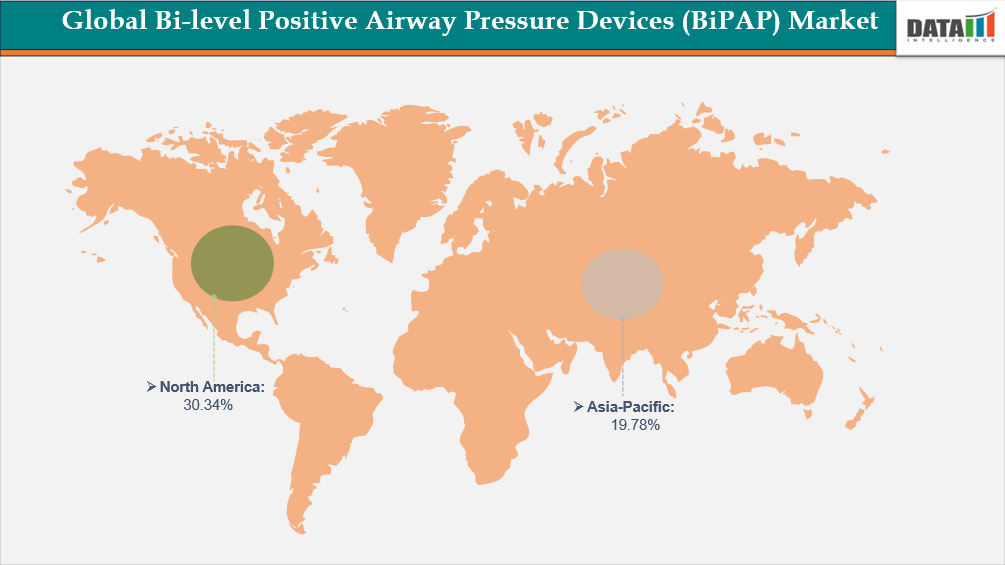
- North America leads the global bi-level positive airway pressure devices (BiPAP) market, capturing the largest revenue share of 30.34% in 2025.
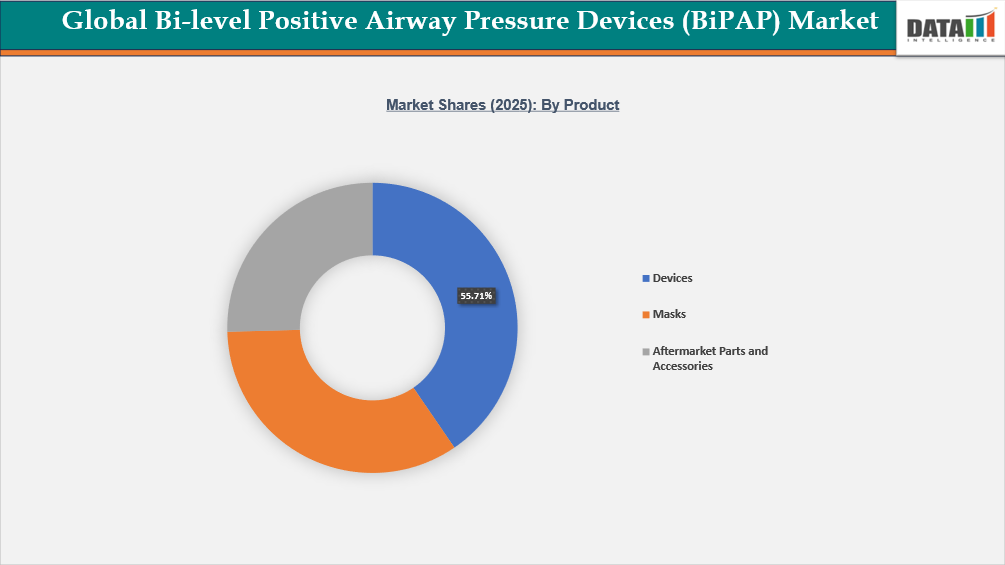
- By product segment, devices led the global bi-level positive airway pressure devices (BiPAP) market, capturing the largest revenue share of 55.71% in 2025.
Global Bi-level Positive Airway Pressure Devices (BiPAP) Market Size and Future Outlook
- 2025 Market Size: US$2.43 Billion
- 2033 Projected Market Size: US$3.70 Billion
- CAGR (2026–2033): 5.5%
- Dominating Market: North America
Fastest Growing Market: Asia-Pacific
Source : DataM Intelligence
For More Detailed information Request for Sample
Market Dynamics
Rising prevalence of psychiatric disorders and substance-induced agitation
The increasing global burden of psychiatric disorders is contributing to higher hospitalization and emergency-care admissions, which indirectly supports demand for respiratory support devices such as BiPAP. The World Health Organization estimates that around 1 in 7 people worldwide, about 1.1 billion individuals, live with a mental disorder, creating sustained pressure on acute-care and critical-care infrastructure where respiratory monitoring and non-invasive ventilation are frequently required. Psychiatric conditions are also associated with higher rates of metabolic disorders, obesity, and sleep disturbances, all of which increase the likelihood of sleep-disordered breathing and the need for assisted ventilation in clinical settings.
Substance use and severe psychiatric episodes often lead to agitation, delirium, and respiratory complications, particularly during sedation and stabilization in emergency departments. WHO data indicate that only about 29% of people with psychosis receive formal treatment, meaning many patients present in advanced stages requiring intensive care and supportive therapies, including oxygen and non-invasive ventilation. In addition, disorders such as schizophrenia, affecting around 23 million people globally, are linked with higher hospitalization rates and comorbid respiratory risks, further supporting the need for respiratory support technologies like BiPAP in hospitals and long-term care facilities.
Segmentation Analysis
The global bi-level positive airway pressure devices (BiPAP) market is segmented based on product, indication, patient type, technology, portability, end-user and region.
Devices Product Drive Sustained Demand for Bi-level Positive Airway Pressure Devices (BiPAP)
Demand for BiPAP devices is strongly supported by the rising global burden of sleep-related breathing disorders, particularly obstructive sleep apnea, which affects nearly 1 billion adults worldwide, with about 425 million requiring treatment, a large patient pool that depends on positive-airway-pressure therapies. Clinical practice patterns further sustain device demand, as positive airway pressure therapies are prescribed to around 80–85% of diagnosed moderate-to-severe sleep-apnea patients, making PAP and BiPAP systems a standard treatment approach in respiratory care.
BiPAP devices are particularly required for patients with complex conditions such as obesity-hypoventilation syndrome, COPD with hypercapnia, or those unable to tolerate standard CPAP therapy, and clinical studies show they are used in a meaningful share of treated patients. In addition, growing diagnosis rates, expansion of home-care respiratory therapy, and the increasing prevalence of obesity and aging populations, both major risk factors for sleep apnea, continue to expand the number of patients needing long-term non-invasive ventilation, sustaining demand for BiPAP devices globally.
Geographical Penetration
Largest Market:
Demand for Bi-level Positive Airway Pressure Devices (BiPAP) Market in North America
Demand for BiPAP devices in North America is driven mainly by the high prevalence of sleep apnea and chronic respiratory diseases across the region. Clinical research indicates that over 83 million adults in the United States alone were estimated to have obstructive sleep apnea in 2024, highlighting a very large treatment population requiring positive-airway-pressure therapy.
In Canada, public-health assessments show that more than one-quarter of adults are at high risk of obstructive sleep apnea, indicating a significant undiagnosed patient pool that supports long-term demand for respiratory support devices. Rising obesity rates, aging demographics, and strong adoption of home-care respiratory equipment in hospitals and outpatient settings continue to expand the need for non-invasive ventilation such as BiPAP across the region.
U.S. Bi-level Positive Airway Pressure Devices (BiPAP) Market Outlook
The United States accounts for the largest share of BiPAP demand in North America due to the scale of sleep-disorder prevalence and diagnosis activity. Studies estimate that around 83.7 million U.S. adults, about 32% of the adult population, live with obstructive sleep apnea, many requiring long-term PAP or BiPAP therapy.
Projections indicate the patient pool could approach 77 million diagnosed or clinically significant cases by 2050, reflecting continued growth driven by aging and rising BMI levels.
Sleep apnea is also strongly associated with cardiovascular disease, diabetes, and stroke risk, leading physicians to increasingly prescribe non-invasive ventilation and home respiratory therapy to prevent complications.
Canada Bi-level Positive Airway Pressure Devices (BiPAP) Market Trends
Canada shows steady demand growth for BiPAP devices supported by a significant at-risk population and expanding diagnosis programs. Government health data indicates about 858,900 Canadian adults have been diagnosed with sleep apnea, while 26% of adults show symptoms or risk factors associated with the condition.
Population studies also show that a large majority of high-risk individuals remain undiagnosed, demonstrating substantial unmet need for sleep-disorder diagnosis and treatment equipment. The high prevalence of obesity, hypertension, and aging, key risk factors for sleep apnea, continues to increase the number of patients requiring long-term respiratory support, strengthening demand for BiPAP devices in both hospital and home-care settings.
Fastest Growing Market:
Asia-Pacific Records the Fastest Growth in the Bi-level Positive Airway Pressure Devices (BiPAP) Market
Demand for BiPAP devices in Asia-Pacific is primarily driven by the large and growing burden of chronic respiratory diseases and sleep disorders. According to the Global Burden of Disease analysis, East Asia and South Asia together account for more than 95 million COPD cases, among the highest regional burdens worldwide.
Rapid population aging is another key factor; countries such as India and China are seeing sharp increases in elderly populations, which are more prone to sleep apnea and respiratory insufficiency. In addition, urban air pollution, smoking exposure, and rising obesity rates are increasing the incidence of obstructive sleep apnea (OSA) and chronic lung disease, leading to greater demand for long-term non-invasive ventilation and home-care respiratory support across the region.
China Bi-level Positive Airway Pressure Devices (BiPAP) Market Insights
China represents one of the largest demand centers for BiPAP devices because of the very high prevalence of respiratory diseases. National studies show that about 99–100 million adults in China live with COPD, and prevalence increases significantly with age. COPD is a leading cause of mortality in the country and has been responsible for hundreds of thousands of deaths annually, highlighting the need for long-term respiratory support therapies.
Government programs have expanded screening and pulmonary function testing in primary care, which is improving diagnosis rates and increasing the number of patients receiving non-invasive ventilation and home respiratory therapy. In addition, persistent air-pollution exposure and a rapidly aging population continue to expand the patient pool, sustaining long-term demand for BiPAP systems in both hospital and home-care settings.
India Bi-level Positive Airway Pressure Devices (BiPAP) Market Industry Growth
India is witnessing strong growth in demand for BiPAP devices due to a large undiagnosed population with sleep and respiratory disorders. Clinical analyses suggest that around 104 million Indians may suffer from obstructive sleep apnea, with nearly half experiencing moderate to severe disease requiring therapeutic intervention. Chronic respiratory diseases are also widespread; estimates indicate tens of millions of Indians live with COPD and asthma, reflecting a substantial need for respiratory support equipment and long-term ventilation.
The country’s elderly population is expanding rapidly and is projected to more than double by 2050, which will significantly increase the prevalence of sleep disorders and chronic lung disease. Rising awareness of sleep studies, growth of pulmonary clinics, and increasing adoption of home-care ventilation are gradually improving diagnosis and treatment rates, strengthening future demand for BiPAP devices across urban and tier-2 cities.
Competitive Landscape
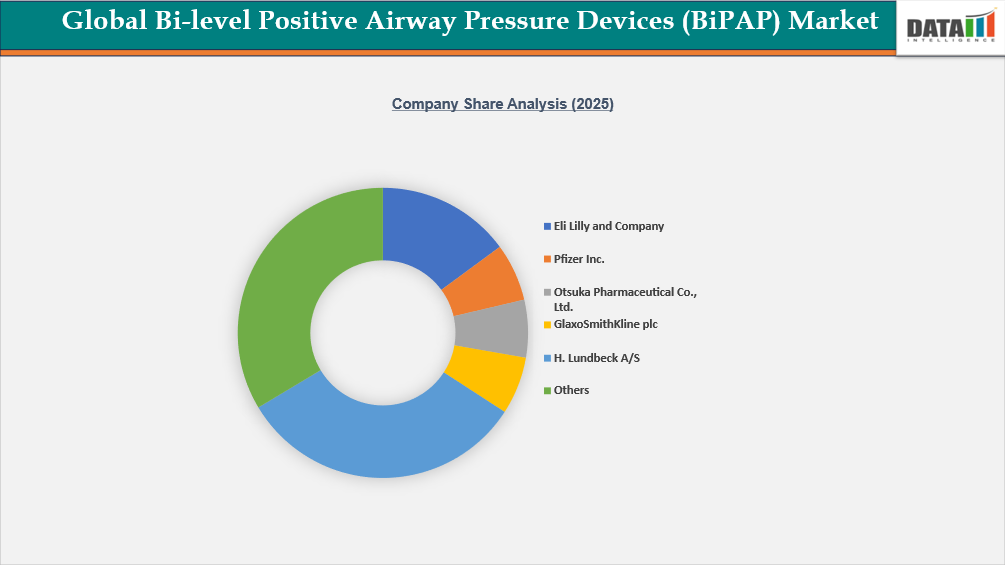
In the Global Bi-level Positive Airway Pressure (BiPAP) Devices market, the competitive landscape is moderately consolidated, with leadership largely held by specialized respiratory device manufacturers such as ResMed, Philips Respironics, and Fisher & Paykel Healthcare, which together account for a major share of sleep-apnea therapy equipment through strong product portfolios, digital monitoring platforms, and broad distribution networks.
Pharmaceutical companies such as Eli Lilly, Pfizer, GlaxoSmithKline, Teva, AbbVie, Bristol-Myers Squibb, and Otsuka participate indirectly in this ecosystem by developing therapies for sleep disorders, obesity, respiratory conditions, and central nervous system disorders that influence apnea management, thereby shaping treatment pathways and creating complementary competition to device-based therapy.
Emerging and mid-sized firms including Axsome Therapeutics, Alkermes, BioXcel Therapeutics, Impel Pharmaceuticals, Hikma, Amneal, Aurobindo Pharma, Apotex, Lee Pharma, Alexza Pharmaceuticals, and Lundbeck primarily compete through niche formulations, generics, or neuropsychiatric therapeutics that address comorbidities such as insomnia, anxiety, or depression, which are closely associated with sleep-disorder treatment.
Overall, competition is driven by innovation in non-invasive ventilation technology, drug-based alternatives, strategic collaborations with healthcare providers, and expansion into digital sleep-health platforms, making the market increasingly multidisciplinary, combining medical devices, pharmaceuticals, and digital therapeutics.
Key Developments
- In February 2024, ResMed launched the AirCurve 11, a new bi-level positive airway pressure device designed as an alternative to CPAP therapy for sleep apnea patients. The device uses advanced algorithms to adapt therapy to individual breathing patterns and integrates with AirView and myAir digital platforms for remote monitoring and patient engagement. The launch expands ResMed’s respiratory portfolio and strengthens its position in the sleep therapy and connected respiratory care segment.
- In July 2024, VARON launched the SUNNY GRAND Series of CPAP and BiPAP machines designed for sleep apnea management, expanding its respiratory care portfolio with feature-rich and user-friendly devices. The new lineup includes the 20A CPAP and 25S BiPAP models, offering multiple therapy modes such as CPAP, APAP, and bilevel options to support personalized treatment. This launch positions VARON to compete with established players by providing advanced features and flexible pressure delivery at a competitive price point.
What Sets This Global Bi-level Positive Airway Pressure Devices (BiPAP) Market Intelligence Report Apart
- Latest Data & Forecasts – Comprehensive and up-to-date market intelligence with forecasts through 2033, covering global demand by key segmentation, with region-wise analysis across North America, Europe, Asia-Pacific, South America, and the Middle East & Africa.
- Regulatory Intelligence – In-depth assessment of global pharmaceutical regulatory frameworks impacting market development and commercialization, including FDA, EMA, NMPA, PMDA, and CDSCO requirements, clinical trial pathways, labeling standards, patent exclusivity, and post-marketing surveillance.
- Competitive Benchmarking – Structured benchmarking of leading innovator and generic manufacturers based on product portfolios, pipeline strength, geographic reach, pricing strategies, clinical differentiation, and partnerships in the market.
- Geographic & Emerging Market Coverage – Regional analysis highlighting key impacting factors, with special focus on growth opportunities in Asia-Pacific, Latin America, and Middle Eastern markets.
- Actionable Strategies & Cost Dynamics – Strategic insights into lifecycle management, generic entry risks, combination therapy positioning, pricing pressures, and manufacturing cost structures, supported by expert perspectives from various specialists, regulatory advisors, and pharmaceutical executives.




























































