


Breast Cancer Therapeutics Market Size & Industry Outlook
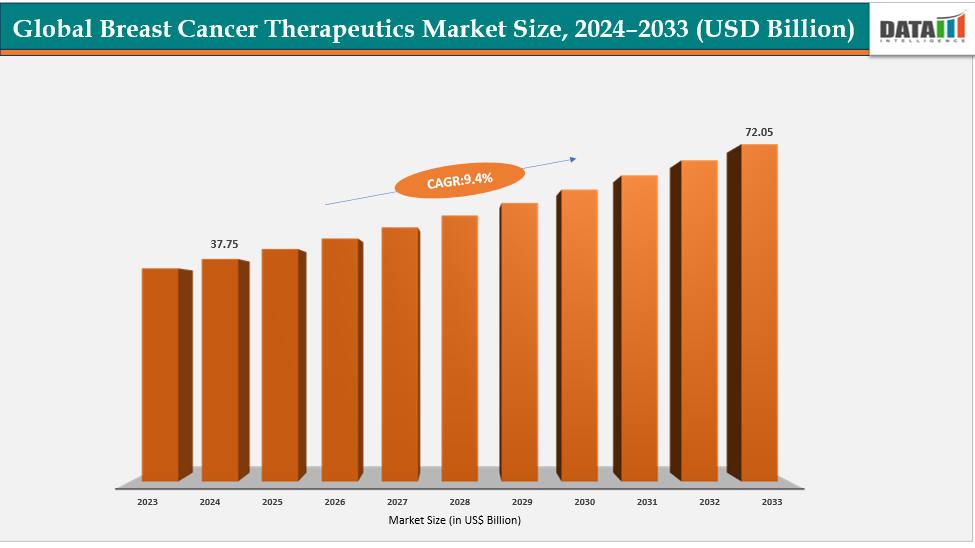
The global breast cancer therapeutics market size reached US$ 37.75 Billion in 2024 and is expected to reach US$ 72.05 Billion by 2033, growing at a CAGR of 9.4% during the forecast period 2025-2033. The global market for breast cancer is expanding due to rising prevalence and demand for advanced therapies, early diagnostic solutions, and supportive care options. Pharmaceutical manufacturers are investing heavily in research and development to strengthen oncology portfolios and address unmet medical needs. Globally, breast cancer ranks as the second most common cause of death for women. For instance, according to the American Cancer Society, in 2024 in the United States, 310,720 new invasive breast cancers are diagnosed in women, with women under 50 accounting for 16% of these cases. Approximately 56,500 cases of DCIS (stage 0 disease) were diagnosed in 2024. An estimated 42,250 women will die from breast cancer in the US in 2024, more than half of whom will be ages 70 and older.
Key Highlights
For patients with early-stage breast cancer, surgery is a crucial component of care; over 90% of patients have some kind of surgical resection. Chemotherapy is the first-line treatment for malignant breast cancer; it is capturing a 43.6% share in 2024.
North America expected to lead the breast cancer drug market, holding a 42.1% share in 2024, driven by strong healthcare systems, major pharmaceutical players like Genentech USA, Inc., Merck & Co., Inc., Pfizer, and Bristol-Myers Squibb, and active clinical research backed by FDA approvals.
Intravenous therapies are the leading route of administration segment, holding a 44.3% share in 2024, as they provide comprehensive cancer care, advanced technologies, and direct access to branded therapies.
The major market players in the Breast Cancer Therapeutics Market are Genentech USA, Inc., Pfizer Inc., Novartis Pharmaceuticals Inc., AstraZeneca, and Eli Lilly Canada Inc., among others.
Market Dynamics
Drivers:Rising prevalence of breast cancer is significantly driving the breast cancer therapeutics market growth
The rising prevalence and risk of breast cancer are increased by a number of factors, such as advancing age, obesity, harmful use of alcohol, radiation exposure history, family history of breast cancer, reproductive history (including the age at which menstruation began and the age at first pregnancy), tobacco use, and postmenopausal hormone therapy. Other than being female and being older than forty, women who have no discernible breast cancer risk factors account for around half of all new cases of breast cancer.
For instance, in 2025, according to the National Breast Cancer Foundation, Inc., an estimated 316,950 women and 2,800 men will be diagnosed with invasive breast cancer, and an additional 59,080 new cases of non-invasive (in situ) breast cancer will be diagnosed. There are presently more than 4 million breast cancer survivors in the United States. In 2025, it is anticipated that 42,170 women in the United States will die because of breast cancer.
Restraints:High treatment costs and risks of therapy are hampering the growth of the Breast Cancer Therapeutics Market
The breast cancer drug market faces challenges due to high treatment costs, particularly for targeted therapies and immunotherapies, which create affordability issues for patients and strain healthcare systems. Limited insurance coverage and disparities in access to advanced therapies also limit market penetration in low- and middle-income countries.
For instance, according to the American Cancer Society, the average cost of treatment can vary so widely that one patient could owe anywhere from $20,000 to $100,000 in the United States, and in Canada the average cost of treatment is $33,000 compared to the USA.
For more details on this report, Request for Sample
Segmentation Analysis
The global breast cancer therapeutics market is segmented based on therapy, route of administration, distribution channel, and region.
By Therapy:The chemotherapy segment is dominating the Breast Cancer Therapeutics Market with a 43.6% share in 2024

Chemotherapy for breast cancer uses drugs to target and destroy breast cancer cells. These drugs are usually injected directly into a vein through a needle or taken by mouth as pills. It can reduce tumor size, eradicate leftover cells, or treat symptoms in advanced stages of breast cancer before or after surgery. It consists of a mix of medications based on the patient's cancer stage and type.
Chemotherapy is utilized as the primary treatment for women whose cancer has progressed to distant organs such as the liver or lungs. Chemotherapy can be administered either when breast cancer is diagnosed or following early therapies. The length of treatment is determined by the efficacy of the chemotherapy and your tolerance for it.
Chemotherapy is most effective when more than one medicine is taken at the same time. Frequently, combinations of two or three medications are employed. Doctors utilize a variety of pharmacological combinations, and it's unclear which one is best.
Owing to factors like FDA approvals, ongoing clinical trials also help the segment to grow during the forecast period. For instance, in October 2024, the FDA approved inavolisib (Itovebi, Genentech, Inc.) with palbociclib and fulvestrant for adults with endocrine-resistant, PIK3CA-mutated, hormone receptor (HR)-positive, human epidermal growth factor receptor 2 (HER2)-negative, locally advanced or metastatic breast cancer.
By Route of Administration – Intravenous is expected to lead the market with strong growth potential:
The intravenous segment held the market share by 44.3% in 2024 and is projected to register the fastest growth, with a CAGR of 5.5% from 2025 to 2033. The intravenous (IV) route of administration is the preferred method due to its rapid and uniform systemic delivery of high-potency chemotherapeutic agents, particularly in high-dose protocols and combination regimens like paclitaxel plus gemcitabine injection. Advancements in infusion technologies, such as smart pumps with real-time monitoring and safety features, have improved the precision, safety, and efficiency of IV chemotherapy, reinforcing its continued preference in cancer treatment.
For instance, in January 2025, the FDA approved datopotamab deruxtecan-dlnk for unresectable or metastatic, HR-positive, HER2-negative breast cancer, which is administered as an intravenous infusion to the patients.
Geographical Analysis
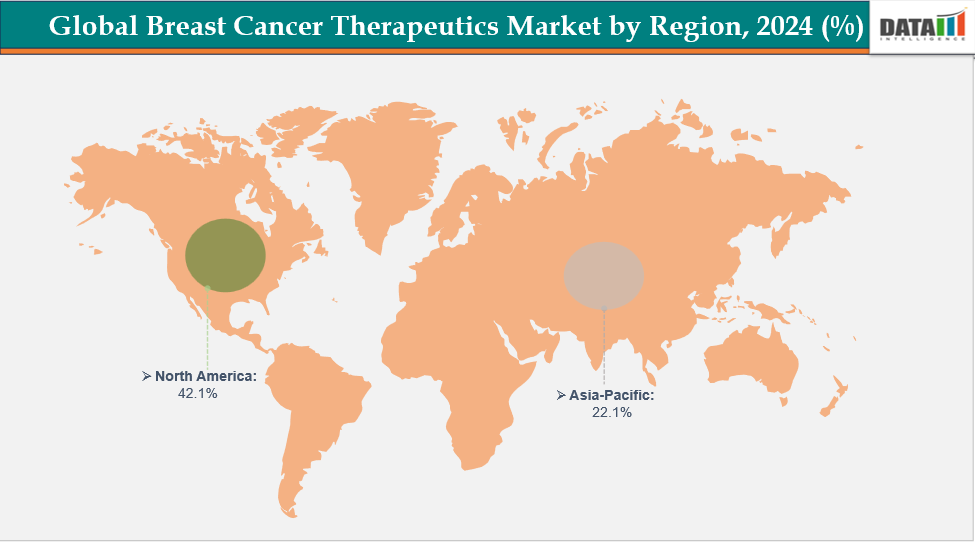
North America is dominating the global breast cancer therapeutic market share with 42.1% in 2024.
Many Canadians are affected by breast cancer. The incidence of breast cancer is higher in Canada. Among Canadian women, it is the most prevalent cancer and the second most common cause of cancer-related mortality.
For instance, according to the Canadian Task Force on Preventive Healthcare, in 2024, it is estimated that 30,500 women diagnosed with breast cancer, representing 25.4% of all new cancers diagnosed. It is also estimated that 5,500 are died from the disease, representing 13.5% of all cancer mortality among this group in 2024. The treatments for breast cancer are improving and offer more and more hope for women with breast cancer.
The US is expected to grow in the North American Breast Cancer Therapeutics Market with a revenue share of 85.1% due to its robust oncology research environment and sophisticated healthcare infrastructure, with a 42.1% market share. Hospitals and treatment facilities administer chemotherapy precisely by using cutting-edge technologies. The increased incidence of cancer fuels the need for both conventional and novel treatments. Leaders in pharmaceuticals around the world guarantee a strong supply of new medications, which accelerates the uptake of combination and targeted treatments.
For instance, in March 2025, Arvinas and Pfizer announced positive topline results from Phase 3 of VERITAC-2, which evaluated vepdegestrant monotherapy versus fulvestrant in adults with estrogen receptor-positive, human epidermal growth factor receptor 2-negative (ER+/HER2-) advanced or metastatic breast cancer. The Asia Pacific region is the fastest-growing region in the breast cancer therapeutic market, with a CAGR of 7.6% in 2024.
Europe is dominating the global breast cancer therapeutic market share with 35.2% in 2024.
Breast cancer cases are rising in Europe due to an aging population, lifestyle risks such as obesity, alcohol consumption, sedentary habits, delayed childbirth, and lower breastfeeding rates. Expanded mammography screening and stronger cancer registries also detect more cases, contributing to higher incidence. Environmental and dietary factors, alongside increased use of hormone replacement therapy, add to the risk. While diagnoses continue to grow, mortality is falling thanks to improved awareness, early detection programs, and advanced treatment options across the region.
For instance, in 2022, breast cancer remained a major health burden across Europe, with incidence and mortality varying by country. Luxembourg reported the highest incidence among women at nearly 190 cases per 100,000, followed by Belgium and Cyprus, while the EU-27 average stood at 147.6 cases per 100,000. More broadly, Denmark recorded the highest overall cancer incidence in Europe at 728.5 cases per 100,000, ahead of Ireland and the Netherlands, both around 641. Breast cancer also accounted for the highest female cancer mortality, with Cyprus experiencing the highest rate at 45.1 per 100,000 women.
The Asia Pacific region is the fastest-growing region in the global breast cancer therapeutics market, with a CAGR of 8.2% in 2024.
The Asia Pacific Breast Cancer Therapeutics Market is experiencing rapid growth due to demographic changes and improved healthcare access. Rising cancer incidence, urbanization, and lifestyle changes are driving demand for oncology treatments. Governments in India are investing in healthcare infrastructure, promoting advanced treatments, and conducting awareness programs related to cancer.
For instance, in August 2025, the Government of West Bengal launched the ‘Pink Corridor’ awareness program in collaboration with the Association of Breast Surgeons of India. As many as 59 lakh women were screened for breast cancer; 29,000 were identified as “suspects,” and 1,900 were diagnosed with the disease.
Moreover, in December 2024 Japan approved DATROWAY as the first TROP-2 directed therapy for the treatment of adult patients with hormone receptor (HR) positive, HER2 negative (IHC 0, IHC 1+, or IHC 2+/ISH-) unresectable or recurrent breast cancer after prior chemotherapy.
Competitive Landscape
Top companies in the Breast Cancer Therapeutics Market are Genentech USA, Inc., Pfizer Inc., Novartis Pharmaceuticals Inc., AstraZeneca, Eli Lilly Inc., Bristol-Myers Squibb Company, Merck & Co., Inc., and GSK, among others.
Genentech USA, Inc.: Genentech USA, Inc. (subsidiary of the Roche group) is a leading player in the Breast Cancer Therapeutics Market; their strong oncology pipelines and portfolios in chemotherapy, targeted therapy, and immunotherapy drive market growth. Innovative treatments, FDA approvals, and strategic collaborations further support market growth. Mergers and acquisitions further strengthen their drug pipelines.
Market Scope
Metrics | Details | |
CAGR | 9.4% | |
Market Size Available for Years | 2022-2033 | |
Estimation Forecast Period | 2025-2033 | |
Revenue Units | Value (US$ Bn) | |
Segments Covered | By Therapy | Chemotherapy, Hormonal Therapy, Immunotherapy, Targeted Therapy, Radiation Therapy, Surgery |
By Routes of Administration | By Oral Route, By Intravenous (IV) Route, Subcutaneous (SC) Route, Other routes | |
By Distribution Channel | Hospital Pharmacy, Retail Pharmacy, Online Pharmacies | |
Regions Covered | North America, Europe, Asia-Pacific, South America and the Middle East & Africa | |
The global breast cancer market report delivers a detailed analysis with 56 key tables, more than 52 visually impactful figures, and 159 pages of expert insights, providing a complete view of the market landscape.
Suggestions for Related Report
For more pharmaceutical-related reports, please click here


























































