


Anti Caking Agents Market Size and Forecast
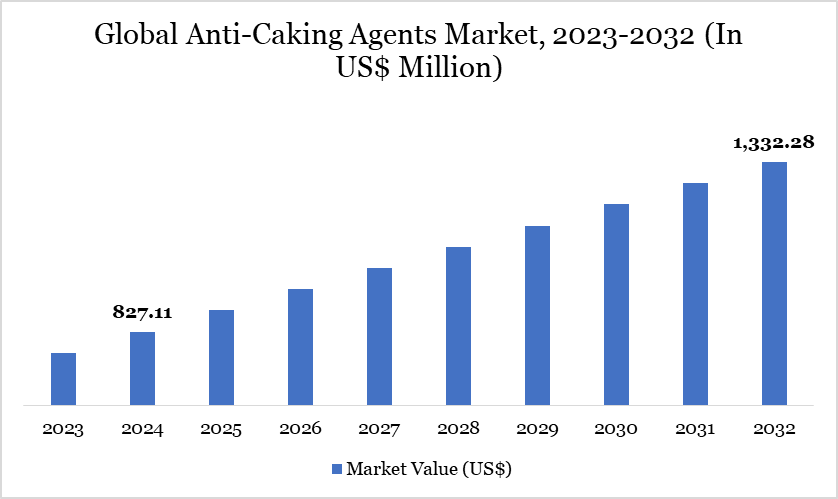
The Anti Caking Agents Market will reach US$ 930.07 million in 2026, up from US$ 877.89 million in 2025, and is projected to reach US$ 1,694.46 million by 2035, registering steady growth at a CAGR of 6.14% during the forecast period from 2026 to 2035.
Anti-caking agents are anhydrous substances included in minimal quantities into dry food products to inhibit particle aggregation and facilitate optimal drying and flow. Anticaking chemicals function by absorbing surplus moisture and coating particles to enhance water repellency. The heightened demand for convenience food, including packaged and ready-to-eat options, is attributed to a growing workforce, economic advancements, and increasingly hectic and stressful lifestyles.
The foods, encompassing shelf-stable products, refrigerated or frozen items, and dry mixes that necessitate no preparation, are designed for convenience in consumption. The demand for the food and beverage industry is increasing due to urbanization, improved living conditions, and shifts in dietary habits and lifestyles. The market for anti-caking chemicals is expected to grow substantially due to the increasing demand for traditional cuisine, which incorporates various thickeners such as cornstarch, arrowroot, cassava, agar-agar, gelatin, and eggs.
Anti Caking Agents Market Trend
Consumers are increasingly favoring natural and clean-label products, which is propelling the demand for anti-caking agents derived from plant fibers, starches, and minerals. In response, manufacturers are innovating to create solutions that align with clean-label expectations while maintaining high-performance standards. One such innovation is microencapsulation technology, which involves coating anti-caking agents in a protective shell to enhance their stability and dispersibility.
This technique improves the efficiency of anti-caking agents in applications like instant soups, spice mixes, and powdered supplements. Additionally, the rise in demand for customized food and beverage products is prompting manufacturers to offer tailor-made anti-caking solutions. These are specifically designed to meet precise requirements related to particle size, moisture control, and ingredient compatibility, fostering innovation and market differentiation.
To know more insights Download Sample
Anti Caking Agents Market Key Takeaways
- Asia-Pacific accounts for the largest share of the global market, driven by rapid urbanization, expanding food processing industries, and increasing demand for packaged and convenience foods.
- Food & beverages remain the leading application segment, supported by rising consumption of instant foods, seasonings, dairy products, bakery mixes, and powdered beverages.
- Natural anti-caking agents are witnessing strong demand, driven by the growing preference for clean-label and plant-based food ingredients.
- Convenience food manufacturers account for a major share of product consumption, owing to increasing global demand for ready-to-eat and ready-to-cook products.
- Demand for customized anti-caking solutions is increasing, enabling manufacturers to optimize moisture control, particle flow, and product stability across various applications.
- Microencapsulation technologies and advanced ingredient formulations are improving product stability, dispersibility, and processing efficiency, supporting next-generation food ingredient development.
- Applications in animal feed, fertilizers, pharmaceuticals, and industrial products are expanding, creating new revenue opportunities beyond food processing.
- Sustainable ingredient development and clean-label innovations are becoming major competitive differentiators among global manufacturers.
- Growing investments in processed food production, agricultural inputs, pharmaceutical manufacturing, and specialty ingredient technologies are expected to support long-term market growth.
Anti Caking Agents Market Scope
| Metrics | Details |
| By Source | Natural, Synthetic |
| By Type | Sodium compounds, Calcium compounds, Magnesium compounds, Silicon dioxide, Microcrystalline cellulose |
| By Form | Powder, Granule, Liquid |
| By Application | Food & Beverages, Animal Feed, Fertilizers, Pharmaceuticals, Others |
| By Region | North America, South America, Europe, Asia-Pacific, Middle East and Africa |
| Report Insights Covered | Competitive Landscape Analysis, Company Profile Analysis, Market Size, Share, Growth |
Anti Caking Agents Market Dynamics
Anti Caking Agents Market Growing Demand for Clean Label Products
The rising demand for clean label products is playing a key role in propelling the growth of the anti-caking agents market, as health-conscious consumers increasingly examine product labels for transparency. In response, food manufacturers are actively reformulating their offerings by incorporating natural anti-caking agents sourced from ingredients such as rice flour, tricalcium phosphate, and plant-based fibers to align with clean label expectations.
For instance, according to new research by Ingredion, clean label products are expected to comprise 70% of food and beverage ingredient portfolios within the next two years up from 52% in 2021. This surge highlights the increasing consumer demand for transparency and simplicity in the ingredients used in their food. Thus, above factors helps to boost the market growth.
Anti Caking Agents Market Regulatory Challenges
Certain areas, including the European Union, have stringent laws regarding the allowable doses and varieties of anticaking agents utilized in food and feed products. The European Food Safety Authority (EFSA) assesses these ingredients to guarantee safety, potentially postponing market entry for new products. In US, the Food and Drug Administration (FDA) and the Environmental Protection Agency (EPA) each possess distinct criteria, occasionally resulting in discrepancies in regulatory requirements for the same drugs in various locations.
Sodium ferrocyanide, a prevalent anticaking agent, is authorized for use in salt in US but encounters stringent regulations in the EU due to apprehensions regarding potential health hazards. Such variations can pose challenges for multinational businesses, which must contend with differing safety standards and approval processes. This inconsistency frequently results in challenges regarding product composition, regulatory adherence, and access to overseas markets.
Anti Caking Agents Market Latest Trends and Insights
Growing Demand for Clean-Label Anti-Caking Solutions
Clean-label positioning is becoming an important product-development priority in food and beverage applications. Manufacturers are exploring anti-caking ingredients based on plant fibers, starches, cellulose, and naturally occurring minerals to meet consumer expectations for recognizable and transparent ingredients.
The trend is particularly relevant to powdered seasonings, dairy powders, nutritional products, bakery mixes, and instant food formulations where manufacturers need both effective moisture control and consumer-friendly ingredient declarations.
Microencapsulation and Engineered Particle Technologies
Microencapsulation is emerging as an important technology for improving the stability, dispersibility, and controlled performance of anti-caking ingredients.
Engineered particle technologies can help manufacturers optimize moisture absorption and improve compatibility with specific powdered formulations. These technologies are particularly relevant to instant foods, spice blends, powdered supplements, and other products where consistent dispersion is important.
Application-Specific Formulations
Manufacturers are increasingly moving away from one-size-fits-all formulations. Anti-caking requirements can vary considerably according to particle size, moisture content, storage conditions, packaging format, and the chemical characteristics of the underlying product.
This is encouraging suppliers to develop customized solutions for food ingredients, fertilizers, animal feed, pharmaceuticals, and industrial powders.
Expansion of Convenience and Powdered Foods
The continued development of ready-to-use, instant, and shelf-stable foods is creating additional opportunities for anti-caking agents. Powdered soups, seasonings, dairy ingredients, baking mixes, nutritional powders, and powdered beverages require effective flow properties throughout manufacturing, transportation, storage, and final use.
Increasing Importance of Sustainability
Sustainability is becoming an increasingly relevant product-development consideration. Suppliers are exploring renewable feedstocks, lower-impact manufacturing processes, biodegradable alternatives, waste reduction, and more sustainable packaging.
The trend is particularly important for manufacturers serving food and beverage customers with environmental and clean-label targets.
Anti Caking Agents Market Value Chain Analysis
The Anti-Caking Agents value chain begins with raw-material suppliers providing minerals, salts, silica, cellulose, plant-based fibers, and other chemical or natural inputs.
The next stage involves ingredient processing and formulation, where manufacturers control particle size, purity, moisture characteristics, surface properties, and functional performance.
Anti-caking agent producers then conduct quality testing and application-specific performance evaluation before supplying products to food manufacturers, fertilizer companies, animal-feed producers, pharmaceutical manufacturers, and other industrial users.
The downstream stage includes distribution and technical support, where specialty chemical distributors and ingredient suppliers provide products to regional and local customers.
The final stage is end-use incorporation, where anti-caking agents are blended into powdered foods, fertilizers, animal feed, pharmaceuticals, nutritional products, and other dry formulations.
Technical support and formulation customization are becoming increasingly important throughout the value chain as customers seek solutions tailored to specific moisture levels, particle sizes, storage conditions, and regulatory requirements.
Anti Caking Agents Market Segment Analysis
The global anti-caking agents market is segmented based on source, type, form, application and region.
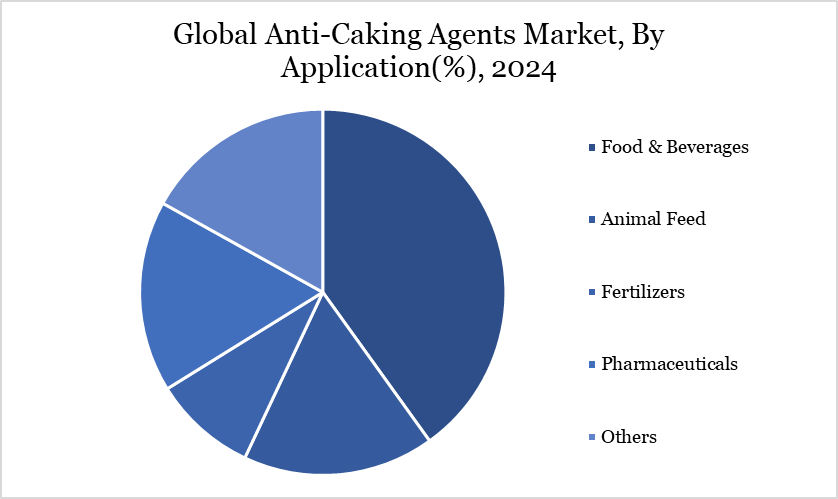
Food & Beverages Segment: A Key Growth Driver for the Anti-Caking Agents Market
The food and beverages segment plays a pivotal role in driving the anti-caking agents market, owing to the widespread use of powdered and granulated ingredients in processed foods. Anti-caking agents are essential in maintaining the free-flowing nature and shelf stability of products such as powdered soups, seasonings, baking mixes, coffee creamers, and dairy powders. As consumer demand for convenience foods rises, especially in urban areas, manufacturers are increasing production of ready-to-eat and instant food items that rely heavily on anti-caking agents to prevent clumping during storage and distribution.
For instance, in the snack industry, spice blends and flavoring powders use agents like calcium silicate to ensure even dispersion and longer shelf life. Similarly, in the bakery sector, ingredients such as flour mixes and powdered sugar require anti-caking agents to maintain texture and prevent moisture absorption. The rapid expansion of the food processing industry, particularly in emerging economies, further amplifies the demand for efficient anti-caking solutions, making the food and beverages segment a key growth driver in the global market.
Anti Caking Agents Market Geographical Share
Anti Caking Agents Market Continuous Growth in North America End-User Industries
The North American food manufacturing sector relies heavily on anticaking agents to prolong product shelf life and improve the texture of powdered ingredients. The rising popularity of convenience foods, dietary supplements, and the expansion of e-commerce in the food sector are substantial factors driving the demand for anticaking agents. As consumer preferences shift towards healthier and clean-label food options, there is a growing focus on natural and organic anticaking agents which is expected to drive further market growth.
Notable trends include the rising utilization of plant-based and environmentally friendly compounds, such as cellulose and silica, as alternatives to traditional synthetic materials. Moreover, there is an increasing focus on regulatory compliance and safety standards by the FDA (Food and Drug Administration) and EPA (Environmental Protection Agency), necessitating that producers emphasize the use of non-toxic and safe anticaking agents in food and agricultural goods.
Anti Caking Agents Market Major Players
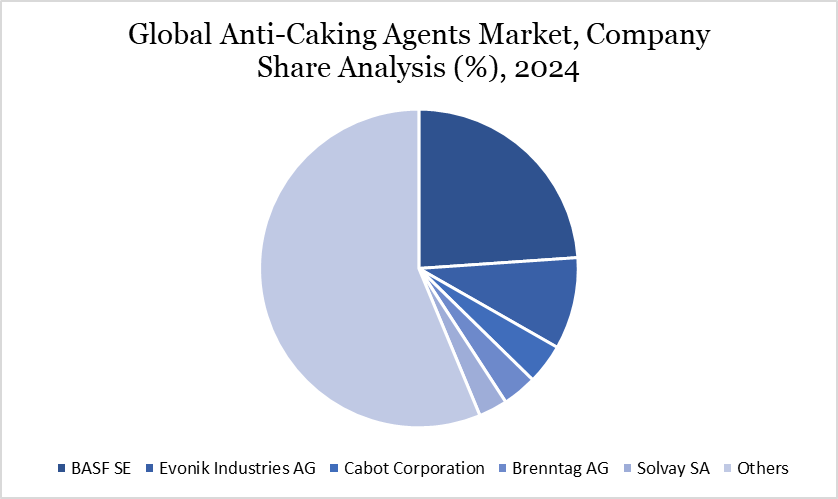
The major global players in the market include BASF SE, Evonik Industries AG, Cabot Corporation, Brenntag AG, Solvay SA, Agropur Ingredients, Kao Corporation, Univar Solutions Inc., Huber Engineered Material, PPG Industries Inc and among others.
Key Developments in the Anti Caking Agents Market
- June 2026: BASF SE expanded its specialty ingredients portfolio by increasing production capacity for food and industrial additives to support growing global demand for functional ingredient solutions.
- June 2026: Evonik Industries AG strengthened its specialty additives business through continued investments in sustainable ingredient technologies for food, pharmaceutical, and industrial applications.
- May 2026: Cabot Corporation expanded its portfolio of specialty performance materials by enhancing production capabilities for silica-based additives used in food and industrial applications.
- May 2026: Brenntag AG broadened its distribution network for specialty food ingredients and additives through strategic partnerships, improving supply chain efficiency across key markets.
- April 2026: Solvay SA advanced sustainable specialty chemical solutions by expanding its high-performance silica and specialty materials portfolio for food and industrial applications.
- April 2026: Univar Solutions Inc. strengthened its specialty ingredients business by expanding distribution agreements and technical support services for food manufacturers.
- March 2026: Kao Corporation continued developing sustainable ingredient technologies and specialty chemical solutions to support food processing and industrial manufacturing applications.
- March 2026: PPG Industries Inc. expanded production of specialty silica and performance materials used across industrial applications, supporting increased demand for functional additives.
Why Choose DataM?
Data-Driven Insights: Dive into detailed analyses with granular insights such as pricing, market shares and value chain evaluations, enriched by interviews with industry leaders and disruptors.
Post-Purchase Support and Expert Analyst Consultations: As a valued client, gain direct access to our expert analysts for personalized advice and strategic guidance, tailored to your specific needs and challenges.
White Papers and Case Studies: Benefit quarterly from our in-depth studies related to your purchased titles, tailored to refine your operational and marketing strategies for maximum impact.
Annual Updates on Purchased Reports: As an existing customer, enjoy the privilege of annual updates to your reports, ensuring you stay abreast of the latest market insights and technological advancements. Terms and conditions apply.
Specialized Focus on Emerging Markets: DataM differentiates itself by delivering in-depth, specialized insights specifically for emerging markets, rather than offering generalized geographic overviews. This approach equips our clients with a nuanced understanding and actionable intelligence that are essential for navigating and succeeding in high-growth regions.
Value of DataM Reports: Our reports offer specialized insights tailored to the latest trends and specific business inquiries. This personalized approach provides a deeper, strategic perspective, ensuring you receive the precise information necessary to make informed decisions. These insights complement and go beyond what is typically available in generic databases.
Why Should You Buy This Report?
This report provides comprehensive market size estimates and forecasts through 2035, helping organizations identify high-growth opportunities across food and beverages, pharmaceuticals, fertilizers, animal feed, and industrial applications. It delivers detailed analysis of market drivers, restraints, opportunities, and challenges, along with regional and country-level trends supporting strategic business planning. The report offers competitive intelligence covering company strategies, product launches, partnerships, acquisitions, and ingredient innovations. It also analyzes emerging technologies including microencapsulation, clean-label formulations, natural anti-caking agents, precision moisture-control technologies, and sustainable ingredient development. Additionally, it supports investment planning, product development, market expansion, and competitive benchmarking while helping organizations capitalize on the growing demand for high-performance, clean-label, and sustainable anti-caking solutions.
Target Audience 2026
Manufacturers/ Buyers
Industry Investors/Investment Bankers
Research Professionals
Emerging Companies
The Anti-Caking Agents Market Report is designed for food ingredient manufacturers, specialty chemical companies, anti-caking agent producers, fertilizer manufacturers, animal-feed companies, pharmaceutical manufacturers, and ingredient distributors seeking insights into product development, application opportunities, market dynamics, and competitive positioning.
The report is particularly valuable for CEOs, R&D professionals, procurement managers, formulation specialists, quality and regulatory teams, business development executives, product managers, and strategic planners evaluating new formulations, sourcing strategies, manufacturing investments, and market expansion.
Investors, regulatory authorities, food technology companies, agricultural organizations, research institutions, and consulting firms can use the report to evaluate emerging technologies, clean-label opportunities, regional growth prospects, regulatory developments, and investment opportunities across the global anti-caking agents industry.



























































