


Food Processing Equipment Market Size and Overview
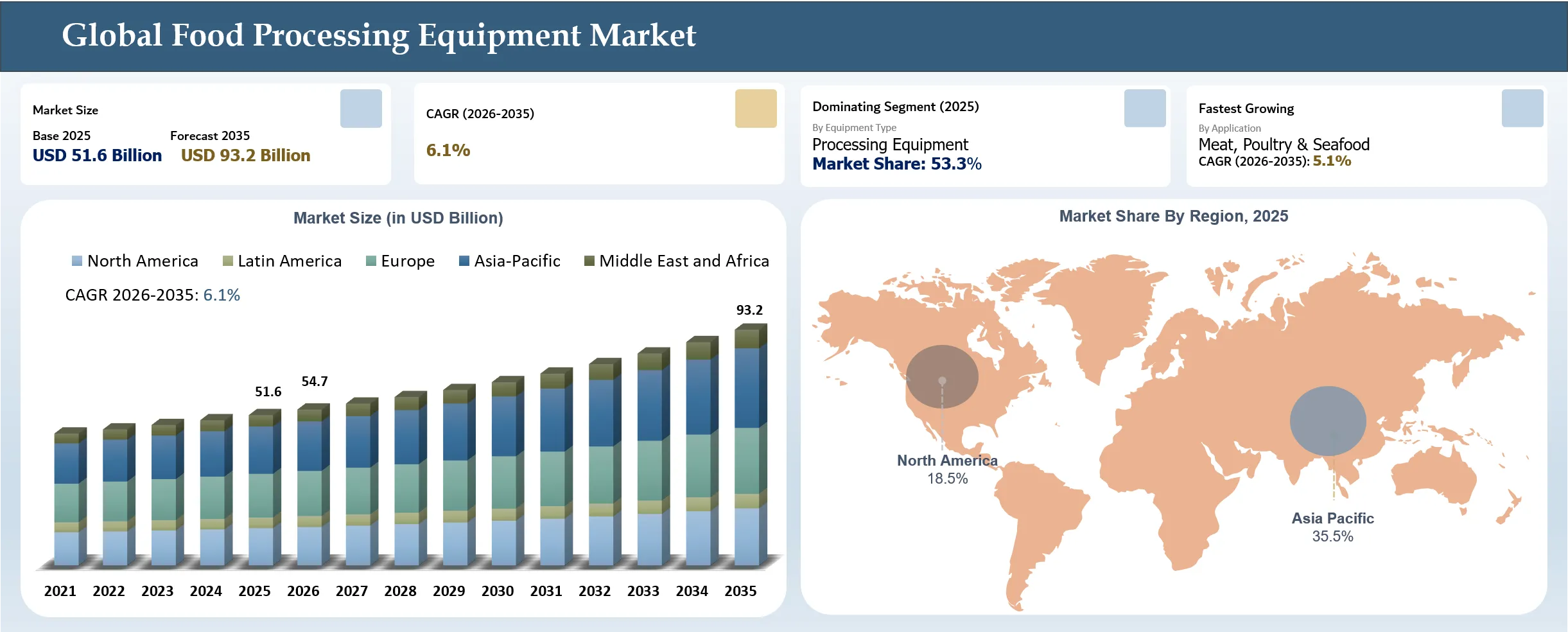
The global food processing equipment market reached USD 51.6 billion in 2025 and is expected to reach USD 93.2 billion by 2035, growing with a CAGR of 6.1% during the forecast period 2026-2035. The market is experiencing continued equipment modernization as food manufacturers focus on greater production capacity, automation, hygiene, efficiency, and process control. In December 2025, Food Ingredients First, the Fi Europe Food Manufacturing Innovation Awards, reported that the number of entries in the competition increased 22% year over year to reach 177 in six categories, compared to 145 last year, indicating rising levels of innovation in food-processing technology. The Industrial Protein Mixer from Tetra Pak has a capacity to process 50,000 liters an hour, saving 455 hours a year in cleaning downtime, and resulting in annual savings exceeding €100,000 (USD 116,000).
The Air Jet Cleaning system shortens the time for cleaning the equipment using the powder to 30 minutes from 90 minutes per cycle and has a capacity to recover up to 50 liters of the product per cycle. In May 2026, according to Protein Production Technology International, Bühler launched its Nutrex 7 Series extrusion technology, which has the ability to reduce wastage by up to 30% per production cycle due to its automated StepFlow technology.
White-Space Opportunities for Meat & Poultry Processing Equipment Modernization and Capacity Expansion
In July 2026, the U.S. Department of Agriculture (USDA) Rural Development made USD 60 million available through Phase 4 of the Meat and Poultry Processing Expansion Program (MPPEP) to expand and diversify U.S. meat and poultry processing capacity, with the highest individual investment category being Processing Expansion Projects, which provides USD 50,000–USD 2 million per project and supports equipment purchases above USD 250,000, facility upgrades, renovations, retrofits, and capacity expansion.
The second investment area, Simplified Equipment-Only Projects, provides USD 10,000–USD 250,000 specifically for equipment purchases. The USD 60 million pool is divided equally between Very Small and Small Processors and Intermediate Processors, meaning each competition receives approximately USD 30 million.
The funding creates procurement opportunities for food-processing machinery suppliers; the direct grant recipients are eligible U.S.-based, independently operated processors. Potential equipment suppliers that could benefit indirectly include JBT Marel for poultry and meat processing lines, deboning, cutting, portioning and automation; BAADER for poultry processing, evisceration, deboning and further-processing systems.
The Middleby Corporation for food-processing, cooking and industrial food equipment; GEA Group for processing, mixing, marinating, cooking, chilling and freezing equipment; MULTIVAC for meat and poultry packaging, thermoforming, tray sealing and automated packaging systems; Key Technology for sorting, inspection and conveying systems; Heat and Control for processing, conveying, weighing and packaging equipment; and Dorner for sanitary conveyor systems used in meat and poultry production facilities.
Food Processing Equipment Market Key Takeaways
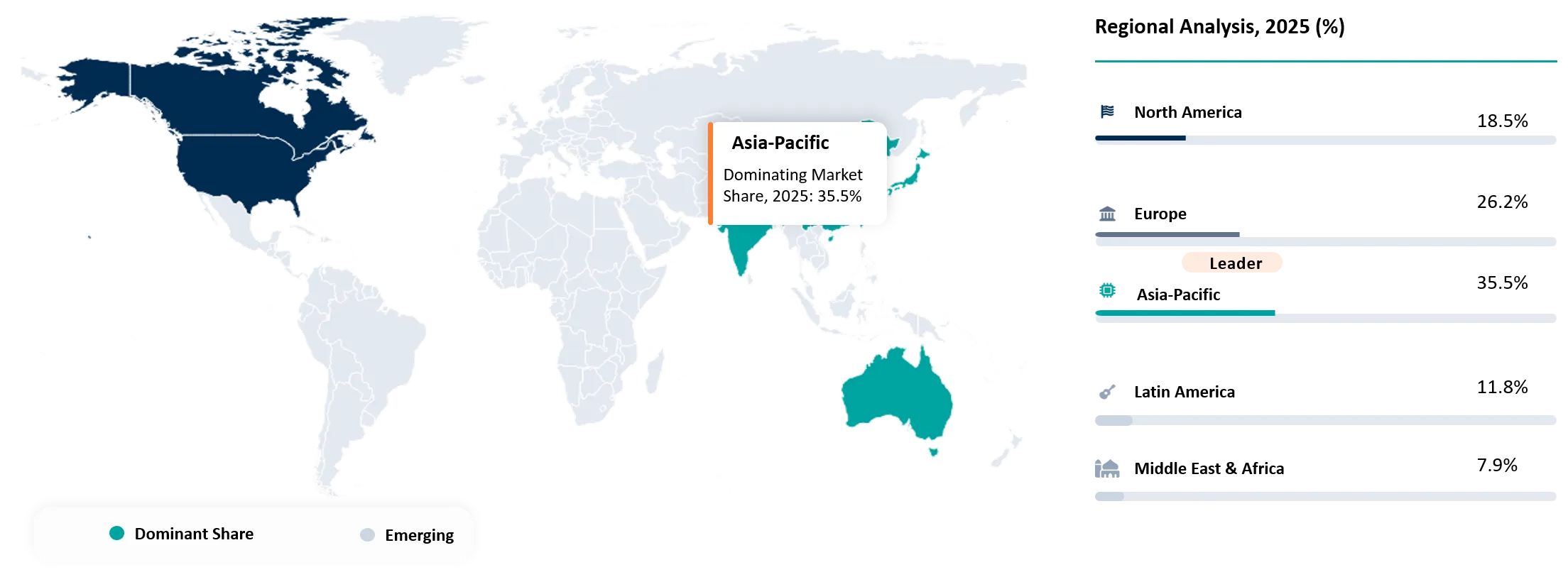
- The Asia-Pacific region dominated the global marketplace, holding a 35.5% revenue share in 2025. The region is slated to remain both the largest and fastest-growing market through 2035.
- The processing equipment segment captured the majority of the market, holding a 53.3% global market share in 2025. Driven by a 23% market growth impact, manufacturers rely on processing units to transform raw ingredients into consumer goods.
- UK food and drink production costs rose by an average of 4.5% in the year leading up to March 2025. Furthermore, over 20% of food manufacturing companies experienced severe cost increases of up to 10%.
- Phase 4 of the MPPEP allocated USD 60 million to expand U.S. meat and poultry processing infrastructure. Processing Expansion Projects offer USD 50,000 to USD 2 million per project for equipment purchases exceeding USD 250,000.
Food Processing Equipment Market Scope
| Metrics | Details | |
| 2025 Market Size | USD 51.6 Billion | |
| 2035 Projected Market Size | USD 93.2 Billion | |
| CAGR (2026-2035) | 6.1% | |
| Largest Market | Asia-Pacific | |
| Fastest Growing Market | Asia-Pacific | |
| By Equipment Type | Processing Equipment, Pre-Processing Equipment | |
| By Operation | Automatic, Semi-Automatic, Manual | |
| By Application | Bakery & Confectionery, Beverages, Dairy & Dairy Alternatives, Meat, Poultry, & Seafood, Fruits & Vegetables, Grains & Cereals, Other Applications | |
| By Region | North America | U.S., Canada, Mexico |
| Europe | Germany, UK, France, Spain, Italy, Poland, Netherlands, Switzerland | |
| Asia-Pacific | China, India, Japan, Australia, South Korea, Indonesia, Malaysia | |
| Latin America | Brazil, Argentina | |
| Middle East and Africa | UAE, Saudi Arabia, South Africa, Israel, Türkiye | |
| Report Insights Covered | Competitive Landscape Analysis, Company Profile Analysis, Market Size, Share, Growth | |
Food Processing Equipment Market BCG Matrix: Company Evaluation
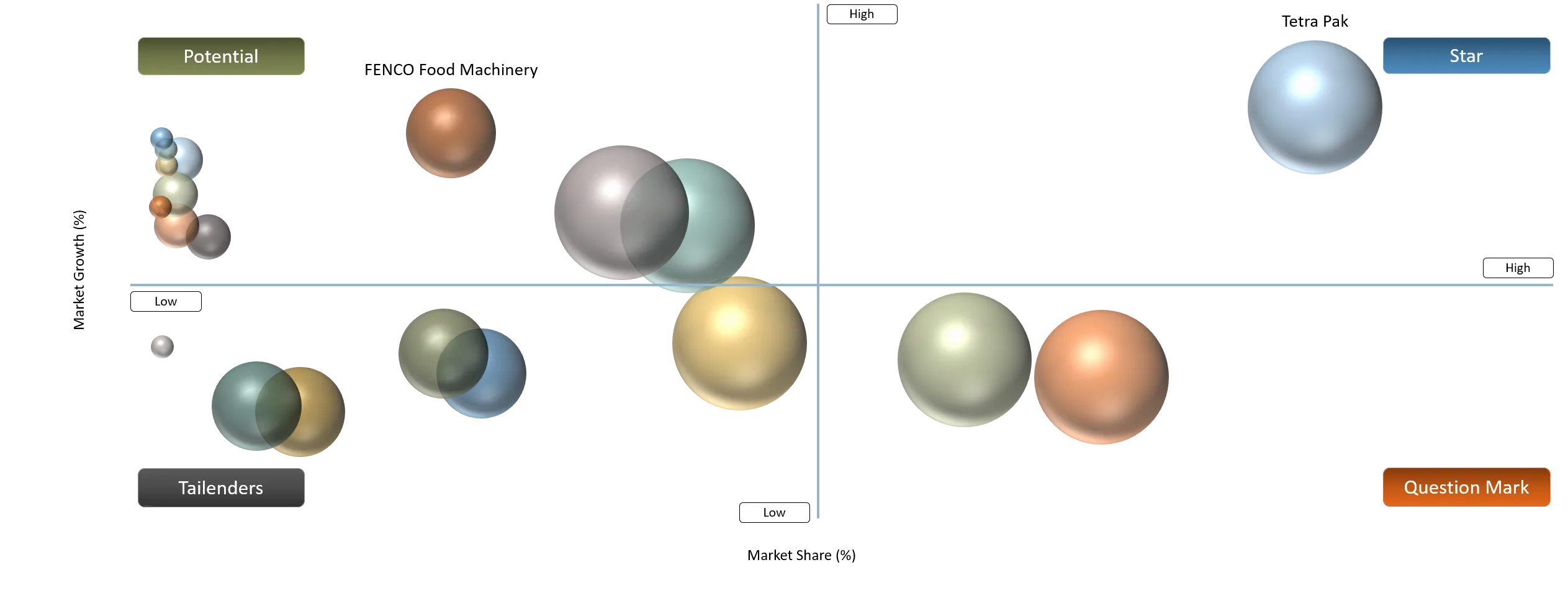
Stars include Tetra Pak, GEA Group AG, and JBT Corporation, supported by their broad food-processing equipment portfolios, established global customer bases, and continued development of automated, hygienic, digital, and high-efficiency processing technologies. The Question Mark category includes Alfa Laval, Krones AG, and Heat and Control, Inc., which have significant capabilities in specialized processing technologies but operate across competitive equipment segments where market positions vary by application and geography.
The Potential category comprises FENCO Food Machinery, Haarslev, and Marlen International, which have established expertise in specific processing applications but have narrower portfolios or market coverage than the larger diversified equipment suppliers. The Middleby Corporation is placed in the Tailenders category in this company-evaluation framework because its food equipment portfolio is strongly concentrated in commercial foodservice and kitchen equipment alongside food-processing solutions, giving it a different market exposure from companies primarily focused on industrial food-processing systems.
Food Processing Equipment Market Dynamics
Driver Impact Analysis
| Driver | Market Growth Impact (%) | Demand Concentration | Impacted Use Case | Strategic Impact |
Rising automation and labor shortages are accelerating demand for automated food processing equipment. | 25% | High — large food manufacturers, high-volume processing plants, and developed markets | Automated processing lines, robotics, material handling, inspection, sorting, filling, and packaging | Accelerates replacement of manual operations with automated and connected equipment, improving throughput, labor productivity, consistency, and operational continuity. |
Increasing food safety and hygiene requirements are driving adoption of equipment with hygienic designs, automated cleaning, and | 20% | Very High — meat & poultry, dairy, beverages, ready-to-eat foods, and processed foods | Cleaning-in-place (CIP), pasteurization, sterilization, hygienic conveying, processing, and contamination control | Increases demand for sanitary equipment, automated cleaning systems, traceability, and designs that reduce contamination risks and production downtime. |
Growing demand for processing efficiency and higher throughput is encouraging manufacturers to upgrade to advanced cooking, extrusion, roasting, sorting, and handling equipment. | 23% | High — high-volume food processing and large-scale manufacturing facilities | Cooking, extrusion, roasting, frying, grinding, sorting, conveying, and high-speed handling | Supports equipment modernization and higher-capacity production lines, while improving yield, throughput, product consistency, and resource utilization. |
Rising adoption of digital process control and smart equipment is increasing demand for machinery with sensing, monitoring, automation, and process-optimization capabilities. | 17% | Medium–High — technologically advanced plants and large/medium food manufacturers | Predictive maintenance, real-time process monitoring, quality inspection, remote diagnostics, and automated control | Shifts equipment purchasing toward connected and intelligent systems, creating opportunities for AI-enabled monitoring, IoT integration, predictive maintenance, and data-driven optimization. |
Rising automation and labor shortages are accelerating demand for automated food processing equipment
The growing shortage of skilled workers in the food and beverages industry is making automation in food processing systems a requirement as manufacturers strive to keep up their production capabilities and increase productivity without relying too much on manpower. The use of robotic devices, automated material handling systems, machine vision, automated inspection systems, and digitally controlled systems in food processing is becoming commonplace as manufacturers automate repetitive and manpower-intensive processes.
Food producers are facing greater pressure to boost productivity and decrease their reliance on manual labor due to increased labor shortages and rising cost of production. In January 2026, according to Food Processing Technology (FPT), the food and drinks manufacturing industry in the UK had a 4.2% vacancy rate in 2025. Another finding from Food Processing Technology (FPT) is that 43% of the leaders of food and beverages production companies considered labor shortage and skills shortage as one of the biggest challenges faced by the industry, whereas only 30% of other industries were affected in the same way.
On the other hand, food and drinks production costs in the UK rose by an average of 4.5% during the year to March 2025, whereas over 20% of companies had an increase in their production costs of up to 10%.
Food Processing Equipment Market Segment Analysis
The global food processing equipment market is segmented based on equipment type, operation, application, and region.
Processing Equipment Segment Dominates Due to High-Volume Food Production and Automation Demand
The processing equipment segment dominates the food processing equipment market, accounting for 53.3% of the market share in 2025. Processing equipment, which is made up of the cooking and heating system, ovens, dryers, fryers, extrusion equipment, mixers, grinders, pasteurizers, sterilizers, forming machinery, and other forms of equipment, is crucial as it transforms the raw materials into suitable, ready-to-eat food products. Processing equipment can be used in nearly all food industries, such as meat and poultry production, dairy product making, bakery, preparing food products, making beverages, etc.
Automation and digital technologies are changing the way food processing happens through increased productivity, minimized wastage, and efficient use of equipment. In November 2025, Tetra Pak launched its Factory OS portfolio to support AI-ready food and beverage production by way of automation, digitalization, real-time monitoring, and integration of equipment data. A comparative analysis showed that automated beverage factories demonstrated 20% better OEE performance, 45% less product loss, and 20% fewer stops on the packaging line compared to non-automated plants. The Factory OS from Tetra Pak helps integrate all the equipment and systems in the plant to present a real-time view of the plant operation.
Food Processing Equipment Market Geographical Penetration
Rapid Food Manufacturing Modernization and Processing Capacity Expansion in the Asia-Pacific Region
The Asia-Pacific region dominates the food processing equipment market, accounting for an estimated 35.5% of the global market in 2025, supported by the region’s large food and beverage manufacturing base, expanding processed-food production, and increasing adoption of automated processing technologies. The combination of growing food consumption, manufacturing capacity expansion, and modernization of existing processing facilities is increasing demand for equipment used in cooking, mixing, heat treatment, drying, extrusion, filling, and other production processes.
These strategic partnerships strengthen Asia-Pacific food-processing equipment capabilities by accelerating automation, AI integration, and energy-efficient machinery adoption. In August 2025, EPB Group Bhd, a Malaysia-based food processing and packaging machinery provider, partnered with Shenzhen Honglin Machinery Equipment Co Ltd, a China-based machinery company, to establish AI MEDIC, with EPB holding an 80% stake and Shenzhen Honglin's shareholder, Fan Yanlin 20%. The venture will integrate robotics, semiconductor software, and AI into food-processing machinery. EPB also partnered with Nidec Corp, a Japan-based industrial technology company, to integrate its S100 Series Inverter into food-processing machines, providing 10-30% energy savings, while EPB is expanding its Penang facility across 7.84 acres to strengthen manufacturing and R&D capacity in ASEAN.
China Food Processing Equipment Market Trends
China holds a dominant position in the Asia-Pacific food processing equipment market due to its large food manufacturing base, extensive agricultural processing industry, and increasing investment in production equipment and industrial modernization. The country’s broad food-processing ecosystem creates sustained demand for processing systems used for cooking, mixing, grinding, drying, forming, sterilization, and other value-added operations.
The launch strengthens China’s food-processing equipment capabilities by expanding advanced machinery for human and pet food production. In November 2025, FAMSUN Co., Ltd., a China-based agri-food equipment manufacturer, launched FAMSCEND, a premium brand focused on high-value equipment for human and pet food production. FAMSUN also introduced the PX190 High-end Single-screw Pet Food Extruder and CBHD1200 Baking & Drying Integrated Machine at PET FAIR ASIA 2025; the PX190 supports formulations containing up to 50% fresh meat slurry, while its digital factory solution enables real-time monitoring and traceability.
Japan Food Processing Equipment Market Outlook
Japan is one of the major countries in the Asia-Pacific food processing equipment market, supported by its mature food manufacturing sector, strong engineering capabilities, and increasing adoption of automation to address labor constraints. The country’s food-processing industry is increasingly focused on improving productivity through robotics, AI, IoT, and automated machinery, creating demand for advanced equipment across processing and production operations.
The acquisition strengthens Japan’s food-processing equipment ecosystem by combining Mabuchi Motor’s motor technologies with MASDAC’s specialized confectionery machinery capabilities. In April 2026, Mabuchi Motor Co., Ltd., a Japan-based electric motor manufacturer, announced the acquisition of MASDAC Co., Ltd., a Japan-based food machinery manufacturer, making MASDAC part of the Mabuchi Motor Group. MASDAC supplies food-processing machinery including ovens, steamers, depositors, dorayaki machines, and integrated confectionery production lines, strengthening Mabuchi Motor’s presence in food-processing equipment and confectionery machinery.
Advanced Automation and Processing Capacity Expansion Strengthening North America’s Food Processing Equipment Market
North America region represents a significant market for food processing equipment, which constitutes an 18.5% market share in 2025, due to its well-established food and beverage production sector, efficient processing facilities, and investments in automation technology. Food processors in North America have been adopting processing equipment in their operations in order to solve problems of labor shortages, improve processing capacity and sanitation levels, and increase production efficiency.
The development highlights growing adoption of hygienic and efficient cleaning technologies within North America’s poultry-processing equipment industry. In September 2026, JBT Marel Corporation, a U.S.-based food-processing equipment manufacturer, highlighted its integrated hygienic-processing and cleaning technologies for the poultry-processing industry. The company has more than 50 years of experience in hygienic poultry processing, with its equipment designed to reduce contamination risks and support consistent sanitation across processing lines; its poultry systems can handle processing capacities from 1,000 to 15,000 birds per hour, demonstrating their application across different production scales.
U.S. Food Processing Equipment Market Trends
The U.S. holds a dominant position in the North American food processing equipment market on account of its huge food and beverage production capacity, existing processing facilities, and the increasing use of automation and digitization technologies. Food producers are making use of new processing equipment to cope with labor shortages, increase efficiency, enhance food safety, and overcome operational inefficiencies.
The launch highlights the growing adoption of automated and digitally enabled packaging equipment in the U.S. food and beverage industry. In August 2026, SOMIC Packaging, Inc., a U.S.-based packaging machinery manufacturer, announced that it would showcase its new SOMIC 202 machine series and digital solutions at PACK EXPO International 2026 in Chicago, Illinois. The new platform is designed for automated cartoning and case packing, with a processing speed of up to 20 cartons per minute, while its digital solutions support machine diagnostics and troubleshooting, strengthening automation capabilities for food and beverage packaging operations.
Food Processing Equipment Market Competitive Landscape
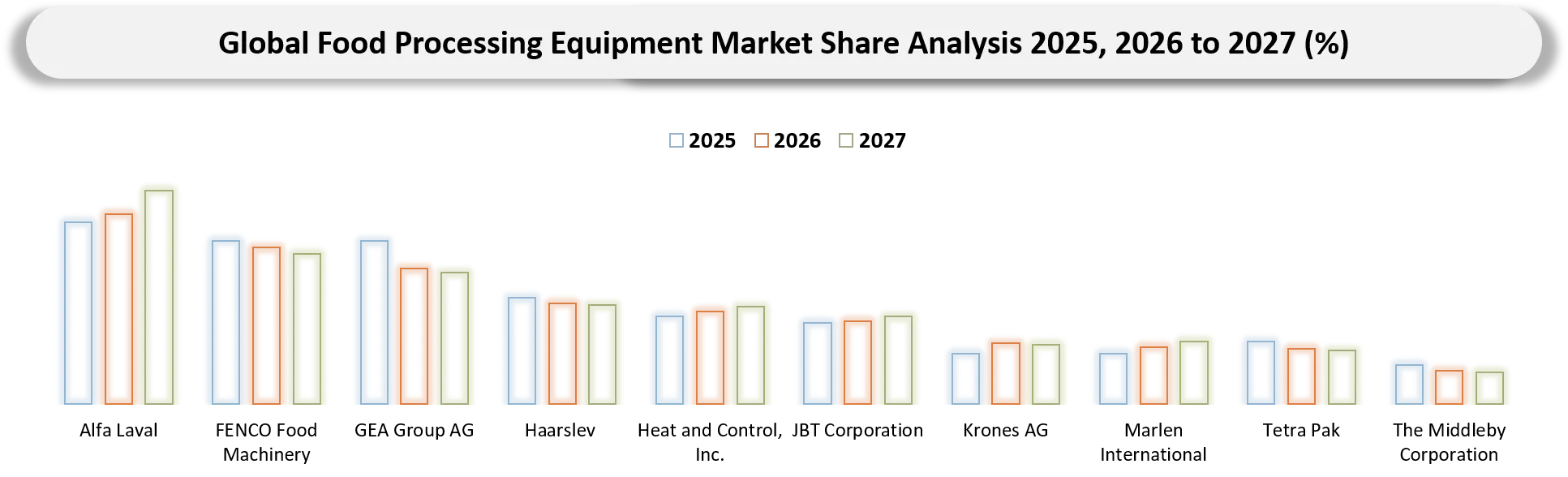
- The food processing equipment market is characterized by three broad participant groups: diversified process-technology and equipment suppliers, integrated food and beverage processing-line providers, and specialized machinery manufacturers. Alfa Laval, GEA Group AG, JBT Corporation, Krones AG, and Tetra Pak compete through broad processing portfolios, automation, thermal processing, separation, filling, and integrated production systems, while Heat and Control, FENCO Food Machinery, Haarslev, and Marlen International focus on specialized processing applications and customized production lines. The Middleby Corporation has a significant food-processing equipment platform focused on industrial protein, bakery, and snack applications. This creates a competitive landscape in which equipment breadth, automation capabilities, process integration, geographic reach, and specialization across food categories influence competitive positioning.
- Key players include: Alfa Laval (Sweden), FENCO Food Machinery (Italy), GEA Group AG (Germany), Haarslev (Denmark), Heat and Control, Inc. (U.S.), JBT Corporation (U.S.), Krones AG (Germany), Marlen International (U.S.), Tetra Pak (Switzerland), and The Middleby Corporation (U.S.).
Key Developments
- May 2026: GEA Group, a Germany-based food processing and packaging equipment manufacturer, launched the PowerPak 5000 thermoformer at interpack 2026 for medium-sized food producers.
- February 2026: KRONEN GmbH, a Germany-based food-processing equipment manufacturer, and Urschel Laboratories, Inc., a U.S.-based food-cutting equipment manufacturer, jointly showcased their food-processing technologies for the first time in Asia at ProPak Philippines 2026.
- September 2025: De Heus, a Netherlands-based animal nutrition and feed company, partnered with JBT Marel, a Netherlands-based food-processing equipment and technology company, on a greenfield poultry-processing plant in Tây Ninh, Vietnam.
- May 2025: ANKO Food Machine, a Taiwan-based food-processing machinery manufacturer, launched the PS-900, described by the company as the world’s first automated solution for forming authentic Punjabi samosas.
- February 2026: ROCKY-ICHIMARU Co., Ltd., a Japan-based industrial equipment manufacturer, acquired 100% of Ohyama Foods Machinery Co., Ltd., a Japan-based food-processing machinery manufacturer, making it a wholly owned subsidiary.
- May 2025: Heat and Control, a U.S.-based food-processing equipment manufacturer, acquired Tek-Dry Systems Ltd., a U.K.-based thermal-processing equipment manufacturer, and Hunt Heat Exchangers, a heat-transfer equipment provider, to expand its food-processing equipment portfolio.
Key Procurement Priorities and Buyer Evaluation Criteria
- Organizations procuring equipment for the Food Processing Equipment Market increasingly select suppliers based on their ability to provide high-throughput, hygienic, reliable, and energy-efficient processing systems that can meet specific production volumes and food-safety requirements.
- The procurement decision-making process is increasingly influenced by the need for automation, digital process control, AI-enabled monitoring, labor reduction, flexible production, and integration with existing manufacturing systems, particularly as food processors modernize facilities and respond to workforce constraints.
- Buyers consider factors such as equipment throughput and capacity, sanitation and hygienic design, food-safety compliance, energy and water efficiency, product yield, operating costs, equipment reliability, maintenance requirements, and total cost of ownership when selecting food processing equipment suppliers.
Why Choose DataM?
- Technological Innovations: Explores advancements in food processing equipment, including automated processing systems, AI-enabled monitoring, robotics, digital process control, hygienic equipment design, energy-efficient technologies, and integrated production lines that improve throughput, food safety, consistency, and resource efficiency.
- Product Performance & Market Positioning: Evaluates how different equipment suppliers deliver processing solutions based on processing capacity, automation level, energy efficiency, sanitation, product yield, reliability, flexibility, and total cost of ownership, highlighting differentiation across bakery, beverages, dairy, meat and poultry, fruits and vegetables, grains, and prepared-food applications.
- Real-World Evidence: Highlights the adoption of advanced food processing equipment across commercial food manufacturing facilities, demonstrating benefits such as higher equipment effectiveness, reduced product waste, fewer production stoppages, improved hygiene, lower labor requirements, and greater production consistency.
- Market Updates & Industry Changes: Tracks key developments such as new equipment launches, processing-line expansions, automation upgrades, AI integration, digital factory initiatives, capacity investments, and modernization programs across Asia-Pacific, North America, Europe, and other major food-processing markets.
- Competitive Strategies: Analyzes how leading companies expand through equipment innovation, automation and digitalization, integrated processing solutions, strategic partnerships, acquisitions, capacity expansion, and application-specific technologies to address evolving requirements across global food manufacturing industries.
- Pricing & Market Access: Examines equipment pricing variations based on processing capacity, automation level, equipment configuration, customization, technology integration, materials, and hygiene requirements, along with market access through direct sales, system integrators, distributors, and turnkey food-processing solutions.
- Market Entry & Expansion: Identifies growth opportunities driven by food manufacturing capacity expansion, labor shortages, automation adoption, food-safety requirements, convenience-food production, energy efficiency, waste reduction, and facility modernization, while outlining strategies such as localized manufacturing, technology differentiation, integrated solutions, and partnerships to expand across regional food-processing markets.
Target Audience 2026
- Food & Beverage Manufacturers
- Food Processing Plant Operators
- Equipment Manufacturers & Technology Providers
- Procurement & Supply-Chain Teams
- Automation & Digital Technology Providers
- Engineering, System Integrators & EPC Companies
- Food Safety & Quality Professionals



























































