


Neurodegenerative Disease Therapeutics Market Size
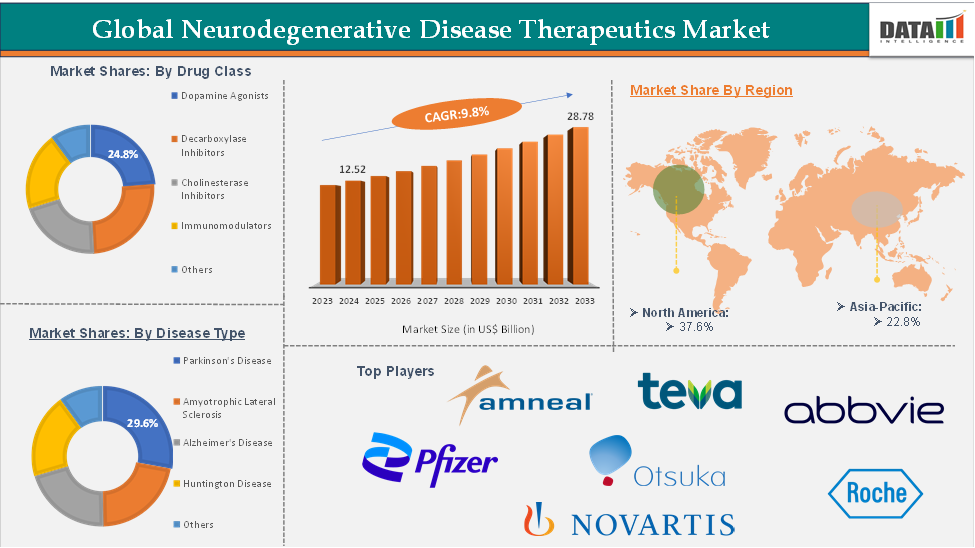
The neurodegenerative disease therapeutics market size reached US$ 13.75 billion in 2025 and is expected to reach US$ 35.12 billion by 2035, growing at a CAGR of 9.8% during the forecast period 2026-2035.
The neurodegenerative disease therapeutics market is experiencing robust growth, fueled by the increasing prevalence of disorders such as Alzheimer’s, Parkinson’s, and Huntington’s disease, particularly among the aging population. With an estimated 6.9 million Americans aged 65 and older living with Alzheimer’s in 2024, the demand for effective treatment options is escalating rapidly.
Pharmaceutical companies are intensifying their focus on this space by pursuing strategic collaborations and licensing agreements to accelerate drug development and expand global reach. For instance, in December 2024, Novartis entered into a global licensing and partnership agreement with PTC Therapeutics to advance PTC518, an investigational oral therapy for Huntington’s disease. Such initiatives highlight the industry's commitment to addressing the urgent need for innovative therapeutics targeting neurodegenerative conditions.
Key Takeaways
- The neurodegenerative disease therapeutics market is projected to grow from US$ 13.75 billion in 2025 to US$ 35.12 billion by 2035, highlighting sustained commercial opportunities across neurological drug development.
- North America accounted for approximately 37.6% of the global market in 2024, supported by strong federal research funding, continuous FDA approvals, and the presence of leading pharmaceutical manufacturers.
- Dopamine agonists represented approximately 24.8% of total revenue in 2024, reflecting their established clinical role in Parkinson's disease management and continued product innovation.
- The increasing prevalence of Alzheimer's disease is creating significant demand for disease-modifying therapies. Approximately 6.9 million Americans aged 65 years and older were living with Alzheimer's disease in 2024, strengthening long-term market fundamentals.
- Pharmaceutical companies are increasingly relying on licensing agreements and strategic collaborations to accelerate pipeline expansion. Partnerships such as Novartis and PTC Therapeutics demonstrate the industry's focus on next-generation neurological therapies.
- Regulatory approvals across ALS, multiple sclerosis, Parkinson's disease, and Alzheimer's disease continue to improve treatment availability while expanding commercial opportunities for innovative manufacturers.
- Asia-Pacific remains the fastest-growing regional market due to expanding healthcare infrastructure, increasing neurological disease prevalence, growing pharmaceutical R&D, and improving patient access to advanced therapies.
Neurodegenerative Disease Therapeutics Market Scope
| Metrics | Details |
| Market Size (2025) | US$ 13.75 Billion |
| Forecast Market Size (2035) | US$ 35.12 Billion |
| CAGR (2026-2035) | 9.80% |
| Historic Years | 2023-2024 |
| Base Year | 2025 |
| Forecast Period | 2026-2035 |
| Revenue Unit | US$ Billion |
| Segments Covered | Drug Class, Disease Type, Route of Administration, Region |
| Leading Region | North America |
| Fastest Growing Region | Asia-Pacific |
Neurodegenerative Disease Therapeutics Market Executive Summary
For more details on this report – Request for Sample
Neurodegenerative Disease Therapeutics Market Dynamics: Drivers & Restraints
Rising approvals for innovative drugs is expected to significantly drive the neurodegenerative disease therapeutics market
The neurodegenerative disease therapeutics market is being significantly propelled by an increasing number of regulatory approvals, which are expanding treatment options for patients with conditions such as Alzheimer’s disease, Parkinson’s disease, and multiple sclerosis. In recent years, regulatory bodies like the FDA and EMA have approved a variety of innovative therapies that not only target symptoms but also aim to modify disease progression. For instance, in May 2024, Biogen Inc. announced that the European Commission (EC) has granted marketing authorization under exceptional circumstances for QALSODY (tofersen), while also maintaining its orphan drug designation. QALSODY is approved for the treatment of adults with amyotrophic lateral sclerosis (ALS) linked to mutations in the superoxide dismutase 1 (SOD1) gene.
Additionally, in September 2024, Roche received FDA approval for OCREVUS ZUNOVO, a twice-yearly subcutaneous injection for relapsing and primary progressive multiple sclerosis, offering patients a more convenient and effective treatment option.
Similarly, in January 2024, AbbVie launched PRODUODOPA in the European Union to treat advanced Parkinson’s disease with severe motor fluctuations. These approvals reflect a growing commitment to advancing personalized and disease-modifying therapies, fostering greater competition and innovation within the market to address the complex needs of neurodegenerative disease patients.
Side effects and safety concerns are expected to hinder the neurodegenerative disease therapeutics market
Side effects and safety concerns pose significant challenges to the neurodegenerative disease therapeutics market. Many treatments, especially novel or disease-modifying therapies, can lead to adverse reactions ranging from mild symptoms to serious complications, which may limit their widespread adoption. Regulatory authorities enforce stringent safety standards, and drugs with unfavorable safety profiles often face delays or rejection, impacting the speed of market entry.
Additionally, concerns over long-term safety and tolerability can affect patient adherence and physician willingness to prescribe certain therapies. These factors collectively hinder market growth by reducing the pool of viable treatment options and increasing the costs and timelines associated with drug development.
Neurodegenerative Disease Therapeutics Market Segment Analysis
The global neurodegenerative disease therapeutics market is segmented based on drug class, disease type, route of administration, and region.
Drug Class:
The dopamine agonists segment is expected to hold 24.8% of the market share in 2024 in the neurodegenerative disease therapeutics market
The dopamine agonists segment is expected to dominate the neurodegenerative disease therapeutics market due to its central role in managing Parkinson’s disease and other dopamine-related neurological disorders. As the global prevalence of Parkinson’s disease continues to rise, especially in aging populations, the demand for effective, long-term treatment options is increasing. Dopamine agonists offer significant advantages, particularly in the early stages of Parkinson’s, where they are often used to delay levodopa initiation and minimize long-term motor complications. Their favorable safety profile and efficacy in alleviating symptoms such as tremors and rigidity make them a preferred choice for both patients and clinicians.
Several compaies are conducting clinical trials to introduce advanced dopamine agonists solutions to make them available for the treatment of various neurodegenerative diseases. For instance, in September 2024, AbbVie announced positive topline results from its pivotal Phase 3 TEMPO-1 trial, evaluating tavapadon as a once-daily monotherapy for early Parkinson’s disease. Tavapadon is an investigational D1/D5 dopamine receptor partial agonist.
This development further underscores the growing dominance of dopamine agonists in the neurodegenerative disease therapeutics market. These agents play a central role in managing Parkinson’s disease by directly stimulating dopamine receptors, thereby alleviating motor symptoms like tremors, rigidity, and bradykinesia.
Additionally, these drugs are used in treating conditions like Restless Legs Syndrome, expanding their therapeutic reach. The market is further bolstered by innovations such as extended-release formulations and transdermal patches, which enhance patient compliance. The availability of generics and growing adoption in emerging markets, supported by strategic industry collaborations, are also contributing to the segment’s dominance in the neurodegenerative disease therapeutics market.
Neurodegenerative Disease Therapeutics Market Geographical Analysis
North America is expected to hold 37.6% of the market share in 2024 in the global neurodegenerative disease therapeutics market with the highest market share
North America holds a leading position in the global neurodegenerative disease therapeutics market and is projected to maintain a significant share throughout the forecast period. This dominance is driven by the rising prevalence of neurodegenerative disorders, robust research and development activities focused on innovative treatments, the presence of numerous multinational pharmaceutical companies, and strong regulatory support coupled with increasing funding for neurodegenerative disease research.
Government funding plays a vital role in fueling the market’s growth in North America by supporting ongoing research, development, and innovation in this critical healthcare segment. For example, in March 2024, an additional $100 million was allocated to the National Institutes of Health (NIH), bringing the annual federal funding for Alzheimer’s research to approximately $3.8 billion. Furthermore, in fiscal year 2022, the National Institute of Neurological Disorders and Stroke (NINDS) funded about $125 million of the $259 million total NIH-supported research for Parkinson’s disease.
The surge in drug approvals within the region is also a key growth driver, offering patients more treatment options. Pharmaceutical companies are actively developing new neurodegenerative disease therapies to meet this growing demand. Notably, in August 2024, Amneal Pharmaceuticals received FDA approval for CREXONT (carbidopa and levodopa) extended-release capsules for Parkinson’s disease. CREXONT combines immediate-release granules with extended-release pellets in a novel oral formulation. Similarly, in May 2024, Teva Pharmaceuticals obtained FDA approval for AUSTEDO XR, a once-daily, single-pill treatment available in four new tablet strengths, indicated for tardive dyskinesia (TD) and Huntington’s disease (HD) chorea in adults.
Together, these factors are expected to drive North America’s expanding market share in the neurodegenerative disease therapeutics sector.
Asia-Pacific is expected to hold 22.8% of the global neurodegenerative disease therapeutics market in 2024
The Asia-Pacific region is experiencing the fastest growth in the global neurodegenerative disease therapeutics market, driven by several key factors. A major contributor to this growth is the increasing prevalence of neurodegenerative disorders such as Alzheimer’s and Parkinson’s disease, which has led to a rising demand for healthcare services in countries like China and India. As these numbers continue to rise, the demand for effective drugs and treatments in the region is expected to grow substantially, thereby boosting the region’s market share.
Additionally, the strong pharmaceutical industry in Asia-Pacific, comprising both multinational corporations and local companies, plays a pivotal role in driving market expansion through active research and development efforts. This focus on innovation is improving the availability of advanced therapies that address the unique needs of patients in the region. For instance, in September 2024, Otsuka Pharmaceutical Co., Ltd. received regulatory approval in Japan for an expanded indication of Rexulti (brexpiprazole), targeting symptoms such as excessive motor activity and aggressive behavior linked to mood fluctuations and irritability in patients with Alzheimer’s disease dementia. Collectively, these factors are expected to propel the Asia-Pacific region to become the fastest-growing market for neurodegenerative disease therapeutics.
Neurodegenerative Disease Therapeutics Market Opportunities
The neurodegenerative disease therapeutics market presents substantial long-term opportunities as healthcare systems prioritize earlier diagnosis, personalized treatment, and disease-modifying interventions. Rising healthcare expenditure, expanding neurological research, and increasing regulatory support are encouraging pharmaceutical companies to strengthen clinical pipelines across Alzheimer's disease, Parkinson's disease, Huntington's disease, and amyotrophic lateral sclerosis (ALS). Companies capable of introducing therapies that improve long-term patient outcomes while demonstrating favorable safety profiles are expected to strengthen their competitive positions over the forecast period.
Biotechnology companies and pharmaceutical manufacturers also have significant opportunities to leverage strategic licensing agreements, co-development partnerships, and commercialization alliances to reduce development timelines and broaden market access. The licensing collaboration between Novartis and PTC Therapeutics illustrates how partnerships are becoming an effective strategy for accelerating innovation in neurological disorders while expanding global commercialization capabilities.
Emerging economies across Asia-Pacific represent another attractive investment destination. Improving healthcare infrastructure, increasing neurological disease awareness, expanding reimbursement programs, and growing pharmaceutical manufacturing capabilities are creating favorable conditions for market expansion. Local manufacturers collaborating with multinational pharmaceutical companies can capitalize on rising demand for advanced therapeutics while improving regional treatment accessibility.
Healthcare providers and hospital systems are also expected to benefit from increasing availability of innovative neurological therapies. Earlier diagnosis supported by improved treatment options is likely to encourage broader adoption of disease-modifying therapies, particularly as physicians seek to improve patient quality of life and reduce long-term healthcare costs associated with progressive neurological disorders.
Neurodegenerative Disease Therapeutics Market Top Companies
Top companies in the neurodegenerative disease therapeutics market include AbbVie Inc., Amneal Pharmaceuticals LLC., Eisai Co., Ltd., F. Hoffmann-La Roche Ltd, Merck KGaA, Novartis AG, Pfizer Inc., Teva Pharmaceutical Industries Ltd., Otsuka Pharmaceutical Co., Ltd., Orion Corporation, among others.
Key Developments in Neurodegenerative Disease Therapeutics Market
- June 2026: AbbVie Inc. continued advancing its neuroscience pipeline by expanding clinical development programs targeting neurodegenerative disorders, including innovative therapies designed to address disease progression and symptom management.
- June 2026: Eisai Co., Ltd. strengthened its Alzheimer's disease portfolio through the continued global expansion and clinical evaluation of disease-modifying therapies aimed at improving patient outcomes in neurodegenerative diseases.
- May 2026: F. Hoffmann-La Roche Ltd. advanced its neuroscience research initiatives by progressing novel therapeutic candidates targeting Alzheimer's disease, Parkinson's disease, and other neurodegenerative conditions.
- May 2026: Novartis AG expanded its neuroscience capabilities through ongoing investments in precision medicine approaches and next-generation therapeutic platforms for neurological disorders.
- April 2026: Pfizer Inc. continued enhancing its neuroscience research portfolio by supporting the development of innovative treatments targeting neurodegenerative disease pathways and unmet clinical needs.
- April 2026: Merck KGaA strengthened its neurodegenerative disease research programs through advancements in molecular and biomarker-based technologies supporting therapeutic development.
- March 2026: Teva Pharmaceutical Industries Ltd. expanded its central nervous system (CNS) portfolio through continued investments in therapies addressing neurological and neurodegenerative disorders.
- March 2026: Otsuka Pharmaceutical Co., Ltd. advanced its neuroscience initiatives by progressing research programs focused on innovative therapeutic approaches for neurodegenerative diseases.
- February 2026: Orion Corporation strengthened its neurological therapeutics portfolio through collaborations and research efforts aimed at developing treatments for neurodegenerative conditions, including Parkinson's disease.
Investment, Licensing, and Strategic Collaboration Analysis
Public and private sector investments supporting neuroscience innovations continue creating substantial commercialization opportunities globally. Pharmaceutical organizations, biotechnology companies, and institutional investors are increasingly allocating resources toward clinical development programs, licensing agreements, and strategic collaboration initiatives supporting advanced neurological therapeutics. Strategic acquisitions involving next-generation therapeutic platforms are anticipated to significantly accelerate future market developments. Additionally, increasing investments supporting biomarker research and disease-modifying therapeutics are expected to strengthen competitive positioning worldwide.
Emerging Technologies and Pipeline Analysis
Emerging technologies involving gene therapies, RNA-based therapeutics, monoclonal antibodies, neuroprotective therapeutic platforms, and artificial intelligence-enabled drug discovery capabilities are substantially transforming future market opportunities. Innovations supporting personalized medicine initiatives and targeted neurological interventions are anticipated to significantly improve therapeutic outcomes globally. Furthermore, increasing diversification across neurodegenerative therapeutic pipelines is expected to create attractive commercialization opportunities throughout the forecast period.
Future Market Trends (2026–2035)
The Neurodegenerative Disease Therapeutics Market is expected to witness substantial growth throughout the forecast period driven by increasing disease prevalence, expanding precision medicine initiatives, and continuous technological advancements across neuroscience therapeutics. Future market expansion will be supported by disease-modifying therapies, biomarker-guided treatment approaches, and next-generation neurological therapeutic platforms. Additionally, increasing investments supporting commercialization activities, manufacturing innovations, and regulatory advancements are anticipated to significantly influence future market dynamics across major healthcare economies.
Neurodegenerative Disease Therapeutics Market Impact Analysis
Regulatory Approvals Are Accelerating Market Expansion
Regulatory agencies continue to play a pivotal role in shaping the neurodegenerative disease therapeutics market by facilitating access to innovative therapies. Approvals for treatments addressing Alzheimer's disease, ALS, Parkinson's disease, and multiple sclerosis are broadening therapeutic options while encouraging pharmaceutical companies to invest further in neurological drug development.
The increasing availability of disease-modifying therapies is expected to improve treatment outcomes, expand physician confidence, and stimulate greater adoption across healthcare systems worldwide.
Research Funding Supports Long-Term Innovation
Government investment remains a major contributor to neurological research. Increased funding for Alzheimer's disease and Parkinson's disease research, particularly in North America, is accelerating scientific discovery and supporting the development of novel therapeutic approaches.
Public-sector funding also encourages collaboration among academic institutions, biotechnology firms, and multinational pharmaceutical companies, strengthening the overall innovation ecosystem.
Strategic Partnerships Reduce Development Risk
Licensing agreements and research collaborations enable pharmaceutical companies to share scientific expertise, reduce financial risk, and accelerate commercialization. These collaborative business models are expected to become increasingly important as neurological drug development grows more complex and capital-intensive.
Report Benefits
This report provides valuable strategic insights for organizations operating across the neurodegenerative disease therapeutics value chain by offering comprehensive market intelligence, competitive analysis, and future growth assessments.
The report helps:
- Pharmaceutical Manufacturers evaluate commercialization opportunities, product pipeline strategies, and competitive positioning.
- Biotechnology Companies identify partnership opportunities and emerging areas for neurological drug innovation.
- Investors and Venture Capital Firms assess high-growth therapeutic segments, regulatory trends, and long-term investment potential.
- Healthcare Providers understand evolving treatment options, disease-modifying therapies, and future clinical adoption trends.
- Procurement Teams evaluate supplier capabilities, approved therapies, and product availability across key markets.
- Strategy and Business Development Teams identify regional expansion opportunities, licensing prospects, and competitive benchmarking.
Target Audience
- Pharmaceutical Companies
- Biotechnology Companies
- Contract Research Organizations (CROs)
- Drug Developers
- Clinical Research Organizations
- Hospitals and Specialty Neurology Centers
- Healthcare Providers
- Government Healthcare Agencies
- Regulatory Authorities
- Medical Device and Drug Delivery Companies
- Institutional Investors
- Venture Capital Firms
- Private Equity Investors
- Healthcare Consultants
- Market Intelligence Firms
- Academic and Research Institutions
- Distribution and Procurement Organizations
Conclusion
The neurodegenerative disease therapeutics market is positioned for sustained expansion through 2035, supported by the growing prevalence of neurological disorders, continuous regulatory approvals, increasing research investment, and strong pharmaceutical innovation. As healthcare systems increasingly emphasize early diagnosis and disease-modifying treatment strategies, demand for advanced therapeutics addressing Alzheimer's disease, Parkinson's disease, Huntington's disease, ALS, and related neurological conditions is expected to rise steadily.
Strategic collaborations, licensing agreements, and accelerated clinical development programs are enabling pharmaceutical companies to strengthen their competitive positions while expanding treatment accessibility across global markets. At the same time, continued government funding and supportive regulatory pathways are fostering an environment conducive to long-term neurological research and commercialization.
Despite promising growth prospects, manufacturers must continue addressing challenges related to safety, long-term efficacy, regulatory compliance, and development costs. Companies capable of delivering clinically differentiated therapies with favorable safety profiles, convenient administration methods, and demonstrable patient benefits are expected to achieve stronger commercial success.
For investors, pharmaceutical manufacturers, biotechnology innovators, and healthcare stakeholders, the neurodegenerative disease therapeutics market represents a strategically important opportunity where scientific advancement, regulatory support, and rising clinical demand are expected to drive sustainable business growth throughout the forecast period.
Who Should Buy This Report?
This report is designed for pharmaceutical organizations, biotechnology companies, neuroscience research institutions, healthcare technology providers, Contract Research Organizations (CROs), and strategic consulting firms seeking actionable insights into emerging neurodegenerative disease therapeutic technologies and commercialization opportunities. Institutional investors, venture capital organizations, business development teams, and manufacturing leaders can leverage the report to evaluate investment trends, technological developments, and competitive dynamics shaping the global market. Furthermore, healthcare providers, regulatory stakeholders, and translational medicine researchers can utilize the report to support informed decisions related to product development initiatives, strategic partnerships, manufacturing expansion strategies, and long-term commercialization planning activities.
Why Should You Buy This Report?
This report provides comprehensive market intelligence on the Neurodegenerative Disease Therapeutics Market by delivering valuable insights into technological advancements, clinical development trends, regulatory developments, and investment opportunities across major global markets. It enables stakeholders to identify high-growth opportunities across disease-modifying therapeutics, biomarker-guided treatment technologies, and precision medicine applications while evaluating evolving market adoption patterns worldwide. Furthermore, the report supports strategic decision-making related to product innovation initiatives, manufacturing capacity expansion strategies, strategic collaborations, and market entry opportunities by providing in-depth analyses of competitive dynamics, regional growth opportunities, and future technological developments expected to shape the industry through 2035.




























































