


Global 5G in Healthcare Market: Industry Outlook
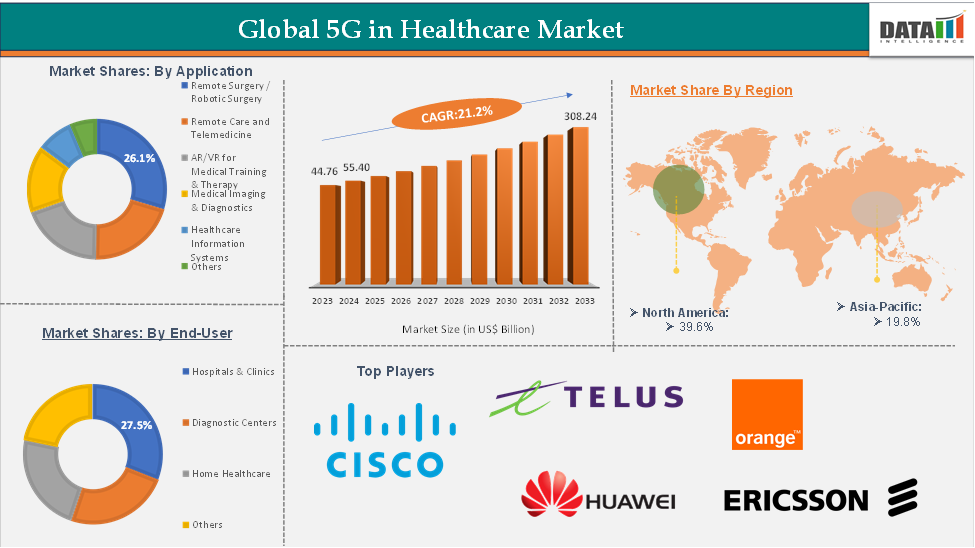
The global 5G in healthcare market reached US$ 44.76 billion in 2023, with a rise of US$ 55.40 billion in 2024, and is expected to reach US$ 308.24 billion by 2033, growing at a CAGR of 21.2% during the forecast period 2025-2033.
The 5G in healthcare market is witnessing rapid growth as healthcare systems worldwide embrace digital transformation to improve patient outcomes, reduce costs, and expand access to care. The rollout of 5G networks offers ultra-low latency, high bandwidth, and real-time data transmission. As demand for virtual care and remote patient management continues to rise, particularly in the wake of the COVID-19 pandemic, 5G is becoming a foundational technology enabling these services at scale. Major investments from both public and private sectors, along with collaborations between telecom and healthcare companies, are accelerating innovation.
The market is expected to grow significantly as smart hospitals, Internet of Medical Things (IoMT), and real-time health analytics become more mainstream. With its ability to support personalized, connected, and decentralized care, 5G is set to play a transformative role in the future of global healthcare delivery.
Executive Summary
Dynamics: Drivers & Restraints
Driver: Rising Demand for Remote Healthcare Services
The rising demand for remote healthcare services is a key driver fueling the adoption of 5G technology in healthcare. With the increasing prevalence of chronic diseases, aging populations, and the ongoing emphasis on minimizing in-person visits, remote patient monitoring, telemedicine, and virtual consultations have become essential components of modern healthcare. 5G’s high-speed connectivity and ultra-low latency enable seamless, real-time video consultations and continuous data transmission from wearable devices and home monitoring systems. This enhances the quality of care by allowing healthcare providers to detect early signs of deterioration, adjust treatments promptly, and reduce hospital readmissions.
Real-world collaborations and implementations are now demonstrating how 5G-powered solutions are bridging gaps in healthcare access and delivery. For instance, in March 2025, Airtel Business partnered with Fortis Healthcare to launch a Smart Clinics solution utilizing Airtel’s 5G network, aimed at enhancing telemedicine access in both urban and rural regions. This initiative seeks to transform telemedicine by enabling real-time consultations, integrating connected medical devices, and ensuring secure management of health data. The solution leverages live interactions and connected technology to efficiently handle patient health information, improving the quality and reach of healthcare services.
As patients and providers increasingly prioritize convenience and accessibility, 5G networks offer the necessary infrastructure to scale these remote healthcare solutions efficiently, thereby accelerating market growth.
Restraint: Data Security and Privacy Concerns
Data security and privacy concerns present significant challenges that could hamper the adoption of 5G technology in healthcare. The increased connectivity and vast data exchange enabled by 5G networks raise the risk of cyberattacks, data breaches, and unauthorized access to sensitive patient information. Healthcare data is highly confidential, and any compromise can lead to severe legal, financial, and reputational consequences for providers. Concerns around compliance with regulations such as HIPAA and GDPR may delay implementation as organizations strive to ensure robust security protocols. These issues can reduce stakeholder trust, slow the rollout of 5G-enabled healthcare solutions, and increase costs related to cybersecurity measures, ultimately restraining market growth.
For more details on this report, Request for Sample
Segmentation Analysis
The global 5G in Healthcare market is segmented based on application, end-user, and region.
Application:
The remote care and telemedicine segment is estimated to have 26.1% of the 5G in healthcare market share.
The remote care and telemedicine segment is poised to dominate the 5G in Healthcare market due to the transformative impact of 5G technology on virtual healthcare delivery. With its high bandwidth and ultra-low latency, 5G enables seamless, high-quality video consultations and real-time data exchange, overcoming previous limitations such as lag and connectivity issues. This enhances patient-provider interactions, making remote diagnosis, monitoring, and treatment more effective and reliable.
The growing patient preference for convenient, at-home care, combined with increasing healthcare access challenges in rural and underserved areas, further drives demand for telemedicine solutions powered by 5G. Additionally, the integration of wearable devices and IoT sensors with 5G networks allows continuous remote monitoring of vital signs, enabling proactive and personalized care. These factors collectively position remote care and telemedicine as the leading application segment within the expanding 5G healthcare ecosystem.
Geographical Share Analysis
The North America 5G in healthcare market was valued at 39.6% market share in 2024
North America is expected to dominate the 5G in healthcare market, driven by its advanced digital infrastructure, strong investment in healthcare innovation, and early adoption of next-generation technologies. The region benefits from the presence of major telecom operators, technology providers, and healthcare institutions that are actively collaborating to integrate 5G into medical applications. Government initiatives to expand 5G networks, coupled with significant funding for telehealth and digital health solutions, further support this growth.
The U.S., in particular, has seen rapid adoption of telemedicine, remote monitoring, and AI-driven diagnostics. Additionally, favorable regulatory support, rising demand for personalized and remote care, and ongoing pilot programs in smart hospitals and connected ambulances contribute to North America's leadership in this evolving market.
Major Players
The major players in the 5G in healthcare market include Cisco Systems, Inc., TELUS, Orange 5G Lab, Huawei Technologies Co., Ltd., Telefonaktiebolaget LM Ericsson, among others.
Key Developments
In March 2025, Airtel Business partnered with Fortis Healthcare to launch a Smart Clinics solution utilizing Airtel’s 5G network, aimed at enhancing telemedicine access in both urban and rural regions. This initiative seeks to transform telemedicine by enabling real-time consultations, integrating connected medical devices, and ensuring secure management of health data. The solution leverages live interactions and connected technology to efficiently handle patient health information, improving the quality and reach of healthcare services.
In September 2024, TrueBusiness and Intel partnered to transform Thailand’s healthcare into a fully digital ecosystem. Combining TrueBusiness’s 5G network with Intel’s AI technologies, they introduced seven smart healthcare solutions to enhance diagnosis, treatment, rehabilitation, and patient data management. This collaboration aims to streamline the public health system, improve efficiency, and establish Thailand as a leading medical hub in Southeast Asia, elevating health outcomes nationwide.
Report Scope
Metrics | Details | |
CAGR | 21.2% | |
Market Size Available for Years | 2022-2033 | |
Estimation Forecast Period | 2025-2033 | |
Revenue Units | Value (US$ Bn) | |
| Application | Remote Surgery / Robotic Surgery, Remote Care and Telemedicine, AR/VR for Medical Training & Therapy, Medical Imaging & Diagnostics, Healthcare Information Systems, Wearable Devices & Remote Monitoring, Others |
| End-User | Hospitals & Clinics, Diagnostic Centers, Home Healthcare, Others |
Regions Covered | North America, Europe, Asia-Pacific, South America, and the Middle East & Africa | |
The global 5G in healthcare market report delivers a detailed analysis with 73 key tables, more than 76 visually impactful figures, and 195 pages of expert insights, providing a complete view of the market landscape.
Suggestions for Related Report
For more healthcare IT-related reports, please click here



























































