


AI in Healthcare Market Size
AI in Healthcare Market reached US$ 35.96 Billion in 2025 and is expected to reach US$ 305.96 Billion by 2033, growing at a CAGR of 30.1% during the forecast period 2026-2033.
The Global AI in Healthcare Market showed resilience and upward growth in its early stages, moving from US$ 17.91 billion in 2022 to US$ 22.02 billion in 2023.
Artificial intelligence in healthcare refers to the deployment of technologies like machine learning, natural language processing, computer vision, and predictive analytics to enhance clinical decision-making, diagnostics, treatment planning, patient monitoring, and operational efficiency.
Key drivers fueling this growth include the rising incidence of chronic diseases, an aging global population, the need for early and accurate disease detection, and the exponential increase in healthcare data from sources like electronic health records and wearables.
Opportunities abound in areas such as medical imaging analysis, personalized medicine, drug discovery, virtual assistants, and remote patient monitoring, with AI enabling faster diagnoses, cost reductions, and improved patient outcomes.
Major trends shaping the market include the proliferation of AI-powered diagnostic tools, the integration of AI in clinical trials and drug development, the adoption of AI for administrative automation, and growing investments from both the government and private sectors to accelerate innovation and implementation.
Executive Summary
For more details on this report – Request for Sample
AI in Healthcare Market Dynamics: Drivers
Rising Demand for Enhanced Efficiency and Accuracy
Rising demand for enhanced efficiency and accuracy is a major driver in the global AI in healthcare market. As healthcare systems face increasing patient loads, complex administrative processes, and a surge in medical data, there is a pressing need to streamline operations and reduce human error.
AI technologies address these challenges by automating routine administrative tasks-such as data entry, claims processing, and appointment scheduling-freeing up valuable time for healthcare professionals to focus on patient care. In diagnostics, AI-powered algorithms can analyze medical images and patient data with remarkable speed and precision, often surpassing human capabilities in detecting subtle patterns and anomalies, which leads to earlier and more accurate disease detection.
Furthermore, major players in the industry have key initiatives and product launches that would drive the global AI in healthcare market growth. For instance, in April 2024, the World Health Organization (WHO) announced the launch of S.A.R.A.H., which stands for Smart AI Resource Assistant for Health. This innovative digital health promoter prototype is powered by generative artificial intelligence (AI) and is designed to enhance public health engagement ahead of World Health Day, which focuses on the theme “My Health, My Right.
AI in Healthcare Market Dynamics: Restraints
Data security and privacy concerns
AI in healthcare systems relies heavily on access to large volumes of sensitive patient data, such as electronic health records (EHRs), medical imaging, and personal health information (PHI). This data is highly confidential, and its protection is critical for maintaining patient trust and adhering to legal and regulatory standards.
In the United States, for example, the Health Insurance Portability and Accountability Act (HIPAA) sets stringent guidelines for managing PHI. Healthcare organizations must ensure that any AI technologies they adopt are fully compliant with these regulations, which include implementing robust safeguards to protect the confidentiality, integrity, and availability of patient data. For instance, generative AI tools used in healthcare must undergo comprehensive security assessments and require a signed Business Associate Agreement (BAA) to ensure regulatory compliance.
AI in Healthcare Market Segment Analysis
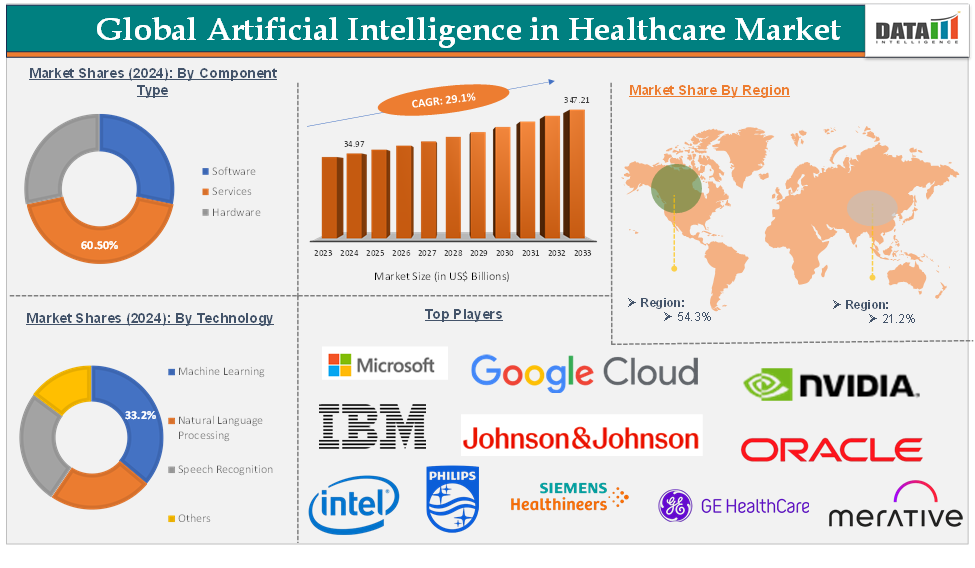
The global AI in healthcare market is segmented based on component type, technology, application, end-user, and region.
Component Type:
The software segment is expected to hold 60.5% of the global AI in healthcare market
The software segment is a crucial and rapidly expanding component of the global AI in healthcare market. This segment encompasses a wide range of AI-driven applications and platforms designed to enhance various aspects of healthcare delivery, from clinical decision support and diagnostics to patient management and administrative automation.
AI healthcare software includes solutions for medical imaging analysis, predictive analytics, natural language processing (NLP), virtual health assistants, and electronic health record (EHR) integration. For example, AI-powered diagnostic tools can analyze radiology images such as X-rays, MRIs, and CT scans with high accuracy, assisting clinicians in detecting diseases like cancer, cardiovascular conditions, and neurological disorders at earlier stages. Predictive analytics software leverages machine learning algorithms to forecast patient outcomes, identify at-risk populations, and optimize treatment plans, leading to improved patient care and resource allocation.
Furthermore, major players in the industry product launching products that would drive the global AI in healthcare market growth. For instance, in May 2025, Iodine Software launched Aware Pre-Bill, a next-generation AI solution designed to optimize revenue cycle management for hospitals and health systems. This new pre-bill tool specifically targets the post-discharge phase, where hospitals often miss out on revenue due to incomplete or inaccurate documentation and coding after a patient leaves the facility.
AI in Healthcare Market Geographical Analysis
North America is expected to hold 54.3% of the global AI in healthcare market
North America, particularly the U.S., benefits from highly developed healthcare systems and widespread adoption of electronic health records (EHRs), enabling seamless integration of AI solutions. The explosion of healthcare data from diverse sources necessitates advanced analytics and AI to interpret and utilize this information efficiently, leading to better patient outcomes and operational efficiency.
The rapid digitalization of healthcare, including the use of wearable devices, IoT sensors, and real-time patient data, creates a rich environment for AI applications. Machine learning, deep learning, and natural language processing are increasingly used to enhance diagnostics, personalize treatments, and streamline workflows.
Both healthcare professionals and patients are increasingly aware of AI’s potential to improve operational efficiency, diagnostic accuracy, and personalized care, fostering broader acceptance and investment in these technologies. Major technology companies such as Microsoft, NVIDIA, Intel, and Amazon Web Services are actively developing and deploying AI healthcare solutions. Strategic collaborations between tech firms, healthcare providers, and pharmaceutical companies are accelerating innovation and adoption.
These significant initiatives by leading technology firms are strengthening North America’s position as a dominant force in the global AI in healthcare market, driving innovation, accelerating adoption, and setting new standards for quality and trust in AI-powered healthcare solutions.
AI in Healthcare Market Major Players
The major global players in the AI in healthcare market include Intel Corporation, Koninklijke Philips N.V., Microsoft, Siemens Healthcare GmbH, NVIDIA Corporation, Merative, GE Healthcare, Medtronic, Google (Alphabet Inc.), Arterys Inc. (Tempus), IBM, Google, Itrex Group, Oracle, Medidata, Merck, IQVIA, Epic System Corporation, and Cognizant, among others.
Recent Developments
- April 2026 – LatentView Analytics invests $3 million in healthcare AI platform Healtheon AI
LatentView Analytics announced a $3 million investment in Healtheon AI to develop agentic AI solutions for healthcare revenue cycle management, including medical coding, claims processing, and workflow automation. - April 2026 – AI chatbot pilot enables prescription refills for mental health treatment in the U.S.
A pilot program in Utah allows an AI chatbot to prescribe and refill certain psychiatric medications under controlled conditions, marking a major step toward AI-assisted clinical decision-making despite ongoing safety concerns. - April 2026 – AI-based diabetic foot screening clinic launched in India
A new AI-powered diagnostic clinic in Chandigarh uses automated risk classification and digital monitoring to improve early detection of diabetic complications, enhancing preventive care capabilities. - March 2026 – Roche deploys large-scale AI infrastructure to accelerate drug discovery
Roche launched an AI-powered “factory” with over 2,000 GPUs to accelerate development of diagnostics and therapeutics, significantly reducing drug discovery timelines. - March 2026 – Google invests $10 million to expand AI-driven clinician training and patient care tools
Google announced funding to train healthcare professionals in AI usage and enhance personalized health insights through platforms like Fitbit and integrated medical records. - February 2026 – AI becomes core operational layer in hospitals across APAC
Healthcare systems are embedding AI into daily clinical workflows for decision support, automation, and personalized treatment, transitioning from pilot projects to full-scale deployment. - January 2026 – AI agents evolve into semi-autonomous healthcare assistants
AI systems are moving beyond assistive roles to handle administrative tasks, care coordination, and clinical insights, reducing workload and improving efficiency in healthcare delivery. - January 2026 – Regulatory frameworks for healthcare AI expand globally
Governments are introducing stricter regulations on AI in healthcare to ensure safety, transparency, and accountability, particularly for clinical decision-making systems.
Market Scope
Metrics | Details | |
CAGR | 30.1% | |
Market Size Available for Years | 2025-2033 | |
Estimation Forecast Period | 2026-2033 | |
Revenue Units | Value (US$ Bn) | |
Segments Covered | Component Type | Software, Services, Hardware |
Technology | Machine Learning, Natural Language Processing, Speech Recognition, Others | |
Application | Medical Imaging & Diagnostics, Precision Medicine, Drug Discovery & Development, Virtual Assistants, Lifestyle Management & Monitoring, Healthcare Assistant Robots, Insights & Risk Analytics, Others | |
End-User | Healthcare providers, Healthcare payers, Pharmaceutical & Biotechnological Companies, Others | |
Regions Covered | North America, Europe, Asia-Pacific, South America, and Middle East & Africa | |



























































