


The global data center battery energy storage market is segmented based on battery type, storage duration, battery capacity, data center type, deployment architecture, application, and region.
FOR IMMEDIATE RELEASE
LEANDER, Texas: Rising AI Workloads, Increasing Demand for Uninterrupted Power Supply, and Growing Renewable Energy Integration Accelerate the Global Data Center Battery Energy Storage Market
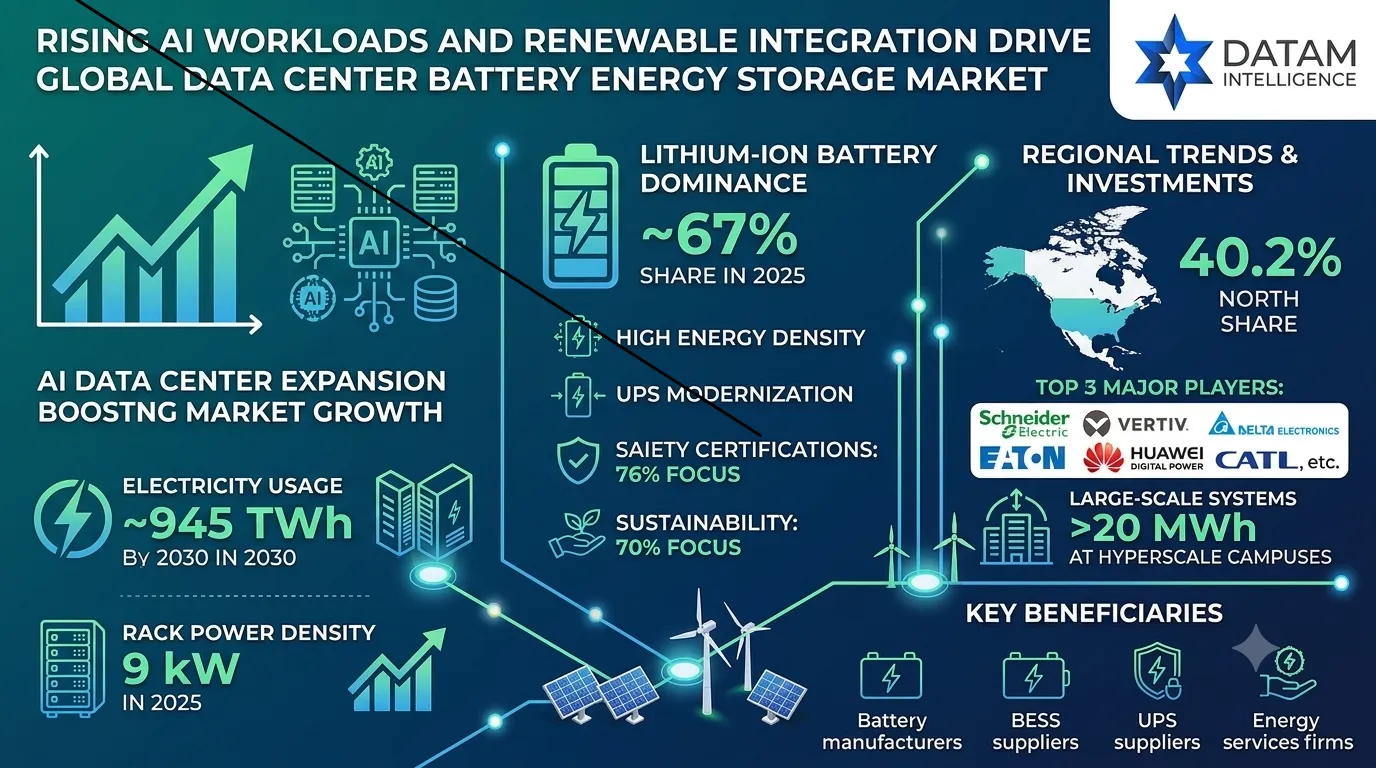
Global Data Center Battery Energy Storage Market is growing rapidly due to the fast development of the AI computing infrastructure, increased investments in hyperscale data centers, and the need for reliable and sustainable power systems. In 2025, As per the International Energy Agency, the global electricity usage by data centers is forecasted to more than double, reaching around 945 TWh by 2030, and AI-powered data centers are becoming one of the fastest-growing electricity users. In the meantime, the Uptime Institute Global Data Center Survey 2025 reported that the average rack power density increased from 8.3 kW in 2024 to 9 kW in 2025, with the quick proliferation of 10-30 kW racks to cater to the needs of artificial intelligence (AI) and HPC workloads. Among the major technology vendors in the industry, Schneider Electric, Vertiv, Eaton, ABB, Huawei Digital Power, and Delta Electronics are offering a variety of advanced battery energy storage solutions based on lithium-ion and LFP batteries to serve the requirements of AI-ready and high-density data centers.
This illustrates the trend towards the utilization of energy storage solutions that exhibit high-performance abilities for creating AI-based computing infrastructure without affecting their efficiency and reliability. According to the Business Wire report, in March 2026, ZincFive’s 2026 Data Center Energy Storage Report highlighted that with the growing AI workloads, there was a reconsideration of data center energy storage priorities. As per the study, 57% of respondents were encountering increased requirements of power density owing to AI, whereas 84% of the respondents stated that total cost of ownership (TCO) was the prime criterion in selecting the energy storage solution. Besides TCO, 76% of respondents gave priority to the safety of the battery chemistry, while 70% highlighted the sustainability issue.
Key Takeaways
- North America dominated the global scene by commanding an estimated 40.2% of the overall market share in 2025. This regional expansion was bolstered by a 36% year-over-year operational capacity growth in primary U.S. data center markets.
- Lithium-ion battery technology thoroughly dominated the sector by capturing a maximum market share of about 67% in 2025. This major share is driven by facilities migrating away from conventional valve-regulated lead-acid (VRLA) setups.
- Battery safety performance is highly prioritized, with 76% of surveyed buyers heavily focusing on chemical safety. Additionally, 70% of buyers explicitly emphasize environmental sustainability when selecting their energy storage systems.
- The average modal rack power density grew to nearly 9 kW in 2025, rising from 8.3 kW the previous year. This power surge is pushing an increased installation of high-density racks ranging from 10 to 30 kW.
Discover Growth Opportunities in the Data Center Battery Energy Storage Market
Get access to a detailed Data Center Battery Energy Storage Market sample report covering market dynamics, technology trends, investment opportunities, key players, and emerging applications of battery energy storage systems across hyperscale and AI-powered data centers.
Wide Space Opportunities Driven by AI Data Center Expansion and Battery Energy Storage Infrastructure Investments
In July 2026, Meta announced the expansion of its Hyperion AI data center campus in Louisiana to achieve 5 GW of compute capacity, increasing its total investment in the project to over USD 50 billion. While the investment will be more inclined towards the infrastructure of AI data centers rather than battery deployment, it marks one of the significant demand avenues for the Data Center Battery Energy Storage Market, owing to the massive electricity demands of AI data centers. With the need to meet investments in backup power systems, BESS, UPS, microgrids, and other renewable integration solutions to meet grid resiliency and reliability, large-scale AI data centers are progressively shifting from diesel generators to advanced battery systems. The largest share of upcoming investment is expected to flow toward large-scale stationary battery systems, lithium-ion battery packs, and integrated energy storage systems for use by hyperscale data centers. The battery pack manufacturers, such as CATL, LG Energy Solution, Samsung SDI, Panasonic Energy, and Fluence Energy, will take advantage of growing demands for high-capacity storage batteries, and the infrastructure providers, Schneider Electric, Vertiv, Eaton, ABB, and Delta Electronics, will profit from battery-integrated UPS systems, power management systems, and electrical infrastructure solutions for data centers.
Moreover, renewable energy companies and microgrid system providers will gain opportunities from using solar panels, wind turbines, battery packs, and smart energy management systems that enable reduced dependency on grid electricity. The key beneficiaries across the value chain are expected to include battery cell manufacturers, BESS suppliers, UPS system suppliers, power electronics firms, and energy infrastructure providers. Batteries should profit from higher demand for batteries that have high cycle life and high density, whereas firms like Vertiv, Schneider Electric, Eaton, and ABB should profit from increased demand for power backup and distribution systems. The engineering and energy services firms would also see growth opportunities in developing and running microgrids within data centers, energy management platforms, and hybrid power systems. With ongoing AI-led data center development around the world, the investments are going to increasingly move towards resilient and low-carbon power infrastructure that relies on batteries.
The rapid expansion of AI and high-density computing infrastructure is increasing demand for resilient battery-based power systems in data centers
With the rapid development of artificial intelligence (AI), high-performance computing (HPC), and hyperscale data center infrastructure, there arises the need for robust and versatile battery energy storage systems across the world. The processing capabilities needed for AI applications call for greater processing power, which increases the density of racks, uses up more electrical power, and poses new challenges to power management. Battery Energy Storage Systems (BESS) are an important part of modern data center infrastructure because they enable uninterrupted power supply (UPS), enhance the reliability of backups, minimize the dependency on traditional power sources, and manage power variations due to high-density computing workloads.
The growing need for energy resilience is further supported by concerns regarding grid capacity constraints caused by AI-powered data center growth. In October 2025, the Canadian Association for the Club of Rome (Canadian Cores) highlighted that the rapid expansion of AI-powered data centers is exerting additional strain on the American electric grid. The report noted that the U.S. had more than 5,400 data centers by March 2025, and the Department of Energy predicted that data centers may consume up to 12% of American electricity within the next three years. Therefore, the battery energy storage systems and UPS equipment are being used to ensure a reliable power supply and operate the next generation of AI data centers sustainably.
Lithium-ion Battery Dominates the Data Center Battery Energy Storage Market Owing to High Energy Density and UPS Modernization
The Lithium-ion Battery segment dominated the Global Data Center Battery Energy Storage Market, with a 67% market share in 2025. There has been a shift from VRLA (valve-regulated lead-acid) battery to lithium-ion battery because of the higher energy density, increased lifetime, improved charge speed, minimal maintenance, and better space utilization. With AI-driven computing and high-performance computing (HPC) workloads increasing rack power densities, lithium-ion batteries are becoming a preferred energy storage technology for supporting next-generation uninterrupted power supply (UPS) systems and ensuring reliable backup power availability.
The development of the segment is also boosted by the consistent increase in the production capacity of stationary batteries as well as the deployment of energy storage systems on a large scale. According to the CATL's 2025 Annual Report, the company has become the leader of the global energy storage battery market for the fifth year in a row, with its 30.4% of total global deliveries of energy storage batteries in 2025 and involvement in about 2,300 energy storage projects around the world. Being prominent companies in the field of data centers' technological provision, Schneider Electric, Vertiv, Eaton, ABB, Huawei Digital Power, and Delta Electronics are continuously working on the development of lithium-ion and LFP-based technologies for AI-ready facilities.
Large-Scale Battery Energy Storage Systems Above 20 MWh Gain Momentum Through AI Data Center Expansion and Increasing Power Reliability Requirements
Large-scale battery energy storage systems with capacities above 20 MWh have become one of the fastest-growing segments in the global Data Center Battery Energy Storage Market, driven by the growing installation of hyperscale data centers, AI-enabled computing facilities, and growing demand for backup power for a longer period of time. Such large-scale energy storage systems have gained significance due to the need for scalable battery energy storage systems that can support power density and backup duration requirements.
Analysis of the data center energy storage landscape indicates that facilities supporting AI and high-performance computing workloads are increasingly moving toward larger battery installations to manage growing electricity requirements and maintain uninterrupted operations. The segment recorded a CAGR of approximately 21% in 2025, driven by the rapid expansion of hyperscale and colocation data centers requiring modular and scalable energy storage architectures.
North America Leads the Data Center Battery Energy Storage Market Through Large-Scale AI Infrastructure and Grid Modernization
The North America region remains dominant in the Data Center Battery Energy Storage Market because of the rapid development of AI infrastructure, increasing construction of hyperscale data centers, and investment in resilient power solutions. In 2025, North America was expected to command a 40.2% market share owing to the presence of key cloud service providers, robust data center infrastructure, and high usage of battery energy storage systems based on lithium-ion and LFP batteries. The United States and Canada regions have seen an increase in demand for battery energy storage systems due to the need for reliable backup power, improved flexibility, and sustainable energy management solutions.
In December 2025, Vertiv, a U.S.-based public company specializing in critical digital infrastructure such as power and thermal solutions for data centers, launched the Vertiv EnergyCore, which is a utility-scale Battery Energy Storage System (BESS). This launch will help ensure that there are no issues relating to data center interconnections and grid resilience in North America. The EnergyCore can generate power of up to 5 MW while storing energy of up to 25 MWh.
U.S. Maintains Leadership in the Data Center Battery Energy Storage Market Through Hyperscale Data Center Expansion and AI Infrastructure Investments
U.S. continues to maintain its dominant position in the North American Data Center Battery Energy Storage Market due to its extensive hyperscale data center landscape, development of the artificial intelligence (AI) computing infrastructure, and investments in robust and resilient power systems. This is driven by the fact that several key cloud and technology players are operating in the United States, such as Amazon Web Services (AWS), Microsoft, Google, Meta, and Oracle, which drive the construction of new data centers and deployment of BESS. Power requirements of AI and HPC workloads have additionally stimulated the development of lithium-ion and LFP energy storage solutions.
In October 2025, Honeywell, a U.S.-based public multinational specializing in industrial automation, energy management, and digital technologies, partnered with LS ELECTRIC, a South Korean public company specializing in power systems and industrial automation, to accelerate innovation for data centers and battery energy storage systems (BESS).
Competitive Landscape and Strategic Developments
The global Data Center Battery Energy Storage Market is highly competitive and ecosystem-driven, with market competition shaped by technological capabilities, data center infrastructure expertise, battery technology advancements, safety certifications, and the ability to support AI-driven high-density computing environments. Market participants are broadly categorized into three major groups: data center power infrastructure providers, battery energy storage system (BESS) integrators, and lithium-ion battery manufacturers. Companies are increasingly focusing on integrated energy solutions combining UPS systems, battery storage, microgrid platforms, intelligent energy management software, and renewable energy integration capabilities to address the growing power reliability requirements of hyperscale and AI-enabled data centers. Leading data center infrastructure providers, including Schneider Electric, Vertiv, Eaton, ABB, Huawei Digital Power, and Delta Electronics, are strengthening their market positions through advanced power management systems, modular BESS solutions, and digital energy optimization platforms. Meanwhile, companies such as Fluence Energy and Hitachi Energy are expanding their presence through large-scale battery storage integration, grid interaction technologies, and intelligent energy management solutions. Battery manufacturers, including LG Energy Solution, Samsung SDI, CATL, and Panasonic Energy, are enhancing market competitiveness through high-performance lithium-ion battery cells, LFP-based storage technologies, and scalable energy storage modules designed for next-generation data center applications.
In December 2025, KULR Technology Group, Inc., a U.S.-based public energy technology company, announced that it would showcase its AI Datacenter Battery Energy Storage Solution at Reuters Energy Live 2025, featuring its next-generation KULR ONE® MAX ORV3 Battery Backup Unit (BBU) architecture designed for AI-scale data centers.
Key Developments:
- In July 2026, NOMAD Power Solutions, Inc., a U.S.-based public energy infrastructure technology company, unveiled the upgraded third-generation Voyager mobile energy storage series, increasing storage capacity across its portfolio by more than 50% without increasing system footprint or deployment time.
- In October 2025, LS ELECTRIC Co., Ltd., a South Korea-based public company specializing in power systems, industrial automation, smart energy solutions, and energy storage technologies, announced a strategic partnership with Honeywell, a U.S.-based industrial technology company, to jointly develop power management, distribution, and Battery Energy Storage System (BESS) solutions for data centers in North America.
- In July 2026, PowerBank Corporation, a Canada-based public renewable energy infrastructure developer and independent power producer, partnered with Nodiac Corp., a U.S.-headquartered modular data center infrastructure company, to deploy modular, containerized data centers co-located with solar and BESS assets across North America.
Leading Company Profiles and Strategic Developments
Schneider Electric (France)
Schneider Electric is one of the leading companies in the global Data Center Battery Energy Storage Market, supported by its extensive portfolio of data center power management solutions, uninterruptible power supply (UPS) systems, microgrid platforms, and integrated battery energy storage technologies. The company has established a strong market position by providing end-to-end energy infrastructure solutions that enable reliable, efficient, and sustainable operations for hyperscale, colocation, and enterprise data centers. Schneider Electric’s expertise in energy management software, digital monitoring platforms, and modular power systems positions the company as a key technology provider for AI-driven data centers requiring high-density and resilient power infrastructure.
In July 2026, Schneider Electric launched its next-generation integrated Battery Energy Storage System (BESS), combining power infrastructure with digital energy management capabilities to improve energy resilience and operational flexibility. Although the solution targets broader energy storage and grid applications, it strengthens Schneider Electric’s positioning in the data center power ecosystem, where battery storage is increasingly being adopted for backup power, renewable integration, and energy optimization amid rising AI-driven electricity demand.
Analyst Opinion
The Data Center Battery Energy Storage Market is entering a critical phase where battery systems are shifting from being a backup power component to becoming an essential part of data center energy architecture. In my view, the biggest change in this market is not simply the growth in the number of data centers, but the transformation in the type of computing infrastructure being deployed. AI workloads are creating unprecedented power density requirements, and traditional backup systems designed for conventional enterprise data centers are increasingly becoming insufficient. The rise of AI clusters, high-performance computing, and hyperscale facilities is pushing operators toward larger, smarter, and more flexible battery energy storage systems. The market is likely to remain ecosystem-driven rather than dominated by a single technology provider. Companies such as Schneider Electric, Vertiv, Eaton, ABB, Huawei Digital Power, and Delta Electronics have an advantage due to their established relationships with data center operators and their ability to provide complete power infrastructure solutions. Meanwhile, battery manufacturers such as CATL, LG Energy Solution, Samsung SDI, and Panasonic Energy will continue influencing the market through advancements in battery chemistry, scalability, and energy storage performance.
The strongest opportunities will emerge around AI-focused data center campuses, hyperscale facilities, and regions facing grid capacity constraints. North America, particularly the U.S., is expected to remain a leading market due to rapid AI infrastructure investments and increasing pressure on electricity networks. However, the next phase of market development will depend on how effectively companies address safety concerns, regulatory requirements, supply chain stability, and the integration of BESS with renewable energy and grid management systems. Overall, the Data Center Battery Energy Storage Market is moving beyond traditional backup applications and becoming a strategic energy infrastructure segment for the future digital economy.
Media Contact
Company Name: DataM Intelligence 4Market Research
Contact Team: Media Relations and Analyst Inquiries
Email: [email protected]
Corporate Address: 2243 Rocoso TRL, Leander, TX 78641, USA
Official Website: https://www.datamintelligence.com/
Topic: Data Center Battery Energy Storage Market
Download Sample Report: https://www.datamintelligence.com/download-sample/data-center-battery-energy-storage-market