


Data Center Battery Energy Storage Market Definition and Overview
The global Data Center Battery Energy Storage market reached USD 952.3 million in 2025 and is expected to reach USD 4,274 million by 2035, growing with a CAGR of 16.2% during the forecast period 2026-2035. The market expansion is being driven by the rapid increase in AI computing capacity and hyperscale data center construction, which are significantly increasing electricity demand and the need for resilient power infrastructure. Based on the forecasts made by the International Energy Agency (IEA, 2025), electricity consumption in the world by data centers is expected to more than double from the current levels to around 945 TWh by 2030. Artificial intelligence-enabled data centers are among the fastest-growing segments of electricity consumers. According to the Uptime Institute Global Data Center Survey 2025, the average modal rack power density in 2025 was close to 9 kW, an increase from 8.3 kW from last year, with an increasing number of 10-30 kW racks installed due to an increase in power consumption demands for AI and HPC applications. The shift from the use of lead acid to lithium-ion and LFP has been facilitated by factors such as increased durability and reduced maintenance. Various companies like Schneider Electric, Vertiv, Eaton, ABB, Huawei Digital Power, and Delta Electronics are developing products to cater to the growing number of AI-ready data centers that have high-density energy needs.
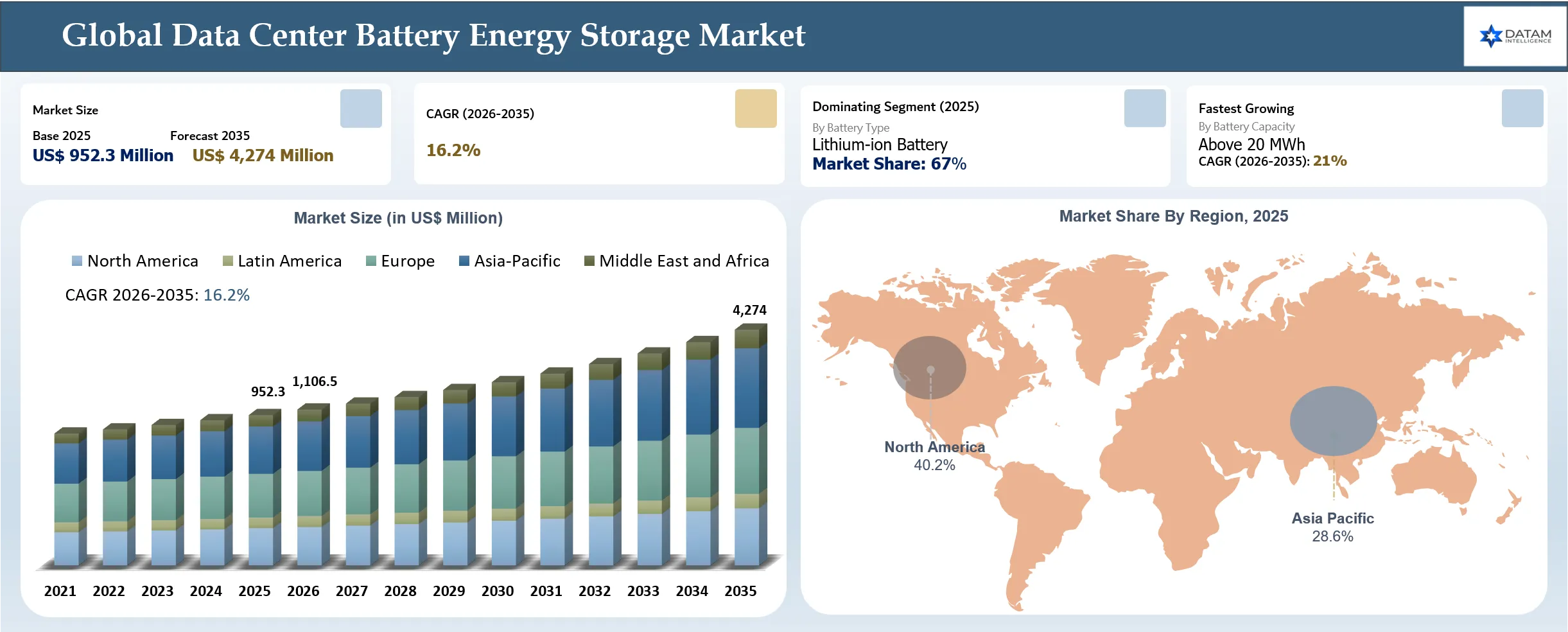
This shows the development of a trend towards the use of energy storage solutions that have high-performance capabilities to facilitate AI-enabled computing facilities without compromising reliability and safety. In March 2026, according to the Business Wire report published, ZincFive’s 2026 Data Center Energy Storage has indicated that with the rising growth of AI workloads, there is a re-evaluation of the priorities in data center energy storage. As per the study, 57% of people surveyed were facing increased power density needs due to AI, while 84% stated total cost of ownership (TCO) as the foremost consideration in choosing an energy storage system. Apart from TCO, 76% considered the safety of the battery chemistry, while 70% emphasized sustainability.
Data Center Battery Energy Storage Market Key Takeaways
- North America dominated the global scene by commanding an estimated 40.2% of the overall market share in 2025. This regional expansion was bolstered by a 36% year-over-year operational capacity growth in primary U.S. data center markets.
- Lithium-ion battery technology thoroughly dominated the sector by capturing a maximum market share of about 67% in 2025. This major share is driven by facilities migrating away from conventional valve-regulated lead-acid (VRLA) setups.
- Battery safety performance is highly prioritized, with 76% of surveyed buyers heavily focusing on chemical safety. Additionally, 70% of buyers explicitly emphasize environmental sustainability when selecting their energy storage systems.
- The average modal rack power density grew to nearly 9 kW in 2025, rising from 8.3 kW the previous year. This power surge is pushing an increased installation of high-density racks ranging from 10 to 30 kW.
- Operator surveys show that 57% of facilities face heightened power density needs directly due to growing AI workloads. Consequently, 84% of respondents state that the total cost of ownership (TCO) is their foremost system consideration.
Data Center Battery Energy Storage Market Industry Trends and Strategic Insight
- The rapid expansion of AI training clusters and high-density GPU servers is fundamentally changing data center power architecture. Operators are deploying battery energy storage systems (BESS) not only for backup power but also to manage rapid load fluctuations, reduce peak demand charges, and stabilize facility-level power quality.
- Data centers are increasingly integrating utility-scale BESS with conventional UPS systems to create multi-functional energy assets capable of peak shaving, renewable energy shifting, voltage regulation, and participation in demand response programs.
- LFP batteries are replacing conventional lead-acid and increasingly competing with NMC batteries due to their longer cycle life, improved thermal stability, and lower total ownership costs.
- Cloud service providers are pairing onsite solar and wind generation with battery energy storage to improve renewable energy utilization and reduce carbon emissions.
- Battery management is shifting from basic monitoring toward AI-enabled predictive analytics capable of optimizing state-of-charge, extending battery life, forecasting degradation, and enabling predictive maintenance.
Data Center Battery Energy Storage Market Scope
| Metrics | Details | |
| 2025 Market Size | USD 952.3 Million | |
| 2035 Projected Market Size | USD 4,274 Million | |
| CAGR (2026-2035) | 16.2% | |
| Largest Market | North America | |
| Fastest Growing Market | Asia-Pacific | |
| By Battery Type | Lithium-ion Battery, Lithium Iron Phosphate (LFP) Battery, Nickel Manganese Cobalt (NMC) Battery, Lead-acid Battery, Others | |
| By Storage Duration | Below 2 hours, 2 - 4 hours, 4 - 8 hours & above | |
| By Battery Capacity | Below 1 MWh, 1–5 MWh, 5–20 MWh, above 20 MWh | |
| By Data Center Type | Hyperscale Data Centres, Colocation Data Centres, Enterprise Data Centres, Others | |
| By Deployment Architecture | New Data Centers (Greenfield), Existing Data Centers (Retrofit), Behind-the-meter (BTM), Front-of-the-meter (FTM) | |
| By Application | Backup Power, Peak Shaving & Load Management, Renewable Energy Integration, Grid Support & Demand Response, Power Quality & Voltage Stabilization, Microgrid Support, UPS Support, Others | |
| By Region | North America | U.S., Canada, Mexico |
| Europe | Germany, UK, France, Spain, Italy, Poland | |
| Asia-Pacific | China, India, Japan, Australia, South Korea, Indonesia, Malaysia | |
| Latin America | Brazil, Argentina | |
| Middle East and Africa | UAE, Saudi Arabia, South Africa, Israel, Türkiye | |
| Report Insights Covered | Competitive Landscape Analysis, Company Profile Analysis, Market Size, Share, Growth | |
Data Center Battery Energy Storage Market Disruption Analysis
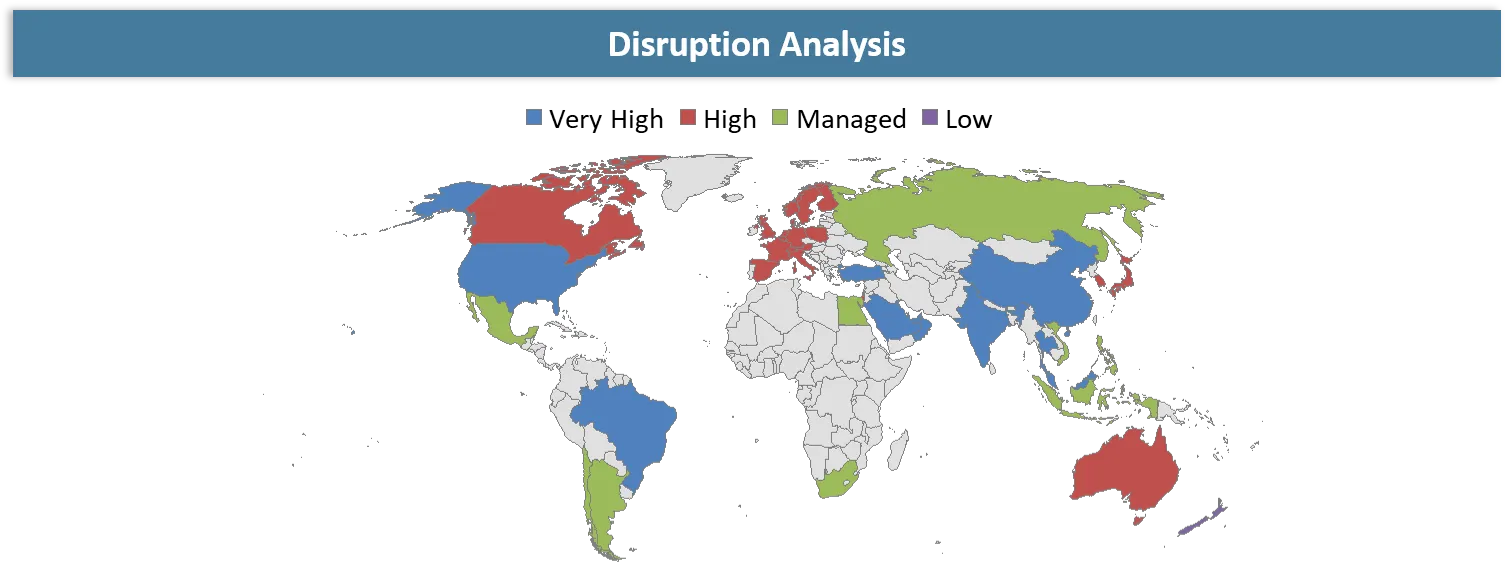
Transition from Backup Power to Intelligent Energy Management Reshaping the Data Center Battery Energy Storage Market
The disruption in the data center battery energy storage is being fueled by the evolution of the battery energy storage system (BESS) from being just a conventional backup energy source to an advanced energy management system. Historically, BESS was used for emergency power supply during any grid outage situation. However, new BESS is being used in combination with the energy management system (EMS) that helps reduce peak demand, optimize renewable energy, load balance, and participate in grid services. The focus for investments has undergone a major shift because of this innovation.
This emerging necessity is shown by the fast adoption of lithium-ion batteries. According to the Battery Council International (BCI) Guide to Battery Applications and Technologies published by the Battery Council International (September 2025), the share of lithium-ion batteries in the global UPS market is expected to grow from 16% in previse year to 30% in 2030 due to higher energy density, longer lifespan, and fewer maintenance costs. With further development of critical power infrastructure in data centers, vendors of battery technologies start integrating lithium-ion BESS into intelligent battery management and energy optimization software thus turning energy storage into a part of facility energy management system.
Data Center Battery Energy Storage Market BCG Matrix: Company Evaluation
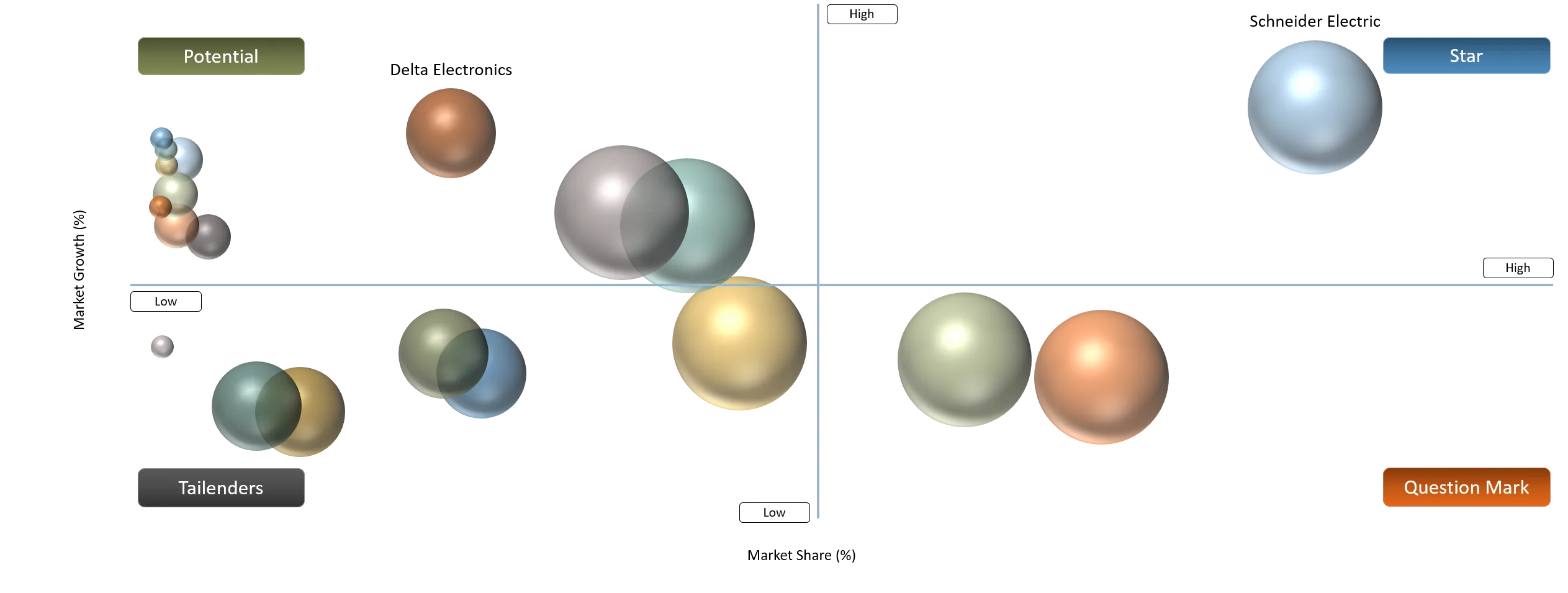
Stars include Schneider Electric, Vertiv, and Eaton because they possess strong market positions in critical power infrastructure and have established portfolios combining battery energy storage systems (BESS), UPS technologies, intelligent energy management platforms, and AI-ready power solutions for hyperscale and colocation data centers. Question Marks include ABB, Huawei Digital Power, and Hitachi Energy as they are rapidly expanding their battery energy storage and digital power businesses for mission-critical facilities.
The Potential category comprises Delta Electronics, Fluence Energy, and Samsung SDI. Delta Electronics has a well-established presence in UPS systems and power electronics and is increasingly integrating battery storage into data center solutions. Tailenders include LG Energy Solution, CATL, and Panasonic Energy. Although these companies are global leaders in lithium-ion battery manufacturing, their involvement in the Data Center Battery Energy Storage Market is primarily as battery cell and module suppliers rather than providers of complete data center energy storage systems or integrated power infrastructure.
Data Center Battery Energy Storage Market Dynamics
Driver Impact Analysis
| Driver | Market Growth Impact (%) | Demand Concentration | Impacted Use Case | Strategic Impact |
The rapid expansion of AI and high-density computing infrastructure is increasing demand for resilient battery-based power systems in data centers. | 35% | Very High | AI/HPC data centers, Hyperscale facilities | Drives deployment of high-capacity lithium-ion BESS, enhances power resilience, and supports high-density computing workloads. |
The rising integration of renewable energy sources into data center power infrastructure is driving the deployment of battery energy storage systems for energy balancing. | 23% | High | Renewable-powered data centers, Microgrids | Accelerates renewable energy utilization, improves energy flexibility, and supports corporate decarbonization goals. |
Increasing electricity costs and demand charge management are encouraging investment in battery storage for peak shaving and energy optimization. | 19% | High | Peak shaving, Energy optimization | Reduces operating costs through demand charge management and improves overall energy efficiency. |
Expansion of hyperscale and colocation data centers is strengthening demand for scalable and high-capacity battery energy storage solutions. | 21% | High | Hyperscale and Colocation data centers | Increases adoption of modular, scalable BESS to support rapid infrastructure expansion and higher power availability. |
Growing emphasis on reducing dependence on diesel generators is accelerating the adoption of battery-supported low-carbon backup power systems. | 13% | Medium to High | Backup power, Hybrid energy systems | Supports transition toward low-carbon backup infrastructure, reduces emissions, and strengthens ESG compliance. |
The rapid expansion of AI and high-density computing infrastructure is increasing demand for resilient battery-based power systems in data centers
The rapid expansion of artificial intelligence (AI) and high-density computing technology is emerging as a key factor for growth in the data center battery energy storage market, owing to the demands made by the advanced generation of data centers, which need highly reliable and agile power systems for ensuring sustained operation. The AI clusters and HPC systems are contributing heavily to the increase in power density in data centers and making the traditional power backup systems inadequate for dealing with power demand fluctuations. This has led to the increased adoption of BESS with the UPS system in data centers.
These trends underscore the increasing importance of battery energy storage systems in maintaining reliable, uninterrupted power for AI-intensive data centers while reducing strain on the electrical grid. In October 2025, the Canadian Association for the Club of Rome (Canadian Cores) reported that the fast growth of AI-powered data centers poses a challenge for the US power grid, thus making Battery Energy Storage Systems (BESS) more popular and necessary. Specifically, Canadian Cores highlights that there were over 5,400 data centers in the United States as of March 2025, and according to projections of the U.S. Department of Energy, the data centers could take up to 12% of electricity consumption in the country over the next three years.
Restraint Impact Analysis
| Restraint | Drag on Market Growth (%) | Primary Impact Area | Impacted Use Case | Strategic Impact |
Thermal management and battery safety requirements increase system complexity and deployment costs in high-density data centers. | 9% | System Design & Regulatory Compliance | AI/HPC Data Centers, Large-Scale BESS Installations | Increases engineering complexity, cooling infrastructure requirements, and certification costs, extending deployment timelines |
Limited availability and price volatility of lithium and other critical battery materials create procurement and cost challenges. | 8% | Raw Material Supply Chain | Lithium-ion & LFP Battery Procurement | Raises battery procurement costs, creates sourcing uncertainty, and affects long-term project economics. |
Battery degradation over repeated charge-discharge cycles increases lifecycle replacement costs for mission-critical facilities. | 7% | Asset Lifecycle Management | Peak Shaving, Renewable Integration, Daily Cycling Applications | Increases replacement frequency and maintenance expenditure, reducing total return on investment over the battery lifecycle. |
Space constraints within existing data centers restrict the deployment of large-capacity battery energy storage systems. | 6% | Facility Infrastructure | Retrofit Projects, Enterprise & Colocation Data Centers | Limits installation capacity, increases retrofit complexity, and encourages adoption of compact, high-energy-density battery technologies. |
Thermal management and battery safety requirements increase system complexity and deployment costs in high-density data centers
The growing complexity about thermal management and safety of batteries in high-density data centers is one of the important factors restraining the Data Center Battery Energy Storage market. With more operators looking to deploy lithium-ion and lithium-iron-phosphate (LFP) battery energy storage systems to cater to AI and HPC workloads, the temperature levels of the batteries must be maintained within the safe operating levels to avoid thermal runaway. This necessitates the adoption of cooling solutions, fire detection and suppression systems, and advanced battery management systems, along with compliance to standards such as NFPA 855, UL 9540, and UL 9540A, thus adding high cost to the project.
The incorporation of cutting-edge cooling technology and battery energy storage system architectures indicates that there is a need for more sophisticated energy storage systems for handling AI-related workloads. In December 2025, Interesting Engineering reported that Gotion developed an 800V immersion-cooled battery energy storage system meant for AI-driven data centers due to the increasing issues of thermal management and power reliability. This energy storage system can deliver up to 1.2 MW of power output, uses an 800V architecture, and has immersion cooling technology to enhance thermal management, battery safety, and operational performance.
Data Center Battery Energy Storage Market Segment Analysis
The global data center battery energy storage market is segmented based on battery type, storage duration, battery capacity, data center type, deployment architecture, application, and region.
Lithium-ion Battery Dominates the Data Center Battery Energy Storage Market Owing to High Energy Density and UPS Modernization
The Lithium-ion Battery segment dominated the Data Center Battery Energy Storage Market, accounting for the maximum share of about 67% in 2025. It was led by the adoption of lithium-ion batteries in hyperscale, colocation, and enterprise data centers as opposed to conventional VRLA (valve-regulated lead-acid) batteries. The energy density is high in Lithium-ion batteries and hence can deliver higher performance. They have longer lives, fast charging capabilities, reduced maintenance, and low installation space, among other benefits that make them suitable for use in high-density computing centers. With growing demand for computing centers that rely on AI and cloud computing, lithium-ion batteries are preferred.
The dominance of lithium-ion batteries has been further cemented through the development of advancements in stationary energy storage technology. As per the 2025 Annual Report of CATL, the organization maintained its status as the largest supplier of energy storage batteries in the world for the fifth year in a row, accounting for 30.4% of total energy storage battery deliveries globally in 2025, along with 2,300 energy storage projects around the world.
Data Center Battery Energy Storage Market Geographical Penetration
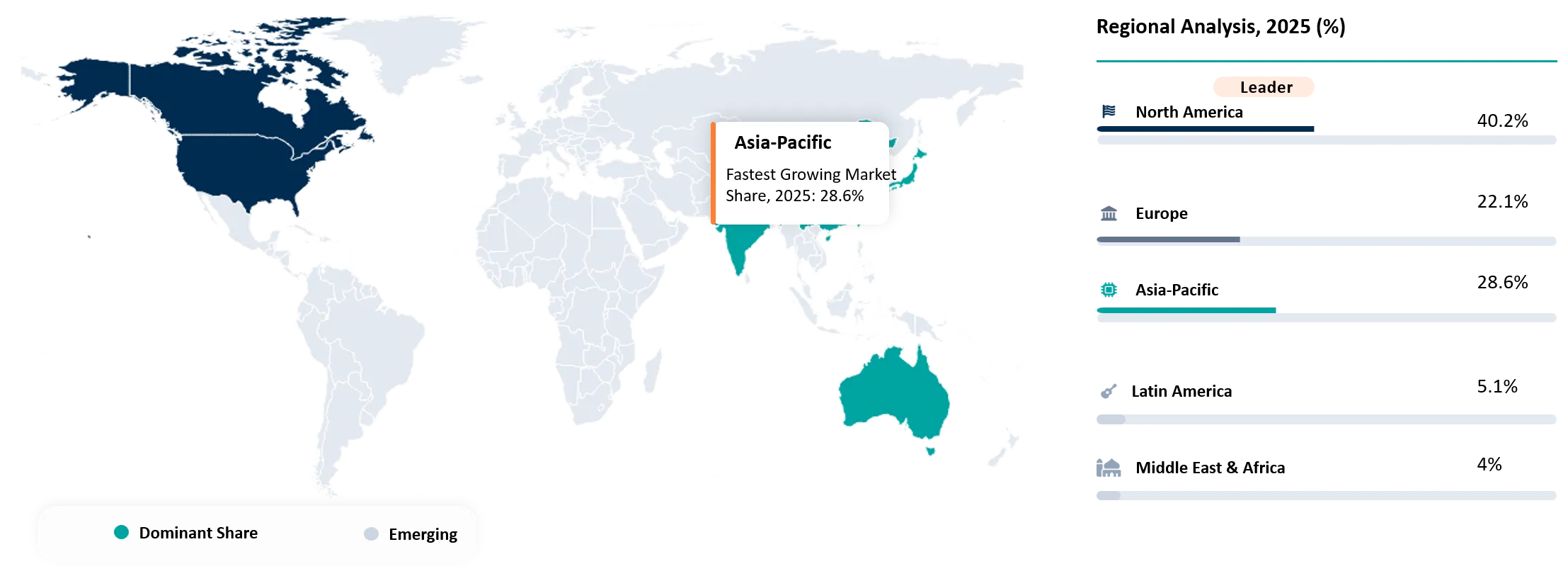
North America Leads the Data Center Battery Energy Storage Market Through Large-Scale AI Infrastructure and Grid Modernization
North America dominated the Data Center Battery Energy Storage Market, accounting for an estimated 40.2% of the global market share in 2025. The region's leadership is supported by the world's largest concentration of hyperscale data centers, rapid deployment of AI computing infrastructure, and strong investments in resilient power systems across the United States and Canada. The company’s e-STORAGE division of Canadian Solar announced in March 2026 regarding plans to deploy a 500 MW / 2,493 MWh battery energy storage system to facilitate the power needs of a major U.S. utility's data center, making it one of the biggest installations to reinforce grid resilience for hyper-scale data centers. Moreover, according to the Energy Information Administration (EIA) report in 2026, developers have decided to install 24 GW of utility-scale battery storage capacity in comparison to a record-high of 15 GW added in 2025, most of which would be in Texas, California, and Arizona – states where significant development is taking place in the field of AI and cloud data centers.
This launch is in tandem with the rise in the implementation of energy storage systems aimed at ensuring the availability of energy and the growth of AI-based data centers in North America. In December 2025, Vertiv, a U.S.-based public company specializing in critical digital infrastructure such as power and thermal solutions for data centers, launched the Vertiv EnergyCore, which is a utility-scale Battery Energy Storage System (BESS). This launch will help ensure that there are no issues relating to data center interconnections and grid resilience in North America. The EnergyCore can generate power of up to 5 MW while storing energy of up to 25 MWh.
U.S. Data Center Battery Energy Storage Market Trends
The United States holds the dominant position in the North American Data Center Battery Energy Storage Market owing to its extensive hyperscale data center ecosystem, rapid commercialization of artificial intelligence (AI) infrastructure, and continuous investment in resilient power systems. The presence of leading cloud service providers, including Amazon Web Services (AWS), Microsoft, Google, Meta, and Oracle, has accelerated the deployment of battery energy storage systems to support uninterrupted operations, grid resilience, and renewable energy integration. Furthermore, CBRE's North America Data Center Trends H2 2025 reported that the U.S. primary data center markets recorded a 36% year-over-year increase in operational capacity during 2025, driven largely by AI and cloud computing demand.
This partnership highlights the increasing collaboration between energy technology providers to deliver scalable battery storage solutions for AI-powered data centers and modern power networks. In October 2025, Honeywell is a U.S.-based public multinational specializing in industrial automation, energy management, and digital technologies, partnered with LS ELECTRIC, a South Korean public company specializing in power systems and industrial automation, to accelerate innovation for data centers and battery energy storage systems (BESS).
Canada Data Center Battery Energy Storage Market Outlook
Canada is rapidly strengthening its position in the North American Data Center Battery Energy Storage Market due to its abundant low-carbon electricity resources, favorable climate for energy-efficient data center operations, and increasing investments in AI and hyperscale digital infrastructure. Provinces such as Quebec, Ontario, and Alberta are attracting cloud service providers and colocation operators because of their reliable hydroelectric power, competitive electricity prices, and expanding transmission networks. These advantages are accelerating the deployment of battery energy storage systems (BESS) to enhance power reliability, integrate renewable energy, and support the growing electricity demand of next-generation data centers.
The partnership strengthens Canada’s battery energy storage ecosystem by improving access to large-scale BESS solutions for high-reliability applications such as data centers and critical infrastructure. In July 2025, Energy Plug Technologies Corp., a Canada-based publicly held energy technologies company, specializes in battery energy storage systems, microgrids, and sustainable energy infrastructure. It recently announced a strategic alliance with SEETEL New Energy Co., Ltd., a Taiwan-based energy storage solutions company, whereby it would get the exclusive rights to distribute SEETEL’s advanced Battery Energy Storage Systems (BESS).
Data Center Battery Energy Storage Market Competitive Landscape
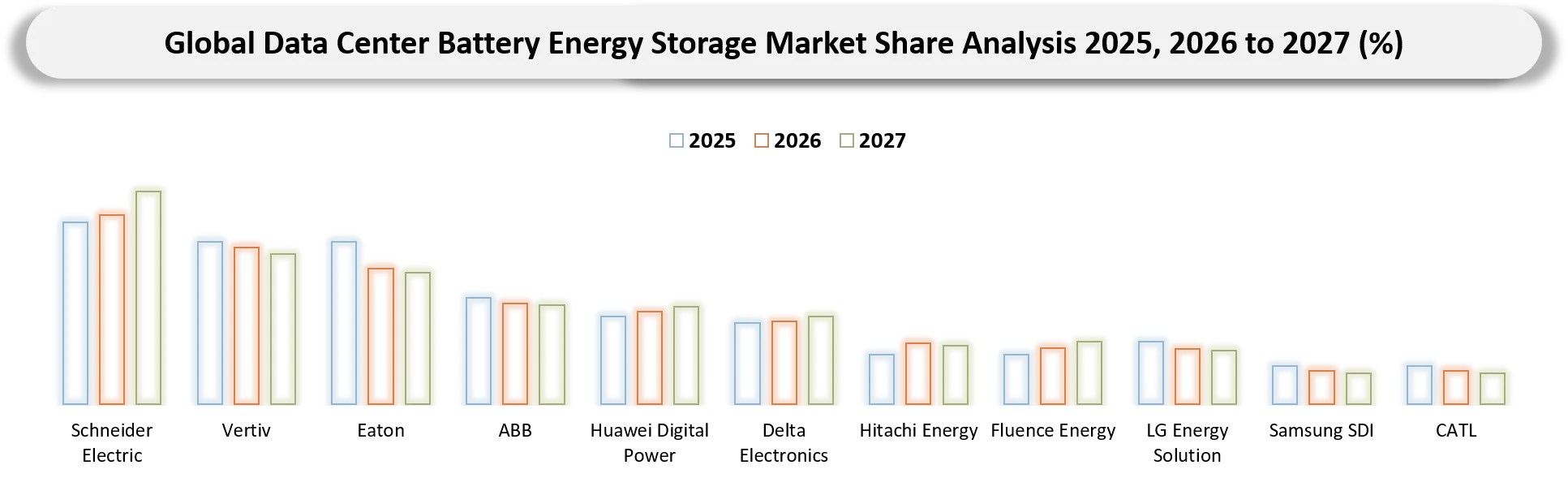
- The market is characterized by three major participant groups: data center power infrastructure providers, battery energy storage system integrators, and lithium-ion battery manufacturers. Schneider Electric, Vertiv, Eaton, ABB, Huawei Digital Power, and Delta Electronics lead the data center power management and integrated BESS ecosystem through UPS systems, microgrid platforms, energy management software, and backup power solutions. Fluence Energy and Hitachi Energy focus on large-scale battery storage integration, grid interaction, and intelligent energy management solutions, while LG Energy Solution, Samsung SDI, CATL, and Panasonic Energy strengthen the market through advanced lithium-ion battery cells and storage modules. The competitive landscape is highly ecosystem-driven, where technology integration, reliability, safety certifications, global data center partnerships, and the ability to support AI-driven high-density computing facilities determine market competitiveness.
- Key players include Schneider Electric, Vertiv, Eaton, ABB, Huawei Digital Power, Delta Electronics, Hitachi Energy, Fluence Energy, LG Energy Solution, Samsung SDI, CATL, and Panasonic Energy.
Data Center Battery Energy Storage Market Key Developments
- In December 2025: KULR Technology Group, Inc., a U.S.-based public energy technology company, announced that it would showcase its AI Datacenter Battery Energy Storage Solution at Reuters Energy Live 2025, featuring its next-generation KULR ONE® MAX ORV3 Battery Backup Unit (BBU) architecture designed for AI-scale data centers.
- In July 2026: NOMAD Power Solutions, Inc. is a U.S.-based public energy infrastructure technology company, unveiled the upgraded third-generation Voyager mobile energy storage series, increasing storage capacity across its portfolio by more than 50% without increasing system footprint or deployment time.
- In October 2025: LS ELECTRIC Co., Ltd. is a South Korea-based public company specializing in power systems, industrial automation, smart energy solutions, and energy storage technologies, announced a strategic partnership with Honeywell, a U.S.-based industrial technology company, to jointly develop power management, distribution, and Battery Energy Storage System (BESS) solutions for data centers in North America.
- In July 2026: PowerBank Corporation, a Canada-based public renewable energy infrastructure developer and independent power producer, partnered with Nodiac Corp., a U.S.-headquartered modular data center infrastructure company, to deploy modular, containerized data centers co-located with solar and BESS assets across North America.
- In May 2026: Enbridge Inc. is a Canada-based energy infrastructure company, expanded its partnership with Meta Platforms, Inc., a U.S.-based public technology company, through the Cowboy Project, a solar-plus-battery energy storage initiative developed to support Meta’s data center operations in Wyoming, U.S. The project combines 365 MW of solar generation capacity with a 200 MW / 1,600 MWh Battery Energy Storage System (BESS) to provide reliable, dispatchable power, enhance grid resilience, and support the increasing electricity requirements of large-scale digital infrastructure.
- In June 2026: T1 Energy Inc. is a U.S.-based solar energy and clean technology company, announced a definitive agreement to acquire KORE Power, Inc., a U.S.-based private battery energy storage systems (BESS) and energy storage software solutions provider, to expand its presence into the Battery Energy Storage System (BESS) and AI data center infrastructure markets.
- In July 2025: Eaton Corporation plc is an Ireland-based intelligent power management company, announced an agreement to acquire Resilient Power Systems Inc., a U.S.-based energy technology company developing advanced power conversion solutions, including medium-voltage solid-state transformer technology.
Key Procurement Priorities and Buyer Evaluation Criteria
- The procurement decision-making process is being influenced by the rapid expansion of AI-driven data centers, increasing rack power densities, demand for uninterrupted power supply, renewable energy integration, and the need for efficient peak-load management, driving buyers toward advanced battery storage systems that can support high-performance computing environments.
- Buyers evaluate factors such as battery safety performance, energy density, round-trip efficiency, cycle life, thermal management capability, scalability, response time, and compliance with global safety standards when selecting battery energy storage providers for mission-critical data center applications.
- The buyer considers system integration capabilities, battery management system (BMS) intelligence, software-based energy optimization, grid interaction capabilities, cybersecurity features, and compatibility with existing data center infrastructure while choosing technology partners for large-scale deployments.
- Procurement decisions are also shaped by sustainability objectives, with buyers evaluating suppliers based on carbon footprint reduction, use of recyclable battery materials, renewable energy compatibility, and adherence to environmental regulations, as data center operators focus on improving energy efficiency and achieving net-zero targets.
Why Choose DataM?
- Technological Innovations: Explores advancements in data center battery energy storage technologies, including lithium-ion battery systems, advanced battery management systems (BMS), modular energy storage platforms, liquid-cooled battery solutions, and AI-enabled energy optimization technologies, enabling higher reliability, improved efficiency, reduced downtime, and scalable power support for hyperscale, colocation, and edge data centers.
- Product Performance & Market Positioning: Evaluates how different players deliver battery energy storage solutions based on critical performance parameters such as energy density, cycle life, power output, charging efficiency, thermal management, safety features, footprint optimization, and integration with UPS and microgrid systems, highlighting how leading companies differentiate through reliability, scalability, and mission-critical power capabilities.
- Real-World Evidence: Highlights the adoption of battery energy storage systems across hyperscale data centers, cloud infrastructure facilities, AI computing centers, and edge data centers, demonstrating benefits such as improved power resilience, peak demand management, renewable energy integration, reduced operational costs, and enhanced energy efficiency.
- Market Updates & Industry Changes: Tracks key developments such as new battery storage deployments, expansion of manufacturing capacity, AI data center power requirements, advancements in lithium-ion and alternative battery technologies, strategic partnerships, and regional investments across North America, Europe, and Asia-Pacific, supporting the transition toward intelligent and sustainable data center power infrastructure.
- Competitive Strategies: Analyzes how leading companies expand through technology innovation, strategic collaborations, acquisitions, capacity expansion, integrated UPS and energy storage offerings, and software-driven energy management platforms to address increasing electricity demand from AI workloads, cloud computing, and high-density data center environments.
- Pricing & Market Access: Explains pricing variations based on battery chemistry, storage capacity, system configuration, deployment scale, lifecycle performance, and integration requirements, along with market access through equipment manufacturers, energy storage integrators, UPS providers, and specialized data center infrastructure suppliers supporting global deployments.
- Market Entry & Expansion: Identifies growth opportunities driven by rising AI infrastructure investments, increasing data center electricity consumption, renewable energy adoption, grid constraints, and demand for reliable backup power solutions, while outlining strategies such as regional manufacturing expansion, technology differentiation, strategic partnerships, and customized energy storage solutions for emerging data center markets.
Target Audience
- Data Center Operators & Hyperscale Cloud Providers
- Data Center Infrastructure Providers
- Battery Energy Storage System (BESS) Manufacturers
- Lithium-Ion Battery Manufacturers & Cell Suppliers
- Power Equipment & Electrical Infrastructure Companies
- Energy Storage Integrators & Solution Providers
- Renewable Energy Developers & Grid Service Providers


























































