


Lithium Market Research Insights
Lithium sits at the center of electric vehicle batteries, energy storage systems, consumer electronics and several industrial applications. According to DataM Intelligence, the global Lithium Market reached US$ 30.52 billion in 2025 and is expected to reach US$ 99.89 billion by 2035, growing at a CAGR of 19.5% during 2026 to 2035. The market covers lithium alloys, metal, chloride, carbonate, hydroxide and concentrate, with applications across batteries, lubricants, automotive parts, aluminum smelting and alloys, medical applications, glass and glass ceramics, air treatment, metallurgy and polymers. Asia Pacific is both the largest and fastest growing region.
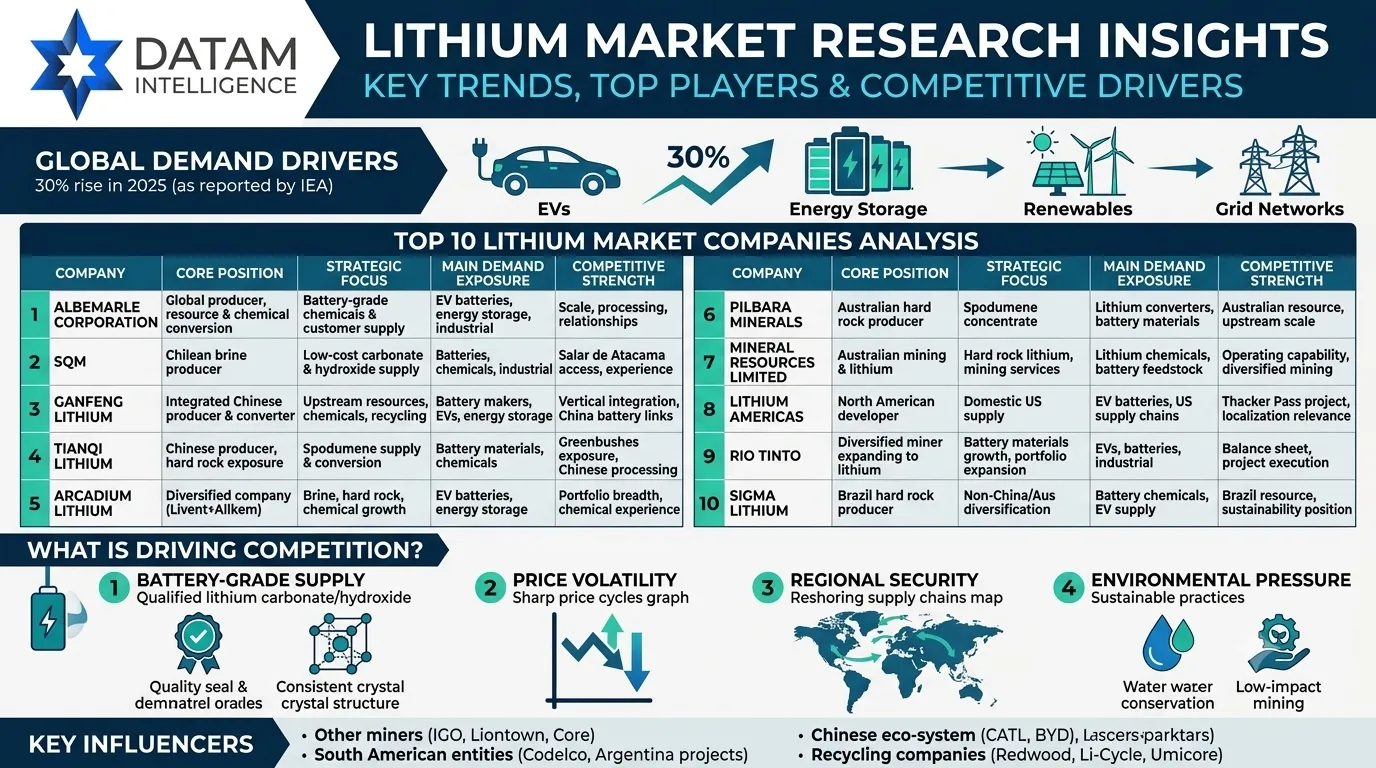
The demand story is still strong. The International Energy Agency’s 2025 outlook reported that lithium demand rose by nearly 30% in 2025, well above the annual growth rates seen during the previous decade. That growth was driven mainly by energy applications such as electric vehicles, battery storage, renewables and grid networks.
Gain a competitive edge with a sneak peek into our comprehensive 187-page analysis. Preview the latest regulatory updates, competitive landscape profiles for top players like Albemarle and Ganfeng, and detailed geographic market shares. Claim your complimentary sample now to evaluate our research methodology firsthand.
But lithium is not an easy market to win. Prices can move sharply. Projects can be delayed. Refining and conversion capacity matter as much as mine output. Battery makers do not simply need lithium resources. They need qualified lithium carbonate or lithium hydroxide, delivered consistently, with the right impurity profile, from suppliers that can survive price cycles and customer audits.
That is why the competitive landscape is split between several types of companies. There are large lithium producers with brine and hard rock assets. There are Chinese companies with strong refining and conversion positions. There are Australian spodumene producers. There are emerging North American and South American developers trying to serve regional supply chain needs. The strongest players are usually the ones that connect resources, conversion capability, customer relationships and balance sheet strength.
Top 10 Lithium Market Companies Analysis
Albemarle Corporation
Albemarle remains one of the most important lithium companies globally. Its position is built on resource access, lithium chemical production and relationships with battery and automotive customers. The company has exposure to both hard rock and brine linked lithium supply, which gives it a broader operating base than many pure developers.
Its advantage is not only size. Albemarle understands the part of the market that matters most to battery makers: converting lithium resources into qualified lithium chemicals. That is where many promising lithium stories become more difficult. A mine can look attractive on paper, but customers need material that works inside commercial cathode and battery production.
Albemarle’s challenge is the same one facing the whole sector. Lithium prices can turn quickly. When prices weaken, expansion plans, capital spending and contract structures all come under pressure. Still, Albemarle remains a benchmark producer because it combines scale, technical capability and customer access.
Sociedad Química y Minera de Chile
SQM is one of the strongest lithium brine producers in the world. Its position is tied to Chile’s Salar de Atacama, one of the most important lithium producing regions globally. The company benefits from resource quality, operating experience and a deep role in lithium chemicals.
SQM’s advantage is cost position and production experience. That matters in a market where weaker producers can struggle during price downturns. It also has long standing customer relationships across battery and industrial markets.
There is nuance here. Chile’s lithium policy, environmental scrutiny and water related concerns remain important. SQM’s future position will depend on how well it manages resource growth, government partnerships, sustainability expectations and customer commitments.
Ganfeng Lithium
Ganfeng Lithium is one of China’s most important lithium companies, with activities across mining, conversion, battery materials and recycling. Its strength comes from vertical reach. It is not only exposed to upstream lithium resources. It also participates in downstream processing and battery adjacent markets.
That makes Ganfeng strategically important. China remains central to lithium refining and battery supply chains, and Ganfeng benefits from being close to that ecosystem. It also has international resource exposure, which helps secure feedstock.
The company’s competitive strength is integration. Its risk is exposure to a market where geopolitics, pricing and customer diversification are becoming more sensitive. For global battery buyers, Ganfeng is both a major supplier and a reminder of how concentrated lithium conversion capacity remains.
Tianqi Lithium
Tianqi Lithium is another major Chinese lithium company with strong exposure to hard rock lithium through interests linked to Australia’s Greenbushes operation. Greenbushes is one of the highest profile spodumene assets in the world, and that gives Tianqi a strategically valuable position.
Tianqi’s strength lies in resource access and Chinese conversion capacity. The company is tied to a battery ecosystem that continues to dominate global cell manufacturing. That proximity gives it customer advantages and processing depth.
Still, the company is exposed to the same volatility that affects the broader sector. Lithium price swings, partnership dynamics and downstream competition can all influence performance. In lithium, even strong assets do not eliminate market risk.
Arcadium Lithium
Arcadium Lithium became one of the more important names in the sector after the combination of Livent and Allkem. Its position spans lithium brine, hard rock exposure and lithium chemical production, giving it a more diversified profile than many smaller competitors.
The company matters because it brings together operational experience across Argentina, Australia and downstream lithium chemicals. Argentina is especially important because its lithium brine resources are becoming a larger part of future supply planning.
Arcadium’s challenge is integration and execution. Combining assets is one thing. Building a reliable, cost competitive lithium growth platform is another. The market will watch whether it can convert portfolio breadth into disciplined supply growth and stronger customer relationships.
Pilbara Minerals
Pilbara Minerals is one of Australia’s leading hard rock lithium producers. It supplies spodumene concentrate into the battery materials chain, making it a key upstream player for lithium conversion markets.
The company’s appeal is straightforward. Australia remains one of the most important lithium producing regions globally, and spodumene supply is central to the lithium chemicals industry. Pilbara Minerals has scale, resource quality and strong exposure to battery demand.
Its risk is also straightforward. Spodumene producers feel lithium price volatility quickly. When lithium chemical prices fall, concentrate pricing and margins can come under pressure. Pilbara Minerals remains important, but it operates in one of the more cyclical parts of the lithium value chain.
Mineral Resources Limited
Mineral Resources is an important Australian mining company with lithium exposure through hard rock assets and joint venture structures. It also brings mining services capability, which gives it a different profile from pure lithium producers.
The company’s strength is operating capability. Developing and running hard rock mining assets takes technical and logistical discipline, and Mineral Resources has that background. Its lithium position benefits from Australia’s role in supplying spodumene to global converters.
The company is not a clean lithium pure play, which can be either useful or frustrating depending on the market cycle. Diversification can soften volatility, but lithium investors often want direct exposure. Mineral Resources sits somewhere between both worlds.
Lithium Americas
Lithium Americas is one of the most watched North American lithium developers because of its Thacker Pass project in Nevada. The company matters because the United States wants more domestic lithium supply for EV batteries, energy storage and critical mineral security.
Its strategic value is high. The commercial test is still ahead. Large lithium projects need permitting, capital, construction discipline, processing capability and customer qualification. Thacker Pass has policy relevance, but the market will judge Lithium Americas on execution.
For North American battery supply chains, Lithium Americas is important because regional lithium supply is still limited. If it can move from project development to reliable production, its role becomes far more significant.
Rio Tinto
Rio Tinto is not historically thought of as a lithium specialist, but it is becoming more relevant through its move into battery materials. Its acquisition of Arcadium Lithium strengthened its lithium exposure and gave it a larger role in the sector.
Rio Tinto brings something many smaller lithium developers do not have: balance sheet strength, project execution experience and global mining capability. That matters because lithium growth projects can be capital intensive and technically difficult.
The question is whether Rio Tinto can turn lithium into a meaningful growth pillar without losing speed inside a much larger diversified mining portfolio. The assets are there. Execution will decide the impact.
Sigma Lithium
Sigma Lithium is a Brazil based lithium producer focused on hard rock lithium. Its position has gained attention because Brazil is becoming more visible in global lithium supply discussions.
The company’s appeal comes from its resource base, sustainability positioning and exposure to non China supply diversification. It offers buyers another hard rock supply route outside the most established Australian system.
The challenge is scale and consistency. Battery supply chains reward suppliers that can deliver reliably over long periods. Sigma Lithium has strategic relevance, but it will need to keep proving operating discipline as the market matures.
Competitor Analysis: Top Lithium Market Players
| Company | Core Position | Strategic Focus | Main Demand Exposure | Competitive Strength |
| Albemarle Corporation | Global lithium producer with resource and chemical conversion assets | Battery grade lithium chemicals and customer supply agreements | EV batteries, energy storage and industrial lithium | Scale, processing capability and customer relationships |
| SQM | Chilean brine based lithium producer | Low cost lithium carbonate and hydroxide supply | Batteries, chemicals and industrial applications | Salar de Atacama resource access and operating experience |
| Ganfeng Lithium | Integrated Chinese lithium producer and converter | Upstream resources, lithium chemicals and recycling | Battery makers, EVs and energy storage | Vertical integration and China battery ecosystem links |
| Tianqi Lithium | Chinese lithium producer with hard rock exposure | Spodumene linked supply and lithium conversion | Battery materials and lithium chemicals | Greenbushes exposure and Chinese processing base |
| Arcadium Lithium | Diversified lithium company formed from Livent and Allkem | Brine, hard rock and lithium chemical growth | EV batteries and energy storage | Portfolio breadth and lithium chemicals experience |
| Pilbara Minerals | Australian hard rock lithium producer | Spodumene concentrate supply | Lithium converters and battery materials | Large Australian resource base and upstream scale |
| Mineral Resources Limited | Australian mining and lithium producer | Hard rock lithium and mining services capability | Lithium chemicals and battery feedstock | Operating capability and diversified mining exposure |
| Lithium Americas | North American lithium developer | Domestic US lithium supply | EV batteries and US battery supply chains | Thacker Pass project and US localization relevance |
| Rio Tinto | Diversified miner expanding into lithium | Battery materials growth and lithium portfolio expansion | EVs, batteries and industrial materials | Balance sheet strength and project execution capability |
| Sigma Lithium | Brazil based hard rock lithium producer | Non China, non Australia lithium supply diversification | Battery chemicals and EV supply chains | Brazil resource base and sustainability positioning |
The split is clear. Albemarle, SQM, Ganfeng and Tianqi are established anchors. Arcadium and Rio Tinto bring portfolio scale and consolidation logic. Pilbara Minerals, Mineral Resources and Sigma Lithium are tied closely to hard rock lithium feedstock. Lithium Americas represents the strategic North American development story. Each group faces a different test.
Who Are Other Companies Influencing the Market?
Several other companies influence the lithium market even if they do not sit in the top group. IGO Limited matters because of its exposure to Australian lithium assets and the Greenbushes supply chain. Liontown Resources is relevant because Australian hard rock lithium remains central to future supply. Core Lithium and Sayona Mining are watched as smaller producers and developers that can benefit when pricing improves, though they are more exposed to downturns.
In South America, Codelco is becoming more important through Chile’s lithium strategy and its partnership framework with SQM. Argentina’s lithium sector also brings companies such as Allkem legacy assets now inside Arcadium, as well as multiple project developers working across the lithium triangle.
Chinese players remain influential beyond Ganfeng and Tianqi. CATL, BYD and other battery ecosystem participants influence lithium demand, contract structures and supply chain investment. Even when they are not lithium miners, they shape the market because they determine what battery producers need, when they need it and how much they are willing to secure through long term arrangements.
Recycling companies are also becoming part of the lithium story. Redwood Materials, Li Cycle, Ascend Elements and Umicore influence the broader battery materials ecosystem. Recycled lithium will not replace primary lithium soon, but it will matter more as EV batteries reach end of life and as regions try to retain more battery materials within domestic supply chains.
What Is Driving Competition in the Market?
Competition in the lithium market is being driven by battery demand, but the real fight is over qualified supply. That distinction matters.
A lithium resource is not enough. Battery makers need lithium carbonate or lithium hydroxide that meets strict specifications. They need consistency. They need stable delivery. They need suppliers that can pass qualification and support production ramps. This is why conversion capacity and customer approval can be more important than headline resource size.
Price volatility is also shaping competition. Lithium demand rose strongly in 2024, but the market has still experienced sharp price cycles. The IEA’s 2025 report notes that price volatility, bottlenecks and geopolitical concerns have made critical minerals a major policy and trade focus. Lithium producers with stronger balance sheets can survive downturns more easily. Smaller developers may struggle when prices weaken and capital markets tighten.
Regional supply security is another driver. North America and Europe want more local lithium supply because battery manufacturing is becoming part of industrial policy. Asia Pacific still dominates downstream battery production, with China remaining especially important in lithium processing and EV battery manufacturing. That creates a competitive gap between where many governments want supply chains to be and where the existing processing base actually sits.
Environmental pressure cannot be ignored. Brine extraction raises water and community concerns. Hard rock mining has land, energy and waste impacts. Conversion facilities need chemical processing controls. Buyers increasingly want proof that lithium supply is not only available, but also responsibly produced.
The next stage of competition will likely favor companies that can connect four things: resource access, conversion capacity, customer qualification and financial discipline. The lithium market still has strong growth potential. It just no longer rewards every growth story equally.