


Introduction
Quantum magnetometer sensors are becoming one of the most important technologies in the global quantum sensing ecosystem. Unlike conventional magnetic field sensors, quantum magnetometers use quantum effects in atoms, vapors, superconducting systems, or diamond nitrogen-vacancy centers to detect extremely weak magnetic signals with high precision.
In 2026, the technology is moving from specialist laboratories into real-world applications. Healthcare organizations are evaluating wearable magnetoencephalography systems for brain imaging. Defense and aerospace users are exploring magnetic sensing for GPS-independent navigation. Industrial companies are studying quantum magnetometers for nondestructive testing, mineral exploration, semiconductor analysis, and high-precision field mapping.
This blog highlights key companies developing quantum magnetometer sensors in 2026, with a focus on verified commercial activity, core technologies, target markets, and strategic direction.
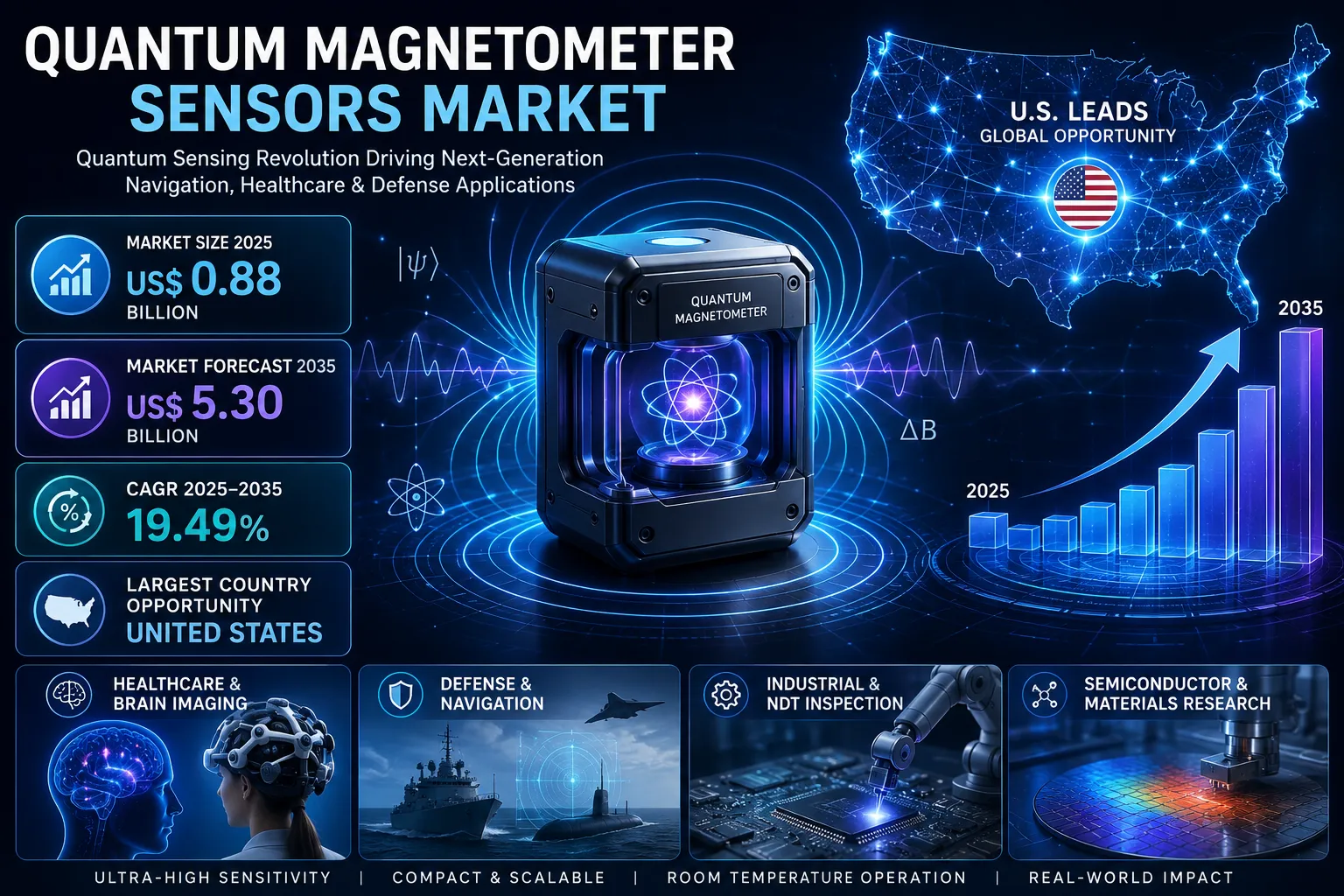
Request for Exclusive Sample Report: https://www.datamintelligence.com/download-sample/quantum-magnetometer-sensors-market
Why Quantum Magnetometer Sensors Are Gaining Industry Attention
Several trends are accelerating interest in quantum magnetometers. First, the demand for GPS-independent navigation is rising because satellite navigation can be jammed, spoofed, or unavailable underwater, underground, indoors, and in contested defense environments. Quantum magnetometers can support magnetic navigation by detecting local variations in Earth’s magnetic field.
Second, healthcare is emerging as a major growth area. Optically pumped magnetometers are enabling wearable MEG systems that can detect magnetic fields generated by brain activity without the cryogenic cooling required by traditional SQUID-based MEG systems. This opens the door to more flexible brain-imaging systems for neuroscience, epilepsy research, cognitive studies, and potentially clinical workflows.
Third, advances in diamond NV sensing are creating compact, solid-state quantum magnetometers that can operate at room temperature. These devices are gaining attention for semiconductor inspection, materials science, current imaging, medical diagnostics, and field-deployable sensing.
Finally, global investment in quantum technologies is supporting commercialization. Governments, defense agencies, research institutions, and venture investors are backing companies that can translate quantum sensing into deployable products.
Top Companies Developing Quantum Magnetometer Sensors in 2026
QuSpin
QuSpin is one of the best-known commercial developers of optically pumped magnetometers. The company focuses on extreme field sensing and offers non-cryogenic optical magnetometers designed to move high-sensitivity magnetic sensing from the laboratory into practical use.
Key Technologies
QuSpin’s core technology includes optically pumped magnetometers, zero-field OPMs, and pulsed rubidium OPM systems. Its product portfolio supports biomagnetic measurements and high-sensitivity field detection. The company has also introduced integrated OPM-MEG solutions such as Neuro-1 for high-channel-density biomagnetic applications.
Key Applications
QuSpin’s sensors are used in neuroscience research, medical imaging, biomagnetic sensing, and defense-related research. In healthcare and neuroscience, its OPMs support wearable MEG systems that detect weak magnetic fields generated by the brain.
Strategic Focus in 2026
In 2026, QuSpin’s strategic focus is likely to remain centered on expanding OPM product capabilities, supporting OPM-MEG workflows, and strengthening its position in biomagnetic sensing.
Cerca Magnetics
Cerca Magnetics is focused on wearable OPM-MEG systems. The company integrates optically pumped magnetometers with magnetic shielding and helmet-based sensor arrays to capture brain-generated magnetic fields.
Key Technologies
Cerca’s core technology includes OPM-MEG systems, wearable sensor helmets, shielding technologies, and integrated arrays of optically pumped magnetometers.
Key Applications
The company primarily serves neuroscience, brain imaging, cognitive research, clinical research, and academic institutions. Its systems are designed to make MEG more flexible and accessible compared with large, fixed, cryogenic scanners.
Strategic Focus in 2026
Cerca’s direction in 2026 is expected to focus on expanding OPM-MEG installations, improving wearable neuroimaging capabilities, and supporting research collaborations with hospitals and universities.
FieldLine Medical
FieldLine Medical develops wearable OPM-MEG systems for functional brain imaging. Its HEDscan system is described as a non-invasive, wearable MEG device based on quantum magnetometer OPM sensor technology.
Key Technologies
FieldLine’s HEDscan platform combines OPM sensors, a smart helmet, control electronics, shielding, and software interfaces for real-time recording and analysis.
Key Applications
The company targets neuroscience, neurological treatment research, mental health research, and brain-function mapping. Its technology is designed to record magnetic signals from the brain and nervous system without radiation, injections, or large magnetic fields.
Strategic Focus in 2026
FieldLine Medical’s focus in 2026 is expected to include expanding adoption of wearable OPM-MEG, supporting clinical and research users, and improving compact brain-imaging workflows.
Qnami
Qnami develops quantum sensing solutions based on scanning nitrogen-vacancy magnetometry. The company focuses on nanoscale magnetic imaging for research and industrial use.
Key Technologies
Qnami’s technology uses NV centers in diamond to measure magnetic fields at the nanoscale. Its ProteusQ platform and Quantilever sensor probes support high-resolution magnetic field imaging.
Key Applications
Key markets include semiconductor inspection, materials science, magnetic materials research, quantum device characterization, and academic research.
Strategic Focus in 2026
In 2026, Qnami’s strategic focus is expected to center on industrial-scale nanoscale sensing, stronger quantum imaging capabilities, and broader use in semiconductor and advanced materials workflows.
QZabre
QZabre is an ETH Zurich spin-off developing scanning NV magnetometers, diamond probes, and quantum sensing instruments for research laboratories and institutes.
Key Technologies
QZabre’s products use single nitrogen-vacancy centers in diamond as atomic-scale magnetic field sensors. Its quantum scanning microscope and diamond probe technologies are designed for nanoscale imaging.
Key Applications
The company serves university labs, quantum research centers, nanoscience, magnetic materials research, and quantum computing research.
Strategic Focus in 2026
QZabre’s 2026 focus is expected to include improving speed, sensitivity, and resolution in scanning NV magnetometry while expanding adoption among research institutions.
Twinleaf
Twinleaf develops precision magnetic field sensors and related systems. The company describes itself as a magnetometer company and offers several high-performance magnetic sensing products.
Key Technologies
Twinleaf’s portfolio includes pulsed pump magnetometers, pulsed pump vector magnetometers, optical magnetic gradiometers, and microSERF magnetometers.
Key Applications
Applications include geophysical exploration, magnetic survey, environmental monitoring, defense research, industrial measurements, and laboratory instrumentation.
Strategic Focus in 2026
Twinleaf’s focus in 2026 is expected to remain on compact, high-sensitivity, field-deployable magnetic sensing systems for research, government, and industrial customers.
Q.ANT
Q.ANT is a German photonic deep-tech company developing quantum sensing technologies, including NV diamond magnetic field sensors.
Key Technologies
Q.ANT’s magnetometer technology is based on nitrogen vacancies in diamond. The company has presented compact room-temperature magnetic sensing systems designed for sensitive magnetic field measurement.
Key Applications
Potential applications include medical technology, bio-magnetic sensing, industrial sensing, prosthetics control, human-machine interfaces, and diagnostics research.
Strategic Focus in 2026
Q.ANT is expected to focus on compact NV magnetometers, life-science applications, and integration of quantum magnetic sensors into everyday industrial and medical environments.
Quantum Brilliance
Quantum Brilliance is known for diamond-based quantum technology and room-temperature quantum devices. In sensing, the company is developing diamond-powered vector magnetometers for real-world deployment.
Key Technologies
Its quantum magnetometer technology is based on diamond systems designed for reliable operation across industrial, mobile, and field environments.
Key Applications
Key applications include navigation, industrial sensing, field sensing, mineral exploration, medical research, and infrastructure-related monitoring.
Strategic Focus in 2026
Quantum Brilliance’s focus in 2026 is expected to include scaling diamond quantum technology, supporting deployable sensing platforms, and expanding its commercial diamond quantum ecosystem.
Deteqt
Deteqt is developing chip-scale quantum sensing platforms based on diamond-on-chip technology. The company focuses on making magnetic field data machine-readable and actionable.
Key Technologies
Deteqt’s platform uses compact solid-state NV diamond quantum sensors and semiconductor-integrated control and readout systems.
Key Applications
Its target applications include navigation, autonomous systems, mining, resource discovery, defense, imaging, and biomedical sensing.
Strategic Focus in 2026
Deteqt’s 2026 strategy is expected to focus on rugged, low-power, scalable quantum magnetometers for real-world deployment in harsh environments.
SBQuantum
SBQuantum is a Canadian quantum sensing company developing diamond-based quantum magnetic sensors and magnetic mapping solutions.
Key Technologies
The company uses nitrogen-vacancy diamond magnetometry to develop field-proven quantum magnetic sensors capable of supporting magnetic navigation and mapping.
Key Applications
SBQuantum targets defense, homeland security, public safety, space, commercial navigation, weapons detection, and high-resolution magnetic mapping.
Strategic Focus in 2026
In 2026, SBQuantum is strongly positioned around GPS-independent navigation, space-deployable magnetometers, magnetic mapping, and defense-oriented sensing.
Supracon
Supracon develops superconducting sensor systems and SQUID-based measurement technologies. SQUID systems remain an important branch of quantum magnetometry, especially where extreme sensitivity is required.
Key Technologies
The company’s work includes SQUID sensors, superconducting systems, and integrated magnetometer research for biomagnetic signal detection.
Key Applications
Applications include biomagnetic sensing, geophysical exploration, nondestructive testing, scientific research, and advanced magnetic measurement systems.
Strategic Focus in 2026
Supracon’s focus is expected to remain on superconducting quantum sensing, SQUID system development, and specialized high-sensitivity measurement applications.
Emerging Startups Transforming the Quantum Magnetometer Market
The quantum magnetometer market is being shaped by startups and university spin-offs that combine quantum physics, semiconductor engineering, diamond materials, and applied sensing. Companies such as Deteqt, SBQuantum, QZabre, and Qnami show how academic research is moving into commercial instruments.
These startups are not all targeting the same market. Some focus on nanoscale imaging, while others target defense navigation, space sensing, medical imaging, or industrial field deployment. This diversity is important because quantum magnetometers are not a single product category; they are a family of technologies designed for very different sensitivity, size, cost, and operating-environment requirements.
Technology Comparison of Leading Quantum Magnetometer Developers
| Company | Core Technology | Primary Focus | Key Industries |
| QuSpin | Optically pumped magnetometers | Biomagnetic sensing | Healthcare, research |
| Cerca Magnetics | OPM-MEG systems | Wearable brain imaging | Healthcare, neuroscience |
| FieldLine Medical | OPM quantum magnetometers | Wearable MEG | Medical research |
| Qnami | NV diamond magnetometry | Nanoscale sensing | Semiconductors, materials science |
| QZabre | Scanning NV magnetometers | Quantum microscopy | Research, nanotechnology |
| Twinleaf | Atomic magnetometers | Portable field sensing | Geophysics, defense, research |
| Q.ANT | NV diamond magnetometers | Compact magnetic sensing | Medical, industrial |
| Quantum Brilliance | Diamond quantum magnetometers | Field-deployable sensing | Navigation, industry |
| Deteqt | Diamond-on-chip quantum sensors | Integrated magnetometers | Defense, mining, medical |
| SBQuantum | NV diamond magnetic sensors | Magnetic navigation and mapping | Defense, space, public safety |
| Supracon | SQUID-based quantum sensors | Superconducting magnetometry | Research, biomagnetics |
Request for Customized Sample Report as per Your Business Requirements: https://www.datamintelligence.com/customize/quantum-magnetometer-sensors-market
Key Industry Partnerships and Collaborations in 2026
Partnerships are central to commercialization. Healthcare-focused companies are collaborating with universities, hospitals, and neuroscience centers to validate wearable MEG systems. Defense-oriented companies are working with government agencies to explore GPS-independent navigation, magnetic anomaly detection, and field sensing. Diamond quantum companies are building links with semiconductor manufacturers, materials researchers, and national laboratories.
Research consortiums are also important because quantum magnetometers require combined expertise in physics, photonics, electronics, software, shielding, calibration, and application-specific integration.
Investment and Funding Trends
Investment in quantum sensing is growing as investors look beyond quantum computing toward nearer-term quantum technologies. Magnetometers are attractive because they can solve practical problems in navigation, brain imaging, mineral exploration, and industrial sensing.
Funding trends include venture capital for diamond quantum startups, government grants for defense and space navigation, strategic investments in quantum hardware manufacturing, and public-sector support for healthcare and neuroscience research infrastructure.
Challenges Facing Quantum Magnetometer Commercialization
Despite strong momentum, commercialization is not simple. Quantum magnetometers can be expensive to produce, especially when they require high-quality diamond materials, specialized vapor cells, precision optics, shielding, or cryogenic systems. Calibration complexity is another barrier because high-sensitivity sensors must perform reliably outside controlled laboratories.
Manufacturing scalability is also critical. Companies must reduce size, weight, power consumption, and cost while maintaining sensitivity. Regulatory requirements may slow healthcare adoption, and the industry still faces a shortage of engineers who understand both quantum physics and commercial product development.
Future Outlook for Quantum Magnetometer Sensor Companies
The outlook for quantum magnetometer companies is highly promising. Healthcare adoption is likely to grow as wearable OPM-MEG systems become more practical for research and clinical environments. Defense demand may rise as armed forces seek resilient navigation technologies that do not depend entirely on GPS. Industrial markets could expand as compact magnetometers support nondestructive testing, infrastructure monitoring, semiconductor inspection, and mineral exploration.
By 2035, quantum magnetometers may become a standard part of advanced sensing systems. The companies best positioned for growth will be those that can combine scientific performance with rugged design, scalable manufacturing, software integration, and clear application value.
Read Complete Research Report: https://www.datamintelligence.com/research-report/quantum-magnetometer-sensors-market
FAQ
Which company is leading quantum magnetometer sensor development in 2026?
There is no single leader across all categories. QuSpin, Cerca Magnetics, FieldLine Medical, Qnami, QZabre, Twinleaf, Q.ANT, Quantum Brilliance, Deteqt, and SBQuantum are advancing different types of quantum magnetometer technologies for healthcare, defense, industrial, and research applications.
What industries use quantum magnetometer sensors?
Major industries include healthcare, defense, aerospace, geophysical exploration, mining, semiconductor inspection, industrial automation, environmental monitoring, and scientific research.
What is the most advanced type of quantum magnetometer?
Optically pumped magnetometers and NV diamond magnetometers are among the most commercially advanced technologies today. SQUID magnetometers remain extremely sensitive and important for specialized scientific and biomagnetic applications.
How are quantum magnetometer companies generating revenue?
Companies generate revenue through sensor hardware sales, complete imaging systems, scientific instruments, software platforms, research partnerships, government contracts, and application-specific sensing solutions.
What is the future market potential for quantum magnetometer sensors?
The market potential is strong because quantum magnetometers address high-value problems in brain imaging, GPS-independent navigation, magnetic mapping, semiconductor inspection, and national security. Growth through 2035 will depend on cost reduction, system integration, manufacturing scale, and application validation.