


Quantum Hardware Market Overview
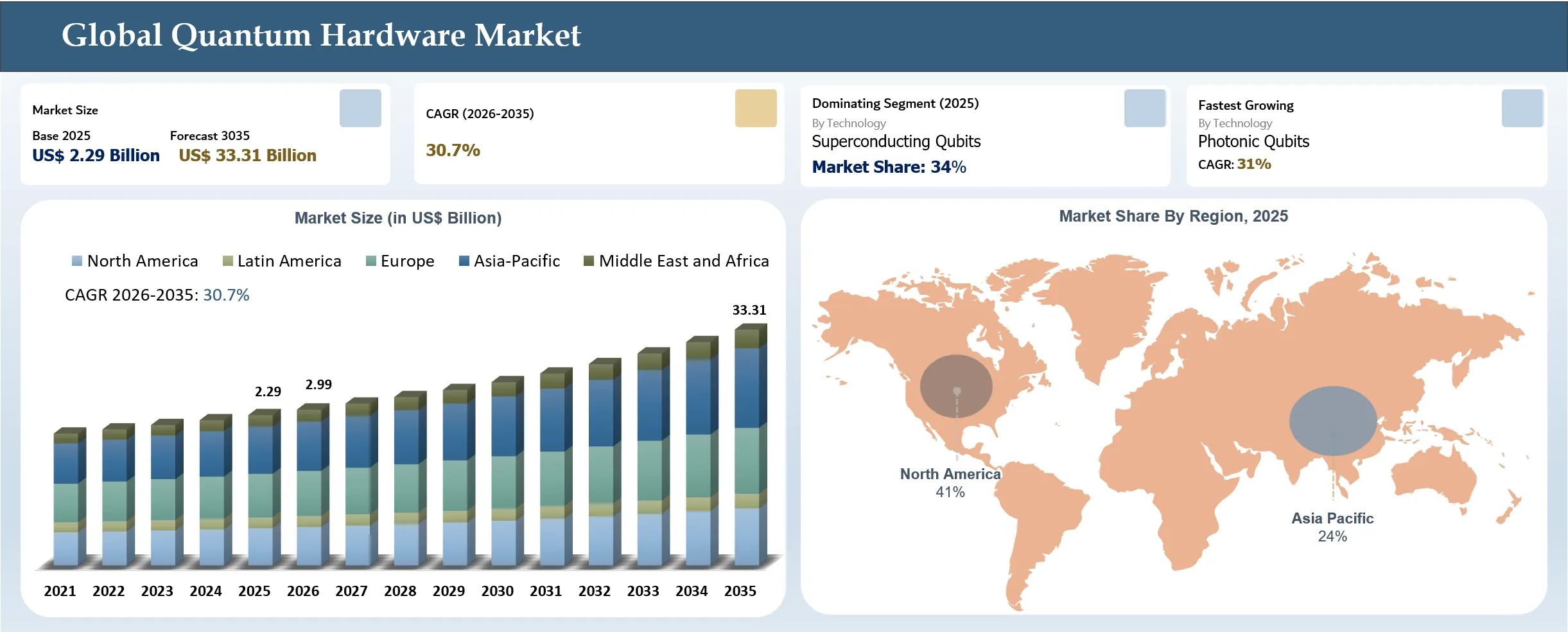
The global quantum hardware market reached US$ 2.29 billion in 2025 and is expected to reach US$ 33.31 billion by 2035, growing with a CAGR of 30.7% during the forecast period 2026-2035. The quantum hardware market is growing very quickly since both businesses and technology providers are scrambling to develop robust, highly scalable, and quantum-proof systems, which can withstand both the current quantum threats and potential future quantum computing power. The significance of hardware cannot be overlooked, both for the development of quantum computing systems and in the protection of traditional computing infrastructure from quantum-based attacks through the creation of silicon-based chips. For instance, in 2025, SEALSQ, an international company that specializes in semiconductor technologies and post-quantum cryptography, unveiled the Quantum Shield QS7001 chip at the Q+AI Conference in New York, becoming the first such silicon chip incorporating NIST-approved PQC algorithms. The product was set to go on sale in mid-November of the same year.
Key Takeaways
- North America is dominating the global quantum hardware market, accounting for a share of 41% in 2025, while Asia-Pacific is forecast to 31.5% CAGR between 2026 and 2035.
- In 2025, Superconducting qubit technology led the market with a share of approximately 34%.
- Photonic qubit technology is the fastest-growing technology in 2025, with a CAGR 31%.
- The growing focus on trapped ion and neutral atom architectures is a major driver accelerating innovation and scalability in the quantum hardware market.
- IonQ, D-Wave Quantum, and Rigetti Computing have established themselves as leading players in the market through continued advancements in scalable quantum computing architectures, expanding commercial deployment capabilities, strategic collaborations.
Quantum Hardware Industry Trends and Strategic Insights
- Quantum hardware vendors continue to focus on superconducting, trapped-ion, neutral atom, photonics, and silicon-spin technologies, where IBM, Quantinuum, IonQ, QuEra, PsiQuantum compete in the race for commercializing these technologies. The competition landscape in the industry moves from qubits number towards logical qubits robustness, high gate fidelity, and error correction capabilities.
- The advantage of trapped ions and neutral atoms is evident by the increasing interest from companies that consider such systems due to high coherence and fidelity levels. Meanwhile, photonic quantum computing gains large investments for room-temperature scalability and CMOS compatibility of its devices. Hardware vendors specializing in photonic quantum computing increasingly favor silicon photonics technology for future commercialization purposes.
- Investment trends started to develop more actively during 2025–2026 when the industry was gradually moving from R&D-focused investments to infrastructure-oriented funding. The public offering prospectus issued by Quantinuum, the acquisition strategy of IonQ, and several billion dollars raised by PsiQuantum prove that the investors are confident about quantum hardware ecosystems' scalability.
Quantum Hardware Market Scope
| Metrics | Details | |
| 2025 Market Size | US$ 2.29 Billion | |
| 2035 Projected Market Size | US$ 33.31 Billion | |
| CAGR (2026-2035) | 30.7% | |
| Largest Market | North America | |
| Fastest Growing Market | Asia-Pacific | |
| By Technology | Superconducting Qubits, Trapped Ion Qubits, Photonic Qubits, Spin Qubits, Neutral Atom Qubits, Quantum Annealing Hardware, Topological Qubits | |
| By Application | Cryptography, Drug Discovery, BSFI, Artificial Intelligence and Machine Learning (AI/ML), Materials Science and Chemical Simulation, Optimization Problems, Climate Modeling, Others | |
| By Region | North America | U.S., Canada, Mexico |
| Europe | Germany, UK, France, Spain, Italy, Poland | |
| Asia-Pacific | China, India, Japan, Australia, South Korea, Indonesia, Malaysia | |
| Latin America | Brazil, Argentina | |
| Middle East and Africa | UAE, Saudi Arabia, South Africa, Israel, Turkiye | |
| Report Insights Covered | Competitive Landscape Analysis, Company Profile Analysis, Market Size, Share, Growth | |
Why this report matter in 2026?
The Quantum Hardware Market will experience a significant commercialization trend in 2026, as there is an increase in competition for establishing leadership in the emerging computing architecture among governments, hyperscalers, and venture capital firms. The mounting attention to quantum supremacy, resilient cybersecurity, and advanced sovereignty technologies by governments around the world has been driving investments from both public and private sectors in the U.S., China, the European Union, and other regions. The rapid evolution of this landscape into an economically and politically strategic sector is transforming the market into a promising technology market.
Moreover, quantum hardware manufacturers have started to experience an increased demand to showcase their scalable, fault-tolerant, and commercial architecture amidst increasing enterprise demands. The exponential progress in the development of superconducting qubits, trapped ions, neutral atoms, and photonic quantum computing is repositioning the quantum hardware industry. Technology buyers, investors, and industry experts have started to demand greater insights about qubit scalability, error correction, cryogenic technologies, platform compatibility, partnership strategies, and publicly funded funding sources in order to ensure viable technologies and minimize risks associated with investing in commercially competitive ecosystems.
Quantum Hardware Market Disruption Analysis

Shift from Classical High-Performance Computing to Quantum-Native Processing Architectures Reshaping Compute Paradigms
The key disruption in the quantum hardware industry can be defined by the shift from classic computing paradigms to quantum computing systems designed to offer unprecedented computational power in optimization and simulation tasks, making them exponentially faster than traditional models. The classic HPC systems based on semiconductor chips have reached their computational limits for tasks related to molecular modeling, encryption, and large-scale optimization.
The other key disruption is associated with the integration of quantum computing technologies into cloud environments and hybrid quantum-classic architectures. Enterprises are gradually migrating to quantum platforms available via cloud services and do not require ownership of specialized quantum hardware. Such a strategy facilitates commercial adoption and lowers the entry barrier for quantum solutions. Companies that will not be able to progress beyond prototyping quantum technology would find themselves behind in the quantum race.
Quantum Hardware Market BCG Matrix: Company Evaluation

Firms such as IonQ, Inc., D-Wave Quantum Inc., and Rigetti Computing are called Stars due to advances in commercialization, cloud quantum computing, and increased usage of quantum optimization and simulation use cases in business processes. These firms benefit from being early players, consistent funding, and cooperation with hyperscalers and research organizations. Better performance of qubits, as well as hybrid quantum computing operations, increase the market leadership position of these firms.
Organizations like PsiQuantum, Corp., Xanadu Quantum Technologies, Infleqtion, and Pasqal are grouped into Question Marks due to competing in the emerging and high-growth quantum hardware market which has not been commercialized, along with scalability and error correction problems. New ventures, such as ID Quantique, MagiQ Technologies, and QuantumCTek, are considered Potential companies because of niche dominance and governmental implementation in quantum communication and sensing use cases. Lastly, firms that are either small or focused and cannot offer universality in quantum computing as well as do not operate in quantum hardware and only rely on localized uses are classified as Tailenders.
Quantum Hardware Market Dynamics
Driver Impact Analysis
| Driver | Market Growth Impact (%) | Demand Concentration | Impacted Use Case | Strategic Impact |
Growing Focus on Trapped Ion and Neutral Atom Architectures | 4.8% | North America, Western Europe, and Asia-Pacific quantum research ecosystems | Fault-tolerant quantum computing, quantum simulation, optimization workloads | Accelerates commercialization of scalable and high-coherence quantum hardware systems |
Expanding Government and Defense Funding Initiatives | 5.1% | U.S., China, European Union, UK, and national defense laboratories | quantum cryptography, defense simulations, secure communications, advanced sensing | Strengthens national quantum infrastructure development and strategic technology leadership |
Increasing Investments in Superconducting Qubit Development and Cryogenic Infrastructure | 4.5% | Large-scale quantum computing companies and advanced semiconductor ecosystems | Quantum processors, hybrid HPC-quantum systems, cloud-access quantum computing | Enhances qubit scalability and improves hardware stability for enterprise-grade applications |
Rising Collaboration Between Quantum Hardware Companies, Universities, and Research Institutes | 4.0% | Academic research clusters and public-private innovation partnerships | Quantum algorithm testing, hardware prototyping, materials research | Accelerates innovation cycles and supports faster transition from research to commercialization |
Growing Focus on Trapped-Ion and Neutral-Atom Architectures
The rising interest in trapped-ion and neutral-atom quantum architectures has led to significant innovation in the development of quantum hardware solutions across the globe. Trapped ions and neutral atoms as qubit sources bring certain benefits to the performance of quantum computing devices in terms of precision, coherence time, and scalability. The emerging quantum architectures are expected to be especially effective when solving optimization tasks, conducting high-fidelity calculations, and developing AI/ML algorithms. Businesses and scientific organizations are now making investments into the improvement of quantum hardware and the creation of control electronics and integrated optical solutions. For example, in 2025, IonQ, an American quantum computing company, intensified its cooperation with QuantumBasel, developing new generation trapped ion hardware solutions that include rack-based Tempo systems with QCCD modules for scalable ion shuttling and all-to-all connectivity.
Restraint Impact Analysis
| Restraint | Drag on Market Growth (%) | Primary Impact Area | Impacted Use Case | Strategic Impact |
| High Error Rates and Limited Scalability | 4.4% | Quantum processor performance and system reliability | Fault-tolerant quantum computing, large-scale quantum simulations | Slows the commercialization of scalable quantum hardware systems |
| Lack of Standardization Across Platforms | 3.8% | Hardware interoperability and software compatibility | Cross-platform quantum development, enterprise integration | Delays ecosystem maturity and increases technology adoption complexity |
| High Infrastructure and Cryogenic Cooling Costs | 4.2% | Capital expenditure and operational scalability | Superconducting quantum systems, research-grade installations | Restricts adoption among small enterprises and emerging research facilities |
Limited Availability of Quantum-Skilled Workforce and Specialized Talent | 3.6% | Quantum hardware development and maintenance | Quantum system engineering, calibration, and algorithm optimization | Slows innovation cycles and deployment efficiency across the quantum ecosystem |
High Error Rates and Limited Scalability
Although quantum hardware technology is increasingly being adopted, quantum hardware still faces difficulties in connection with error rates of the qubits and scalability. Scaling of quantum hardware is problematic, as the error rates in large numbers of qubits can significantly impair performance on complex computing tasks involving AI applications and simulations. Scaling the hardware itself also brings with it additional costs and other difficulties. Vendors such as Rigetti and IonQ are overcoming some of these limitations by using a modular approach, error mitigation techniques, and built-in hardware controllers. However, organizations need to conduct rigorous evaluation before utilizing the quantum hardware platforms in mission-critical applications.
Quantum Hardware Market Segmentation Analysis
The global quantum hardware market is segmented based on technology, application, and region.
Enterprise Adoption Strengthened by Mature, High-Performance Superconducting Platforms
The superconducting qubits continue dominating the quantum hardware industry with a market share of about 34% as a result of high-level adoption within enterprises and research organizations along with large investments towards scalability. These technologies benefit from having established fabrication techniques, robust ecosystem and well-integrated high-performance computing systems, which make superconducting qubits the most preferable solution when it comes to applying quantum computers to solving complex optimization problems, simulating chemistry and machine learning tasks. For instance, IBM, an American technology company, announced a major development of new processors and software for quantum computing in November 2025. Specifically, it introduced an advanced version of the IBM Quantum Nighthawk processor that boasts improved qubit connectivity and error suppression mechanisms, thus bringing quantum computers closer to demonstrating quantum advantage and fault-tolerant computing.
Rapid Growth Fueled by Strategic Investment in Scalable Photonic Quantum Systems
The photonic qubit has become the fastest growing category in quantum hardware technology, taking up about 15% of the market share but receiving huge investments due to its room temperature capabilities, higher bandwidth optical networking, and scalability capabilities. This is because it uses photon particles as carriers of information that can be manufactured via semiconductor processes and have advantages in terms of connectivity and lower cooling complexities than cryogenic qubits. For example, the American quantum hardware company known as PsiQuantum in September 2025 received one billion dollars in funding to develop utility-scale and fault-tolerant quantum computers through its silicon photonic chip technologies, thereby building prototypes in Brisbane and Chicago.
Quantum Hardware Market Geographical Penetration
Rising Government Investments in Asia-Pacific
The Asia Pacific quantum hardware market is the most rapidly growing market among all global markets and holds approximately 24% of the share in 2025. The governments of all the countries in the region are working rigorously to establish the quantum infrastructure of their country in order to enhance their research capacity, reduce dependency on foreign technologies, and increase the commercialization of quantum solutions.
For example, in 2026, Singapore launched the Asia Pacific Quantum Research Hub (APQRH), it is a billion-dollar project that will include facilities for quantum hardware labs, cryogenic units, semiconductor lines, and collaboration with leading technology firms around the globe in the fields of cybersecurity, logistics, and AI.
Japan Quantum Hardware Market Outlook
Japan has been moving forward with its national quantum efforts by relying on domestically engineered technology and innovation from academic research. For instance, in 2025, the country rolled out its first-ever domestic quantum computer based on its superconducting qubits and open-source technologies developed by the University of Osaka.
South Korea Quantum Hardware Market Trends
South Korea is growing its quantum landscape through the implementation of various strategies by the government. For instance, in 2025, South Korea fast-tracked the development of its national quantum strategy by investing in research & development and fabrication of domestically produced hardware, such as superconducting QPUs and photonic qubits.
Rising Strategic Investments and Infrastructure Expansion in North America
The North American holds the most significant position in the global quantum hardware market, contributing to 41% of the overall market share due to its government funding, enterprise application, and research activities. The continent is seeing active scaling in quantum hardware capacity from technology companies and national laboratories. As an example, IonQ, which is a United States quantum computer company, signed an agreement with SkyWater Technology in 2026 to purchase the company for around $1.8 billion as part of an all-cash and stock deal to advance the development of quantum processors using their internal manufacturing facility capability. The acquisition of SkyWater will allow the integration of the chip manufacturing process into IonQ’s facilities in Minnesota, Florida, and Texas, allowing proximity in testing and development processes of quantum hardware.
U.S. Quantum Hardware Market Insights
In the U.S., flows of investment dollars and industry optimism are beginning to take the form of actual infrastructure investments. For instance, in 2025, PsiQuantum, a quantum hardware company from California, laid the foundation for its quantum computing facility within the Illinois Quantum and Microelectronics Park after raising an astounding $1 billion in funding. The initiative represents the start of quantum hardware development efforts in creating intermediate-scale and utility-class quantum computers right within the country’s borders.
Canada Quantum Hardware Industry Growth
Within Canada, quantum hardware developments are being promoted through ecosystem collaborations that include research organizations and industry groups. In 2025, C2MI, an innovation center located in Québec, collaborated with various organizations from industry and research to promote quantum developments in Canada by developing more sophisticated micro/nanofabrication facilities for quantum devices. Such an approach can be helpful for advancing the hardware technologies and moving closer to commercial applications through collaboration with researchers and industry organizations.
Quantum Hardware Market Competitive Landscape

- The global quantum hardware market is characterized by a competitive landscape that includes both established and regional players.
- Key players include IonQ, Inc., D-Wave Quantum Inc., Rigetti Computing, PsiQuantum, Corp., Xanadu Quantum Technologies, Infleqtion, ID Quantique, MagiQ Technologies, QuantumCTek, Pasqal.
Key Developments in Quantum Hardware Market
- July 2026: IonQ, Inc. expanded its trapped-ion quantum computing platform by advancing next-generation quantum hardware designed to improve qubit fidelity, scalability, and enterprise computing performance.
- July 2026: D-Wave Quantum Inc. strengthened its quantum computing portfolio by enhancing annealing quantum hardware and hybrid quantum-classical solutions for optimization and industrial applications.
- June 2026: Rigetti Computing, Inc. advanced its superconducting quantum processor roadmap through continued development of higher-performance quantum hardware and cloud-based quantum computing services.
- June 2026: PsiQuantum Corp. accelerated the development of fault-tolerant photonic quantum computers by expanding silicon photonics technologies and large-scale quantum hardware engineering initiatives.
- May 2026: Xanadu Quantum Technologies Inc. strengthened its photonic quantum computing platform through continued advancements in optical quantum processors and scalable quantum hardware architectures.
- May 2026: Infleqtion expanded its quantum technology portfolio by advancing neutral-atom quantum computing systems and precision quantum hardware for commercial and research applications.
- April 2026: ID Quantique SA enhanced its quantum technology offerings by expanding quantum-safe cryptography and quantum sensing solutions while continuing investments in quantum hardware innovation.
- April 2026: MagiQ Technologies, Inc. continued advancing quantum communication and cryptographic hardware technologies supporting secure quantum information infrastructure.
- March 2026: QuantumCTek Co., Ltd. strengthened its quantum information technology portfolio by expanding quantum communication hardware and supporting the commercialization of quantum networking solutions.
Key Procurement Priorities and Buyer Evaluation Criteria
- Organizations investing in the Quantum Hardware Market are increasingly selecting vendors based on their ability to deliver commercially scalable systems with stronger processing reliability, lower operational complexity, and long-term technology upgrade potential.
- Procurement strategies are being shaped by the rapid evolution of superconducting, trapped-ion, neutral atom, and photonic quantum technologies, alongside growing demand for integration with cloud-based quantum services and hybrid AI-computing environments.
- Governments, research institutions, cloud providers, and enterprise buyers evaluate qubit stability, error-correction capabilities, processing fidelity, and cryogenic infrastructure requirements before selecting quantum hardware platforms and technology partners.
Why Choose DataM?
- Data-Driven Insights: Dive into detailed analyses with granular insights such as pricing, market shares and value chain evaluations, enriched by interviews with industry leaders and disruptors.
- Post-Purchase Support and Expert Analyst Consultations: As a valued client, gain direct access to our expert analysts for personalized advice and strategic guidance, tailored to your specific needs and challenges.
- White Papers and Case Studies: Benefit quarterly from our in-depth studies related to your purchased titles, tailored to refine your operational and marketing strategies for maximum impact.
- Annual Updates on Purchased Reports: As an existing customer, enjoy the privilege of annual updates to your reports, ensuring you stay abreast of the latest market insights and technological advancements. Terms and conditions apply.
- Specialized Focus on Emerging Markets: DataM differentiates itself by delivering in-depth, specialized insights specifically for emerging markets, rather than offering generalized geographic overviews. This approach equips our clients with a nuanced understanding and actionable intelligence that are essential for navigating and succeeding in high-growth regions.
- Value of DataM Reports: Our reports offer specialized insights tailored to the latest trends and specific business inquiries. This personalized approach provides a deeper, strategic perspective, ensuring you receive the precise information necessary to make informed decisions. These insights complement and go beyond what is typically available in generic databases.
Target Audience
- Manufacturers/ Buyers
- Industry Investors/Investment Bankers
- Research Professionals
- Emerging Companies


























































