


Introduction
Battery manufacturing has become one of the most important industrial growth areas in the global energy transition. Earlier, the battery industry was mostly viewed through consumer electronics, lead-acid batteries and small rechargeable cells. In 2026, the industry is far broader. It now includes electric vehicle batteries, lithium-ion cells, sodium-ion batteries, solid-state batteries, medical batteries, smartphone batteries, battery recycling, battery materials, separators, electrolytes, anodes, cathodes, battery packaging, battery management systems and energy storage batteries.
The reason is simple: batteries now sit at the center of electric mobility, renewable energy storage, smart grids, data centers, consumer devices, medical equipment and industrial electrification. As EV adoption increases and energy storage becomes critical for solar and wind integration, battery companies are no longer just component suppliers. They are strategic infrastructure players.
The global EV battery market continues to be led by Asian manufacturers, especially companies from China, South Korea and Japan. According to SNE Research data reported by CnEVPost, global EV battery usage reached 244.6 GWh during January–March 2026, up 9.1% year-on-year, with CATL holding 40.7% of the market and BYD ranking second with 13.7%. This shows why battery manufacturing is increasingly linked with national supply chains, automaker strategy, raw material security and technology leadership.
This blog analyzes the top battery manufacturing companies across the most important battery segments, including EV batteries, lithium-ion batteries, sodium-ion batteries, solid-state batteries, medical batteries, cell phone batteries, graphene batteries, battery recycling, Chinese battery manufacturers and battery material suppliers.
Request for Analyst call on Battery Market: Request Call
How These Battery Companies Were Selected
The companies in this blog are selected based on their relevance to each battery segment, commercial presence, technology portfolio, manufacturing capability, supply chain importance, partnerships, market visibility and role in future battery development.
The ranking is not based only on revenue. Battery manufacturing is a layered industry. Some companies lead in EV battery installations, some dominate consumer electronics batteries, some are important in sodium-ion or solid-state innovation, while others are essential suppliers of lithium compounds, cathode materials, separators, electrolytes and recycling solutions.
Key evaluation factors include:
- Commercial battery manufacturing scale
- EV and energy storage supply relationships
- Battery chemistry expertise
- Global and regional manufacturing footprint
- Technology pipeline
- Strategic partnerships with automakers and energy companies
- Material sourcing and recycling capability
- Role in next-generation battery development
- Relevance to buyers, suppliers, investors and market-entry teams
Battery Manufacturing Industry Overview in 2026
The battery industry in 2026 is moving in three directions at the same time.
First, lithium-ion batteries remain the backbone of the market. They dominate EVs, consumer electronics, power tools, energy storage systems, medical devices and industrial applications. Companies such as CATL, BYD, LG Energy Solution, Panasonic Energy, Samsung SDI and SK On continue to lead this space.
Second, alternative chemistries are becoming commercially important. Sodium-ion batteries are gaining attention because they use more abundant raw materials and can reduce dependence on lithium, nickel and cobalt. Solid-state batteries are attracting investment because they promise higher energy density, improved safety and better performance, although mass production remains difficult.
Third, battery recycling and materials are becoming as important as cell manufacturing. As battery demand rises, companies need reliable access to lithium, nickel, cobalt, graphite, separators, electrolytes and cathode materials. Recycling is also becoming a strategic supply source for recovered metals and battery-grade materials.
For buyers and partners, this means the battery ecosystem should not be viewed as one single market. It is a connected value chain with different leaders at each stage.
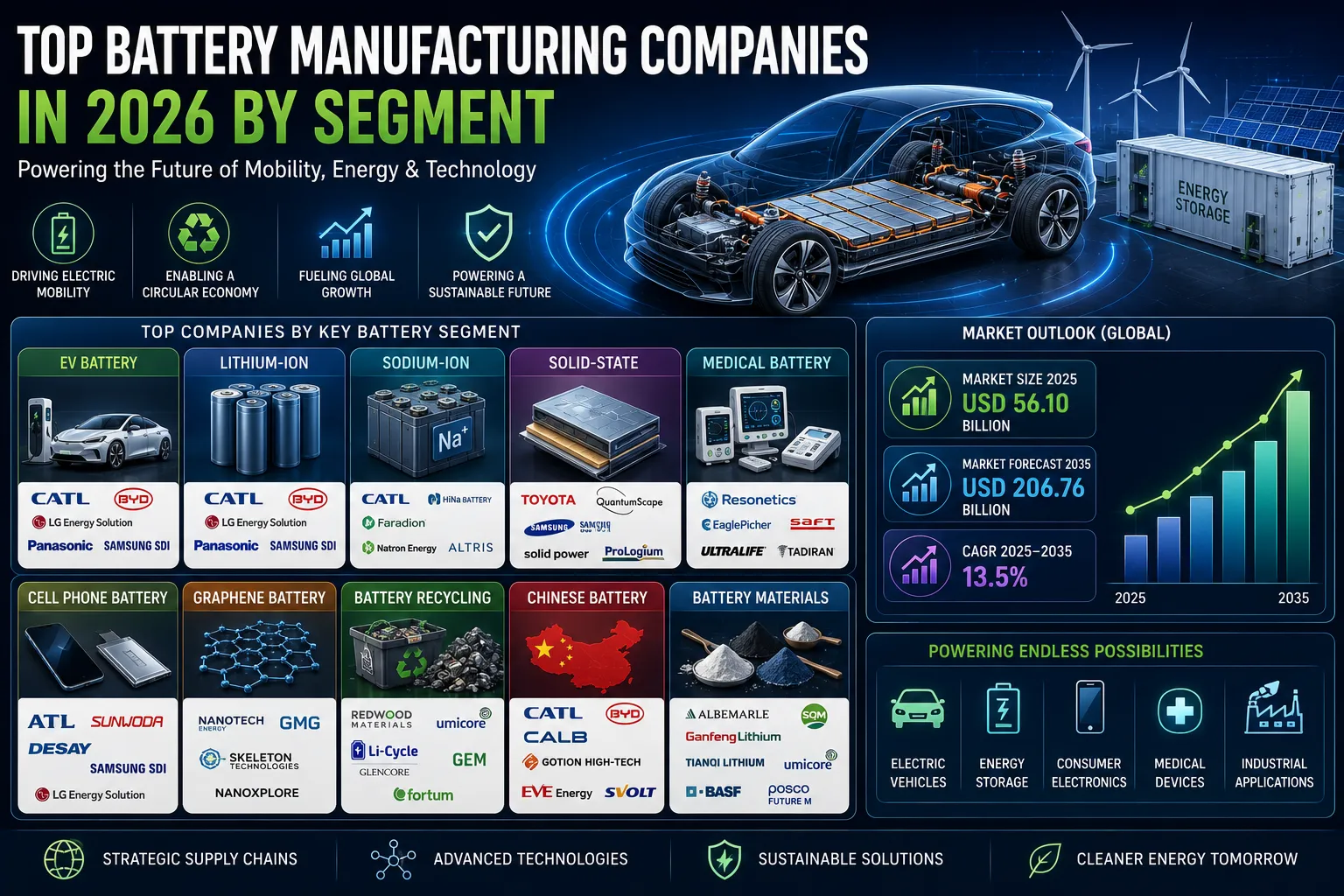
Top Battery Companies by Segment
| Battery Segment | Leading Companies |
| EV Battery Manufacturing | CATL, BYD, LG Energy Solution, Panasonic Energy, Samsung SDI, SK On |
| Lithium-Ion Battery Manufacturing | CATL, BYD, LG Energy Solution, Panasonic Energy, Samsung SDI, EVE Energy |
| Sodium-Ion Battery Manufacturing | CATL, HiNa Battery, Faradion, Natron Energy, Altris, Tiamat |
| Solid-State Battery Manufacturing | Toyota, QuantumScape, Samsung SDI, Solid Power, ProLogium, Factorial Energy |
| Medical Battery Manufacturing | Integer, Resonetics, EaglePicher, Ultralife, Saft, Tadiran |
| Cell Phone Battery Manufacturing | ATL, Sunwoda, Desay Battery, Samsung SDI, LG Energy Solution, Murata |
| Graphene Battery Companies | Nanotech Energy, Graphene Manufacturing Group, Skeleton Technologies, NanoXplore |
| Battery Recycling Companies | Redwood Materials, Umicore, Li-Cycle/Glencore, GEM, Brunp, Fortum |
| Chinese Battery Manufacturers | CATL, BYD, CALB, Gotion, EVE Energy, SVOLT |
| Battery Material Suppliers | Albemarle, SQM, Ganfeng Lithium, Tianqi Lithium, Umicore, BASF, POSCO Future M |
Request for Analyst call on Battery Management Systems Market: Request Call
1. Top 10 EV Battery Manufacturing Companies
EV battery manufacturing is the most competitive and visible part of the global battery industry. Automakers are selecting battery partners not only on cost, but also on energy density, safety, charging speed, localization, supply security and chemistry flexibility.
Top 10 EV Battery Manufacturers in 2026
| Rank | Company | Country | Key Strength |
| 1 | CATL | China | Global EV battery leader with LFP, NCM and sodium-ion capability |
| 2 | BYD | China | Vertically integrated EV and battery manufacturer |
| 3 | LG Energy Solution | South Korea | Major supplier to global automakers |
| 4 | Panasonic Energy | Japan | Strong cylindrical cell position and long EV battery history |
| 5 | Samsung SDI | South Korea | Premium EV batteries and solid-state development |
| 6 | SK On | South Korea | EV battery partnerships with global automakers |
| 7 | CALB | China | Fast-growing Chinese EV battery supplier |
| 8 | Gotion High-Tech | China | LFP batteries and international expansion |
| 9 | EVE Energy | China | EV, cylindrical and energy storage battery portfolio |
| 10 | SVOLT Energy | China | Cobalt-free and short-blade battery technology |
Request for Exclusive Sample on Battery Recycling Market
CATL
CATL is the largest EV battery manufacturer globally. The company has built a strong position through scale, cost control, chemistry diversity and partnerships with major automakers. CATL’s product portfolio includes lithium iron phosphate batteries, nickel-based batteries, sodium-ion batteries and energy storage systems. Its leadership is clearly visible in 2026 market data, where it held more than 40% of global EV battery usage in the first quarter.
BYD
BYD is one of the strongest battery companies because it is both a battery manufacturer and an EV manufacturer. Its Blade Battery has become one of the most recognized LFP battery platforms in the market. BYD’s vertical integration gives it cost, supply chain and technology advantages. The company’s rise as a leading EV seller also strengthens its battery demand base.
LG Energy Solution
LG Energy Solution is one of the most important South Korean EV battery suppliers. It works with global automakers and has invested heavily in battery production capacity across South Korea, Europe and North America. Its strength is in lithium-ion battery scale, automotive partnerships and cell technology.
Panasonic Energy
Panasonic Energy remains a major player in cylindrical battery cells, especially for electric vehicles. The company has a long history in lithium-ion battery manufacturing and continues to focus on high-performance cells for mobility and energy applications.
Samsung SDI
Samsung SDI is positioned in premium EV batteries, prismatic cells and next-generation battery development. The company is also one of the companies to watch in solid-state battery development, giving it a strong future-facing position.
SK On
SK On has grown through partnerships with automakers and expansion of EV battery production capacity. Its role is important in global supply diversification, especially for companies looking beyond China-based suppliers.
CALB
CALB is one of China’s fast-growing EV battery manufacturers. The company has gained visibility in the EV supply chain and competes strongly in lithium-ion battery technologies.
Gotion High-Tech
Gotion High-Tech is known for LFP battery manufacturing and international expansion. The company is relevant for EVs, stationary storage and cost-sensitive battery applications.
EVE Energy
EVE Energy has a broad battery portfolio covering EV batteries, consumer batteries and energy storage. Its presence across multiple battery applications makes it one of the most versatile Chinese battery manufacturers.
SVOLT Energy
SVOLT Energy focuses on EV batteries, cobalt-free chemistries and short-blade battery formats. It is an important Chinese battery company for automakers looking for alternative suppliers.
2. Top 10 Lithium-Ion Battery Manufacturing Companies
Lithium-ion batteries continue to dominate the global rechargeable battery market. Even with sodium-ion and solid-state batteries gaining attention, lithium-ion remains the commercial standard for EVs, smartphones, laptops, medical devices, grid storage and industrial equipment.
Top 10 Lithium-Ion Battery Manufacturers
| Rank | Company | Country | Core Application Areas |
| 1 | CATL | China | EVs, energy storage, mobility |
| 2 | BYD | China | EVs, energy storage, consumer applications |
| 3 | LG Energy Solution | South Korea | EVs, consumer electronics, storage |
| 4 | Panasonic Energy | Japan | EVs, cylindrical cells, industrial batteries |
| 5 | Samsung SDI | South Korea | EVs, electronics, energy storage |
| 6 | SK On | South Korea | EV batteries |
| 7 | EVE Energy | China | EVs, consumer batteries, storage |
| 8 | Gotion High-Tech | China | LFP batteries, EVs, storage |
| 9 | CALB | China | EV batteries |
| 10 | Murata Manufacturing | Japan | Electronics and small lithium-ion batteries |
Request for Exclusive Sample on Lithium-Ion Battery Market
Lithium-ion battery manufacturing is increasingly shaped by chemistry choice. LFP batteries are gaining popularity because of cost and safety advantages, while nickel-rich chemistries remain important for applications that need higher energy density. Companies that can offer multiple chemistries have an advantage because automakers and storage developers are no longer dependent on one battery design.
CATL, BYD, LG Energy Solution, Panasonic, Samsung SDI and SK On remain the most visible lithium-ion battery companies because of their large-scale EV battery supply relationships. Murata is also important in smaller lithium-ion battery formats used in electronics and compact devices.
3. Top 10 Sodium-Ion Battery Manufacturing Companies
Sodium-ion batteries are one of the most important emerging battery technologies in 2026. They are not expected to fully replace lithium-ion batteries, but they can become important in cost-sensitive EVs, two-wheelers, stationary storage, backup power and cold-weather applications.
Sodium is more abundant than lithium, and sodium-ion batteries can reduce dependence on lithium, nickel and cobalt. This makes them attractive for markets looking for lower-cost and more secure supply chains.
Top 10 Sodium-Ion Battery Companies
| Rank | Company | Country | Sodium-Ion Focus |
| 1 | CATL | China | Sodium-ion batteries for EVs and storage |
| 2 | HiNa Battery | China | Sodium-ion cells and energy storage systems |
| 3 | Faradion | UK/India | Sodium-ion technology for mobility and storage |
| 4 | Natron Energy | USA | Industrial and backup power sodium-ion batteries |
| 5 | Altris | Sweden | Sodium-ion cathode and cell technology |
| 6 | Tiamat Energy | France | High-power sodium-ion batteries |
| 7 | BYD | China | Sodium-ion commercialization and EV applications |
| 8 | BenAn Energy | China/Singapore | Stationary sodium-ion energy storage |
| 9 | KPIT Technologies | India | Sodium-ion battery technology development |
| 10 | Veken Technology | China | Sodium-ion battery manufacturing |
Request for Exclusive Sample on Sodium-Ion Battery Market
CATL is the most visible sodium-ion player because it combines chemistry innovation with large manufacturing capability. China has also moved sodium-ion technology into EV applications. Reporting in 2026 noted that the Changan Nevo A06 used CATL’s Naxtra sodium-ion battery, showing sodium-ion’s movement from laboratory and stationary storage use into vehicle applications.
HiNa Battery is another important company in the sodium-ion ecosystem, particularly in China. Faradion, now linked with Indian industrial interest, remains one of the best-known sodium-ion technology companies outside China. Natron Energy is important for high-power industrial and backup applications, while Altris and Tiamat are notable European sodium-ion innovators.
For market researchers and business development teams, sodium-ion is a strong topic because it combines low-cost battery chemistry, energy security, grid storage and EV affordability.
4. Top 10 Solid-State Battery Manufacturing Companies
Solid-state batteries are often described as the future of EV battery technology. They aim to replace liquid electrolytes with solid electrolytes, which can improve safety and potentially increase energy density. However, the sector must be analyzed carefully because many companies are still in pilot production, testing, demonstration or pre-commercial stages.
Top 10 Solid-State Battery Companies
| Rank | Company | Country | Solid-State Position |
| 1 | Toyota | Japan | Strong solid-state EV battery development roadmap |
| 2 | QuantumScape | USA | Lithium-metal solid-state battery technology |
| 3 | Samsung SDI | South Korea | Solid-state battery pilot development |
| 4 | Solid Power | USA | Sulfide-based solid-state battery platform |
| 5 | ProLogium Technology | Taiwan | Ceramic solid-state battery technology |
| 6 | Factorial Energy | USA | Semi-solid and solid-state battery systems |
| 7 | CATL | China | Advanced and next-generation battery R&D |
| 8 | Nissan | Japan | Solid-state EV battery development |
| 9 | Honda | Japan | Solid-state demonstration line |
| 10 | Ilika | UK | Solid-state microbattery and EV battery technology |
Request for Exclusive Sample on Sodium-Ion Battery Market
Toyota is one of the most watched companies in solid-state batteries because of its long-term EV battery roadmap and deep automotive manufacturing capability. QuantumScape is important because of its lithium-metal solid-state battery technology and partnerships. Samsung SDI, Solid Power, ProLogium and Factorial Energy are also highly relevant in the race to commercialize solid-state batteries.
Industry coverage in 2026 continues to show that Toyota, Samsung SDI, QuantumScape and others are competing to move solid-state batteries toward mass production, but technical and manufacturing challenges remain.
The key point for readers is that solid-state batteries are not yet a simple volume manufacturing market like lithium-ion. The winners will be companies that can solve cost, scale, cycle life, safety and production consistency at the same time.
5. Top 10 Medical Battery Manufacturing Companies
Medical batteries are a specialized segment of the battery industry. These batteries must meet high standards for reliability, safety, size, performance and compliance. Demand comes from portable medical equipment, wearable medical devices, diagnostic tools, infusion pumps, patient monitoring devices, hearing aids and non-implantable medical systems.
Top 10 Medical Battery Manufacturers
| Rank | Company | Country | Medical Battery Strength |
| 1 | Integer Holdings | USA | Medical device battery solutions |
| 2 | Resonetics | USA | Implantable and wearable medical batteries |
| 3 | EaglePicher Technologies | USA | Mission-critical and medical battery technology |
| 4 | Ultralife Corporation | USA | Medical, industrial and defense battery packs |
| 5 | Saft | France | Specialty lithium batteries |
| 6 | Tadiran Batteries | Israel | Long-life lithium battery technology |
| 7 | Panasonic Energy | Japan | Rechargeable and specialty batteries |
| 8 | VARTA | Germany | Microbatteries and medical applications |
| 9 | Energizer Holdings | USA | Batteries used in medical devices |
| 10 | Duracell | USA | Consumer and medical device battery applications |
Request for Analyst call on Medical Batteries Market: Request Call
Resonetics is a strong example of specialization in medical power. The company states that it designs and manufactures medical lithium-ion batteries and offers solutions for miniaturized implantable and wearable devices. EaglePicher also has a long history in battery technology and mission-critical power applications.
Medical battery buyers usually look for more than price. They evaluate reliability, form factor, regulatory compatibility, discharge performance, lifecycle, safety and supplier consistency. This makes medical battery manufacturing a high-value, quality-driven segment.
6. Top 10 Cell Phone Battery Manufacturing Companies
Cell phone battery manufacturing is closely linked to smartphone brands, consumer electronics supply chains and lithium-ion pouch cell technology. Smartphone battery suppliers must deliver thin, safe, high-density and fast-charging batteries at very large scale.
Top 10 Cell Phone Battery Manufacturers
| Rank | Company | Country/Region | Key Strength |
| 1 | Amperex Technology Limited | China/Japan-linked ownership | High-volume lithium-ion battery cells and packs |
| 2 | Sunwoda Electronic | China | Smartphone and consumer electronics batteries |
| 3 | Desay Battery | China | Mobile battery packs and electronics power systems |
| 4 | Samsung SDI | South Korea | Consumer electronics and lithium-ion batteries |
| 5 | LG Energy Solution | South Korea | Consumer and EV lithium-ion batteries |
| 6 | Murata Manufacturing | Japan | Small lithium-ion batteries and electronics |
| 7 | BYD Electronics/BYD Battery | China | Consumer electronics and battery systems |
| 8 | Zhuhai CosMX Battery | China | Consumer lithium-ion battery cells |
| 9 | Dynapack | Taiwan | Battery packs for electronics |
| 10 | Simplo Technology | Taiwan | Battery packs for mobile and computing devices |
Request for Exclusive Sample on Cell Phone Battery Market
ATL describes itself as a leading producer and innovator of lithium-ion batteries, with high-volume capabilities in rechargeable lithium-ion battery cells and packs. Apple’s battery supplier ecosystem has also been associated with companies such as TDK/ATL, Sunwoda, Desay, LG Energy Solution, Samsung SDI and Murata.
Smartphone batteries are a difficult market because companies must balance energy density, charging speed, thermal safety, cycle life and thin device design. The suppliers that can support premium smartphone brands usually have strong quality systems and large-scale manufacturing capabilities.
7. Top 10 Graphene Battery Companies
Graphene batteries are still an emerging area. Many companies in this segment are not traditional battery cell manufacturers. Some are graphene material suppliers, some develop graphene-enhanced battery technology, and some focus on supercapacitors or advanced energy storage materials.
For accuracy, this section should be understood as graphene battery and graphene-enhanced energy storage companies, not only finished battery manufacturers.
Top 10 Graphene Battery and Graphene Energy Storage Companies
| Rank | Company | Country | Focus Area |
| 1 | Nanotech Energy | USA | Graphene-enhanced batteries |
| 2 | Graphene Manufacturing Group | Australia | Graphene aluminum-ion battery development |
| 3 | Skeleton Technologies | Estonia/Germany | Supercapacitors and graphene-based materials |
| 4 | NanoXplore | Canada | Graphene materials |
| 5 | First Graphene | Australia/UK | Graphene additives and materials |
| 6 | Graphenea | Spain | Graphene materials and R&D supply |
| 7 | Global Graphene Group | USA | Graphene and battery materials |
| 8 | Directa Plus | Italy | Graphene nanoplatelet materials |
| 9 | Haydale Graphene Industries | UK | Functionalized graphene materials |
| 10 | Black Swan Graphene | Canada | Bulk graphene materials |
Request for Exckusive Sample on Graphene Battery Market
Graphene is attractive because of its conductivity, strength and potential to improve battery performance. However, commercial graphene battery adoption is still at an early stage compared with lithium-ion batteries. For this reason, the blog should avoid overclaiming that graphene batteries are already replacing lithium-ion batteries.
The better positioning is that graphene materials may support faster charging, improved conductivity, better thermal performance and next-generation battery designs.
8. Top 10 Battery Recycling Companies
Battery recycling has become a strategic part of the battery supply chain. It supports metal recovery, circular economy goals, regulatory compliance and supply security. Recycling companies recover valuable materials such as lithium, nickel, cobalt, copper, aluminum and black mass from used batteries and production scrap.
Top 10 Battery Recycling Companies
| Rank | Company | Country | Key Focus |
| 1 | Redwood Materials | USA | Battery recycling and recycled battery materials |
| 2 | Umicore | Belgium | Battery materials and recycling |
| 3 | Li-Cycle / Glencore | Canada/Switzerland | Lithium-ion battery recycling network |
| 4 | GEM Co., Ltd. | China | Battery recycling and materials recovery |
| 5 | Brunp Recycling | China | Battery recycling linked to CATL ecosystem |
| 6 | Fortum Battery Recycling | Finland | Hydrometallurgical recycling |
| 7 | Ascend Elements | USA | Battery recycling and engineered materials |
| 8 | Cirba Solutions | USA | Battery collection, sorting and recycling |
| 9 | Ecobat | USA/Europe | Battery recycling and resource recovery |
| 10 | SungEel HiTech | South Korea | Lithium-ion battery recycling |
Request for Exclusive Sample on Battery Recycling Market
Recycling is a high-growth but challenging market. Companies must manage feedstock availability, material price volatility, processing economics and regulatory requirements. Industry coverage in 2026 highlights companies such as Redwood Materials, Li-Cycle, Umicore, Glencore, Fortum, Ascend Elements and Chinese recyclers such as Brunp and GEM as important players in the global recycling ecosystem.
The strongest recycling companies are those that can connect collection, black mass processing, refining and battery-grade material production. In the long term, recycling will become more important as end-of-life EV batteries increase and governments push for local battery material supply.
9. Top 10 Chinese Battery Manufacturing Companies
China is the most important battery manufacturing country in the world. Chinese companies lead in EV batteries, LFP technology, sodium-ion development, battery materials, energy storage systems and recycling.
Top 10 Chinese Battery Manufacturers
| Rank | Company | Key Battery Segment |
| 1 | CATL (Contemporary Amperex Technology Co., Limited) | EV batteries, energy storage systems (ESS), sodium-ion batteries |
| 2 | BYD Company Limited | EV batteries, electric vehicles, energy storage systems |
| 3 | CALB (China Aviation Lithium Battery) | EV batteries, lithium-ion battery systems |
| 4 | Gotion High-Tech Co., Ltd. | Lithium iron phosphate (LFP) batteries, energy storage |
| 5 | EVE Energy Co., Ltd. | EV batteries, energy storage batteries, consumer batteries |
| 6 | SVOLT Energy Technology Co., Ltd. | EV batteries, cobalt-free battery technology |
| 7 | Sunwoda Electronic Co., Ltd. | Consumer batteries, EV batteries, energy storage |
| 8 | Farasis Energy (Ganzhou) Co., Ltd. | EV batteries, high-energy-density lithium-ion batteries |
| 9 | REPT BATTERO Energy Co., Ltd. | EV batteries, energy storage batteries |
| 10 | Tianneng Battery Group Co., Ltd. | Lead-acid batteries, lithium-ion batteries, mobility batteries |
Request for Sample on China EV Battery Market
China’s dominance is visible in EV battery rankings. In 2025, the global EV battery market reached 1,187 GWh, with CATL, BYD, CALB, Gotion, EVE and SVOLT listed among major global suppliers.
Chinese companies benefit from scale, domestic EV demand, raw material processing capacity, government support, LFP leadership and fast commercialization of new chemistries such as sodium-ion. For global automakers and energy storage developers, Chinese battery manufacturers remain difficult to ignore because of their cost position and production scale.
10. Top 10 Battery Material Supplier Companies
Battery material suppliers are essential to the battery value chain. Without lithium compounds, cathode active materials, anode materials, separators, electrolytes and specialty chemicals, battery cell manufacturing cannot scale.
This section should be separated from battery cell manufacturers because material suppliers play a different role.
Top 10 Battery Material Suppliers
| Rank | Company | Country | Material Strength |
| 1 | Albemarle | USA | Lithium compounds |
| 2 | SQM | Chile | Lithium carbonate and lithium hydroxide |
| 3 | Ganfeng Lithium | China | Lithium compounds and battery materials |
| 4 | Tianqi Lithium | China | Lithium chemicals and spodumene exposure |
| 5 | Umicore | Belgium | Cathode materials and recycling |
| 6 | BASF Battery Materials | Germany | Cathode active materials |
| 7 | POSCO Future M | South Korea | Cathode and anode materials |
| 8 | LG Chem | South Korea | Battery materials |
| 9 | Asahi Kasei | Japan | Battery separators |
| 10 | Toray Industries | Japan | Separators and advanced materials |
Request for Sample on Battery Material Market
Albemarle is one of the leading lithium suppliers and highlights battery materials technology as a major part of its energy storage and EV strategy. Umicore offers battery-grade cobalt and nickel compounds along with cathode active materials for lithium-ion batteries.
Battery material suppliers are increasingly important because raw material access can affect battery cost, cell performance, supply security and regional manufacturing strategy. Companies with integrated lithium, cathode, anode, separator or recycling positions are becoming more valuable to the global battery ecosystem.
Battery Supply Chain Map: Where Each Company Fits
Battery manufacturing is not one industry layer. It is a full supply chain.
| Supply Chain Layer | Example Companies |
| Raw Materials and Lithium Chemicals | Albemarle, SQM, Ganfeng Lithium, Tianqi Lithium |
| Cathode Materials | Umicore, BASF, POSCO Future M, LG Chem |
| Anode Materials | POSCO Future M, BTR, Shanshan, Putailai |
| Separators | Asahi Kasei, Toray, SK IE Technology, Entek |
| Electrolytes and Additives | Capchem, Tinci Materials, Mitsubishi Chemical |
| Battery Cell Manufacturing | CATL, BYD, LG Energy Solution, Panasonic, Samsung SDI |
| Battery Packs and Systems | BYD, Panasonic, Samsung SDI, Sunwoda, Desay |
| Battery Management Systems | Texas Instruments, Analog Devices, Infineon, NXP, Renesas |
| Battery Thermal Management | Valeo, Mahle, Hanon Systems, Modine, Dana |
| Battery Recycling | Redwood Materials, Umicore, GEM, Brunp, Fortum, Cirba |
Request for Analyst call on Battery Market: Request Call
This supply chain view is useful for buyers, investors and suppliers because the best company depends on the requirement. A carmaker may need EV cells, a smartphone brand may need thin pouch cells, a hospital equipment maker may need certified medical battery packs, and a recycling partner may need collection and refining capability.
Regional Battery Manufacturing Analysis
China
China is the strongest battery manufacturing country globally. It leads in EV battery production, LFP chemistry, sodium-ion commercialization, battery materials and recycling. CATL and BYD are the most powerful Chinese battery companies, but CALB, Gotion, EVE, SVOLT, Sunwoda and Farasis are also highly relevant.
South Korea
South Korea is strong in high-quality lithium-ion batteries and global automotive relationships. LG Energy Solution, Samsung SDI and SK On are the three major South Korean battery companies. These companies are important for automakers seeking diversified supply outside China.
Japan
Japan has deep battery technology expertise. Panasonic Energy, Murata, Toyota, Honda, Nissan, TDK and Toray are important across EV batteries, consumer batteries, solid-state batteries, separators and advanced materials. Japan is especially important in high-performance battery technology and materials.
United States
The U.S. battery ecosystem is growing through EV battery manufacturing, recycling, sodium-ion batteries, solid-state batteries and domestic supply chain investment. Key companies include QuantumScape, Solid Power, Factorial Energy, Redwood Materials, Natron Energy, Ultralife, EaglePicher and Integer.
Europe
Europe is building battery capacity but remains behind China in scale. Important European companies include Saft, Umicore, BASF, Skeleton Technologies, Tiamat, Altris, Fortum, Ilika and VARTA. Europe is especially relevant in battery materials, recycling, specialty batteries and advanced technology development.
Key Trends Shaping Battery Manufacturing in 2026
1. LFP Batteries Continue to Gain Share
LFP batteries are gaining share because of safety, cost and long cycle life. Chinese companies have a strong position in LFP technology, but other regions are also investing in localized LFP production.
2. Sodium-Ion Batteries Move Toward Commercial Use
Sodium-ion batteries are becoming more than a research topic. They are being tested and commercialized for EVs, storage and industrial uses. Their biggest advantage is lower raw material risk.
3. Solid-State Batteries Remain a Long-Term Race
Solid-state batteries have strong potential, but mass production is still difficult. Companies that can scale solid electrolyte manufacturing and solve cycle life challenges will have a major advantage.
4. Battery Recycling Becomes a Supply Chain Strategy
Recycling is no longer only a sustainability issue. It is becoming a way to recover lithium, nickel, cobalt and other materials. This helps countries and companies reduce dependence on imported raw materials.
5. Battery Materials Become a Competitive Advantage
Battery companies with strong access to lithium, cathodes, anodes, separators and electrolytes are better positioned to manage cost and supply risk.
6. China Remains the Center of Battery Scale
Chinese companies continue to dominate EV battery manufacturing and supply chain integration. Global competitors are trying to localize capacity, but China’s scale advantage remains strong.
7. Medical and Consumer Battery Niches Stay Highly Profitable
Medical batteries and cell phone batteries are smaller than EV batteries by volume, but they require high reliability, quality control and custom design. This creates strong opportunities for specialized suppliers.
What Buyers Should Check Before Selecting a Battery Company
Selecting a battery company depends on the application. A company that is strong in EV batteries may not be the best supplier for medical devices. A materials company may not manufacture finished cells. A recycling company may recover black mass but not produce battery-grade cathode materials.
Important selection criteria include:
- Battery chemistry
- Energy density
- Cycle life
- Safety performance
- Charging speed
- Manufacturing scale
- Regional supply availability
- Certifications and compliance
- Cost structure
- Recycling or circular economy capability
- Technical support
- Long-term partnership stability
For EVs, energy density, charging performance, safety and cost are critical. For medical devices, reliability and compliance matter more. For smartphones, thin form factor and fast charging are important. For stationary storage, cycle life, safety and total cost of ownership are key.
Frequently Asked Questions
1. Who is the largest battery manufacturer in the world in 2026?
CATL is the largest EV battery manufacturer in the world by global EV battery usage. In January–March 2026, CATL held 40.7% of the global EV battery market, according to SNE Research data reported by CnEVPost.
2. Which company is the largest EV battery manufacturer?
CATL is the largest EV battery manufacturer. BYD ranks second and is also one of the strongest vertically integrated EV and battery companies.
3. Who are the top lithium-ion battery manufacturers?
The top lithium-ion battery manufacturers include CATL, BYD, LG Energy Solution, Panasonic Energy, Samsung SDI, SK On, EVE Energy, Gotion High-Tech, CALB and Murata Manufacturing.
4. Which companies are leading sodium-ion battery development?
Leading sodium-ion battery companies include CATL, HiNa Battery, Faradion, Natron Energy, Altris, Tiamat, BYD, BenAn Energy, KPIT Technologies and Veken Technology.
5. Which companies are developing solid-state batteries?
Toyota, QuantumScape, Samsung SDI, Solid Power, ProLogium, Factorial Energy, CATL, Nissan, Honda and Ilika are among the companies developing solid-state battery technologies.
6. Who are the top battery recycling companies?
Important battery recycling companies include Redwood Materials, Umicore, Li-Cycle/Glencore, GEM, Brunp Recycling, Fortum, Ascend Elements, Cirba Solutions, Ecobat and SungEel HiTech.
7. Which country dominates battery manufacturing?
China dominates global battery manufacturing, especially in EV batteries, LFP technology, sodium-ion development, battery materials and recycling.
8. What is the difference between battery manufacturers and battery material suppliers?
Battery manufacturers produce cells, modules or packs. Battery material suppliers provide lithium compounds, cathode materials, anode materials, separators, electrolytes and specialty chemicals used in battery production.
9. Which companies manufacture batteries for smartphones?
Important cell phone battery manufacturers include ATL, Sunwoda, Desay Battery, Samsung SDI, LG Energy Solution, Murata, BYD Electronics, Zhuhai CosMX, Dynapack and Simplo Technology.
10. Which battery companies are strongest in China?
The strongest Chinese battery companies include CATL, BYD, CALB, Gotion High-Tech, EVE Energy, SVOLT Energy, Sunwoda, Farasis Energy, REPT BATTERO and Tianneng Battery Group.
11. Which battery segment has the highest growth potential?
EV batteries, sodium-ion batteries, solid-state batteries, battery recycling and battery materials are among the highest-growth battery segments. EV batteries lead in current scale, while sodium-ion and solid-state batteries offer strong future growth potential.
12. Are graphene batteries commercially available?
Graphene-enhanced batteries and graphene energy storage technologies are emerging, but graphene batteries are not yet as commercially mature as lithium-ion batteries. Many companies in this space are still focused on materials, prototypes, supercapacitors and performance-enhancing applications.
Conclusion
The battery manufacturing industry in 2026 is larger, more complex and more strategic than ever before. CATL and BYD dominate EV battery manufacturing, while LG Energy Solution, Panasonic Energy, Samsung SDI and SK On remain central to the global lithium-ion supply chain. Sodium-ion companies such as CATL, HiNa Battery, Faradion, Natron Energy and Altris are creating new opportunities beyond lithium. Solid-state companies such as Toyota, QuantumScape, Samsung SDI, Solid Power and ProLogium are working toward the next major battery breakthrough.
At the same time, specialized markets such as medical batteries, cell phone batteries, graphene-enhanced batteries, recycling and battery materials are becoming highly important. Companies such as Resonetics, ATL, Redwood Materials, Umicore, Albemarle, SQM, BASF and POSCO Future M show that battery leadership is not limited to cell manufacturing alone.
For buyers, investors, suppliers and market-entry teams, the best way to understand the battery industry is to look at it by segment. The top EV battery company may not be the top medical battery supplier. The strongest lithium-ion manufacturer may not be the leading solid-state innovator. The most important battery material supplier may not manufacture cells, but it can still control a critical part of the value chain.
Battery manufacturing is now a global race across scale, chemistry, safety, recycling, materials and regional supply security. The companies that combine manufacturing strength with technology innovation and supply chain control will shape the next decade of the battery industry.