


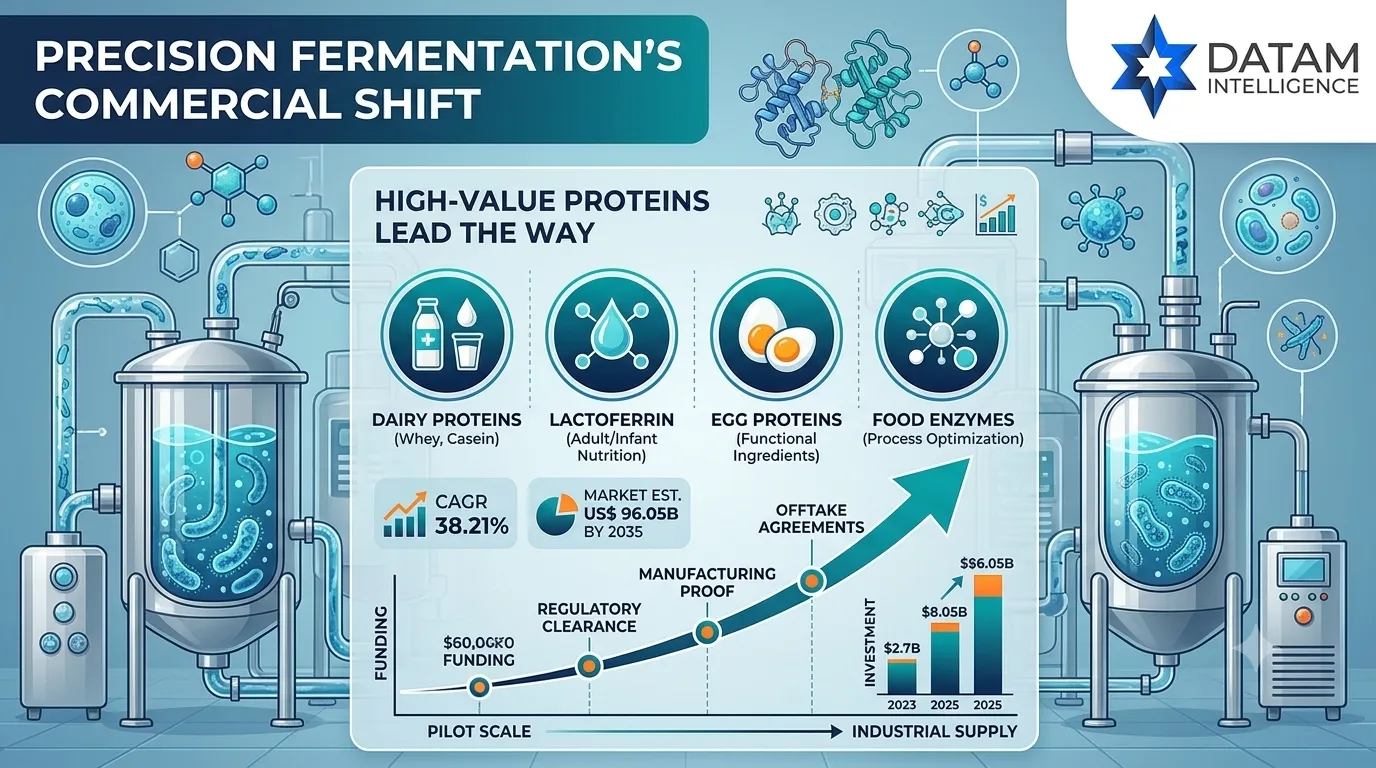
Commercial protein launches and new funding show where precision fermentation can move fastest across dairy proteins, lactoferrin, egg proteins and food enzymes.
Key 2026 Market Signals
| Signal | Why it matters |
| Precision fermentation market growth | DataM Intelligence estimates the market at US$ 6.54 billion in 2025 and US$ 87.05 billion by 2033 with a CAGR of 38.21 percent. |
| Funding returns to scale oriented models | Sector investment increased from US$ 151 million in 2023 to US$ 321 million in 2024 to $414 million in 2025 according to DataM Intelligence, while All G and StrainX raised fresh capital for commercial protein scale up. |
| Commercial protein focus narrows | The strongest early opportunity is shifting toward high value ingredients where performance, scarcity and consistency can justify premium pricing. |
| Manufacturing becomes the adoption test | Buyers are evaluating unit cost, capacity, purification and regulatory readiness before signing broader supply agreements. |
Commercial launches are changing the precision fermentation story
Precision fermentation is moving into a more practical phase. The first wave of the market was defined by scientific possibility, investor enthusiasm and a broad promise that microbes could produce animal proteins, specialty ingredients and functional compounds with fewer agricultural inputs. The current phase is more selective. Food companies, ingredient buyers and investors want to know which proteins can reach the market first, which applications can carry premium pricing and which companies can move from pilot scale into dependable industrial supply.
That shift is visible in the latest funding and commercialization signals. DataM Intelligence estimates that the global Precision Fermentation Market reached US$ 6.54 billion in 2025 and could reach US$ 96.05 billion by 2035, supported by a CAGR of 38.21% during 2026 to 2035. The same report notes that sector investment recovered from US$ 151 million in 2023 to US$ 321 million in 2024 to $414 million in 2025, suggesting capital is returning to companies that can show regulatory progress, manufacturing capability and a clear business to business ingredient model.
Request the full DataM Intelligence Precision Fermentation Market Sample Report to explore detailed market insights, industry trends and growth opportunities
All G shows why high value proteins are leading commercialization
The new All G funding round is important because it shows where precision fermentation can create value before commodity protein economics are solved. The Australian reported that Sydney based All G raised more than US$ 10 million in a convertible note round, bringing total funding to about US$ 50 million. The company is developing recombinant human proteins for infant nutrition and plans to launch recombinant bovine lactoferrin in 2026 for adult nutrition markets, with a longer pathway for human milk proteins in infant formula.
Lactoferrin is a useful example because it is scarce, functional and expensive under traditional production. The protein is usually extracted from cow milk at low yields, which restricts supply and keeps pricing high. Precision fermentation can potentially deliver a more consistent supply profile by programming microorganisms to produce targeted proteins in industrial bioreactors. That makes lactoferrin a more attractive early market than bulk proteins where price pressure is far more intense.
The All G case also highlights the difference between technical proof and commercial permission. Adult nutrition pathways can move faster when a protein has a clear safety dossier, while infant formula requires deeper regulatory review and stronger clinical confidence. This creates a staged commercialization pathway where companies first pursue adult nutrition, sports nutrition or foodservice applications before entering more sensitive categories.
Funding is moving toward scale, offtake and manufacturing proof
The broader funding environment has become more disciplined. Investors are less willing to fund broad platform claims unless companies can show a path to capacity, customer demand and regulatory clearance. This is why new capital is being directed toward companies that can demonstrate fermentation at meaningful scale or secure partnerships with established ingredient buyers.
StrainX Bioworks offers another useful signal. The Economic Times reported in May 2026 that the precision fermentation and synthetic biology startup raised US$ 13 million. The company said it had already demonstrated 10,000 liter fermentation scale and was preparing to move toward 100,000 liter production capacity. It also said it was in discussions with 20 to 30 global food and beverage companies for potential supply partnerships.
These numbers matter because precision fermentation is no longer being judged by lab performance alone. Buyers want evidence that a supplier can repeat batches, meet food grade standards, control downstream purification costs and provide consistent material over time. The companies that can prove these capabilities are more likely to secure offtake agreements and strategic partnerships.
Dairy proteins, lactoferrin, egg proteins and enzymes are the first battlegrounds
The strongest near term opportunities are appearing in ingredients where functionality matters more than bulk calories. Dairy proteins such as whey and casein can improve texture, nutrition and mouthfeel. Lactoferrin can support premium nutrition applications. Egg proteins can provide foaming, binding and emulsification. Food enzymes already fit industrial fermentation logic and serve bakery, dairy, beverage and processed food applications.
This is why the early commercial market is forming around business to business ingredients rather than mass consumer replacements. Food manufacturers can adopt a precision fermented ingredient inside an existing product format without asking consumers to completely change behavior. That lowers adoption friction and gives suppliers a clearer path to recurring demand.
The related dairy protein market also provides a demand signal. DataM Intelligence estimates that the Global Dairy Protein Market reached US$ 14.51 billion in 2025 and could reach US$ 30.13 billion by 2033. Precision fermentation companies do not need to replace conventional dairy protein volume to create a meaningful market. They can first target premium use cases where lactose free positioning, supply security, sustainability claims and consistent functionality create a stronger value proposition.
Download the DataM Intelligence Dairy Protein Market report to explore detailed market insights, emerging trends and growth opportunities shaping the future of dairy protein innovation.
The supply chain test is moving from microbes to industrial execution
The technical foundation of precision fermentation is improving quickly. Synthetic biology tools, strain engineering, bioinformatics and process optimization are helping companies improve yield and reduce development time. DataM Intelligence estimates that the Synthetic Biology Market reached US$ 14.96 billion in 2025 and could reach US$ 67.47 billion by 2033, with North America holding the largest revenue share in 2024.
However, the practical supply chain challenge remains difficult. Precision fermentation companies need reliable feedstocks, bioreactor access, sterile operations, recovery systems and purification infrastructure. They also need quality systems that can satisfy food, nutrition and regulatory buyers. This is why manufacturing partnerships are becoming as important as strain design.
The industry is also moving toward more standardized data and process language. A 2026 research paper introduced PREFER, an ontology designed to standardize precision fermentation data across high throughput bioprocess development. That kind of standardization matters because future scale up will depend on machine readable process data, comparable performance metrics and better learning across fermentation platforms.
Request the full Synthetic Biology Market report from DataM Intelligence and gain access to detailed analysis, market forecasts and industry insights.
Why food enzymes and plant proteins remain part of the same market reset
Precision fermentation is developing alongside existing protein and ingredient categories rather than in isolation. Food enzymes show how fermentation based ingredients can scale when they deliver clear process value. DataM Intelligence estimates that the global Food Enzymes Market reached US$ 1.8 billion in 2022 and could reach US$ 3.2 billion by 2031. The report also notes that enzymes can be produced through microbial fermentation and used across bakery, dairy, beverages and processed foods.
Plant proteins remain another important reference point because they offer scale and cost advantages, while precision fermented proteins offer functionality and molecular specificity. DataM Intelligence estimates that the Plant Protein Market reached US$ 22.20 billion in 2025 and could reach US$ 45.30 billion by 2033. The future protein system is likely to use both categories, with plant proteins providing broad nutrition and precision fermentation providing targeted functionality.
This creates a hybrid ingredient future. A protein beverage, cheese alternative or nutrition product may use plant protein for volume and precision fermented whey, casein or lactoferrin for taste, texture and nutritional differentiation. That is where many early commercial launches are likely to concentrate.
Download the DataM Intelligence Food Enzymes Market report to explore detailed market insights, emerging trends and growth opportunities shaping the future of food enzyme applications.
Where the precision fermentation market is headed
The next phase of the precision fermentation market will be shaped by a smaller number of more serious commercial tests. The first test is whether companies can reduce unit costs without sacrificing purity, safety or performance. The second test is whether they can secure enough fermentation capacity to support customer launches beyond niche volumes. The third test is whether regulators and retailers can become comfortable with ingredient claims. The fourth test is whether food brands can translate technical functionality into consumer value.
The companies most likely to benefit will be those that treat precision fermentation as an ingredient supply chain rather than a standalone food trend. That means building around manufacturable proteins, regulatory readiness, customer formulation support and long term supply agreements. The market will reward companies that can deliver repeatable ingredients into existing food categories before trying to transform entire consumer habits.
Commercial protein launches and new funding are therefore pointing to a more focused industry. Precision fermentation is entering a phase where investor excitement is being replaced by operating discipline. The opportunity remains large, but the winners will be the companies that can turn microbial design into dependable commercial supply.