


Per- and polyfluoroalkyl substances have changed the operating environment for laboratories, manufacturers and environmental service providers. What began as a specialist contaminant-testing requirement has developed into a wider commercial issue involving water compliance, product claims, environmental liability, waste management and supply-chain qualification. The PFAS testing market is therefore no longer defined only by the number of samples a laboratory can process. It is increasingly defined by whether a provider can identify difficult compounds, work across complex sample matrices and produce results that remain credible when regulations, claims or remediation decisions are challenged.
The market is becoming more segmented. A utility monitoring drinking water does not need the same service as a consumer brand screening cookware or a consultant investigating an industrial site. The strongest providers connect laboratory results to a practical compliance or commercial decision.
Request Sample: https://www.datamintelligence.com/download-sample/pfas-testing-market
Why Routine PFAS Panels Are No Longer Enough
Traditional PFAS testing commonly focuses on a defined list of target compounds in water, soil or wastewater. This approach remains essential, especially where a specific method or regulated analyte list applies. However, target panels do not always answer the question a customer is trying to solve. They can miss compounds that are outside the method list, degradation products created during treatment, or short-chain substances that move readily through water systems.
The market is consequently moving towards layered analytical strategies. A routine targeted method may establish whether a known regulated compound is present. Total-fluorine screening can help prioritise products or materials that need closer analysis. High-resolution mass spectrometry can support source investigation, suspect screening and the identification of previously uncharacterised signals. Air and stack-emissions methods are also becoming more important as customers examine whether PFAS treatment or thermal-destruction processes are transferring fluorinated substances into another environmental pathway.
For buyers, this means laboratory selection must be based on the decision they need to make, not simply the quoted price for a standard panel. The right provider should understand the matrix, expected contaminant profile, reporting limits, chain-of-custody requirements and the level of data defensibility required for the project.
The Companies Shaping the PFAS Testing Market
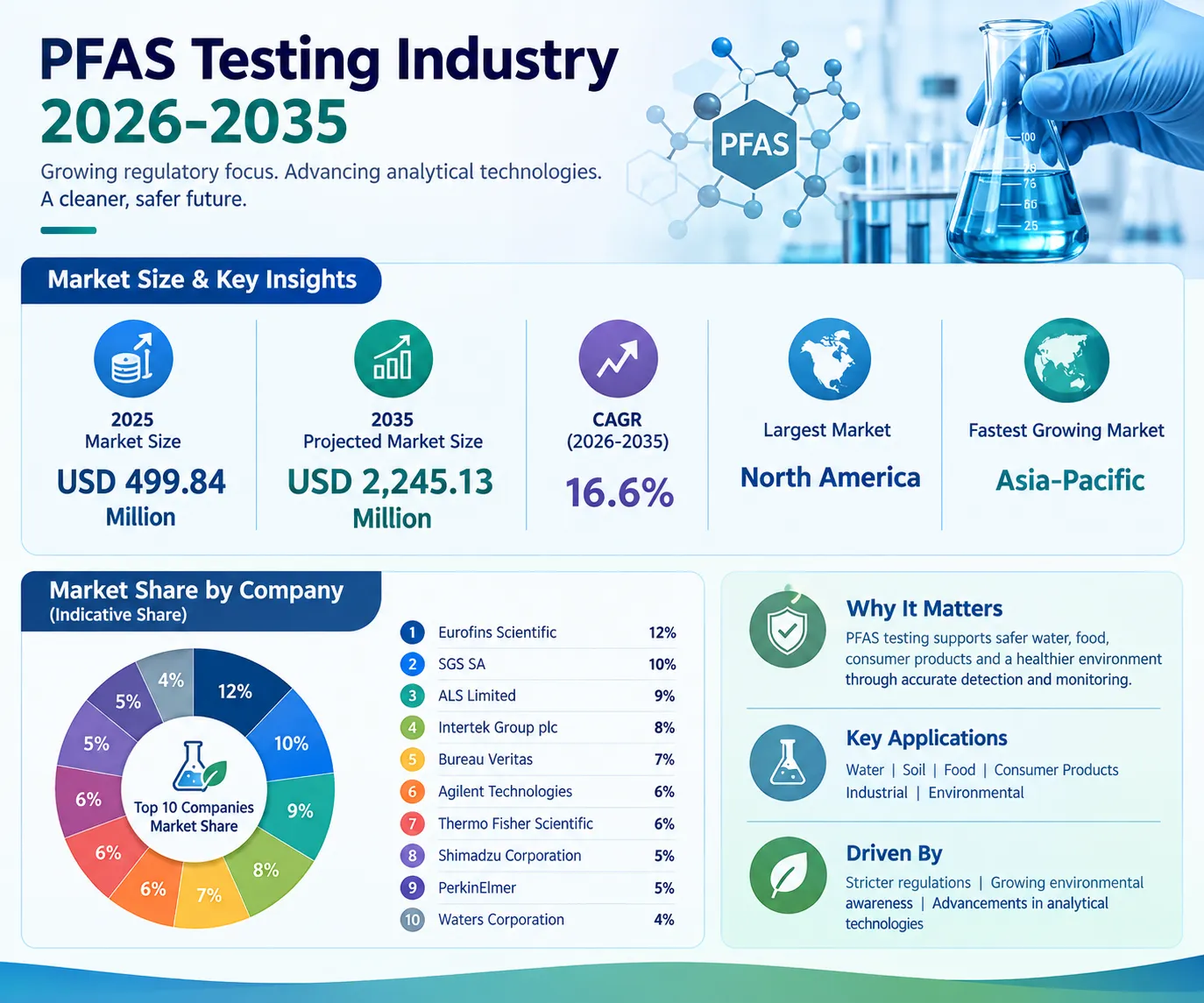
The PFAS testing competitive landscape includes multinational testing, inspection and certification groups, specialised environmental laboratory networks and regional providers with strong local sample logistics. Eurofins Scientific remains a significant participant because of its extensive environmental-testing infrastructure and its focus on targeted, forensic and non-targeted PFAS work. Its commercial relevance lies in helping customers move from a compliance result toward a more detailed understanding of contamination patterns and potential sources.
SGS is another major competitor, with a strong position in environmental testing and a growing emphasis on advanced PFAS characterisation. Its high-resolution mass-spectrometry services reflect demand from customers that need more than a simple detected or not-detected outcome. Intertek brings a different strength to the market through product testing and certification. Its position is particularly relevant for brands seeking to validate PFAS-free claims across consumer and industrial products.
ALS has global environmental-testing coverage and a broad analytical portfolio spanning water, soil, sediment, air and industrial applications. Its expansion into volatile PFAS air analysis shows how the market is extending beyond conventional liquid and solid matrices. Bureau Veritas is similarly relevant in consumer-product compliance, where faster screening and technical support are increasingly important as brands manage restricted-substances risks.
Pace Analytical Services has a strong U.S. environmental laboratory presence and is increasingly visible in emerging-method development. Element Materials Technology serves environmental and industrial testing requirements, including water and emissions-related PFAS work. Enthalpy Analytical adds specialist environmental laboratory capability, particularly for consultants and remediation programmes. AGAT Laboratories and EMSL Analytical complete the competitive picture with regional laboratory coverage and services for environmental, product and building-material applications.
These companies do not compete on a single measure. Global networks suit multi-site programmes and standardised reporting, while specialist laboratories can be attractive for difficult matrices, urgent turnaround or local regulatory support.
Pace Extends the Conversation to Ultrashort-Chain PFAS
One of the most meaningful recent developments came from Pace Analytical Services, which introduced a method for ultrashort-chain PFAS in aqueous samples. These compounds are often highly mobile and can be relevant to drinking-water and groundwater assessments, yet they are not necessarily included in established target-method lists.
As customers recognise the limits of standard panels, they will seek laboratories that can explain what has and has not been captured by a test. Ultrashort-chain capability is especially relevant for utilities, consultants and treatment-technology companies.
SGS Raises the Value of PFAS Forensics
SGS has expanded its high-resolution mass-spectrometry services for PFAS forensics, suspect screening and non-targeted discovery. This development addresses a key market challenge: many contamination investigations cannot be resolved by measuring only a limited set of familiar compounds.
Forensic PFAS work can help customers distinguish potential sources, investigate historical contamination and assess whether remediation is changing a site’s chemical profile. In liability, site-acquisition, insurance or litigation work, broader chemical intelligence can materially reduce uncertainty.
ALS Brings PFAS Analysis Into the Air-Emissions Debate
ALS has introduced volatile PFAS testing in air using a method designed for stationary-source monitoring. This reflects a broader change in how PFAS risk is being assessed. Customers are no longer looking only at water, soil and waste. They are also examining whether manufacturing, incineration or treatment processes may release volatile fluorinated compounds through stack emissions.
Destruction efficiency cannot be judged only by what disappears from the original material. The full assessment must consider whether fluorinated intermediates remain and where they move next.
Bureau Veritas Uses Total Fluorine to Improve Screening Economics
Bureau Veritas has added total-fluorine screening capability at its Buffalo laboratory, creating a quicker route for consumer-product businesses to identify materials that may warrant further PFAS investigation. This matters because detailed compound-by-compound testing can be costly when companies are managing large product portfolios, multiple suppliers or frequent material changes.
Total-fluorine screening does not replace targeted analysis when a regulation or customer specification requires compound-specific results. Its value lies in triage. A brand can use screening to identify products, components or incoming materials with a higher likelihood of fluorinated chemistry, then direct more detailed testing where the risk is greatest. This approach supports faster supplier qualification and can reduce unnecessary analytical spend.
Intertek Turns PFAS Testing Into a Certification Proposition
Intertek’s PFAS-Free Certification Program illustrates how the market is expanding from laboratory analysis into third-party product assurance. The programme combines testing with documentation and quality-system review to support a more defensible PFAS-free claim.
This is commercially relevant for consumer brands facing retailer requirements, investor scrutiny and more informed buyers. Testing alone can describe a sample at a specific point in time. Certification adds a continuing assurance framework around material control, product consistency and supporting evidence. As more companies seek to differentiate products on chemical transparency, certification services may become a higher-value complement to routine PFAS analysis.
Eurofins Expands the Need for Broader Chemical Intelligence
Eurofins continues to emphasise non-targeted and forensic tools for PFAS projects. This reflects an important market reality: the total number of relevant fluorinated compounds is much larger than the analytes in most routine methods. For customers dealing with complex legacy sites, source attribution or treatment verification, a narrow target list can provide only part of the required answer.
The practical opportunity is for laboratories that can build a staged testing plan. Initial targeted results can establish compliance status, while broader screening and forensic work can be deployed where the data reveals uncertainty or commercial exposure. This more flexible approach gives customers better control of cost while retaining access to deeper analysis when the project requires it.
How Buyers Should Select a PFAS Testing Partner
The first question should be whether the laboratory supports the required matrix and method. Drinking water, wastewater, soil, biosolids, food contact materials, textiles and air emissions each present different sampling and analytical challenges. The second is whether the provider can achieve reporting limits that are appropriate for the relevant regulation, internal specification or risk assessment.
Buyers should also ask whether the laboratory can support emerging needs, including ultrashort-chain PFAS, total-fluorine screening, non-targeted analysis, high-resolution confirmation and emissions testing. Turnaround time matters, but it should be evaluated alongside capacity, quality controls and communication. A fast result has little value if it cannot be explained, defended or compared reliably across sites.
For multi-location programmes, sample logistics and consistent reporting are critical. For litigation-sensitive or remediation projects, a laboratory’s experience with documentation, data validation and expert support may be more valuable than the lowest unit price. Manufacturers should also assess whether a provider offers testing alone or can support certification, supplier verification and product-claim substantiation.
The Next Stage of the PFAS Testing Market
The PFAS testing market is moving toward broader chemical coverage and more decision-oriented services. Demand will continue to come from regulation, but the market’s most attractive opportunities will also arise from voluntary product claims, supply-chain controls, environmental due diligence and treatment-performance verification.
Laboratories that can combine reliable targeted testing with advanced screening, forensic insight and customer-specific interpretation will be best positioned to capture this demand. For customers, the goal is not simply to obtain a result. It is to obtain information that supports a safer product, a compliant facility, a defensible investment decision or an effective remediation plan.
DataM Intelligence helps organisations assess PFAS testing-market developments, compare supplier capabilities, identify high-potential service segments and evaluate competitive strategies across environmental and product-compliance applications.
Read Complete Research Report: https://www.datamintelligence.com/research-report/pfas-testing-market