


Introduction: Why Industrial Filtration Has Become a Strategic Manufacturing Priority
Industrial filtration trends in 2026 are being shaped by a major shift in how manufacturers view filtration systems. Industrial filtration is no longer limited to removing dust, particles, oil mist, fumes or suspended solids from production environments. It is becoming a business-critical system linked to plant uptime, worker safety, product quality, energy efficiency, water reuse, regulatory compliance and sustainability performance.
Across manufacturing sectors, filtration is moving from a passive maintenance function to a smart, connected and compliance-driven asset. Plants are investing in industrial air filtration, industrial water filtration, smart filtration systems, PFAS filtration, membrane filtration, nanofiber filters, industrial dust collection and advanced filtration technologies to improve operational reliability and reduce risk.
This shift is being accelerated by tighter environmental expectations, rising industrial water costs, pressure to reduce emissions, contamination-sensitive production, digital manufacturing and the need to lower lifecycle operating costs. EPA defines industrial effluent guidelines as national standards for wastewater discharges to surface waters and municipal treatment plants, based on treatment and control technologies. This makes industrial water filtration a core compliance requirement across many industrial categories.
For manufacturers, filtration is no longer only about buying replacement filters. The real question in 2026 is whether filtration systems can support cleaner production, reduce downtime, lower energy use and provide measurable performance data.
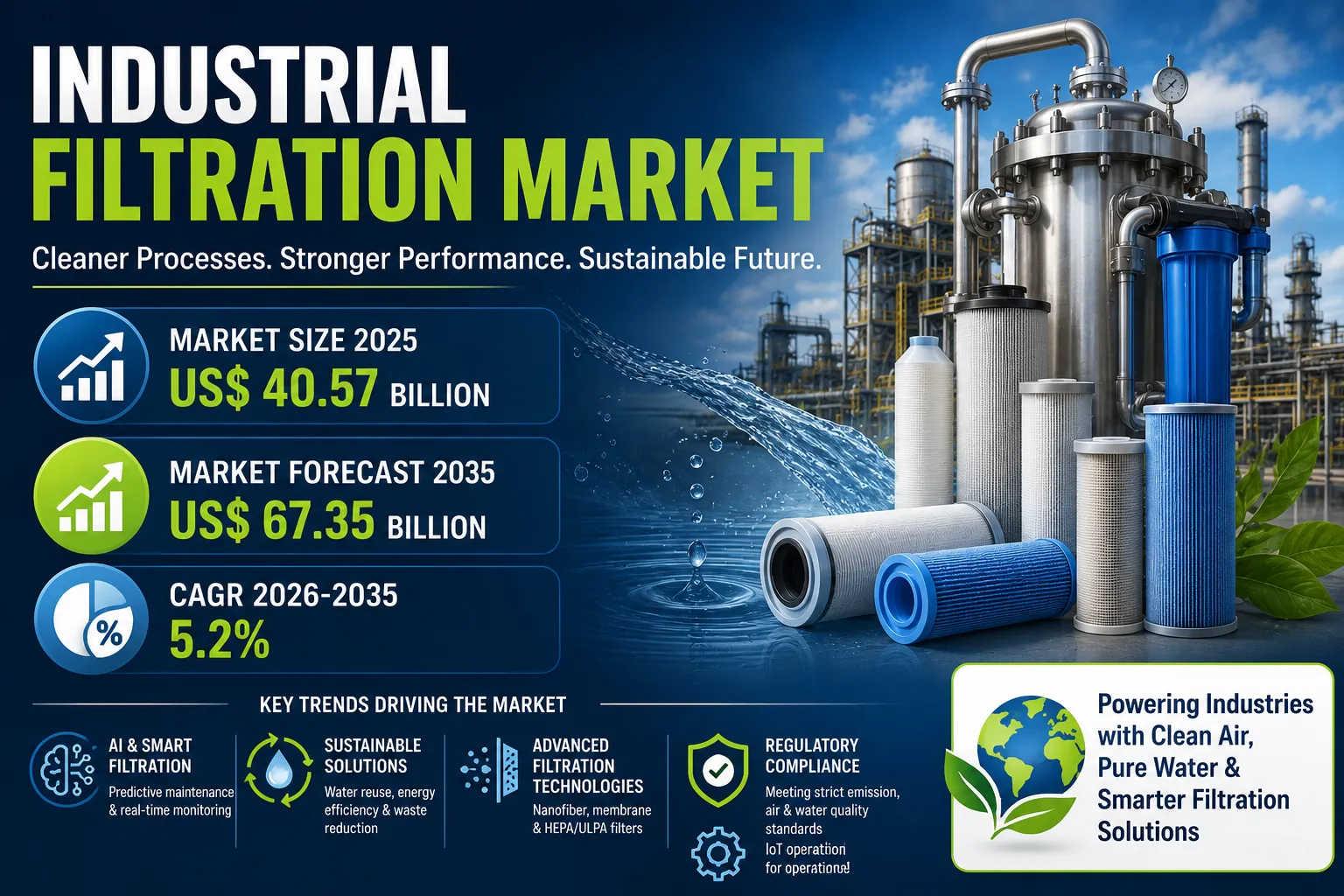
According to DataM Intellignece Research Report,"The global industrial filtration market was valued at US$ 40.57 billion in 2025 and is projected to reach US$ 67.35 billion by 2035, growing at a CAGR of 5.2% during the forecast period 2026–2035."
Request for Exclusive Sample on Industrial Filtration Market
Executive Summary: Key Industrial Filtration Trends in 2026
| Trend | Main Application | Manufacturing Impact |
| AI-powered filtration | Air and liquid filtration systems | Reduces downtime and improves filter replacement timing |
| Smart filters | Dust collectors, membrane systems and process filtration | Enables real-time monitoring and predictive maintenance |
| PFAS filtration | Industrial wastewater treatment | Supports compliance, source control and risk reduction |
| Sustainable filtration | Air, water and process filtration | Reduces waste, energy use and lifecycle cost |
| Nanofiber filters | Industrial air filtration and cleanrooms | Improves particle capture with lower pressure drop |
| Membrane filtration | Wastewater reuse and process water treatment | Improves water recovery and contaminant removal |
| HEPA and ULPA filtration | Pharma, semiconductor and battery plants | Supports contamination control and clean manufacturing |
| Gas-phase filtration | Chemical and industrial facilities | Controls VOCs, odors and corrosive gases |
Request for Exclusive Sample on Industrial Filtration Market
1. AI-Powered Industrial Filtration Is Moving From Concept to Plant-Level Adoption
AI in industrial filtration is one of the most important technology shifts for 2026. Traditional filtration maintenance is often reactive. Filters are replaced after pressure drop becomes too high, after throughput declines, or after a quality issue appears. In some facilities, filters are replaced too early to avoid risk, which increases material cost and waste. In others, filters are replaced too late, which increases energy consumption, contamination risk, and equipment stress.
AI-powered filtration changes this model by using real-time operating data to predict filter performance and maintenance needs. Sensors can track pressure drop, airflow, flow rate, particle load, temperature, humidity, vibration, and membrane fouling patterns. AI models can then identify abnormal behavior and recommend maintenance before the system causes downtime or quality issues.
How AI Is Being Used in Industrial Filtration
AI-based filtration systems can support:
- Filter life prediction
- Pressure drop analysis
- Predictive filter replacement
- Fouling detection in membrane systems
- Automated maintenance alerts
- Energy optimization
- Digital twins for filtration performance
- Failure pattern detection across multiple production lines
The strongest adoption is expected in industries where downtime or contamination is expensive. Semiconductor fabs, pharmaceutical plants, food processing facilities, chemical plants, battery manufacturing sites, and advanced electronics factories are more likely to invest in AI-based filtration because filtration failure can directly affect yield, safety, and compliance.
The business case is straightforward. If AI can help a plant avoid unplanned shutdowns, reduce unnecessary filter replacement, and lower energy demand, filtration becomes a measurable productivity tool instead of a hidden maintenance cost.
2. Smart Filters and IoT Sensors Are Creating Real-Time Filtration Visibility
Smart filtration systems are becoming more important because many facilities still lack real-time visibility into filter health. Operators may know when a system fails, but they may not always know when performance is slowly declining. This is where Industrial IoT is changing filtration management.
Smart filters and sensor-enabled filtration systems can monitor differential pressure, airflow, liquid flow, particle count, filter loading, temperature, humidity, and system performance. This data can be displayed through remote dashboards, connected to maintenance systems, or used to trigger automated alerts.
A smart air filtration system can notify operators when pressure drop rises above normal levels. A membrane filtration system can alert maintenance teams before fouling reduces throughput. A dust collection system can track airflow changes and help support safer plant operation.
Why Smart Filtration Matters
Smart filtration helps manufacturers:
- Reduce unplanned downtime
- Avoid premature filter replacement
- Improve maintenance scheduling
- Lower fan and pump energy use
- Support compliance documentation
- Improve worker safety
- Extend equipment life
The value is especially high in large manufacturing plants with multiple production areas, air handlers, process lines, water systems, and dust collectors. In these environments, manual monitoring is inefficient and reactive. Smart filtration brings filtration into the same connected asset-management ecosystem as motors, compressors, pumps, boilers, and production equipment.
3. PFAS Removal Is Becoming a High-Priority Industrial Water Filtration Opportunity
PFAS filtration is becoming one of the most important industrial water filtration opportunities in 2026. PFAS, often called “forever chemicals,” are persistent compounds that can be difficult to remove from water and wastewater. Industrial sources can include chemicals, textiles, coatings, electronics, metal finishing, landfills, paper and packaging, firefighting foam-related sites and certain manufacturing processes.
EPA’s POTW Influent PFAS Study is designed to collect wastewater sampling data to identify and prioritize industrial point source categories where additional PFAS study or regulation may be needed. The study includes nationwide data collection related to PFAS discharges into publicly owned treatment works. EPA’s final effluent guidelines planning activity also highlights PFAS source verification and data collection on industrial PFAS discharges to municipal treatment systems.
This creates a clear market signal: industrial facilities will face increasing pressure to understand, monitor and control PFAS in wastewater streams.
Best PFAS Filtration Technologies for Industrial Wastewater
| Technology | Role in PFAS Treatment | Limitation |
| Activated carbon | Adsorbs many long-chain PFAS compounds | Requires media replacement and proper disposal |
| Ion exchange | Effective for selected PFAS compounds | Resin management and regeneration/disposal are required |
| Reverse osmosis | High rejection of dissolved contaminants | Produces concentrate stream requiring treatment |
| Nanofiltration | Useful for selective separation | Fouling risk and concentrate management |
| Hybrid systems | Combines adsorption and membrane treatment | Higher upfront design complexity |
Request for Exclusive Sample on Industrial Filtration Market
EPA identifies granular activated carbon, anion exchange, reverse osmosis and nanofiltration among best available technologies for meeting PFAS drinking water limits, while EPA research also recognizes granular activated carbon, ion exchange resins and high-pressure membrane systems as effective PFAS removal processes.
For industrial wastewater, the most practical approach is often not a single technology. Many facilities will require hybrid treatment systems that combine pre-filtration, adsorption, ion exchange, membrane separation and concentrate management.
4. Sustainable Filtration Is Becoming a Cost and Compliance Requirement
Sustainable filtration is becoming a serious purchasing factor in 2026. It is not only an environmental topic. It directly affects operating cost, waste generation, maintenance frequency, water recovery and energy consumption.
Industrial filtration systems influence fan energy, pump load, filter waste, wastewater discharge, sludge volume and replacement frequency. A low-cost filter that creates high pressure drop or requires frequent replacement may be more expensive over its lifecycle than a higher-performance system.
The European Union’s revised Industrial and Livestock Rearing Emissions Directive, known as IED 2.0, is designed to reduce emissions into air, water and land and prevent waste generation from large industrial installations and intensive livestock farms. This regulatory direction supports demand for cleaner, more efficient and lower-waste filtration systems.
Sustainable Filtration Trends
Manufacturers are increasingly looking for:
- Reusable filter media
- Washable and cleanable filters
- Long-life cartridges
- Lower-pressure-drop filter media
- Reduced filter disposal volume
- Water reuse systems
- Membrane-based recovery systems
- Energy-efficient air handling
- Circular filtration service models
Sustainable filtration is particularly important in sectors with high energy use, heavy dust loads, large wastewater volumes or strict environmental reporting requirements. Cement, chemicals, metals, mining, pharmaceuticals, food processing, textiles and battery manufacturing are likely to see stronger adoption.
5. Advanced Industrial Air Filtration Is Gaining Importance in High-Risk Manufacturing
Industrial air filtration demand is increasing as manufacturers look to control particulate matter, protect workers, reduce emissions and support cleaner production environments. In high-value manufacturing sectors such as semiconductors, batteries and pharmaceuticals, air filtration also protects product yield and process reliability.
Industrial air filtration includes dust collection, fume extraction, mist collection, HEPA filtration, ULPA filtration, gas-phase filtration, VOC control, cleanroom filtration and emissions-control systems.
Industries Driving Advanced Industrial Air Filtration
Advanced air filtration demand is rising across:
- Cement plants
- Steel and metals production
- Chemical manufacturing
- Pharmaceutical manufacturing
- Food processing
- Battery manufacturing
- Semiconductor fabs
- Automotive plants
- Welding and metalworking facilities
Industrial dust collection is especially important for safety. OSHA guidance highlights combustible dust hazards, and its combustible dust emphasis material notes that dust generated from manufacturing and processing activities can create fire and explosion risks across industries such as food, wood, agricultural and metal products.
This means industrial air filtration is not only about environmental compliance. In many plants, it is directly connected to safety, insurance risk, facility protection and operational continuity.
6. Industrial Water Filtration Is Shifting Toward Reuse, Recycling and Zero-Liquid-Discharge Strategies
Industrial water filtration is becoming more important as water scarcity, discharge compliance, PFAS concerns and circular economy goals reshape plant operations. Many manufacturers are trying to reduce freshwater intake, recover process water and reduce wastewater discharge.
EPA states that effluent guidelines are national standards for industrial wastewater discharges to surface waters and municipal sewage treatment plants, and they are issued for industrial categories based on treatment and control technologies. This creates a strong compliance foundation for industrial water filtration investment.
Industrial Water Filtration Technologies Gaining Adoption
Important technologies include:
- Ultrafiltration
- Nanofiltration
- Reverse osmosis
- Membrane bioreactors
- Activated carbon
- Ion exchange
- Oil-water separation
- Cartridge filtration
- Sludge reduction systems
- Zero-liquid-discharge support systems
Water-intensive industries such as chemicals, food and beverage, textiles, mining, power generation, pharmaceuticals, semiconductors and battery manufacturing are likely to increase investment in industrial water filtration. The strongest opportunities will be in systems that combine water reuse, contaminant removal, lower operating cost and compliance reporting.
7. Nanofiber Filters Are Improving Filtration Efficiency With Lower Pressure Drop
Nanofiber filters are gaining attention because they can improve filtration efficiency while supporting lower pressure drop. In air filtration, pressure drop matters because it affects fan energy consumption. A filter that captures fine particles efficiently while allowing better airflow can help reduce energy costs and improve system performance.
Nanofiber media has a very fine fiber structure and high surface area. This helps capture smaller particles on the surface of the media rather than allowing particles to load deep inside the filter. The result can be better dust-loading capacity, longer service life and more stable performance.
Where Nanofiber Filters Are Used
Nanofiber filters are increasingly relevant for:
- Industrial air filtration
- HVAC systems
- Cleanroom Technology
- Pharmaceutical manufacturing
- Automotive plants
- Dust collection
- Food processing
- Battery manufacturing
- Electronics production
The main reason manufacturers are paying attention is simple: nanofiber filtration can support both efficiency and cost control. For plants trying to reduce energy consumption without weakening filtration performance, nanofiber media can be an attractive upgrade.
8. Cleanroom and High-Purity Filtration Demand Is Rising From Semiconductors, Batteries and Pharmaceuticals
Cleanroom and high-purity filtration are among the most valuable niches in the industrial filtration industry. Semiconductor fabs, EV battery plants, biologics facilities, medical device manufacturers, solar cell producers and advanced electronics companies require strict contamination control.
In these facilities, filtration failure can reduce yield, compromise quality or trigger compliance issues. That makes HEPA filtration, ULPA filtration, high-purity liquid filtration, microfiltration, cleanroom HVAC filtration and gas-phase filtration essential.
ISO 14644-1 classifies cleanrooms and associated controlled environments by air cleanliness based on particle concentration, and ISO notes that cleanrooms control contamination of air and, where appropriate, surfaces for contamination-sensitive activities. FDA guidance for sterile drug products produced by aseptic processing is intended to help manufacturers meet current good manufacturing practice requirements under 21 CFR Parts 210 and 211.
High-Growth Clean Filtration Applications
| Industry | Filtration Need |
| Semiconductors | Cleanroom air, ultrapure water and chemical filtration |
| Battery manufacturing | Dry room filtration, solvent recovery, slurry filtration and wastewater treatment |
| Pharmaceuticals | Sterile air, process filtration and cleanroom compliance |
| Medical devices | Controlled environment filtration and contamination prevention |
| Advanced electronics | Particle control and chemical filtration |
| Solar manufacturing | Clean production environments and process water filtration |
Request for Exclusive Sample on Industrial Filtration Market
Cleanroom filtration is expected to remain a premium segment because buyers focus on reliability, certification, validation and performance consistency rather than only upfront price.
9. Energy-Efficient Filtration Is Becoming a Direct Operating Cost Strategy
Many industrial facilities still purchase filters based mainly on upfront cost. In 2026, that approach is becoming outdated. The total cost of filtration includes energy use, filter life, replacement labor, downtime, waste disposal, production risk and compliance exposure.
Low-pressure-drop media, optimized airflow, efficient pump operation and smarter filter replacement can reduce operating costs. In air filtration, lower resistance can reduce fan energy. In water filtration, better membrane cleaning and fouling control can reduce pumping energy and chemical consumption.
What Manufacturers Should Evaluate
When selecting filtration systems, facilities should look at:
- Pressure drop over time
- Energy consumption
- Filter replacement frequency
- Labor requirements
- Downtime risk
- Disposal cost
- Water recovery rate
- Maintenance predictability
- Compliance documentation
- Total lifecycle cost
Energy-efficient filtration is especially valuable in large plants where air handlers, dust collectors, pumps and membrane systems operate continuously. In these environments, even small efficiency gains can create meaningful cost savings.
10. Filtration Suppliers Are Moving Toward System-Level Solutions
The industrial filtration market is shifting from standalone filter sales to system-level solutions. Buyers increasingly want suppliers that can provide hardware, filter media, sensors, software, maintenance support, replacement programs, compliance documentation and industry-specific engineering.
This shift is changing the competitive landscape. A company that only sells filter cartridges may struggle to compete with suppliers offering integrated filtration systems, connected monitoring and performance-based service contracts.
What System-Level Filtration Solutions Include
System-level solutions can include:
- Turnkey filtration systems
- Custom-engineered filtration units
- Aftermarket filter replacement programs
- Remote monitoring software
- Preventive maintenance contracts
- Compliance reporting support
- Energy-efficiency assessments
- Industry-specific system design
This trend is important because industrial customers are not only buying filters. They are buying uptime, compliance, lower lifecycle cost and operational confidence.
Which Manufacturing Industries Will Adopt Advanced Filtration Faster in 2026?
| Industry | Filtration Need |
| Semiconductors | Cleanroom air, ultrapure water and chemical filtration |
| Battery manufacturing | Dry room filtration, solvent recovery, slurry filtration and wastewater treatment |
| Pharmaceuticals | Sterile air, process filtration and cleanroom compliance |
| Food and beverage | Hygiene, liquid clarification and product safety |
| Chemicals | Gas-phase filtration, PFAS treatment and emission control |
| Cement and metals | Dust collection, high-temperature filtration and worker safety |
| Automotive | Paint booth filtration, coolant filtration and air quality control |
| Water-intensive manufacturing | Wastewater reuse, membrane filtration and discharge compliance |
Request for Exclusive Sample on Industrial Filtration Market
The fastest adoption will come from industries where filtration failure is expensive. This includes sectors where contamination can destroy product value, where downtime affects production targets or where discharge and emissions rules create compliance exposure.
Business Impact: Why These Industrial Filtration Trends Matter
The biggest change in 2026 is that filtration is becoming measurable. Smart systems, AI models and sensor-based monitoring are giving manufacturers better visibility into filter performance, energy use and maintenance needs.
This creates several business benefits:
- Lower unplanned downtime
- Better compliance readiness
- Reduced filter waste
- Improved product quality
- Safer production environments
- Lower energy cost
- Longer equipment life
- Better water reuse
- Improved sustainability performance
For suppliers, this creates new opportunities in advanced filtration technologies, digital services, predictive maintenance platforms, PFAS treatment, cleanroom filtration and industry-specific filtration systems.
For manufacturers, the message is clear: filtration strategy should not be treated as a low-level maintenance decision. It should be part of plant productivity, compliance and sustainability planning.
Conclusion: Industrial Filtration Trends Are Redefining Manufacturing Performance in 2026
The most important industrial filtration trends in 2026 show that the market is moving toward smarter, cleaner and more performance-driven systems. AI-powered filtration, smart filters, PFAS removal, sustainable filtration, membrane filtration, nanofiber filters, HEPA and ULPA filtration, and advanced industrial air and water filtration technologies are becoming central to modern manufacturing.
The industrial filtration industry is no longer defined only by replacement filters. It is being shaped by digital monitoring, regulatory pressure, water reuse, clean manufacturing, energy efficiency and total lifecycle value.
Plants that adopt advanced filtration systems can improve uptime, reduce compliance risk, lower operating cost and support cleaner production. Suppliers that combine filtration hardware with sensors, software, service and application expertise will be best positioned for the next phase of market growth.
In 2026, industrial filtration is not just a support system. It is becoming a strategic manufacturing advantage.
Read Complete Research Report on Industrial Filtration Market
Frequently Asked Questions
What are the top industrial filtration trends in 2026?
The top industrial filtration trends in 2026 include AI-powered filtration, smart filter monitoring, PFAS removal, sustainable filtration, membrane filtration, nanofiber filter media, cleanroom filtration, industrial dust collection, HEPA and ULPA filtration, and advanced industrial air and water filtration technologies.
How is AI used in industrial filtration?
AI is used in industrial filtration for predictive maintenance, pressure-drop monitoring, filter life prediction, fouling detection, airflow optimization, energy management and automated maintenance alerts. It helps operators replace filters based on real operating conditions rather than fixed schedules.
Why is PFAS filtration important for industrial wastewater?
PFAS filtration is important because PFAS chemicals are persistent contaminants that can remain in water systems for long periods. Industrial facilities are facing growing pressure to identify, monitor and control PFAS discharge, especially in sectors such as chemicals, textiles, coatings, electronics, landfills and metal finishing.
What is smart industrial filtration?
Smart industrial filtration refers to sensor-enabled filtration systems that monitor airflow, pressure, particle levels, liquid flow, temperature, filter condition and system performance in real time. These systems help facilities improve maintenance planning, reduce downtime and optimize filtration performance.
Which industries need advanced industrial filtration?
Industries that need advanced industrial filtration include semiconductors, pharmaceuticals, battery manufacturing, chemicals, food and beverage, metals, cement, automotive, electronics, medical devices, mining, power generation and water-intensive manufacturing.
What are the most important industrial water filtration technologies?
The most important industrial water filtration technologies include reverse osmosis, ultrafiltration, nanofiltration, activated carbon, ion exchange, membrane bioreactors, cartridge filtration, oil-water separation and zero-liquid-discharge support systems.
What are the most important industrial air filtration technologies?
Important industrial air filtration technologies include dust collectors, cartridge filters, baghouse filters, HEPA filters, ULPA filters, electrostatic precipitators, mist collectors, fume extraction systems and gas-phase filtration.
How does sustainable filtration reduce operating cost?
Sustainable filtration reduces operating cost through lower energy use, longer filter life, reduced waste disposal, improved water reuse, fewer unplanned shutdowns and lower maintenance frequency. It also helps facilities support compliance and sustainability targets without sacrificing production reliability.
Read Complete Research Report on Industrial Filtration Market