


Zero Liquid Discharge Systems Market Size & Share
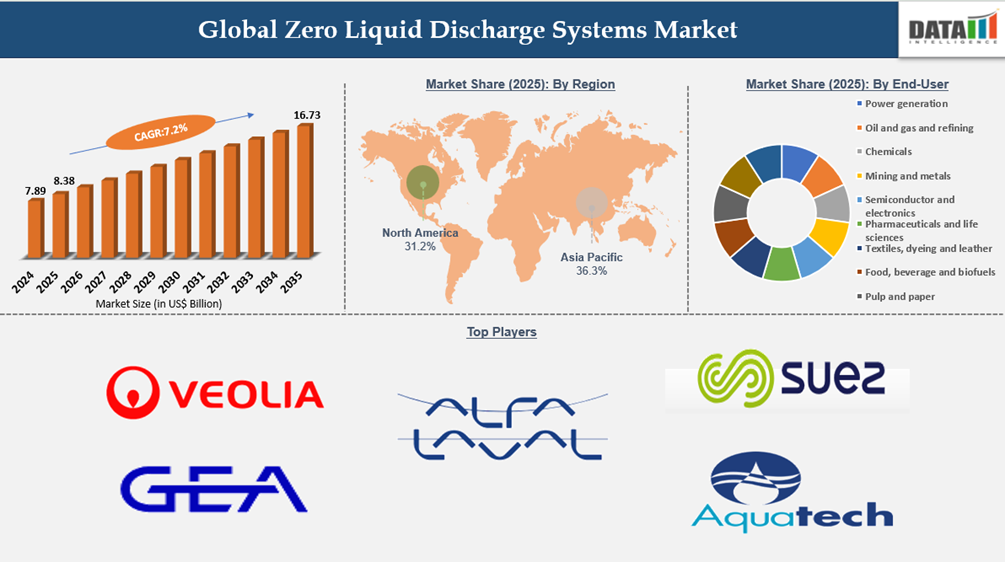
The global zero liquid discharge systems market reached US$ 8.38 billion in 2025 and is expected to reach US$ 16.73 billion by 2035, growing with a CAGR of 7.2% during the forecast period 2026-2035, supported by increasing industrial water reuse initiatives, stringent environmental regulations, and rising investments in sustainable wastewater management solutions.
The global zero liquid discharge systems market is getting bigger because companies must follow strict rules about the water they release. Zero liquid discharge systems are very important because they help get rid of waste by cleaning and reusing water from factories. It is crucial for industries like power generation, chemicals, textiles, pharmaceuticals and mining. The United Nations says that a lot of people around 2.3 billion do not have water. The world will need water, about 20 to 30 percent more, by the year 2050. It means we really need to find ways to reuse water and that is where zero liquid discharge systems come in. Governments are helping to make this happen by making rules to protect the environment and by telling factories they must reuse the water they waste.
For example, the Central Pollution Control Board in India says that certain industries, like textiles and tanneries must use Zero Liquid Discharge systems. The Ministry of Ecology and Environment of China also has strict rules, about the water that factories can release as part of its Water Ten Plan. Zero Liquid Discharge systems are becoming very important for companies to reduce their waste and save water.
Zero Liquid Discharge Systems Industry Trends and Strategic Insights
- The Asia-Pacific region is growing fast in the zero liquid discharge market. It is expected to get around 35 to 38% of the revenue made from this market around the world by 2027. China and India have strict rules about not releasing any bad things into the environment.
- By 2026, smart systems can automatically make things work around 85% of the time. The solutions are used to figure out how much of certain chemicals to add and when to change the temperature all in real time. It helps to use energy, around 15 to 25% less and it also helps to prevent problems, like scaling and unexpected shutdowns of the zero liquid discharge systems.
Global Zero Liquid Discharge Systems Market Size and Future Outlook
- 2025 Market Size: US$ 8.38 billion
- 2035 Projected Market Size: US$ 16.73 billion
- CAGR (2026-2035): 7.2%
- Largest Market: Asia-Pacific
- Fastest Market: North America
Key Takeaways
- The zero liquid discharge (ZLD) systems market is witnessing strong growth driven by stringent environmental regulations, rising water scarcity, and increasing industrial wastewater treatment requirements.
- Power generation, chemicals, textiles, pharmaceuticals, and oil & gas industries are the primary adopters of ZLD systems due to high-volume wastewater generation.
- Thermal-based ZLD systems continue to dominate the market owing to their ability to handle high-salinity and complex industrial effluents effectively.
- Hybrid ZLD systems are gaining traction as industries seek improved energy efficiency, cost optimization, and higher water recovery rates.
- Asia-Pacific leads the global market, supported by rapid industrialization, stricter environmental policies, and large-scale water infrastructure investments.
- Advancements in membrane filtration, evaporation, crystallization, and resource recovery technologies are improving system efficiency and reducing operational costs.
- Increasing focus on circular economy practices and industrial water reuse is accelerating ZLD adoption across both developed and emerging economies.
Analyst Viewpoint
The ZLD systems market is evolving from a compliance-driven wastewater treatment solution into a strategic water resource recovery technology. Industries are increasingly adopting ZLD not only to meet environmental regulations but also to reduce freshwater dependency and improve sustainability performance. Rising capital investments in industrial water treatment infrastructure, particularly in Asia-Pacific and the Middle East, are expected to drive long-term market expansion. However, high installation and operational costs remain a key challenge, pushing innovation toward energy-efficient hybrid systems and advanced membrane-based technologies. Companies focusing on cost reduction, process optimization, and integrated water recovery solutions are likely to gain a competitive advantage.
Zero Liquid Discharge Systems Market Scope
| Metrics | Details | |
| By System Architecture | Thermal Dominant ZLD Systems, Hybrid Membrane and Thermal ZLD Systems, Resource Recovery ZLD Systems, Packaged and Modular ZLD Systems | |
| By Process Stage | Pretreatment, Primary concentration and separation, Thermal concentration, Crystallization and solids handling, Polishing and reuse | |
| By Technology Platform | Thermal technologies, Membrane technologies, Enabling pretreatment and polishing technologies, Digital and automation technologies | |
| By Wastewater Source | Power and utility wastewater, Industrial brines and rejects, Sector specific process wastewater | |
| By Application | Compliance and discharge elimination, Water reuse and recycle, Resource recovery, Brine minimization and concentration | |
| By End-User | Power generation, Oil and gas and refining, Chemicals, Mining and metals, Semiconductor and electronics, Pharmaceuticals and Life Sciences, Textiles, dyeing and leather, Food, beverages and biofuels, Pulp and paper, Municipal and landfill leachate, Others | |
| By Plant Capacity | Less than 50 m3 per day, 50 to 250 m3 per day, 250 to 1,000 m3 per day, 1,000 to 5,000 m3 per day, above 5,000 m3 per day | |
| By Feedwater TDS | (Below 10,000 mg per L), (10,000 to 35,000 mg per L), (35,000 to 70,000 mg per L), (70,000 to 150,000 mg per L), (Above 150,000 mg per L) | |
| By Recovery Objective | Water Reuse with solids disposal, Water and salt recovery, Water and metal and mineral recovery, Water and chemical recovery, Water and solvent recovery | |
| By Contract and Delivery Model | EPC and turnkey, Design build, BOO and BOOT, Lease and Rental, O and M contracts, Retrofit and brownfield, Greenfield | |
| By Offering | Full Turnkey ZLD plants, Packaged modules, Standalone evaporators, Standalone crystallizers, Pretreatment skids, Automation and digital layer, Aftermarket parts and consumables, O and M and service support | |
| By Region | North America | U.S., Canada, Mexico |
| Europe | Germany, UK, France, Spain, Italy, Norway, Netherlands, Poland, Ukraine | |
| Asia-Pacific | China, India, Japan, Australia, South Korea, Indonesia, Malaysia | |
| Latin America | Brazil, Argentina | |
| Middle East and Africa | UAE, Saudi Arabia, South Africa, Israel, Egypt, Türkiye | |
| Report Insights Covered | Competitive Landscape Analysis, Company Profile Analysis, Market Size, Market Share, Market Growth | |
Zero Liquid Discharge Systems Market Dynamics
Rising Industrial Water Scarcity and Regulatory Enforcement
The gap between how much water is needed and how much it is getting bigger. This is a reason why more and more industries are using zero liquid discharge systems. They want to use water and stop releasing wastewater. According to UNESCO, they use 19% of the world's freshwater. The number is expected to go up in countries that are growing fast. Some industries, like textiles and chemicals, use a lot of water. ZLD systems can help them reuse 95 to 99% of their wastewater. It means they don't need to use much freshwater. In India, many textile factories in Tamil Nadu are using ZLD. They recycle millions of liters of water every day. China is also investing in ZLD plants. This is because they want to follow their country's rules about releasing wastewater. The projects are getting money from both government and private investors. Water recycling is becoming very important for industries.
High Capital and Energy Intensity Challenges
ZLD systems have a lot of support from regulators. The big issue is that they cost a lot of money to set up and run, especially when it comes to energy. It is because they use things like evaporation and crystallization, which need a lot of energy. The International Finance Corporation says that systems like ZLD that treat wastewater need a lot of money upfront and use a lot of energy. It makes it hard for medium-sized businesses to use them. The amount of energy that ZLD systems use is a problem, especially in places where electricity is expensive. Systems that use heat, like ZLD, can use a lot of power. It is really important to find ways to make them cost less and to use energy sources if they are going to work in the long term. A lot of industries are now looking at using ZLD systems that combine technologies, like membranes and heat, to make them work better and cost less to run.
Zero Liquid Discharge Systems Market Segmentation Analysis
The global zero liquid discharge systems market is segmented based on the system architecture, process stage, technology platform, wastewater source, application, end-user, plant capacity, feedwater TDS, recovery objective, contract and delivery model, offering and region.
Power Generation Segment Leads Adoption
The power generation sector is an area where ZLD systems are used. It is because power plants use a lot of water for cooling and making steam, which results in a lot of wastewaters. The U.S. Environmental Protection Agency says power plants are one of the polluters of water so there are strict rules about releasing wastewater. Utilities are using ZLD systems increasingly to clean up wastewater from flue gas desulfurization and other sources. In places like North America and Asia-Pacific many old power plants are being updated with ZLD systems to meet the rules. Investing in energy and technologies that save water is also helping this trend.
Textile and Chemical Industries Accelerate Adoption
The textile and chemical sectors are also contributors to zero liquid discharge demand because they cause a lot of pollution and use a lot of water. When we dye and finish textiles it makes water with dyes, salts and chemicals that need special treatment. The European Environment Agency says that making textiles uses a lot of water, which means we need to reuse water to make a system.
In countries like India, Bangladesh and China textile manufacturers are using zero liquid discharge to follow rules and stay competitive when they export goods. The chemical industry is also using Zero Liquid Discharge to manage waste and reduce problems with the environment, especially in places with strict rules. Zero liquid discharge is important for the textile and chemical sectors because it helps them deal with pollution and water issues.
Geographical Penetration
North America Focuses on Advanced and Sustainable Solutions
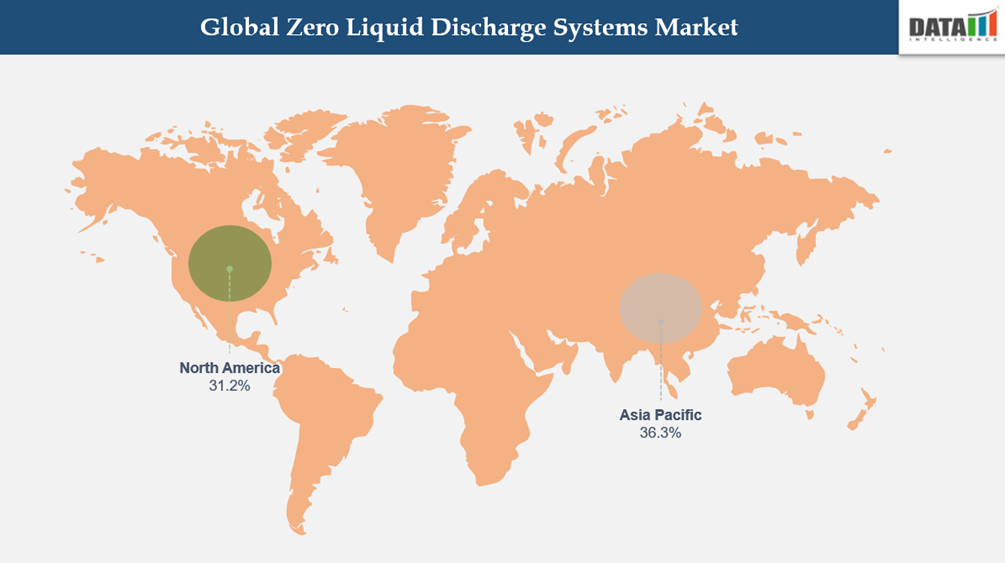
North America is a market with advanced technology and strict rules. The United States is focused on water use in industries. The U.S. Geological Survey says that industries in the U.S. still use a lot of water. It means there is a need for good treatment and reuse systems. Companies here are spending money on zero liquid discharge technologies. These include evaporation systems that don't use energy and digital monitoring tools. Research and development efforts and environmental regulations support this goal. Companies in North America are working on zero liquid discharge technologies. They want to make their water management systems more efficient. The United States is leading this effort with its focus on water management. North America will continue to drive innovation in water treatment.
Asia-Pacific Dominates Global Adoption
Asia-Pacific is leading the way in the Zero Liquid Discharge (ZLD) systems market. It is because the region is industrializing rapidly, facing water scarcity and has rules to protect the environment. Countries like China and India are taking the lead. They have manufacturing sectors and governments that are making rules to support ZLD systems. The Asian Development Bank says that Asia is home to more than 60% of the world’s population. The region does not have enough freshwater resources. It makes water recycling technologies very important. Chinas policies for industries focus on reusing wastewater and controlling pollution. India's rules require industries that have a big impact on the environment to use ZLD systems. Countries in Southeast Asia are also becoming markets for ZLD systems. This is because they are industrializing quickly and people are becoming more aware of issues.
Sustainability Analysis
ZLD systems are important for making industries more sustainable. Many industries reduce the amount of wastewater that gets thrown away and help industries circularly use water. This means that ZLD systems help cut down on pollution and assist industries in reaching their goals of using water in a more neutral way.
The United Nations Environment Programme says that if we can improve the way we manage wastewater, it could have some big benefits for the environment and the economy. It includes cutting down on pollution and making more water available. Companies are also putting money into research and development to come up with solutions that use energy and are more cost-effective, which is in line with the global goal of reducing carbon emissions and ZLD systems are a big part of that.
Competitive Landscape
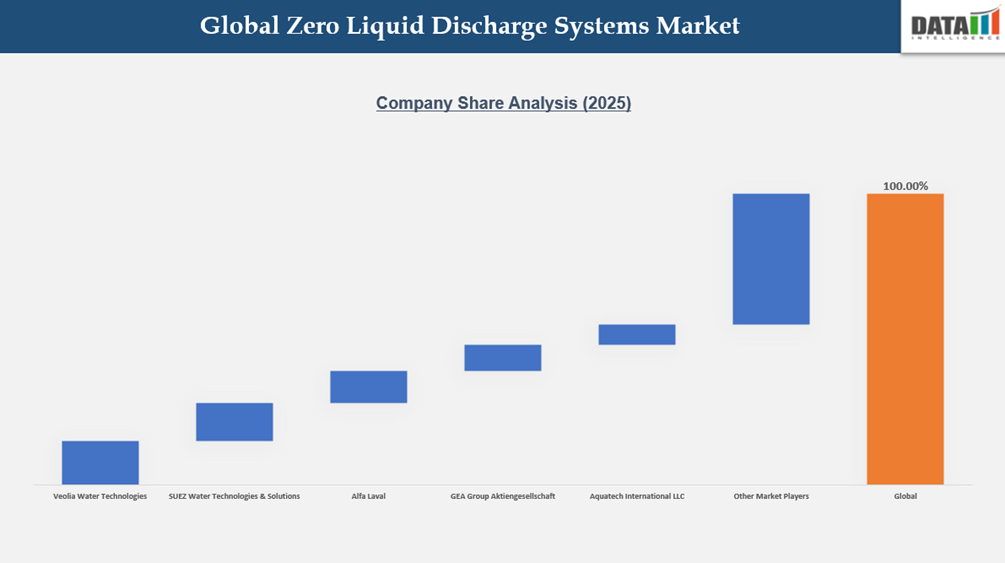
- The Zero Liquid Discharge systems market is competitive. It has a lot of companies, like engineering firms, water technology providers and environmental solution companies.
- The main companies in the zero liquid discharge systems market are working on membrane systems, thermal technologies and integrated water management solutions to get ahead.
- Companies in the zero liquid discharge systems market are trying to come up with technologies and show that they can execute projects well and offer services for the whole lifecycle of a project.
- Investing in water technologies and automation and energy-efficient systems is becoming very important for companies, in the zero liquid discharge systems market to stay competitive.
Key Players:
Veolia Water Technologies, SUEZ Water Technologies & Solutions, Alfa Laval, GEA Group Aktiengesellschaft, Aquatech International LLC, IDE Technologies, Mitsubishi Heavy Industries Ltd., Thermax Limited, Praj Industries, Toshiba Infrastructure Systems & Solutions Corporation, Doosan Corporation, Saltworks Technologies Inc., H2O GmbH, Aquarion AG, Evoqua Water Technologies, Xylem Inc., SafBon Water Technology, Petro Sep Corporation, Oasys Water Inc., Condorchem Envitech.
Key Developments
- April 2026 – Veolia and SUEZ expanding advanced industrial water recovery solutions
Veolia Water Technologies and SUEZ Water Technologies & Solutions enhanced ZLD systems designed to maximize water reuse, reduce wastewater discharge, and improve sustainability across industrial facilities. - March 2026 – Aquatech International and IDE Technologies advancing high-efficiency desalination and ZLD technologies
Aquatech International LLC and IDE Technologies expanded deployment of energy-efficient evaporation, crystallization, and membrane-based solutions to address increasing industrial water scarcity challenges. - February 2026 – Alfa Laval and GEA strengthening thermal separation and wastewater treatment capabilities
Alfa Laval and GEA Group enhanced thermal processing technologies aimed at improving recovery rates, reducing operational costs, and increasing resource efficiency in ZLD applications. - January 2026 – Rising investments in sustainable water management and industrial compliance
Companies such as Thermax Limited, Praj Industries, Saltworks Technologies, Xylem, Evoqua Water Technologies, and Mitsubishi Heavy Industries increased focus on advanced water treatment systems to support stricter environmental regulations and industrial sustainability goals.
Why Choose DataM?
- Data-Driven Insights: Dive into detailed analyses with granular insights such as pricing, market shares and value chain evaluations, enriched by interviews with industry leaders and disruptors.
- Post-Purchase Support and Expert Analyst Consultations: As a valued client, gain direct access to our expert analysts for personalized advice and strategic guidance, tailored to your specific needs and challenges.
- White Papers and Case Studies: Benefit quarterly from our in-depth studies related to your purchased titles, tailored to refine your operational and marketing strategies for maximum impact.
- Annual Updates on Purchased Reports: As an existing customer, enjoy the privilege of annual updates to your reports, ensuring you stay abreast of the latest market insights and technological advancements. Terms and conditions apply.
- Specialized Focus on Emerging Markets: DataM differentiates itself by delivering in-depth, specialized insights specifically for emerging markets, rather than offering generalized geographic overviews. This approach equips our clients with a nuanced understanding and actionable intelligence that are essential for navigating and succeeding in high-growth regions.
- Value of DataM Reports: Our reports offer specialized insights tailored to the latest trends and specific business inquiries. This personalized approach provides a deeper, strategic perspective, ensuring you receive the precise information necessary to make informed decisions. These insights complement and go beyond what is typically available in generic databases.
Who Should Buy This Report?
This report is highly relevant for organizations involved in industrial water treatment, environmental compliance, and process engineering, including:
- ZLD system manufacturers and EPC contractors
- Industrial wastewater treatment solution providers
- Power generation companies and utilities
- Chemical and petrochemical manufacturers
- Textile and dyeing industry operators
- Pharmaceutical and biotechnology companies
- Oil & gas refineries and upstream operators
- Semiconductor and electronics manufacturers
- Municipal and industrial water authorities
- Environmental engineering and consulting firms
- Water treatment chemical and equipment suppliers
- Infrastructure investors, private equity firms, and project financiers
- Government environmental regulatory agencies
- Industrial sustainability and ESG compliance teams
- Market intelligence and consulting organizations
Target Audience
- Manufacturers/ Buyers
- Industry Investors/Investment Bankers
- Research Professionals
- Emerging Companies
Suggestions for Related Report





























































