


Introduction
The global transition toward net-zero emissions is accelerating demand for advanced carbon removal technologies capable of reducing atmospheric carbon dioxide (CO₂) levels and supporting long-term climate goals. As industries face increasing pressure to decarbonize hard-to-abate emissions, carbon removal solutions are emerging as a critical component of future climate strategies.
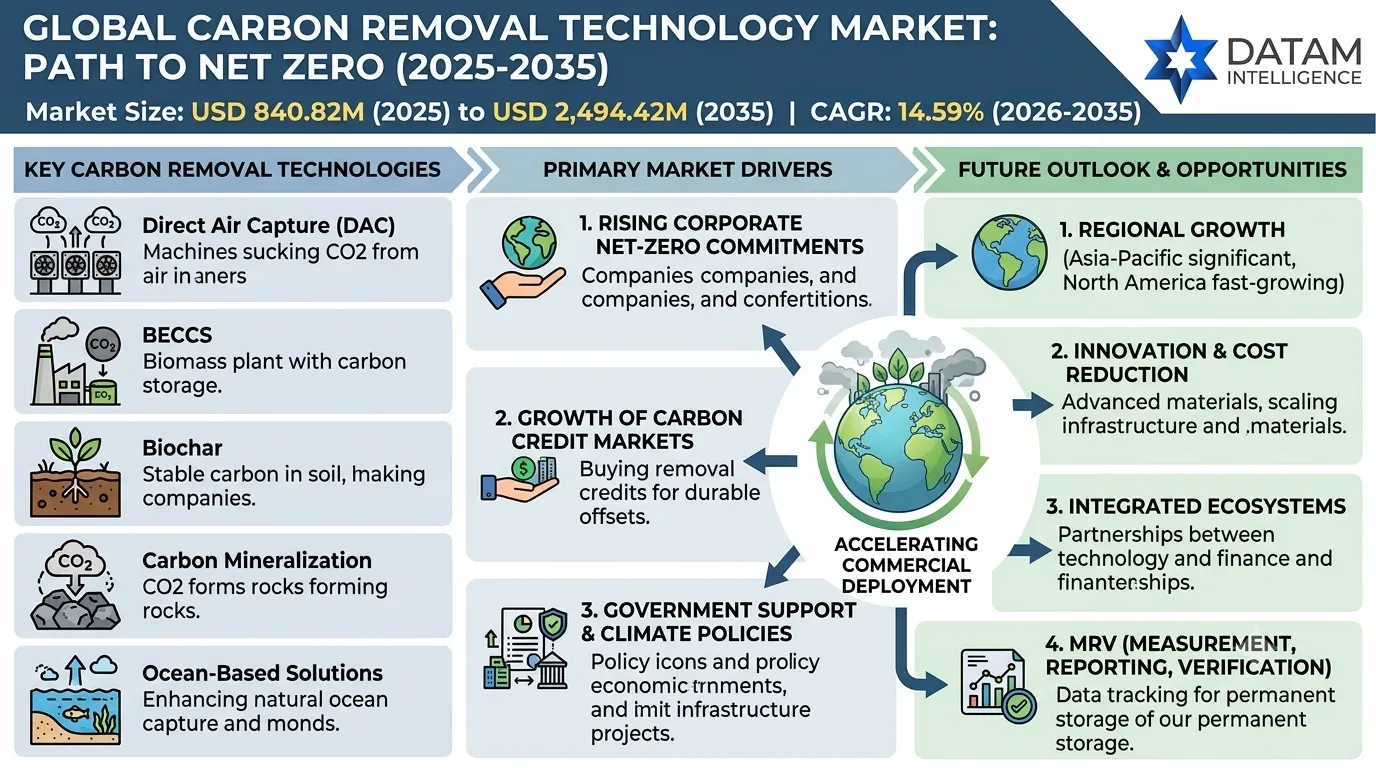
The global carbon removal technology market is projected to expand significantly through 2035, driven by rising corporate net-zero commitments, government climate policies, carbon credit market growth, and increasing investments in direct air capture (DAC), bioenergy with carbon capture and storage (BECCS), biochar, mineralization, and ocean-based carbon removal solutions.
According to DataM Intelligence analysis, the Carbon Removal Technology Market is expected to grow from USD 840.82 million in 2025 to USD 2,494.42 million by 2035, registering a CAGR of 14.59% during 2026 - 2035.
Explore the Global Carbon Removal Technology Market Report
Gain detailed insights into Global Carbon Removal Technology Market size, growth forecasts, competitive landscape, technology trends, investment opportunities, and regional analysis.
Request a Sample Report Today to understand the opportunities shaping the future of carbon removal technologies.
What Is Carbon Removal Technology?
Carbon removal technology refers to a group of solutions designed to extract carbon dioxide from the atmosphere or industrial sources and permanently store it through geological, biological, ocean, or mineral-based methods.
Unlike traditional emission reduction strategies that focus on preventing new emissions, carbon removal technologies address existing atmospheric carbon concentrations.
Key carbon removal approaches include:
- Direct Air Capture (DAC): Uses engineered systems to capture CO₂ directly from ambient air.
- Bioenergy with Carbon Capture and Storage (BECCS): Combines biomass energy production with carbon capture and permanent storage.
- Biochar Carbon Removal: Converts biomass into stable carbon-rich material stored in soil.
- Carbon Mineralization: Converts CO₂ into stable mineral forms.
- Ocean-Based Carbon Removal: Enhances natural ocean carbon absorption processes.
- Afforestation and Reforestation: Uses natural ecosystems for carbon sequestration.
Why Is the Carbon Removal Technology Market Growing?
1. Rising Corporate Net-Zero Commitments
Companies across energy, technology, manufacturing, aviation, and industrial sectors are increasingly investing in carbon removal solutions to meet climate targets.
Many organizations are moving beyond emissions reduction by purchasing carbon removal credits and supporting long-term carbon storage projects.
Corporate demand is becoming a major catalyst for scaling carbon removal startups and technology providers. Initiatives such as advanced market commitments are helping create future demand visibility for emerging carbon removal companies.
2. Growth of Carbon Credit and Carbon Removal Markets
The expansion of voluntary carbon markets is creating new opportunities for carbon removal technology developers.
Businesses are increasingly seeking high-quality carbon removal credits with:
- Permanent carbon storage
- Transparent measurement and verification
- Scientific validation
- Long-term climate impact
Carbon removal technologies are expected to play a larger role as companies prioritize durable carbon credits over traditional offset mechanisms.
3. Government Support and Climate Policies
Governments worldwide are introducing policies supporting:
- Carbon capture infrastructure
- Clean technology investments
- Carbon storage development
- Industrial decarbonization programs
Policy incentives are becoming an important factor in reducing technology costs and accelerating commercial deployment.
Key Carbon Removal Technologies Driving Market Growth
Direct Air Capture (DAC)
Direct Air Capture is one of the most commercially discussed carbon removal technologies.
DAC facilities use chemical processes to capture CO₂ from ambient air and store it permanently underground or convert it into usable products.
Companies are investing heavily in DAC due to its scalability potential, although challenges remain around energy consumption, infrastructure requirements, and cost reduction.
Market Opportunities in DAC:
- Industrial carbon removal services
- Carbon credit generation
- CO₂ utilization products
- Government-supported climate projects
Bioenergy With Carbon Capture and Storage (BECCS)
BECCS combines renewable biomass energy generation with carbon capture technology.
It has gained attention because it can potentially deliver negative emissions while supporting energy production.
Industries exploring BECCS include:
- Power generation
- Waste management
- Agriculture
- Biofuel production
Carbon Mineralization Technology
Carbon mineralization permanently stores CO₂ by converting it into stable mineral compounds.
This technology is attracting investment because mineral storage can provide long-term carbon permanence.
Emerging ocean-based carbon removal approaches are also exploring mineralization pathways to enhance carbon storage duration.
Top Carbon Removal Technology Companies Driving Market Innovation
The global carbon removal technology landscape is evolving rapidly, supported by increasing investments in climate technologies, growing corporate net-zero commitments, and rising demand for permanent carbon dioxide (CO₂) removal solutions. The competitive ecosystem includes direct air capture (DAC) developers, carbon removal project operators, carbon credit platforms, geological storage specialists, and climate technology companies working to commercialize scalable carbon removal solutions.
Leading companies are focusing on improving carbon capture efficiency, reducing technology costs, expanding removal capacity, developing reliable carbon storage infrastructure, and enhancing measurement, reporting, and verification (MRV) systems to support the growth of global carbon markets.
Leading Carbon Removal Technology Companies
1. Climeworks – Advancing Direct Air Capture Solutions
Climeworks is one of the world's leading Direct Air Capture (DAC) technology companies, specializing in capturing carbon dioxide directly from the atmosphere and permanently storing it underground.
The company uses advanced filter-based technology to capture CO₂ from ambient air, which is then transported and stored through permanent geological storage solutions. Climeworks has focused on developing large-scale DAC facilities and building partnerships with corporations seeking verified carbon removal credits.
Key market focus areas:
- Direct air capture technology development
- Permanent carbon storage solutions
- Carbon removal subscription services
- Corporate carbon removal partnerships
Climeworks represents the growing shift toward engineered carbon removal solutions that provide measurable and durable climate impact.
2. Heirloom – Scaling Limestone-Based Carbon Removal Technology
Heirloom is developing an innovative mineral-based carbon removal approach that accelerates the natural carbon mineralization process using limestone.
The company’s technology uses limestone-derived materials to capture atmospheric CO₂ and convert it into stable mineral forms for long-term storage. By leveraging abundant natural materials and improving process efficiency, Heirloom aims to reduce the cost barriers associated with carbon removal deployment.
Key innovation areas:
- Mineral-based carbon capture
- Low-cost carbon removal pathways
- Permanent carbon storage
- Scalable climate infrastructure
Heirloom’s approach highlights the growing importance of mineralization technologies in creating durable carbon removal solutions.
3. Carbon Engineering – Developing Advanced DAC Technologies
Carbon Engineering has been a major contributor to the advancement of Direct Air Capture technology, focusing on systems capable of removing large quantities of CO₂ from the atmosphere.
The company developed a chemical-based DAC process designed for large-scale deployment, with applications across carbon removal services and carbon-neutral fuel production.
Key technology applications:
- Atmospheric CO₂ capture
- Large-scale carbon removal facilities
- CO₂ conversion technologies
- Synthetic fuel production
Carbon Engineering’s technology development has contributed significantly to the commercialization roadmap of DAC solutions globally.
4. 1PointFive – Building Large-Scale Carbon Removal Infrastructure
1PointFive focuses on developing large-scale carbon capture, utilization, and storage (CCUS) infrastructure to support industrial decarbonization and carbon removal markets.
The company is working on expanding commercial-scale carbon removal projects by combining DAC technology, geological storage, and carbon management services.
Strategic focus areas:
- Large-scale DAC deployment
- Carbon storage infrastructure
- Industrial emissions reduction
- Carbon removal credit generation
As demand for permanent carbon removal increases, companies such as 1PointFive are helping establish the infrastructure required for a global carbon removal ecosystem.
5. Carbfix – Advancing Permanent CO₂ Mineral Storage
Carbfix specializes in carbon mineralization technology, converting captured CO₂ into stable carbonate minerals through underground storage processes.
The company's approach enables permanent carbon storage by accelerating natural mineralization processes, offering a long-term solution for reducing atmospheric carbon levels.
Key capabilities include:
- CO₂ mineral storage
- Geological carbon sequestration
- Carbon capture integration
- Permanent carbon locking technology
Carbfix demonstrates the potential of nature-inspired geological solutions for achieving durable carbon removal.
6. Charm Industrial – Biomass-Based Carbon Removal Solutions
Charm Industrial develops biomass-based carbon removal solutions by converting plant material into stable forms of carbon that can be permanently stored underground.
The company’s approach utilizes biomass waste streams to capture atmospheric carbon absorbed by plants and prevent its return to the atmosphere.
Key technology areas:
- Biomass carbon removal
- Bio-oil production
- Permanent underground carbon storage
- Carbon removal credits
Charm Industrial represents the growing role of biological carbon removal technologies in diversifying the global carbon removal market.
Competitive Strategies Shaping the Carbon Removal Technology Market
Leading companies in the carbon removal sector are adopting several strategies to strengthen their market position and accelerate commercialization:
1. Reducing Carbon Removal Costs
High deployment costs remain one of the biggest challenges for carbon removal technologies. Companies are investing in:
- Advanced materials
- Energy-efficient systems
- Automated operations
- Large-scale facility designs
Cost reduction will be critical for achieving widespread adoption across industries.
2. Expanding Carbon Removal Capacity
Technology providers are moving from pilot-scale projects toward commercial-scale facilities capable of removing millions of tons of CO₂ annually.
Expansion strategies include:
- Developing large carbon removal plants
- Establishing storage networks
- Building renewable energy partnerships
- Scaling global operations
3. Improving Measurement, Reporting, and Verification (MRV)
Reliable carbon accounting is essential for building trust in carbon removal markets.
Companies are investing in advanced MRV systems to ensure:
- Accurate CO₂ measurement
- Transparent carbon tracking
- Long-term storage verification
- Compliance with carbon market standards
4. Creating Integrated Carbon Removal Ecosystems
The future competitive landscape will increasingly depend on partnerships between:
- Technology developers
- Energy companies
- Carbon credit marketplaces
- Industrial emitters
- Government agencies
Integrated ecosystems will help accelerate project financing, deployment, and global adoption.
Future Outlook: Competitive Landscape of Carbon Removal Companies
The carbon removal technology market is transitioning from early innovation toward commercial-scale growth. Companies that successfully deliver cost-effective, scalable, and permanently verifiable carbon removal solutions are expected to play a major role in supporting global climate objectives.
As demand for carbon removal credits increases and industries pursue aggressive net-zero targets, leading technology providers will continue investing in advanced capture methods, storage infrastructure, and scalable carbon management platforms.
The competitive landscape is expected to expand further, creating new opportunities for investors, startups, technology developers, and businesses seeking solutions for long-term decarbonization.
Carbon Removal Technology Market Investment Opportunities
The global carbon removal technology market is attracting significant attention from investors, climate funds, technology companies, and industrial stakeholders as the demand for scalable carbon dioxide removal (CDR) solutions continues to accelerate. With governments, corporations, and industries committing to ambitious net-zero targets, carbon removal is increasingly being viewed as a long-term climate infrastructure opportunity rather than an emerging niche technology.
Investors are focusing on companies and technologies that can deliver permanent, measurable, and scalable carbon removal solutions while addressing key challenges such as high costs, infrastructure requirements, and technology commercialization.
1. Growing Climate Technology Funding and Investment Momentum
The rapid growth of climate technology funding is creating substantial investment opportunities across the carbon removal ecosystem. Venture capital firms, private equity investors, governments, and corporate sustainability funds are increasingly allocating capital toward technologies capable of removing carbon dioxide from the atmosphere at commercial scale.
Carbon removal is gaining investor interest because it represents a critical solution for addressing hard-to-abate emissions from sectors where traditional decarbonization strategies alone may not be sufficient.
Key Investment Areas Include:
Direct Air Capture (DAC) Facilities
Direct Air Capture is one of the most actively funded carbon removal technologies due to its potential for large-scale deployment and measurable carbon removal outcomes.
Investment opportunities include:
- Large-scale DAC facility development
- Advanced CO₂ capture materials
- Renewable energy integration
- Carbon storage infrastructure
- Industrial carbon removal services
As technology costs decline and deployment capacity expands, DAC is expected to become a major component of global carbon management strategies.
Carbon Storage Infrastructure
Permanent carbon storage is a critical component of the carbon removal value chain. Investors are increasingly supporting infrastructure projects focused on safe and durable CO₂ storage.
Key opportunities include:
- Geological carbon storage sites
- CO₂ transportation networks
- Mineralization facilities
- Carbon storage monitoring systems
The development of reliable storage infrastructure will be essential for scaling carbon removal projects globally.
Carbon Credit Platforms and Marketplaces
The expansion of voluntary carbon markets is creating new opportunities for digital platforms and marketplaces that connect carbon removal suppliers with corporate buyers.
Investment opportunities include:
- Carbon credit trading platforms
- Carbon removal procurement marketplaces
- Carbon tracking technologies
- Digital verification solutions
As companies seek high-quality carbon removal credits to meet sustainability commitments, transparent and trusted carbon marketplaces are expected to play a larger role.
Measurement, Reporting, and Verification (MRV) Technologies
Accurate carbon measurement and verification are essential for building confidence in carbon removal solutions.
Companies developing advanced MRV technologies are attracting investment due to growing demand for:
- Real-time carbon monitoring
- Data analytics platforms
- Satellite-based verification
- Blockchain-enabled carbon tracking
- AI-driven carbon measurement systems
Improved MRV capabilities will support market transparency and increase adoption among corporate buyers.
Carbon Utilization Products
Beyond permanent storage, captured CO₂ can be converted into commercially valuable products, creating additional revenue opportunities.
Investment areas include:
- Sustainable aviation fuels
- Carbon-based construction materials
- Green chemicals
- Synthetic fuels
- Industrial CO₂ applications
The development of carbon utilization markets can improve the economic viability of carbon removal technologies by creating additional value streams.
2. Expansion of Carbon Removal-as-a-Service Models
The adoption of Carbon Removal-as-a-Service (CRaaS) business models is creating new opportunities across the climate technology ecosystem.
Instead of developing internal carbon removal capabilities, many companies are choosing to purchase verified carbon removal services from specialized providers. This approach allows businesses to achieve sustainability targets while accessing advanced technologies without significant upfront investment.
Carbon removal service models are expected to grow as corporations increasingly prioritize:
- Net-zero commitments
- Scope 3 emissions management
- Climate risk reduction
- Sustainable business practices
Market Opportunities Include:
Technology Providers
Companies developing carbon removal technologies can generate revenue through:
- Carbon removal subscriptions
- Long-term corporate agreements
- Technology licensing
- Project partnerships
Carbon Removal Project Developers
Project developers are creating opportunities by designing, financing, and operating large-scale carbon removal facilities.
Key activities include:
- Project development
- Carbon storage management
- Regulatory approvals
- Carbon credit generation
Carbon Marketplaces
Digital carbon marketplaces are enabling easier access to verified carbon removal solutions by connecting buyers with technology providers and project developers.
Growth opportunities include:
- Carbon credit sourcing
- Portfolio management
- Carbon impact reporting
- Corporate climate solutions
Climate Consulting and Advisory Firms
As businesses navigate complex climate strategies, demand is increasing for consulting services that help organizations:
- Develop carbon removal strategies
- Select appropriate technologies
- Manage climate investments
- Achieve net-zero targets
3. Rising Industrial Decarbonization Demand
Industrial sectors with high carbon emissions are expected to become major adopters of carbon removal technologies due to limited alternatives for eliminating residual emissions.
Industries such as cement, steel, aviation, chemicals, and energy face significant challenges in achieving complete decarbonization because of process-related emissions and energy-intensive operations.
Carbon removal solutions provide these industries with an additional pathway to address unavoidable emissions while progressing toward net-zero goals.
Key Industrial Opportunities:
Cement Industry
Cement production generates significant process emissions that cannot be fully eliminated through renewable energy adoption alone.
Carbon removal technologies can support:
- CO₂ capture integration
- Carbon mineralization
- Low-carbon construction materials
Steel Industry
The steel sector is exploring carbon removal solutions alongside hydrogen-based production and carbon capture technologies to reduce emissions from traditional manufacturing processes.
Aviation Sector
Aviation remains one of the most challenging industries to decarbonize due to limited low-carbon fuel alternatives.
Carbon removal investments can support:
- Sustainable aviation strategies
- Carbon-neutral flight initiatives
- Long-term climate commitments
Chemical Industry
Chemical manufacturers are exploring carbon removal and utilization technologies to reduce emissions while creating circular carbon solutions.
Energy Sector
Energy companies are investing in carbon removal infrastructure to complement renewable energy expansion and address emissions from existing operations.
Future Investment Outlook for Carbon Removal Technology Market
The carbon removal technology market is entering a new phase of commercialization, driven by increasing climate investments, corporate demand, and supportive policy frameworks.
Future investment opportunities will be concentrated around companies that can achieve:
- Lower carbon removal costs
- Higher removal capacity
- Permanent carbon storage solutions
- Transparent verification systems
- Scalable business models
As global industries accelerate their transition toward net-zero emissions, carbon removal technologies are expected to become a critical investment area within the broader climate technology ecosystem, offering significant opportunities for investors, startups, infrastructure developers, and sustainability-focused organizations.
Regional Outlook: Key Markets Driving Carbon Removal Technology Growth
The global carbon removal technology market is expanding across major regions due to increasing climate commitments, government support, industrial decarbonization initiatives, and growing demand for carbon management solutions.
North America: Leading Innovation and Investment Hub
North America is a major market for carbon removal technologies, supported by strong government incentives, venture capital funding, advanced climate technology startups, and growing carbon storage infrastructure. The region is witnessing significant adoption of Direct Air Capture (DAC), carbon storage projects, and carbon credit solutions.
Key growth drivers:
- Government climate incentives
- Climate technology investments
- Industrial decarbonization programs
- Expansion of CO₂ storage infrastructure
Europe: Driving Carbon Neutrality and Sustainable Transformation
Europe continues to advance carbon removal adoption through ambitious net-zero targets, carbon market regulations, and sustainable industrial policies. Companies are increasingly exploring carbon removal solutions to address hard-to-abate emissions.
Key growth drivers:
- Carbon neutrality initiatives
- Carbon credit regulations
- Sustainable industrial transformation
- Advanced climate policies
Asia-Pacific: High-Growth Market Opportunity
Asia-Pacific represents a significant growth opportunity due to rising industrial emissions, expanding renewable energy capacity, and increasing investments in carbon management technologies. Growing government focus on climate action is accelerating adoption across industries.
Key growth drivers:
- Industrial decarbonization demand
- Government climate initiatives
- Renewable energy expansion
- Carbon management investments
Regional Market Outlook
According to DataM Intelligence analysis, Asia-Pacific is positioned as a significant growth market, while North America remains one of the fastest-growing regions due to strong innovation, investment activity, and carbon removal infrastructure development. These regions are expected to play a crucial role in shaping the global carbon removal technology market through 2035.
Future Trends Shaping the Carbon Removal Technology Market Through 2035
1. Artificial Intelligence in Carbon Removal Optimization
AI and advanced analytics will support:
- Carbon monitoring
- Storage optimization
- Project verification
- Operational efficiency
2. Integration With Carbon Markets
Carbon removal technologies will increasingly connect with digital carbon marketplaces and corporate sustainability platforms.
3. Lower-Cost Direct Air Capture Systems
Future innovation will focus on:
- Reducing energy consumption
- Improving capture materials
- Scaling infrastructure
4. Hybrid Carbon Removal Solutions
The future market will likely combine:
- Engineered technologies
- Nature-based solutions
- Carbon storage systems
Frequently Asked Questions
What is the carbon removal technology market?
The carbon removal technology market includes technologies that capture and permanently remove carbon dioxide from the atmosphere or industrial processes, including DAC, BECCS, biochar, mineralization, and ocean-based solutions.
Which carbon removal technology has the highest growth potential?
Direct Air Capture, carbon mineralization, and biochar-based solutions are among the technologies receiving significant investment due to their scalability and carbon storage potential.
Why are companies investing in carbon removal?
Companies are investing in carbon removal to achieve net-zero targets, address unavoidable emissions, improve sustainability strategies, and secure high-quality carbon removal credits.
What is the future outlook for carbon removal technology?
The carbon removal technology market is expected to expand rapidly through 2035 as climate policies, corporate commitments, and investment accelerate commercialization.
Conclusion
The carbon removal technology market is moving from early-stage innovation toward commercial-scale deployment. Growing climate commitments, carbon credit demand, government incentives, and industrial decarbonization requirements are creating significant opportunities for technology developers, investors, and businesses.
Companies that successfully reduce costs, improve scalability, and deliver permanent carbon storage solutions will play a critical role in shaping the future of global climate action.
As investment accelerates, understanding market dynamics, competitive landscapes, technology developments, and regional opportunities will become essential for organizations seeking growth opportunities in the carbon removal ecosystem.