


Treatment-Resistant Depression Market Size
The global treatment-resistant depression market reached US$1.8 billion in 2025 and is expected to reach US$2.8 billion by 2035, growing with a CAGR of 4.5% during the forecast period 2026-2035. Growth is being supported by increasing recognition of patients who fail multiple antidepressant regimens, stronger specialist referral pathways and rising adoption of advanced treatments such as esketamine.
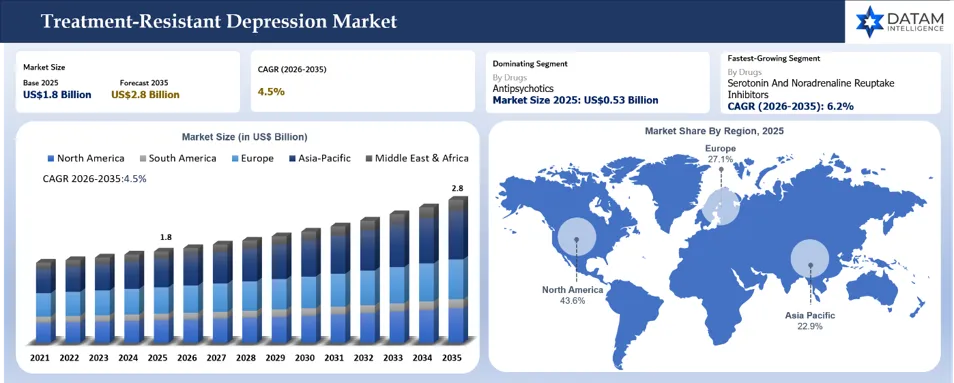
Innovation is increasingly focused on NMDA receptor modulation, neuroplastogens, psilocybin-derived therapies and mebufotenin-based candidates, which aim to deliver faster and more durable responses than traditional daily antidepressants. Johnson & Johnson currently holds a leading commercial position through SPRAVATO, while Compass Pathways, GH Research and Eli Lilly are strengthening the late-stage pipeline. However, treatment-center requirements, reimbursement barriers, monitoring needs and variability in TRD diagnosis continue to limit broader access and market penetration.
Treatment-Resistant Depression Market Key Takeaways
- The global treatment-resistant depression market is estimated at approximately US$1.8 billion in 2025 and is projected to reach about US$2.8 billion by 2035, representing an estimated 4.5% CAGR during 2026-2035.
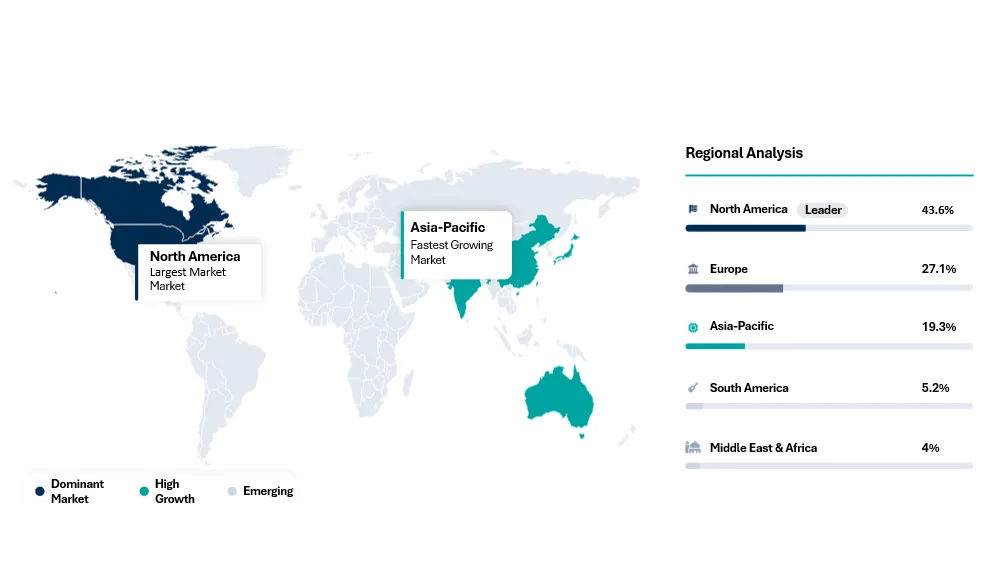
- North America is expected to remain the leading regional market, supported by strong uptake of advanced therapies, established psychiatric care infrastructure, favorable clinical research activity and early adoption of rapid-acting treatments.
- SPRAVATO (esketamine) remains the most commercially established differentiated TRD therapy, while newer neuroplastogens, psilocybin-based treatments and mebufotenin programs are expanding the competitive landscape.
- Market growth is increasingly driven by demand for rapid-onset, durable and non-daily therapies that can improve outcomes in patients who fail multiple conventional antidepressants.
- Future competition will depend on clinical efficacy, treatment durability, safety, monitoring requirements, reimbursement access and treatment-setting scalability, with late-stage pipelines from Compass Pathways, GH Research and Eli Lilly expected to reshape treatment options.
Treatment-Resistant Depression Market Scope
| Metrics | Details | |
| 2025 Market Size | US$1.8 Billion | |
| 2035 Projected Market Size | US$2.8 Billion | |
| CAGR (2026-2035) | 4.5% | |
| Largest Market | North America | |
| Fastest Growing Market | Asia-Pacific | |
| By Drugs | Antipsychotics, Selective Serotonin Reuptake Inhibitors, Serotonin And Noradrenaline Reuptake Inhibitors, Monoamine Oxidase Inhibitors, Others | |
| By Route Of Administration | Oral, Injectable, Others | |
| By Distribution Channel | Hospital Pharmacies, Retail Pharmacies, Online Pharmacies | |
| By Region | North America | U.S., Canada, Mexico |
| Europe | Germany, UK, France, Spain, Italy, Poland | |
| Asia-Pacific | China, India, Japan, Australia, South Korea, Indonesia, Malaysia, Singapore, Vietnam, Thailand, Philippines, Taiwan | |
| South America | Brazil, Argentina | |
| Middle East and Africa | Israel, Saudi Arabia, UAE, Turkiye, South Africa, Nigeria | |
| Report Insights Covered | Competitive Landscape Analysis, Company Profile Analysis, Market Size, Share, Growth | |
Treatment-Resistant Depression Market White Space & Investment Opportunities
- Next-Generation Rapid-Acting Therapies Beyond Conventional Antidepressants: Invest in NMDA-modulating therapies, neuroplastogens, psychedelic-derived compounds and other novel mechanisms capable of producing faster and more durable responses in patients who have failed multiple antidepressants. Opportunities remain particularly strong for therapies that combine rapid symptom improvement with favorable safety and outpatient scalability.
- Biomarker-Guided and Precision Treatment Selection: Develop predictive biomarkers, pharmacogenomic tools, digital phenotyping and AI-supported clinical decision systems that identify which TRD patients are most likely to respond to specific therapies. Reducing trial-and-error prescribing could shorten time to remission, improve treatment efficiency and support more personalized sequencing of antidepressants, augmentation therapies and advanced interventions.
- Convenient, Long-Acting and Lower-Burden Treatment Models: Invest in therapies offering less frequent dosing, simplified administration and reduced monitoring requirements compared with existing supervised treatments. Long-lasting oral, intranasal, injectable or episodic therapies that minimize clinic visits could improve adherence, expand access beyond specialized treatment centers and strengthen adoption among patients facing logistical, affordability and treatment-persistence barriers.
Treatment-Resistant Depression Market Buyer Decision-Making Criteria
Major Buyer Decision-Making Criteria:
- Reduction in Depressive Symptom Severity
- Speed of Onset of Antidepressant Effect
- Durability and Consistency of Treatment Response
- Remission and Response Rates
- Effectiveness After Failure of Multiple Antidepressants
- Ability to Reduce Suicidal Ideation or Acute Symptom Burden
- Safety and Tolerability Profile
- Risk of Sedation, Dissociation and Other Adverse Effects
- Dosing Frequency and Treatment Convenience
- Need for Supervised Administration and Post-Treatment Monitoring
- Ease of Integration With Existing Antidepressant Therapy
- Treatment Persistence and Patient Adherence
- Reimbursement and Insurance Coverage
- Out-of-Pocket Treatment Cost
- Availability of Certified Treatment Centers
- Physician Familiarity and Clinical Confidence
- Regulatory Approval and Label Breadth
- Evidence From Phase III and Real-World Studies
- Suitability for Patients With Comorbid Psychiatric Conditions
- Speed, Consistency and Durability of Response
Treatment-Resistant Depression Market BCG Matrix: Company Evaluation
STAR
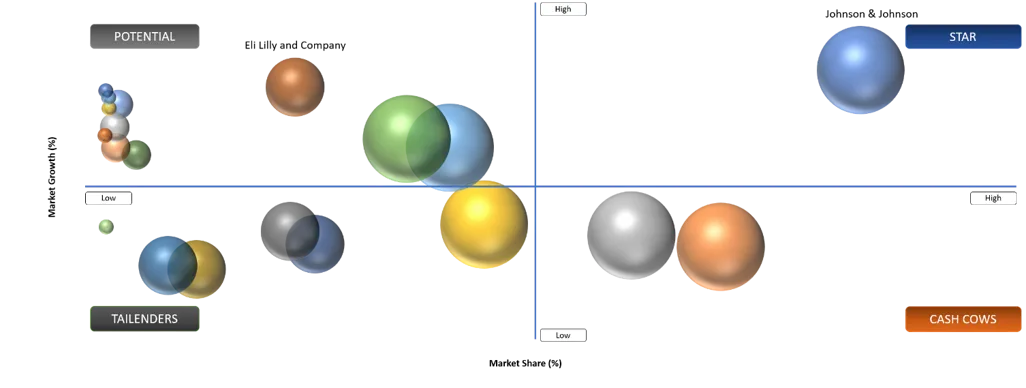
Johnson & Johnson, Axsome Therapeutics, Inc., AbbVie Inc. and the Otsuka Pharmaceutical Co., Ltd.–H. Lundbeck A/S alliance are positioned in the Star category due to their strong depression portfolios, established commercial presence and differentiated therapies for patients inadequately responding to conventional antidepressants. Johnson & Johnson leads directly in TRD through SPRAVATO, which received FDA approval in January 2025 as the first monotherapy for adults with treatment-resistant depression and generated approximately US$1.70 billion in 2025 sales. Axsome Therapeutics continues expanding through AUVELITY, which generated approximately US$507.1 million in 2025. AbbVie remains strongly positioned through VRAYLAR, while Otsuka and Lundbeck maintain an established adjunctive MDD franchise through REXULTI.
POTENTIAL
Eli Lilly and Company, Compass Pathways plc, GH Research PLC and Cybin Inc. are positioned in the Potential category based on differentiated late-stage programs and rapid-acting treatment approaches. Eli Lilly strengthened its TRD pipeline through the acquisition of AtaiBeckley and BPL-003, an intranasal mebufotenin therapy in Phase 3 development. Compass Pathways is advancing COMP360 psilocybin after positive Phase 3 results and regulatory progress in 2026. GH Research is progressing inhaled GH001 toward pivotal development following positive Phase 2b results, while Cybin is evaluating CYB003 in Phase 3 studies for patients with major depressive disorder inadequately responding to antidepressant therapy.
Treatment-Resistant Depression Market Dynamics
Driver Impact Analysis
Driver: Expansion of Rapid-Acting and Novel TRD Therapies
Expansion of rapid-acting and novel therapies is a major driver of the treatment-resistant depression market as patients increasingly gain alternatives to conventional daily antidepressants. In January 2025, the FDA approved SPRAVATO as the first monotherapy for adults with TRD who had inadequate responses to at least two oral antidepressants. Commercial adoption has been strong, with worldwide SPRAVATO sales reaching approximately US$1.696 billion in 2025, increasing 57.4% year over year. Meanwhile, positive Phase III results for COMP360 in 2026 highlight continued therapeutic innovation. These advances are expanding treatment options, improving physician confidence and supporting greater adoption of differentiated TRD therapies.
Restraint Impact Analysis
Restraint: Restricted Administration and Monitoring Requirements for Advanced TRD Therapies
Restricted administration and monitoring requirements are limiting the broader adoption of advanced treatment-resistant depression therapies. SPRAVATO, for example, must be administered under healthcare supervision, with patients monitored for at least two hours following treatment because of risks such as sedation and dissociation. These requirements increase staffing needs, treatment-center infrastructure costs and patient time commitments, particularly during the initial treatment phase. Limited availability of certified treatment centers can also restrict access outside major urban areas. As newer rapid-acting therapies enter the market, requirements for supervised administration, safety monitoring and specialized clinical settings may continue to constrain scalability, treatment initiation and overall market penetration.
Treatment-Resistant Depression Market Geographical Penetration
U.S. Treatment-Resistant Depression Market Landscape
The United States treatment-resistant depression market is advancing rapidly through regulatory expansion, strong commercial uptake and late-stage innovation. In 2025, the FDA expanded SPRAVATO (esketamine) to allow monotherapy for adults with TRD. Momentum continued in 2026, with U.S. SPRAVATO sales reaching approximately US$920 million during the first half of 2026, increasing 43.4% year over year. Pipeline competition is also strengthening: in February 2026, Compass Pathways reported positive Phase 3 results for COMP360 psilocybin in TRD, followed by FDA acceptance of a rolling NDA submission in April. These developments reinforce U.S. leadership in rapid-acting and next-generation depression therapies.
Japan Treatment-Resistant Depression Market Outlook
Japan's treatment-resistant depression landscape is increasingly characterized by clinical investigation of novel pharmacological and neuromodulation approaches. In June 2026, results from a Japanese psilocybin study in TRD showed a 91.7% completion rate, with 11 of 12 patients completing treatment, alongside significant improvements in MADRS, HDRS and QIDS-SR scores. Japan's clinical research registry also listed a 2026 esketamine nasal spray monotherapy study in adults with TRD. In May 2026, Fujita Health University registered an accelerated intermittent theta-burst stimulation study for treatment-resistant depression, while another extended rTMS study was registered in June. These programs highlight Japan's expanding evaluation of rapid-acting and device-based TRD treatments.
Treatment-Resistant Depression Market Competitive Landscape
- The global treatment-resistant depression market is moderately concentrated, with competition centered on differentiated mechanisms of action, rapid onset of efficacy, treatment durability and the ability to address patients who fail conventional antidepressants. Johnson & Johnson holds the strongest direct commercial position through SPRAVATO, while AbbVie, Axsome Therapeutics, Otsuka Pharmaceutical and H. Lundbeck compete through established depression therapies used in patients with inadequate response to standard treatment. Large pharmaceutical companies benefit from strong psychiatry franchises, extensive physician networks and established commercialization capabilities.
- Competitive intensity is expected to increase as late-stage neuroplastogen and psychedelic-based therapies move toward commercialization. Eli Lilly, Compass Pathways, GH Research and Cybin are advancing differentiated candidates designed to provide rapid and potentially durable responses with less frequent dosing. Future market leadership is likely to depend on clinical efficacy in difficult-to-treat populations, safety and monitoring requirements, reimbursement access, treatment-setting scalability and the ability to differentiate from existing oral antidepressants and esketamine-based therapy. Strategic acquisitions, licensing agreements and pipeline expansion are expected to remain important competitive strategies.
Key Companies of Treatment-Resistant Depression Market
- Johnson & Johnson (United States)
- Otsuka Pharmaceutical Co., Ltd. ( Japan)
- H. Lundbeck A/S (Denmark)
- AbbVie Inc (United States)
- Axsome Therapeutics, Inc. (United States)
- Pfizer Inc. (United States)
- Eli Lilly and Company (United States)
- Novartis AG (Switzerland)
- AstraZeneca PLC (, United Kingdom)
- Viatris Inc. (United States)
- Teva Pharmaceutical Industries Ltd. (Israel)
- Sun Pharmaceutical Industries Limited (India)
- Dr. Reddy's Laboratories Limited (India)
- Aurobindo Pharma Limited (India)
- Lupin Limited (India)
- Sumitomo Pharma Co., Ltd. (Japan)
- Biogen Inc. (United States)
- Relmada Therapeutics, Inc. (United States)
- COMPASS Pathways plc (United Kingdom)
- GH Research PLC (Ireland)
Treatment-Resistant Depression Market Recent Developments
- September 2026: Eli Lilly and Company completed its acquisition of AtaiBeckley Inc., adding BPL-003, an investigational intranasal mebufotenin therapy being developed for treatment-resistant depression. The acquisition strengthens Lilly’s neuroscience pipeline with rapid-acting neuroplastogen therapies designed to potentially provide durable benefits without chronic daily dosing.
- September 2026: Johnson & Johnson announced new SPRAVATO (esketamine) analyses for presentation at Psych Congress 2026, including real-world evidence evaluating its impact on anhedonia in patients with depression. SPRAVATO remains FDA-approved as monotherapy or with an oral antidepressant for adults with treatment-resistant depression following inadequate response to at least two oral antidepressants.
- August 2026: Compass Pathways announced collaboration with the U.S. Department of Veterans Affairs on the multi-site PIVOT clinical trial evaluating COMP360 psilocybin in veterans with treatment-resistant depression, including patients with concurrent post-traumatic stress disorder.
- August 2026: GH Research reported that the FDA provided feedback indicating its CMC and proprietary aerosol-device plans for GH001 appeared Phase 3 ready. The company continued preparations for a global pivotal program evaluating inhaled mebufotenin in treatment-resistant depression, with Phase 3 initiation targeted for 2026.
- July 2026: Eli Lilly entered into a definitive agreement to acquire AtaiBeckley for approximately US$2.8 billion upfront, with up to an additional US$1.0 billion tied to development and regulatory milestones. The transaction was centered partly on BPL-003, AtaiBeckley’s lead intranasal mebufotenin program for treatment-resistant depression.
What DATAM UAniquely Provides
- In-depth segmentation of the Treatment-Resistant Depression Market by drug class, route of administration, distribution channel and region, with additional assessment of antidepressants, atypical antipsychotics, NMDA receptor modulators, esketamine-based therapies, neuroplastogens and emerging psychedelic-assisted treatments.
- Competitive analysis of leading treatment-resistant depression companies covering approved product portfolios, mechanism of action, efficacy, onset of action, dosing frequency, safety profile, treatment setting, regulatory status, pipeline maturity, commercialization strategy and geographic expansion.
- Comprehensive assessment of diagnosed and treatment-eligible patient populations, including patients with major depressive disorder showing inadequate response to multiple antidepressants, recurrent depressive episodes, severe depression and difficult-to-treat disease characteristics influencing treatment selection.
- Detailed evaluation of the evolving treatment landscape, including oral antidepressant augmentation, intranasal esketamine, atypical antipsychotic adjunctive therapies, NMDA receptor-targeted approaches, psilocybin-based treatments, mebufotenin therapies and other rapid-acting neuropsychiatric modalities.
- Pipeline and clinical-trial intelligence covering Phase II and Phase III TRD candidates, regulatory milestones, breakthrough therapy designations, NDA progress, clinical efficacy endpoints and emerging mechanisms that could reshape future treatment algorithms.
- Commercial and strategic assessment of prescription trends, product uptake, payer access, reimbursement dynamics, treatment-center requirements, physician adoption, strategic acquisitions, licensing activity and competitive positioning across major global markets.



























































