


Spain Food Supplement Market Size
The Spain food supplement market is US$1.97 billion in 2025 and is expected to reach US$4.85 billion in 2035, growing at a CAGR of 8.48% during the forecast period 2026-2035. The Spain food supplements market is experiencing steady growth, driven by increasing consumer awareness of preventive healthcare, wellness trends, and personalized nutrition. For instance, according to data reflected in the new edition of the FOOD Barometer, 3 in 4 Spaniards are more aware of their health and of following a healthy diet since the COVID-19 pandemic. Furthermore, according to Bord Bia, the Irish Food Board, 55.4% of consumers are willing to spend more on healthier food options.
Additionally, the aging population in Spain is a key driver, as elderly individuals seek gut health, immunity-boosting, and cognitive support supplements to maintain long-term well-being. Additionally, the growth of e-commerce and digital health platforms has made supplements more accessible, with major online pharmacies and direct-to-consumer brands expanding their reach.
Government-backed health awareness initiatives and nutrition programs further support market growth by educating consumers about the benefits of dietary supplements. The market also benefits from strong R&D investments, with companies introducing scientifically backed, innovative formulations that cater to specific health concerns.
Spain Food Supplement Market Scope
| Metrics | Details |
| Market Size (2025) | US$ 1.97 Billion |
| Market Size (2035) | US$ 4.85 Billion |
| CAGR (2026-2035) | 8.48% |
| Historic Years | 2023-2024 |
| Base Year | 2025 |
| Forecast Period | 2026-2035 |
| Segments Covered | Ingredient, Dosage, Application, Age, Distribution Channel |
| Leading Growth Area | Gastrointestinal Health Supplements |
| Fastest Emerging Trend | Personalized Nutrition Solutions |
Spain Food Supplement Market Drivers
Growing Aging Population
Spain’s rapidly aging population is a key driver of the country’s food supplement market. By 2050, Spain's aging population is projected to exceed 36%, according to the NIH, highlighting a growing demographic shift towards an older society. This increase will likely intensify economic and social challenges related to elderly care and workforce sustainability. As life expectancy increases, older adults are prioritizing preventive healthcare, fueling demand for supplements that support joint health, bone density, cardiovascular function, and cognitive well-being.
Omega-3 fatty acids, calcium, vitamin D, and collagen supplements are particularly popular among seniors seeking to maintain mobility and independence. Additionally, rising concerns about age-related diseases such as osteoporosis, arthritis, and dementia are pushing demand for specialized formulations. Immunity-boosting supplements, including probiotics and vitamin C, are also gaining traction as older individuals focus on strengthening their immune systems. The increasing prevalence of digestive issues among seniors is further driving demand for gut health products like probiotics and fiber supplements.
Increasing Demand for Personalized Supplements
The demand for personalized supplements is transforming Spain’s food supplement market, driven by consumers seeking tailored health solutions based on their genetics, lifestyle, and dietary needs. Advances in DNA testing, microbiome research, and AI-driven nutrition are enabling brands to offer customized formulations that cater to specific goals like immune support, cognitive function, weight management, and gut health. Subscription-based and direct-to-consumer (DTC) models are thriving, providing convenient, science-backed supplement packs.
For instance, in 2024, Oriflame introduced a personalized nutrition service in Spain under its Wellosophy brand, offering custom supplement packs based on individual health needs. Through an online assessment, consumers provide details on their diet, lifestyle, and wellness goals, which are analyzed to recommend tailored supplements targeting areas like immunity, sleep, skin health, and energy. This initiative aims to make supplementation easy and sustainable while supporting each customer’s unique health journey.
Restraints
Stringent Regulatory Environment
The stringent regulatory framework and compliance challenges in Spain significantly restrain the growth of the food supplements market by imposing strict approval processes, labeling requirements, and ingredient restrictions under the European Food Safety Authority (EFSA) and national laws. Companies must ensure compliance with Royal Decree 1487/2009, which aligns with EU regulations, making product launches and reformulations time-consuming and costly.
For instance, EFSA’s restrictions on health claims prevent manufacturers from marketing supplements with unapproved claims, limiting their ability to highlight benefits effectively. Additionally, frequent updates to legislation create uncertainty for businesses, requiring continuous adjustments to formulations and packaging, which adds to operational costs. The ban on certain ingredients and high-dose vitamins also forces companies to reformulate products, delaying market entry.
A notable example is the restriction on certain botanical extracts, which led to the reformulation of herbal supplements, impacting sales and consumer trust. Furthermore, compliance costs make it difficult for small and medium-sized enterprises (SMEs) to compete with larger brands that have the resources to navigate complex regulatory requirements. These challenges collectively slow down innovation, increase costs, and limit product availability, thereby restraining overall market growth.
Trends
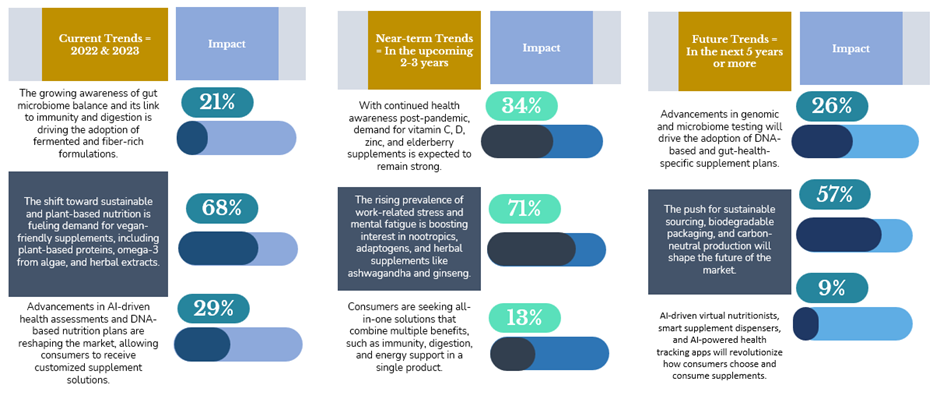
Segmentation Analysis
The Spain food supplement market is segmented based on ingredients, dosage, application, age, and distribution channel.
Growing Demand for Probiotics, Prebiotics, and Digestive Support Products
Gastrointestinal health holds a significant share in the food supplement market in Spain due to increasing consumer awareness of gut health's impact on overall well-being. The demand for probiotics, prebiotics, and digestive enzymes has surged, driven by rising digestive disorders, lifestyle changes, and a growing aging population. In February 2023, ADM launched a new $30 million production facility in Valencia, Spain, increasing its probiotics and postbiotics capacity to 50 metric tons per year. The facility, the first to produce both at the same site, supports ADM’s expansion into global health and wellness markets.
Additionally, regulatory support from the European Food Safety Authority (EFSA) ensures product efficacy and transparency, increasing consumer trust. With a preference for natural and plant-based formulations, Spanish consumers are embracing clean-label and organic gut health supplements. The market is also influenced by the Mediterranean diet, which promotes digestive well-being, reinforcing the demand for complementary supplements.
Sustainability Analysis
Spain has a growing demand for natural and organic supplements, driving companies to adopt sustainable sourcing of ingredients, including plant-based and marine-derived options. Eco-friendly packaging, such as biodegradable or recyclable materials, is becoming a priority to reduce plastic waste. Regulatory frameworks, including EU sustainability policies, push manufacturers toward responsible production and ethical labor practices. The industry is also shifting towards carbon-neutral operations, with brands investing in renewable energy and reducing emissions.
Ethical sourcing and fair-trade certifications are gaining traction to ensure biodiversity conservation and fair labor conditions. Spain's consumer awareness about sustainability is increasing, leading brands to prioritize transparency and traceability in the supply chain. Companies are adopting circular economy principles, repurposing waste materials into new products. Digitalization is enhancing efficiency, reducing waste, and improving logistics to lower the carbon footprint. Sustainable farming practices, such as regenerative agriculture, are gaining importance for ingredient cultivation. Collaborations between businesses, government, and NGOs are fostering industry-wide sustainability improvements.
Unmet Needs
While personalized nutrition is gaining traction, there is still a gap in tailor-made supplement solutions catering to specific demographics, such as pregnant women, menopausal women, and individuals with chronic conditions like diabetes or cardiovascular diseases. Most products offer generalized formulations, limiting the effectiveness of individual health needs.
Traditional supplement formats like pills and capsules dominate the market, but there is a growing demand for more convenient and enjoyable consumption methods, such as gummies, dissolvable powders, and functional beverages. Many consumers, especially elderly individuals and children, find swallowing pills inconvenient, leading to low adherence to supplement regimens.
While urban consumers have easy access to a wide variety of supplements, many rural areas in Spain still face limited product availability and awareness about dietary supplements. A lack of educational initiatives and targeted marketing campaigns in these regions results in lower adoption rates.
Although sustainability is becoming a key focus, the Spanish market still lacks sufficient eco-friendly supplement packaging, carbon-neutral production, and ethically sourced ingredients. Consumers are increasingly looking for plastic-free, biodegradable, and refillable supplement packaging, yet such options remain limited in availability.
Despite rising demand, many supplements lack strong clinical evidence or transparent labeling, leading to consumer skepticism. There is an increasing need for more research-backed formulations, third-party testing, and clear health claims to build trust and credibility.
Competitive Landscape
The major players in the market include AB-BIOTICS, SA, Laboratorios Ordesa, S.L., Faes Farma S.A, TOP4U, BIOITHAS SL, DRKU (Korott), Nestlé España SA (Nestlé S.A.), BioGaia, DANONE Spain (Danone SA), Procter & Gamble Spain (Procter & Gamble), Chiesi Spain SAU (Chiesi Farmaceutici S.p.A), STADA Spain (STADA Arzneimittel AG) and others.
Key Developments
April 2026: Spain increased investments in preventive healthcare and wellness initiatives, supporting growing demand for food supplements focused on immunity, digestive health, sports nutrition, and healthy aging.
March 2026: The United States expanded exports of nutritional ingredients and dietary supplement formulations to European markets, including Spain, supporting product innovation and category diversification.
February 2026: Laboratorios Ordesa S.L. expanded its product portfolio through innovation in vitamins, minerals, and specialized nutrition solutions, strengthening its presence in the Spanish food supplement market.
January 2026: Spanish consumers increasingly adopted personalized nutrition and preventive health solutions, driving demand for premium food supplements tailored to specific health and wellness needs.
December 2025: Supplement manufacturers increased investments in clean-label formulations, natural ingredients, and scientifically validated products to address evolving consumer preferences and regulatory requirements.
November 2025: Nestlé Health Science strengthened its nutrition and wellness portfolio through expanded offerings in medical nutrition, functional supplements, and consumer health products across Europe.
October 2025: Industry participants accelerated development of supplements targeting immune support, gut health, cognitive wellness, and active lifestyles, responding to growing health-conscious consumer demand.
September 2025: Spain strengthened support for innovation in nutraceuticals and functional foods, encouraging research and development activities focused on advanced dietary supplement formulations.
July 2025: Faes Farma S.A. expanded investments in nutritional health products and consumer wellness solutions, supporting growth in the food supplement sector.
May 2025: Companies increased adoption of e-commerce and digital health platforms to improve consumer access to vitamins, minerals, herbal supplements, and specialized nutritional products.
March 2025: Strategic collaborations between supplement manufacturers, research institutions, and healthcare professionals accelerated development of evidence-based nutrition products and personalized wellness solutions.
Why Purchase the Report?
- To visualize the Spain food supplement market segmentation based on ingredient, dosage, application, age, and distribution channel, as well as understand key commercial assets and players.
- Identify commercial opportunities by analyzing trends and co-development.
- Excel data sheet with numerous data points of Spain Food Supplement market-level with all segments.
- PDF report consists of a comprehensive analysis after exhaustive qualitative interviews and an in-depth study.
- Product mapping available as excel consisting of key products of all the major players.
The Spain Food Supplement report would provide approximately 51 tables, 65 figures and 290 pages.
Target Audience 2026
- Manufacturers/ Buyers
- Industry Investors/Investment Bankers
- Research Professionals
- Emerging Companies


























































