


Market Size
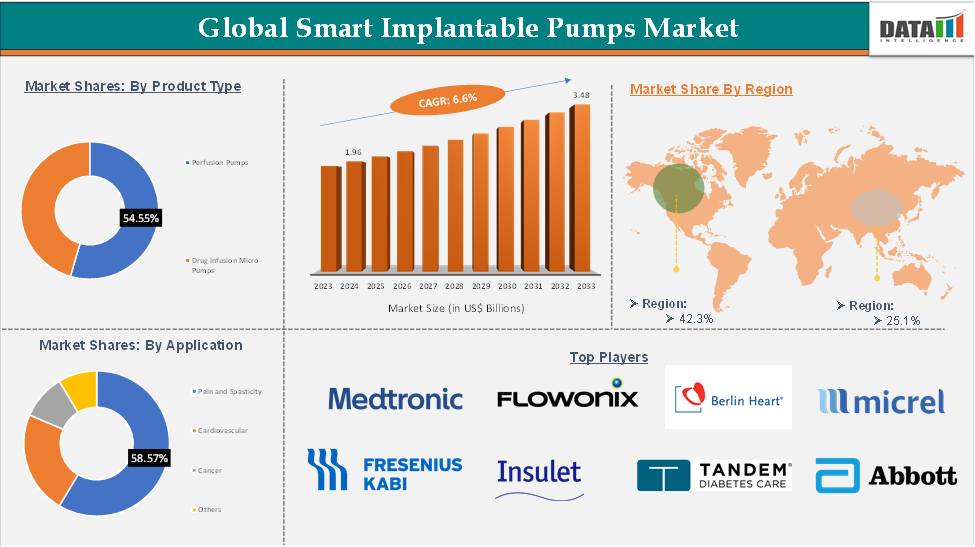
Smart Implantable Pumps Market reached US$ 1.96 Billion in 2024 and is expected to reach US$ 3.48 Billion by 2033, growing at a CAGR of 6.6% during the forecast period 2025-2033.
The global smart implantable pumps market is growing due to the demand for advanced, minimally invasive drug delivery systems. These pumps offer advantages like precise medication dosing, improved patient compliance, and reduced complications. The rising prevalence of chronic conditions, technological innovations, and personalized medicine awareness are driving market expansion. The shift towards home-based care and the adoption of smart implantable pumps are also boosting healthcare systems worldwide.
For more details on this report, Request for Sample
Market Dynamics: Drivers & Restraints
Driver: Technological Advancements in Devices
The global smart implantable pumps market is driven by advancements in medical technology, particularly in drug delivery systems. These pumps deliver medications with precision to targeted areas, improving treatment outcomes and minimizing side effects. They enable programmable and responsive drug release, often integrated with sensors and wireless connectivity. These features improve patient comfort and enable real-time monitoring by healthcare professionals. As demand for personalized treatment grows, smart implantable pumps become a preferred choice for managing chronic conditions, driving market growth.
For instance, in May 2024, Arecor and Medtronic have partnered to develop a new type of insulin that can be used in new insulin pump designs. The goal is to create a high-concentration, thermostable insulin that sits under the skin, reducing pump maintenance interventions and expanding physician utility while saving costs. This collaboration aims to revolutionize new advancements in insulin drug delivery.
Restraint: High Cost Associated with the Devices
The smart implantable pump market faces significant challenges due to high costs. The complex development, manufacturing, and surgical implantation of these devices require specialized medical expertise, leading to high upfront and maintenance costs. Inconsistent insurance coverage and reimbursement policies across countries further restrict widespread adoption, limiting access to these advanced devices and slowing their potential growth despite their clinical benefits. For instance, the cost of a smart implantable pump can range from $3,200 to $30,000, with additional costs including surgical implantation, ongoing maintenance, and potential complications.
Market Segment Analysis
The global smart implantable pumps market is segmented based on product type, application, end user, and region.
Product Type:
The perfusion pumps segment of the product type is expected to hold 54.5% of the smart implantable pumps market
Perfusion pumps are medical devices that control and precisely deliver fluids like blood, medications, or nutrients into a patient's circulatory system. They are crucial in clinical settings like surgeries, intensive care, and organ transplantation, where consistent blood flow and pressure are essential. They play a vital role in cardiopulmonary bypass procedures, ECMO, and transplant viability by mimicking physiological conditions. Their high accuracy makes them indispensable in modern healthcare.
The perfusion pumps market is driven by the increasing demand in the cardiovascular and organ transplantation segments. With rising heart disease incidences and the need for organ transplants, perfusion pumps are increasingly used in surgical procedures and critical care settings. Technological advancements have improved safety, efficiency, and portability, making them suitable for a wider range of clinical applications, thereby boosting demand in these high-growth segments.
Market Geographical Share
North America dominated the global smart implantable pumps market with the highest share of 40.3% in 2024
The smart implantable pumps market in North America is expanding due to a robust healthcare infrastructure, leading medical device manufacturers, and high adoption of advanced technologies. The region benefits from significant healthcare innovation investments, favorable regulatory frameworks. Also, the aging population and increasing prevalence of conditions like cancer, diabetes, and cardiovascular disorders further stimulate demand for advanced drug delivery solutions.
For instance, according to American Cancer Society (ASC), estimated cancer incidence, however, is on the rise for many common cancers. In the coming year, ASC estimates that hit a bleak milestone the first time new cases of cancer in the U.S. are expected to cross the 2-million mark. That’s almost 5,500 cancer diagnoses a day. In 2024, over 611,000 deaths from cancer are projected for the US. That is more than 1,600 deaths from cancer each day.
Additionally, the presence of leading healthcare institutions and specialized centers of excellence fosters the adoption of innovative medical technologies, including smart implantable pumps. Additionally, favorable reimbursement policies and access to healthcare services contribute to market growth in the region.
Asia-Pacific region in the global smart implantable pumps market is expected to grow with the highest CAGR of 17.5% in the forecast period of 2025 to 2033
The Asia Pacific region is experiencing a surge in the demand for smart implantable pumps due to the growing healthcare sector, chronic disease prevalence, and improved access to advanced medical technologies. Countries like China, India, and Japan are investing in healthcare infrastructure and medical device innovation. Government initiatives and the growing demand for efficient, minimally invasive treatment options are also driving the adoption of smart implantable pumps, positioning the region as a high-growth market.
For instance, in Japan, a significant portion of the adult population, especially those over 75, suffers from chronic diseases, with a high prevalence of multiple conditions. A study found that over 90% of adults have at least one chronic disease, with 80% having multiple conditions. Noncommunicable diseases like diabetes, hypertension, ischemic heart disease, and heart failure are also prevalent. Hence, the rise in prevalence indeed necessitates the use of implantable pumps, which helps the region and overall market to grow during the forecast period.
Market Key Players
The major global players in the smart implantable pumps market include Medtronic, Flowonix Medical, Berlin Heart, Micrel Medical Devices, Fresenius Kabi, Insulet Corporation, Tandem Diabetes Care, Abbott Laboratories, Johnson & Johnson, and Baxter International, among others.
Key Developments
April 2026: Increased Focus on Miniaturization and Micro-Pump Innovation
In April 2026, R&D efforts intensified around bioMEMS-based micro pumps and miniaturized implantable systems, enabling more accurate nano-scale drug dosing. Companies are prioritizing smaller, longer-lasting implantable devices to improve patient comfort and expand applications in neurology and oncology.
March 2026: Growth in Homecare-Based Implantable Pump Usage
A notable development in March 2026 shows accelerated adoption of smart implantable pumps in homecare and ambulatory treatment settings. This trend is driven by healthcare cost reduction initiatives and a shift from hospital-centric care to patient-managed chronic therapy, particularly for long-term infusion therapies.
February 2026: Integration of AI and IoT in Implantable Pumps
Industry analysis highlighted a strong shift toward AI-enabled and IoT-integrated smart implantable pumps, improving real-time dose adjustment and patient monitoring. Manufacturers are increasingly focusing on connected drug delivery ecosystems that enhance precision therapy and reduce hospitalization frequency, especially for pain and oncology applications.
January 2026: Strong Market Expansion Outlook Confirmed
The smart implantable pumps market outlook for 2026 was revised upward, with projections indicating steady expansion driven by rising adoption in chronic disease management such as cancer, diabetes, and cardiovascular disorders. The market is estimated to surpass USD 2.7–3.0 billion in 2026, supported by increasing use of programmable drug delivery systems and rising demand for long-term implantable solutions.
Market Scope
| Metrics | Details | |
| CAGR | 6.6% | |
| Market Size Available for Years | 2023-2033 | |
| Estimation Forecast Period | 2026-2033 | |
| Revenue Units | Value (US$ Bn) | |
| Segments Covered | Product Type | Perfusion Pumps, Drug Infusion Micro-Pumps |
| Application | Pain and Spasticity, Cardiovascular, Cancer, Others | |
| End User | Hospitals, Ambulatory Surgical Clinics, Specialty Clinics, Others | |
| Regions Covered | North America, Europe, Asia-Pacific, South America, and the Middle East & Africa | |



























































