


Global Phytosterols Market Overview
The global phytosterols market is experiencing significant growth, driven by increasing consumer health consciousness and rising demand for natural ingredients in functional foods, supplements, cosmetics, and pharmaceuticals.
For instance, according to a report by the Centre for the Promotion of Imports from Developing Countries (CBI), worldwide demand for natural ingredients is on the rise, including in the European market. A 2019 study conducted by the German Ministry of Agriculture and Nutrition found that the trend of removing synthetic ingredients from food products was gaining momentum in Europe.
In addition, according to the American Chemical Society, the shift toward sustainability in the cosmetics industry is illustrated by the burgeoning market for natural ingredients, projected to expand from USD 642 million in 2022 to USD 1,095 million by 2030. This trend reflects a significant change in consumer behavior, with over 40% of shoppers prioritizing natural components in their beauty and personal care products. The demand for environmentally sustainable, safe cosmetics is reshaping how products are formulated, driving an increase in research dedicated to natural ingredients for cosmetics.
Phytosterols Industry Trends and Strategic Insights
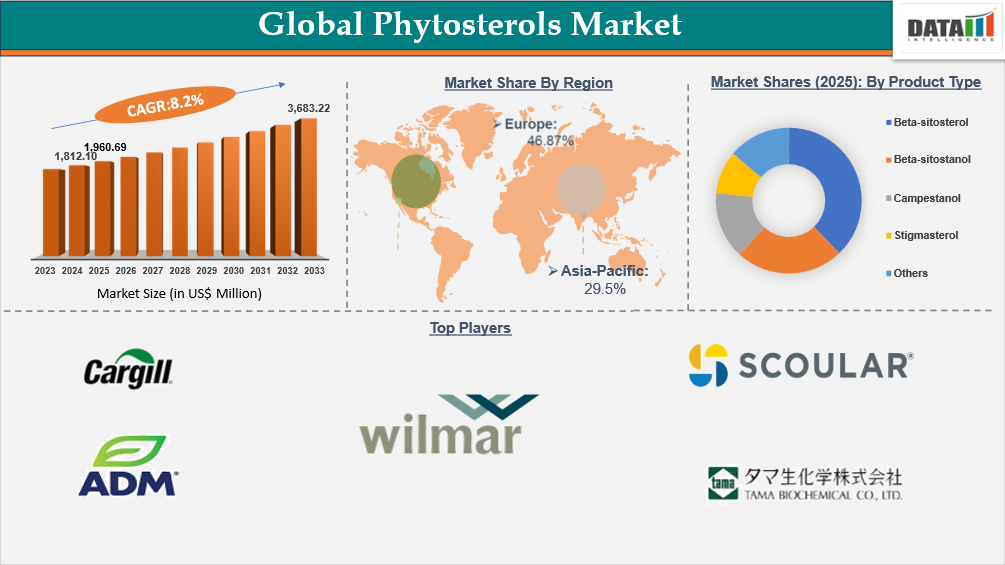
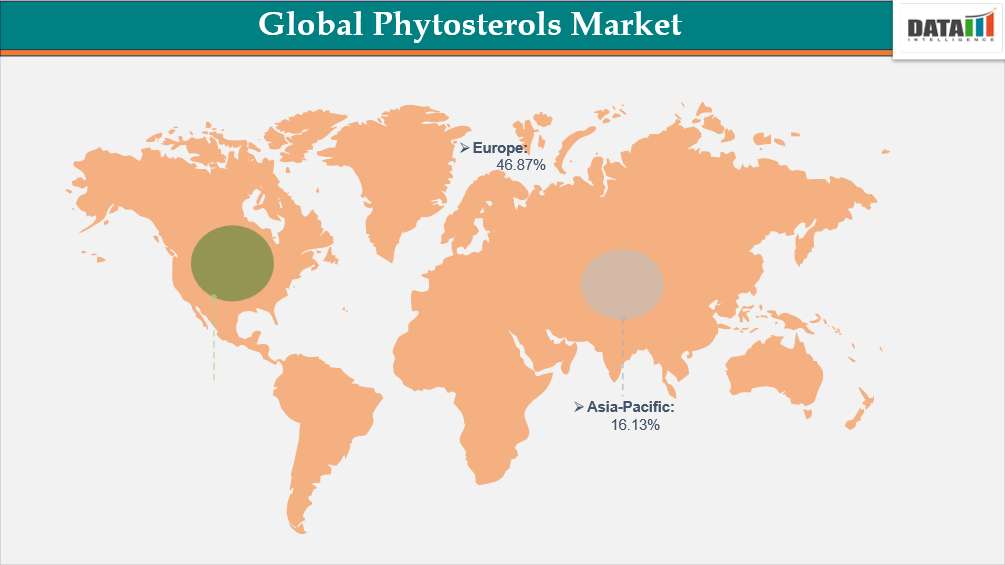
- Asia-Pacific is the fastest-growing region in the phytosterols market, capturing a share of 16.13% in 2025.
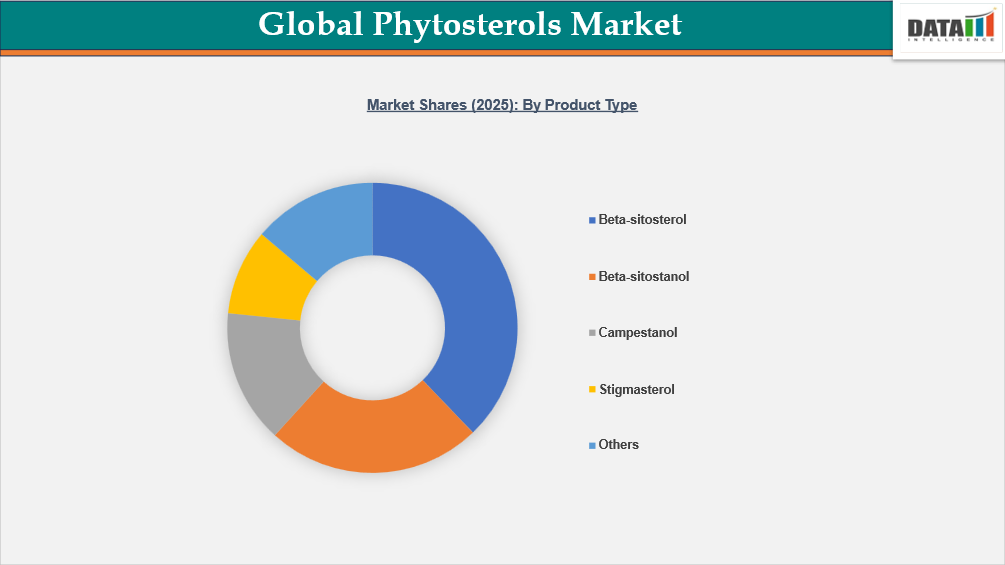
- By product type, the beta-sitosterol is projected to be the largest market, holding a significant share of about 35.6% in 2025.
Global Phytosterols Market Size and Future Outlook
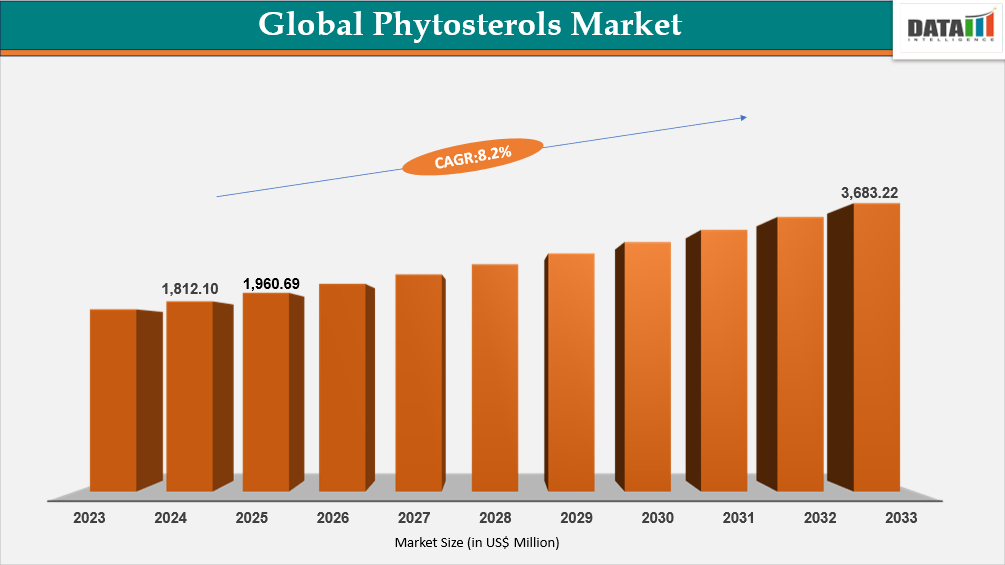
- 2025 Market Size: US$ 1,960.69 Million
- 2033 Projected Market Size: US$ 3,683.22 Million
- CAGR (2026-2033): 8.2%
- Largest Market: Europe
- Fastest Market: Asia-Pacific
Key Takeaways
- The growing consumer preference for heart-health-focused functional foods and dietary supplements is emerging as a key industry trend, with manufacturers increasingly incorporating phytosterols into food, beverage, and nutraceutical formulations to address rising awareness of cholesterol management and preventive healthcare.
- Europe maintains a leading position in the global phytosterols market, supported by well-established functional food adoption, favorable regulatory approvals for health claims, and strong consumer demand for cholesterol-lowering ingredients across food and dietary supplement applications.
- Asia-Pacific is projected to record significant growth, driven by increasing health awareness, expanding nutraceutical and functional food industries, rising disposable incomes, and growing demand for preventive nutrition solutions in emerging economies.
- The increasing prevalence of cardiovascular diseases and high cholesterol levels is becoming a major factor driving the adoption of phytosterol-enriched foods, beverages, and dietary supplements across both developed and developing markets.
- The expanding application of phytosterols in functional foods, fortified dairy products, edible oils, spreads, dietary supplements, and pharmaceutical formulations is strengthening market demand as manufacturers diversify product offerings to meet evolving consumer health preferences.
- Industry participants are increasingly prioritizing sustainable plant-based sourcing, scientific validation of health benefits, product innovation, regulatory compliance, and strategic partnerships with food and nutraceutical manufacturers to strengthen their competitive positioning.
- Rising consumer interest in plant-based nutrition, preventive healthcare, clean-label ingredients, and personalized wellness solutions is creating significant opportunities for phytosterol manufacturers to expand their presence across global food, beverage, nutraceutical, and pharmaceutical industries.
Phytosterols Market Scope
| Metrics | Details |
| By Product Type | Beta-sitosterol, Beta-sitostanol, Campestanol, Stigmasterol, Others |
| By Source | Plant Oils, Vegetables, Nuts, and Seeds, Others |
| By Form | Liquid, Powder |
| By End-User | Food and Beverages, Dietary Supplements, Pharmaceuticals, Cosmetics, Feed industry, Dairy Products, Others |
| By Region | North America, South America, Europe, Asia-Pacific, Middle East, and Africa |
| Report Insights Covered | Competitive Landscape Analysis, Company Profile Analysis, Market Size, Share, Growth |
For More Detailed Information, Request for sample
Phytosterols Market Growth Dynamics
High demand for β-sitosterol in dietary supplements and pharmaceuticals
The global phytosterols market is experiencing strong growth in demand for β-sitosterol, particularly in dietary supplements and pharmaceuticals, driven by its cholesterol-lowering, anti-inflammatory, and anticancer properties. As the most abundant phytosterol, it is increasingly used in functional nutrition and advanced drug formulations.
For instance, CordenPharma launched a β-sitosterol-based cholesterol replacement for Lipid NanoParticle (LNP) formulations, improving mRNA transfection efficiency while adopting sustainable, plant-based sourcing and a closed-loop process that recycles over 98% of solvents.
From a therapeutic perspective, β-sitosterol is gaining traction as a natural chemopreventive agent, as global cancer cases are projected to reach 28.4 million by 2040—a 47% increase from 2020, according to GLOBOCAN. This rising burden highlights the need for safe and affordable alternatives, with over 60% of approved chemotherapeutic drugs already derived from phytochemicals, positioning plant sterols like β-sitosterol as promising low-toxicity candidates with broad biological activity.
Feedstock price fluctuations
Feedstock price fluctuations remain a major restraint for the global phytosterols market, as production depends heavily on plant-based oils such as soybean, rapeseed, sunflower, and tall oil. These raw materials are highly sensitive to seasonal yields, climate change, biofuel demand, and shifting trade policies, leading to volatile pricing and supply instability. Rising global demand for edible oils and biofuels further intensifies competition for these feedstocks, increasing production costs and creating margin pressure across the value chain. This particularly impacts functional foods and dietary supplements, where price sensitivity limits manufacturers’ ability to pass on higher costs.
Regional dependence, such as Europe for tall oil and Asia-Pacific for soybean and rapeseed oils, also exposes the market to logistical disruptions, trade barriers, and currency risks, affecting operational efficiency and production timelines. Small and mid-sized players face greater challenges due to limited hedging capacity. To address these risks, companies are pursuing vertical integration, strategic sourcing partnerships, and R&D into alternative sources like pine-derived sterols and pulp by-products. However, persistent feedstock volatility continues to constrain long-term cost stability and investment confidence in the market.
Phytosterols Market Segmentation Analysis
The global phytosterols market is segmented based on product type, source, form, end-user, and region.
Strong Clinical Validation and Functional Food Adoption Driving Beta-Sitosterol Segment Leadership
The beta-sitosterol segment is dominating the global phytosterols market with the largest revenue share, with 35.6%, supported by its extensive application in functional foods, nutraceuticals, and cholesterol-lowering supplements. Its clinically proven ability to reduce LDL cholesterol, strong formulation compatibility across tablets, capsules, and fortified foods, and cost-effectiveness make it the preferred phytosterol among manufacturers. The segment’s dominance is further reinforced by growing cardiovascular health awareness and rising demand for plant-based bioactives across the pharmaceutical, dietary supplement, and functional food industries.
Manufacturers are actively strengthening production capabilities and product innovation to capitalize on this demand. For instance, CordenPharma, a Germany-based pharmaceutical CDMO company, introduced a β-sitosterol-based cholesterol replacement for Lipid NanoParticle (LNP) formulations to enhance mRNA delivery efficiency. This development demonstrates how suppliers are expanding β-sitosterol applications beyond traditional supplements into advanced drug delivery systems, addressing evolving pharmaceutical and biotechnological needs.
Campesterol’s Antioxidant-Driven Adoption Accelerates Growth in Functional Foods and Dietary Supplements
The Campesterol segment is projected to be the fastest-growing phytosterol, fueled by its antioxidant properties and contribution to cardiovascular health. Its increasing incorporation into dietary supplements and fortified food products reflects rising consumer demand for functional nutrition that supports heart wellness. Food manufacturers and pharmaceutical companies are leveraging Campesterol to enhance product efficacy while meeting regulatory standards and consumer expectations.
Key suppliers are expanding offerings, such as Archer Daniels Midland Company (ADM), which provides Campesterol-containing plant sterol blends under its CardioAid® portfolio, designed for use in supplements, beverages, and fortified foods. By supplying scalable, quality-assured ingredients, ADM and other ecosystem players enable manufacturers to deliver antioxidant-rich, heart-health-focused products to the growing functional nutrition market.
Phytosterols Regional Market Analysis
Expanding Functional Nutrition Demand Drives Asia‑Pacific’s Phytosterols Market
Asia‑Pacific is the fastest-growing regional market for phytosterols, driven by rising disposable incomes, urbanization, and increasing consumer awareness of heart health. Food, beverage, and supplement manufacturers across countries like China, India, Japan, and Australia are incorporating phytosterols into fortified foods and cholesterol-lowering products to meet growing demand for natural, clean-label ingredients.
For instance, Cargill, a US-based specialty ingredient company, expanded its CoroWise plant sterols portfolio across Asia‑Pacific, enabling manufacturers to develop water-dispersible, high-sterol functional foods and supplements. This expansion supports regional product innovation, simplifies formulation, and accelerates adoption of cholesterol-lowering solutions in the Asia-Pacific market.
China Phytosterols Market Trends
China is a major driver of the Asia‑Pacific phytosterols market, with approximately 12% of global demand thanks to rapidly expanding functional food and nutraceutical consumption, growing awareness of cardiovascular health, and strong domestic production capacity that integrates sterol extraction with vegetable oil processing. Manufacturers in the food, beverage, and supplement sectors are increasingly incorporating phytosterols into fortified products to meet rising heart‑health needs.
For instance, Azelis, a global specialty ingredients distributor, reinforced its partnership with BASF SE to distribute BASF’s food and nutrition ingredients, including phytosterol ester, across China’s food industry. This distribution agreement enhances local access to high‑quality phytosterol ingredients for bakery, beverage, and nutritional enhancement applications, enabling Chinese manufacturers to develop heart‑health‑oriented functional foods and supplements more effectively.
India Phytosterols Market Outlook
India’s phytosterols market is gaining traction as preventive health awareness, increasing disposable incomes, and expanding consumption of functional foods and dietary supplements boost demand for plant‑based health ingredients. The country’s burgeoning middle class and growing interest in cholesterol‑lowering natural compounds are encouraging manufacturers to introduce phytosterol‑fortified products tailored to local tastes and clean‑label trends.
For instance, in 2025, India hosted the fourth edition of Vitafoods India at the Jio World Convention Centre in Mumbai, bringing together nutraceutical, functional food, beverage, and dietary supplement companies. This event showcased the expanding ecosystem of health‑oriented products and highlighted how India’s regulatory support and industry collaboration are accelerating the adoption of innovative, phytosterol‑inclusive formulations in supplements and wellness foods.
Rising Consumer Demand for Heart-Healthy and Functional Nutrition Drives Europe’s Leadership in Phytosterols
Europe is the dominating regional market for phytosterols, driven by increasing consumer focus on heart health, functional nutrition, and natural bioactive ingredients. Phytosterols are being incorporated into foods, beverages, and dietary supplements for their proven ability to reduce LDL cholesterol, while strong regulatory support from the European Food Safety Authority (EFSA) endorsing cholesterol-lowering claims reinforces product adoption and market confidence. Industries such as functional food manufacturing, dietary supplements, and health-focused beverages are actively leveraging phytosterols to differentiate products and meet growing consumer expectations for preventive nutrition.
Industry innovators are responding with targeted product developments and cross-sector applications. For instance, Lipofoods SLU, a Spain-based company, launched its palm-free, water-dispersible LIPOPHYTOL phytosterol system, containing up to 90% active plant sterols and enabling direct mixing into food and beverage formulations without emulsification. This innovation reduces manufacturing complexity and costs while delivering EFSA-approved cholesterol-lowering benefits.
Germany Phytosterols Market Insights
Germany leads Europe’s phytosterols market, driven by strong heart-health awareness, growing plant-based diets, and rising demand for functional foods and supplements. Food and beverage manufacturers are increasingly adding phytosterols to spreads, fortified drinks, and nutrition bars, leveraging their cholesterol-lowering benefits and regulatory support.
For instance, in January 2025, BASF SE, a Germany-based specialty ingredient manufacturer, expanded its Vegapure® phytosterol portfolio, including Vegapure® 95 WE, a high-purity plant sterol ester for functional foods and supplements. The update improves solubility and bioavailability, simplifies processing, and supports clean-label product claims.
France Phytosterols Industry Growth
France is a key market for phytosterols in Europe, driven by growing interest in heart-health products, functional foods, and sustainable agricultural solutions. French manufacturers and agritech companies are increasingly exploring plant sterols not only in dietary supplements and fortified foods but also as bioactive ingredients in crop enhancement, reflecting the country’s focus on innovation and clean-label, multifunctional applications.
For instance, Elicit Plant, a French agritech innovator, launched EliSun-a, a phytosterol-based biostimulant formulated to enhance sunflower crop yields and drought resistance. By leveraging phytosterols’ role in regulating plant defense mechanisms and optimizing water-use efficiency, EliSun-a became commercially available across Europe from December 2023, highlighting the growing adoption of phytosterol technology beyond human nutrition. This development underscores France’s leadership in advancing cross-sector applications of phytosterols, from sustainable agriculture to functional food and supplement markets.
Phytosterols Market Sustainability Analysis
A sustainable analysis of the phytosterols market reveals several key factors that are driving its growth while promoting environmental responsibility. Phytosterols, derived from plant sources like vegetable oils, nuts, and seeds, inherently support sustainability by offering a plant-based alternative to synthetic compounds, thus reducing reliance on animal-based ingredients and lowering the carbon footprint. Their production through sustainable agricultural practices, such as organic farming, contributes to the reduction of environmental impact by minimizing the use of harmful pesticides and fertilizers.
Furthermore, the shift toward greener production methods is gaining traction in the phytosterol market. Companies are increasingly adopting environmentally friendly techniques, such as microbial fermentation and enzyme-based processes, to produce phytosterols. These methods not only reduce energy consumption and waste but also eliminate the need for toxic chemicals commonly used in traditional extraction processes. For example, fermentation-based production utilizes renewable resources like plant sugars, which enhances the sustainability of the production cycle.
In addition, phytosterols' role in promoting health and reducing the risk of chronic diseases like cardiovascular conditions aligns with global efforts to prioritize wellness and longevity. The rising demand for plant-based functional foods and supplements that incorporate phytosterols is also reflective of consumer preference for sustainable, health-conscious products.
Phytosterols Market Regulatory Analysis
The phytosterols market is shaped by rigorous regulatory approvals and safety frameworks across major regions. In the EU, phytosterols, phytostanols, and their esters are regulated under Regulation (EC) No. 258/97 on novel foods, requiring strict safety assessments before commercialization. Since the first approval in 2000 for yellow fat spreads, their use has expanded to products including salad dressings, yoghurts, milk- and soy-based beverages, cheeses, and cereal-based foods.
In the US, the FDA recognizes phytosterol-containing foods as supporting heart health, recommending at least 1.3 grams per day, and both phytosterols and phytostanols have passed the self-GRAS process, first approved in 1999 for vegetable oil–based spreads. Regulatory approvals in Australia, Japan, Brazil, Switzerland, South Africa, Turkey, and Israel further reinforce market confidence and facilitate product innovation. These frameworks enable manufacturers to safely develop functional foods and dietary supplements while ensuring global compliance and consumer trust.
Phytosterols Market Competitive Landscape
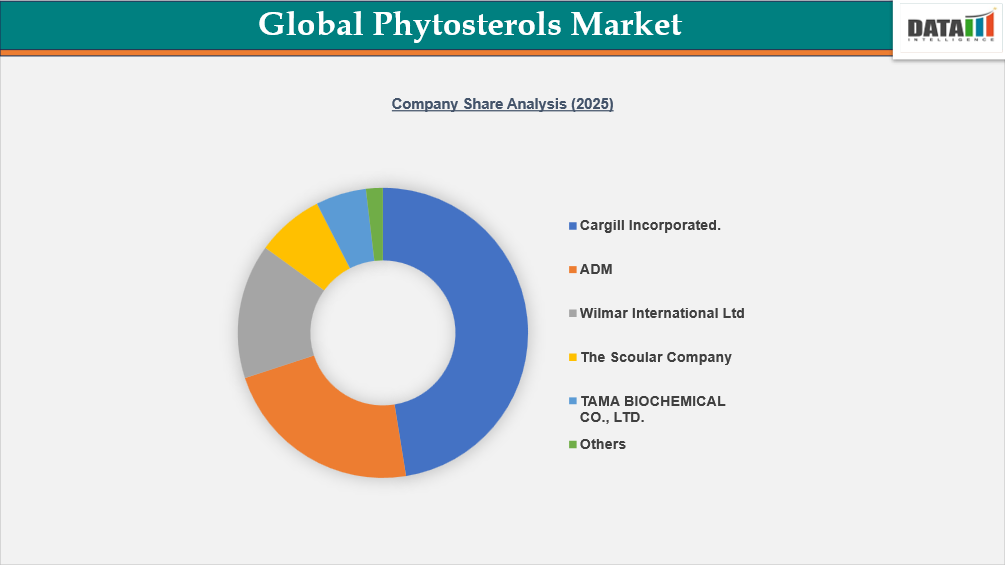
- The global phytosterols market is characterized by a competitive landscape that includes both established and regional players.
- Key players include Cargill Incorporated, ADM, Wilmar International Ltd, The Scoular Company, TAMA BIOCHEMICAL CO., LTD., Raisio Oyj, Arboris, Kensing LLC., VITAE NATURALS, Matrix Life Science, Ebos Biotech, AdvaCare Pharma, Inlife Pharma Private Limited, VetriScience
Key Developments of the Phytosterols Market
December 2025: ADM advanced Plant Sterols AN, a science-backed phytosterol solution for shrimp feed, supported by a 62-day feeding study showing plant sterols could replace animal-derived cholesterol while maintaining comparable growth performance and feed utilisation.
November 2025: Kensing LLC launched Sunvasterol™, a next-generation, non-GMO and allergen-free phytosterol ingredient upcycled from sunflower-oil distillates, following exclusive EU authorisation for naturally derived sunflower-sourced phytosterols.
November 2025: Kensing LLC introduced a circular-production advancement for sunflower phytosterols through its Spanish facilities in Valencia and Talavera de la Reina, converting sunflower-oil byproducts into clean-label sterols for food and dietary-supplement applications.
Why Choose DataM?
- Data-Driven Insights: Dive into detailed analyses with granular insights such as pricing, market shares and value chain evaluations, enriched by interviews with industry leaders and disruptors.
- Post-Purchase Support and Expert Analyst Consultations: As a valued client, gain direct access to our expert analysts for personalized advice and strategic guidance, tailored to your specific needs and challenges.
- White Papers and Case Studies: Benefit quarterly from our in-depth studies related to your purchased titles, tailored to refine your operational and marketing strategies for maximum impact.
- Annual Updates on Purchased Reports: As an existing customer, enjoy the privilege of annual updates to your reports, ensuring you stay abreast of the latest market insights and technological advancements. Terms and conditions apply.
- Specialized Focus on Emerging Markets: DataM differentiates itself by delivering in-depth, specialized insights specifically for emerging markets, rather than offering generalized geographic overviews. This approach equips our clients with a nuanced understanding and actionable intelligence that are essential for navigating and succeeding in high-growth regions.
- Value of DataM Reports: Our reports offer specialized insights tailored to the latest trends and specific business inquiries. This personalized approach provides a deeper, strategic perspective, ensuring you receive the precise information necessary to make informed decisions. These insights complement and go beyond what is typically available in generic databases.
Target Audience
- Manufacturers/ Buyers
- Industry Investors/Investment Bankers
- Research Professionals
- Emerging Companies





























































