


Particle Therapy Market Size
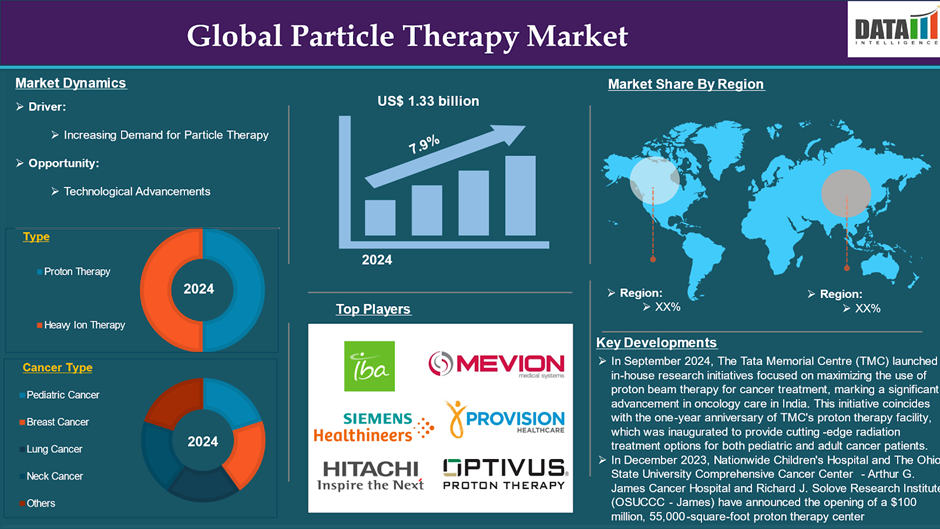
The Global Particle Therapy Market reached US$ 1.44 billion in 2025 and is expected to reach US$ 2.58 billion by 2033, growing at a CAGR of 7.9% during the forecast period 2026-2033.
Particle therapy is an advanced form of radiation treatment that targets cancerous cells with charged particles such as protons, neutrons, and carbon ions. Unlike typical photon-based therapies that use X-rays, particle therapy uses the distinct physical features of charged particles to deliver radiation more precisely. This precision enables the greatest amount of radiation to be localized at the tumor site while minimizing exposure to adjacent healthy tissues, lowering the risk of side effects and long-term consequences associated with traditional radiation therapies.
The increasing demand for particle therapy is the driving factor that drives the market over the forecast period. The increasing number of cancer cases increases the demand for particle therapy since it is used in the treatment and management of cancer. For instance, according to the National Institute of Health, In 2023, the United States is projected to see 1,958,310 new cancer cases. Prostate cancer incidence reached 3% every year from 2014 to 2019, after two decades of reduction, resulting in an additional 99,000 new cases.
Executive Summary
For more details on this report –Request for Sample
Particle Therapy Market : Key Takeaways
- US$ 2.58 billion is the 2033 market opportunity. The market’s expansion from US$ 1.44 billion in 2025 reflects rising adoption of precision radiation therapies, increasing cancer incidence, and continued investments in advanced oncology treatment infrastructure.
- North America leads while Asia-Pacific is the fastest-growing region. North America benefits from established proton therapy centers, favorable reimbursement, and advanced healthcare infrastructure, whereas Asia-Pacific is witnessing rapid expansion through new treatment facilities, government funding, and increasing cancer care investments.
- Proton therapy remains the dominant treatment modality. Its ability to precisely target tumors while minimizing radiation exposure to surrounding healthy tissue continues to drive adoption, particularly for pediatric cancers and complex tumors. Heavy ion therapy is gaining traction for radio-resistant cancers.
- Cancer incidence is the primary demand catalyst. The growing global burden of cancer, coupled with increasing awareness of advanced radiation treatment options, is accelerating investments in particle therapy systems and specialized treatment centers.
- Technology innovation is improving treatment precision. Advancements in beam delivery systems, imaging integration, treatment planning software, and motion management technologies are enhancing clinical accuracy, reducing side effects, and improving patient outcomes.
- Healthcare infrastructure investments are expanding market access. Governments, research institutions, and private healthcare providers are increasing capital spending on proton therapy centers, compact treatment systems, and next-generation oncology facilities to meet growing patient demand.
- Clinical evidence is strengthening adoption across cancer indications. Expanding research demonstrating improved outcomes for pediatric, head & neck, brain, prostate, and other difficult-to-treat cancers is supporting broader physician acceptance and reimbursement discussions.
Particle Therapy Market Scope
| Metrics | Details | |
| CAGR | 7.9% | |
| Market Size Available for Years | 2025-2033 | |
| Estimation Forecast Period | 2026-2033 | |
| Revenue Units | Value (US$ Mn) | |
| Segments Covered | Type | Proton Therapy, Heavy Ion Therapy |
| System | Single Room Systems, Multi-room Systems | |
| Application | Treatment, Clinical Research | |
| Cancer Type | Pediatric Cancer, Breast Cancer, Lung Cancer, Neck Cancer, Others | |
| End-User | Hospitals, Cancer Research Centers, Others | |
| Regions Covered | North America, Europe, Asia-Pacific, South America, and Middle East & Africa | |
Particle Therapy Market Dynamics: Drivers & Restraints
Increasing demand for particle therapy
The increasing demand for particle therapy is expected to be a significant factor in the growth of the global particle therapy market. The global particle therapy market is poised for significant expansion, owing mostly to the rising prevalence of cancer, technological advancements, recent launches and approvals, strategic partnerships, and increasing awareness among people. Particle therapy, which includes proton and heavy ion therapies, has several advantages over typical photon-based radiation treatments, including less harm to healthy tissues and fewer long-term negative effects. This precision in targeting malignancies improves patients' overall quality of life, resulting in an increasing preference for particle therapy among both healthcare practitioners and patients.
The rising global incidence of cancer has a substantial impact on the growing need for particle therapy. Cancer remains one of the top causes of sickness worldwide. For instance, According to the World Cancer Research Fund, the number of cancer cases in 2022, including non-melanoma skin cancer (NMSC), was 19,976,499. When NMSCs were eliminated, the global cancer case count was reduced to 18,741,966 in 2022. There were 9,566,825 males and 9,175,141 females. Furthermore, according to the IARC, there will be about 20 million new cancer cases in 2022 (including nonmelanoma skin cancers [NMSCs]). According to estimates, one in every five men and women will get cancer at some point in their lives. Lung cancer was the most often diagnosed cancer in 2022, accounting for about 2.5 million new cases, or one in every eight malignancies globally (12.4% of all cancers). Thus the need for effective treatment alternatives has never been stronger. This rising incidence highlights the critical need for improved therapeutic techniques such as particle therapy, which comprises proton and heavy ion therapies known for their precision in targeting tumors while causing minimal damage to adjacent healthy tissues.
Technological advancements have significantly improved the accessibility and efficacy of particle treatment. Recent innovations include the advent of compact and less expensive proton therapy devices, which made it possible for the installation of more treatment centers in diverse places. These innovations not only lower total treatment costs but also simplify the operational complexity involved with classic particle therapy systems. For instance, in October 2024, Jefferson Lab announced that it is collaborating with the Hampton University Proton Cancer Institute (HUPCI) and Leo Cancer Care to study the potential of proton therapy as a safer cancer treatment option. This collaboration intends to use new technology to improve the precision and effectiveness of proton therapy, which uses high-energy proton beams to target cancers while causing minimal damage to surrounding healthy tissues. This initiative is particularly significant since it aims to replace standard treatments that rely on radioactive isotopes like cobalt-60, which pose inherent radiological dangers.
High initial costs
Factors such as high initial costs are expected to hamper the global particle therapy market. Setting up a particle therapy center can cost more than USD 100 million, which includes expensive equipment such as cyclotrons or synchrotrons, specific shielding infrastructure, and the technologies required to ensure patient safety during treatment. For instance, according to the National Institute of Health, Particle treatment expenses vary from Euro 10,030 (c-ion: lung cancer) to Euro 39,610 (proton: head & neck malignancies). Many healthcare providers face a barrier to entry as a result of these significant capital commitments, particularly in underdeveloped countries with inadequate funding and healthcare budgets. As a result, the high financial cost of particle therapy limits its widespread acceptance and accessibility to individuals who could benefit from this innovative therapeutic technique.
Particle Therapy Market Segment Analysis
The global particle therapy market is segmented based on type, system, application, cancer type, end-user, and region.
Proton Therapy segment is expected to dominate the global particle therapy market share
The proton therapy segment is anticipated to dominate the global particle therapy market owing to its unique advantages, technological advancements, and increasing acceptance among healthcare providers and patients. Proton therapy uses charged particles, or protons, to deliver targeted radiation to malignant tumors while limiting damage to surrounding healthy tissues. This accuracy is especially useful for treating cancers near important organs, such as brain tumors or pediatric cancers, where conventional radiation therapies may represent a larger risk of collateral damage. As more people become aware of the benefits of proton therapy, demand for its utilization increases.
The increasing prevalence of cancer, as well as technological improvements that have made proton therapy more accessible and effective, are driving the segment's rise. Compact proton therapy devices and advanced imaging techniques have improved treatment delivery, resulting in more efficient patient management and better clinical outcomes. These technological advancements are critical in resolving the limits of standard photon treatment, hence strengthening proton therapy's market position.
Furthermore, the growing number of proton therapy centers worldwide contributes to the segment's dominance. Major investments and launches by healthcare organizations and governments have contributed to financing the establishment of new centers equipped with modern proton treatment devices. For instance, in February 2024, the University of Leeds initiated a trial supported by the National Institute for Health and Care Research (NIHR) and the Medical Research Council (MRC) to look into a possible treatment for brain cancer. A new clinical trial concentrating on proton beam therapy for brain cancer began in the United Kingdom, representing a significant leap in cancer treatment choices. This trial, called APPROACH (Analysis of Proton vs Photon Radiotherapy in Oligodendroglioma and Assessment of Cognitive Health), seeks to determine whether proton beam therapy can lessen long-term side effects when compared to regular photon radiotherapy. The experiment is aimed specifically at patients diagnosed with oligodendroglioma, a kind of brain cancer that affects roughly 350 people in the UK each year.
Particle Therapy Market Geographical Share
North America is expected to hold a significant position in the global particle therapy market share
North America is anticipated to hold a significant portion of the global particle therapy market owing to the rising prevalence of cancer, technological advancements, recent product launches and approvals, strategic partnerships, and increasing awareness. The higher prevalence of cancer in North America also contributes to the increased demand for advanced treatment solutions. This alarming trend highlights the critical need for effective treatment alternatives, encouraging healthcare experts and patients to look into sophisticated medicines like particle therapy. As more patients become aware of the benefits of proton therapy, they are turning to this tailored treatment technique, which allows for more precise tumor targeting while avoiding damage to adjacent healthy tissues.
For instance, according to an article published by the National Institute of Health in 2024, the United States is projected to see 2,001,140 new cancer cases. North America's dominance in the particle therapy segment is due to technological breakthroughs. The emergence of small proton therapy systems has transformed the scene by making treatment more accessible and affordable. These systems require less physical space than traditional setups, allowing more hospitals and clinics to use proton therapy in their cancer treatment options. Furthermore, advances such as pencil-beam scanning and real-time imaging technology improve the precision of proton treatment, allowing practitioners to deliver targeted radiation more effectively while reducing damage to adjacent healthy tissues. This level of accuracy is especially useful for treating tumors near essential structures, such as those found in pediatric patients or brain cancers.
For instance, in December 2023, Nationwide Children's Hospital and The Ohio State University Comprehensive Cancer Center - Arthur G. James Cancer Hospital and Richard J. Solove Research Institute (OSUCCC - James) have announced the opening of a $100 million, 55,000-square-foot proton therapy center, the first treatment facility in central Ohio to provide this highly targeted form of radiation therapy for the treatment of complex tumors that cannot be removed surgically.
Asia Pacific is growing at the fastest pace in the global particle therapy market
One of the key drivers of this expansion is Asia Pacific's huge and expanding population, which contributes to an increased incidence of oncological disorders. As cancer incidence continues to increase across this diverse region, the need for advanced treatment modalities like particle therapy becomes increasingly critical.
For instance, according to the National Institute of Health, the estimated number of cancer cases in India in 2022 is 14,61,427 (crude rate: 100.4 per 100,000). In India, one in every nine people is likely to develop cancer over their lifetime. Males and females were more likely to acquire lung and breast cancers, respectively. This alarming trend underscores the urgent need for effective treatment options that can address the unique challenges posed by various types of cancer prevalent in the region.
Particle Therapy Major Global Players
The major global players in the global particle therapy market include IBA Worldwide, Siemens Healthcare Private Limited, Hitachi High-Tech Corporation, Mevion Medical Systems, Provision Healthcare, Optivus Proton Therapy, Inc., Sumitomo Heavy Industries, Ltd., ProTom International, B dot Medical Inc., Atlas Copco Group among others.
Emerging Players
Panacea, Terapet, and P-Cure among others
Particle Therapy Market Recent Developments
- February 2026: Growing adoption of proton therapy across North America and Europe accelerated demand for advanced particle therapy systems offering precise tumor targeting with reduced damage to surrounding tissues.
- January 2026: Increasing investments in cancer treatment centers in Asia-Pacific and Middle East & Africa strengthened expansion of particle therapy infrastructure and oncology care capabilities.
- December 2025: Rising integration of AI-guided planning across Europe and North America improved treatment accuracy, radiation dose optimization, and patient-specific therapy planning.
- November 2025: Expansion of clinical research in Asia-Pacific and Europe enhanced development of next-generation particle therapy solutions for pediatric and complex cancer cases.
- October 2025: Increasing prevalence of cancer and growing preference for non-invasive oncology treatments in North America and Asia-Pacific boosted demand for effective particle therapy systems globally.
- September 2025: Growing advancements in carbon ion therapy across Europe and Asia-Pacific improved treatment effectiveness for radioresistant and hard-to-treat tumors.
- August 2025: Rising focus on precision oncology in Latin America and Middle East & Africa encouraged adoption of particle therapy technologies for personalized cancer treatment approaches.
- July 2025: Increasing government funding and healthcare modernization initiatives in Asia-Pacific and Europe accelerated installation of advanced particle therapy equipment and expansion of specialized oncology facilities worldwide.
Why Purchase the Report?
- Pipeline & Innovations: Reviews ongoing clinical trials, product pipelines, and forecasts upcoming advancements in medical devices and pharmaceuticals.
- Product Performance & Market Positioning: Analyzes product performance, market positioning, and growth potential to optimize strategies.
- Real-world Evidence: Integrates patient feedback and data into product development for improved outcomes.
- Physician Preferences & Health System Impact: Examines healthcare provider behaviors and the impact of health system mergers on adoption strategies.
- Market Updates & Industry Changes: Covers recent regulatory changes, new policies, and emerging technologies.
- Competitive Strategies: Analyzes competitor strategies, market share, and emerging players.
- Pricing & Market Access: Reviews pricing models, reimbursement trends, and market access strategies.
- Market Entry & Expansion: Identifies optimal strategies for entering new markets and partnerships.
- Regional Growth & Investment: Highlights high-growth regions and investment opportunities.
- Supply Chain Optimization: Assesses supply chain risks and distribution strategies for efficient product delivery.
- Sustainability & Regulatory Impact: Focuses on eco-friendly practices and evolving regulations in healthcare.
- Post-market Surveillance: Uses post-market data to enhance product safety and access.
- Pharmacoeconomics & Value-Based Pricing: Analyzes the shift to value-based pricing and data-driven decision-making in R&D.
Key Procurement Priorities and Buyer Evaluation Criteria
- The procurement decision-making process is being influenced by the increasing global cancer burden, rising demand for highly precise radiation therapies, growing adoption of proton and heavy ion therapy, and expanding investments in advanced oncology infrastructure. These factors are driving healthcare providers toward particle therapy systems that deliver superior tumor targeting while minimizing damage to surrounding healthy tissues.
- Buyers evaluate factors such as treatment accuracy, beam delivery precision, clinical efficacy, patient throughput, system reliability, operational uptime, radiation safety, treatment planning capabilities, and compliance with international healthcare and radiation safety standards when selecting particle therapy solutions for cancer treatment centers.
- The buyer considers system integration capabilities, imaging compatibility, treatment planning software, AI-assisted workflow optimization, maintenance support, service agreements, facility construction requirements, scalability, and interoperability with existing oncology infrastructure while choosing technology partners for new installations or facility expansions.
- Procurement decisions are also shaped by long-term clinical and financial considerations, with buyers evaluating suppliers based on lifecycle costs, energy efficiency, reimbursement potential, training programs, research collaboration opportunities, technological upgrades, and sustainability initiatives as healthcare institutions focus on delivering advanced cancer care while optimizing operational efficiency.
Why Choose DataM?
Technological Innovations
Explores advancements in particle therapy technologies, including proton beam therapy systems, heavy ion therapy platforms, pencil beam scanning, intensity-modulated proton therapy (IMPT), image-guided particle therapy, adaptive treatment planning, AI-enabled workflow optimization, and advanced motion management technologies, enabling greater treatment precision, improved patient outcomes, reduced toxicity, and enhanced operational efficiency.
Product Performance & Market Positioning
Evaluates how different manufacturers deliver particle therapy solutions based on critical performance parameters such as beam accuracy, treatment speed, imaging integration, dose conformity, system reliability, patient positioning accuracy, facility footprint, software capabilities, and lifecycle support, highlighting how leading companies differentiate through clinical excellence, innovation, and comprehensive oncology solutions.
Real-World Evidence
Highlights the adoption of particle therapy systems across comprehensive cancer centers, academic hospitals, specialty oncology institutes, and research organizations, demonstrating benefits such as improved local tumor control, reduced radiation exposure to healthy tissues, enhanced quality of life, and expanded treatment options for pediatric, neurological, head & neck, prostate, and other complex cancers.
Market Updates & Industry Changes
Tracks key developments such as new particle therapy center installations, regulatory approvals, technology upgrades, expansion of proton therapy facilities, AI-enabled treatment innovations, strategic collaborations, research initiatives, and investments across North America, Europe, and Asia-Pacific, supporting the advancement of precision oncology worldwide.
Competitive Strategies
Analyzes how leading companies expand through technological innovation, strategic partnerships, hospital collaborations, research and development investments, service network expansion, integrated treatment planning solutions, and next-generation accelerator technologies to address the growing demand for advanced radiation oncology treatments.
Pricing & Market Access
Explains pricing variations based on therapy system type, accelerator technology, treatment room configuration, imaging capabilities, software integration, maintenance contracts, installation complexity, and service offerings, along with market access through direct sales, healthcare infrastructure partnerships, oncology equipment distributors, and long-term service agreements supporting global healthcare institutions.
Market Entry & Expansion
Identifies growth opportunities driven by increasing cancer incidence, expanding healthcare infrastructure, favorable government investments, growing awareness of advanced radiation therapy, rising demand for precision medicine, and technological innovation, while outlining strategies such as regional expansion, clinical partnerships, localized manufacturing, research collaborations, and customized oncology solutions for emerging healthcare markets.
Target Audience
- Cancer Treatment Centers & Oncology Hospitals
- Proton Therapy Centers
- Academic Medical Centers & Research Institutes
- Radiation Oncology Departments
- Healthcare Infrastructure Developers
- Particle Therapy System Manufacturers
- Medical Device & Radiation Equipment Companies
- Government Healthcare Authorities & Public Health Organizations
- Healthcare Investors & Private Hospital Networks
- Clinical Research Organizations (CROs)
- Oncology Equipment Distributors & Service Providers
- Healthcare Consulting Firms
- Medical Imaging & Treatment Planning Software Providers
- Healthcare Procurement Organizations
- Medical Universities & Cancer Research Institutes




























































