


Orthopedic Appliances and Fracture Aids Market Size
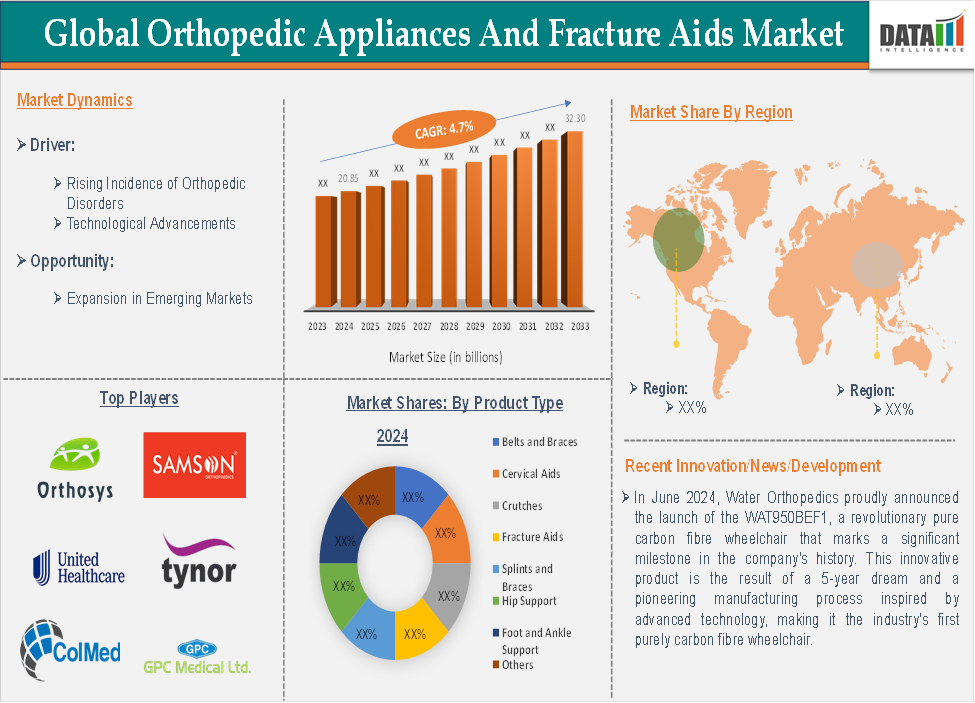
The Orthopedic Appliances and Fracture Aids Market will reach US$ 22.85 billion in 2026, up from US$ 21.83 billion in 2025, and is projected to reach US$ 34.58 billion by 2035, registering steady growth at a CAGR of 4.7% during the forecast period from 2026 to 2035.
Orthopedic devices and fracture management tools are medical equipment designed to provide support, stability, and assistance to the musculoskeletal system. These products are primarily used to treat injuries, deformities, and conditions that affect bones and joints. Orthopedic appliances, such as braces, splints, and supports, are devices that serve a specific medical purpose. They are built to withstand repeated use and are not typically useful for individuals without a medical condition. These appliances aim to restrict or eliminate motion in a diseased, injured, weak, or deformed body part, facilitating healing and improving functionality.
Orthopedic Appliances and Fracture Aids Market Executive Summary
For more details on this report, Request for Sample
Orthopedic Appliances and Fracture Aids Market Scope
| Metrics | Details | |
| CAGR | 4.7% | |
| Market Size Available for Years | 2022-2035 | |
| Estimation Forecast Period | 2025-2035 | |
| Revenue Units | Value (US$ Bn) | |
| Segments Covered | Product Type | Belts and Braces, Cervical Aids, Crutches, Fracture Aids, Splints and Braces, Hip Support, Foot and Ankle Support, Others |
| Application | Fractures, Neurological Disorders, Sport injuries, Sprains, Others | |
| Distribution Channel | Hospital Pharmacies, Retail Pharmacies, Online Pharmacies | |
| Regions Covered | North America, Europe, Asia-Pacific, South America, and the Middle East & Africa | |
Key Takeaways
- North America accounted for approximately 38-42% of the global Orthopedic Appliances and Fracture Aids Market share in 2025, driven by increasing orthopedic procedures, expanding geriatric populations, and significant investments supporting advanced rehabilitation technologies.
- Belts and braces represented nearly 30-35% of total market revenue in 2025 owing to their widespread utilization across musculoskeletal disorders, sports injuries, and post-operative rehabilitation applications.
- Fracture management applications contributed approximately 35-40% of overall market demand in 2025, supported by increasing incidences of trauma-related injuries, osteoporosis-associated fractures, and orthopedic surgical interventions globally.
- More than 70% of newly introduced orthopedic products globally incorporate lightweight materials, ergonomic designs, or advanced patient comfort technologies designed to improve treatment outcomes and patient compliance capabilities.
- Hospitals and specialty orthopedic clinics accounted for nearly 60-65% of total market demand in 2025, reflecting increasing investments supporting orthopedic healthcare infrastructure and rehabilitation programs worldwide.
- Geriatric healthcare applications are anticipated to contribute approximately 30-35% of future commercialization opportunities through 2033 owing to increasing prevalence of osteoporosis, arthritis, and mobility-related disorders among aging populations globally.
- Asia-Pacific is projected to register the fastest regional growth during the forecast period owing to improving healthcare infrastructure, increasing sports participation rates, and expanding investments supporting orthopedic healthcare innovations across emerging economies.
- Smart orthopedic devices and personalized rehabilitation technologies are expected to account for approximately 25-30% of future product innovations globally, substantially strengthening connected healthcare and remote patient monitoring capabilities.
- More than 60% of strategic collaborations announced across the market involve rehabilitation technologies, orthopedic device innovations, and healthcare partnerships, highlighting the increasing importance of technological advancements worldwide.
Orthopedic Appliances and Fracture Aids Market Dynamics: Drivers & Restraints
Orthopedic Appliances and Fracture Aids Market Rising Incidence of Orthopedic Disorders
Musculoskeletal conditions, including osteoarthritis, rheumatoid arthritis, and osteoporosis, are becoming more widespread, particularly among the aging population. As per WHO data in July 2022, around 1.71 billion individuals globally suffer from musculoskeletal conditions. These disorders are the primary cause of disability worldwide, with low back pain recognized as the leading cause of disability in 160 countries.
Moreover, the increase in sports participation has led to a rise in sports-related injuries that necessitate orthopedic care. Conditions like tendinopathies and ligament sprains are becoming more prevalent as individuals take part in more physical activities. In addition, advancements in orthopedic treatments and devices, Innovations such as minimally invasive surgical methods and enhanced imaging technologies are improving diagnostic accuracy and treatment efficacy, driving the market growth.
Major players in the industry are launching innovative products and key developments that would propel this market growth. For instance, in June 2024, Water Orthopedics proudly announced the launch of the WAT950BEF1, a revolutionary pure carbon fibre wheelchair that marks a significant milestone in the company's history. This innovative product is the result of a 5-year dream and a pioneering manufacturing process inspired by advanced technology, making it the industry's first purely carbon fibre wheelchair. All these factors demand the global orthopedic appliances and fracture aids market.
Orthopedic Appliances and Fracture Aids Market Stringent Regulatory Approvals
One of the key challenges in the global orthopedic appliances and fracture aids market is the stringent regulatory approvals required for product development and commercialization. Since these devices are directly involved in patient care and rehabilitation, they must meet rigorous safety, quality, and performance standards set by health authorities.
In the United States, for instance, the Food and Drug Administration (FDA) classifies most orthopedic appliances as Class I or Class II medical devices, which require either general controls or premarket notification (510(k)) to demonstrate substantial equivalence to a legally marketed device. In Europe, manufacturers must comply with the Medical Device Regulation (MDR), which enforces more comprehensive documentation, clinical evaluations, and post-market surveillance compared to the previous Medical Device Directive (MDD). Thus, the above factors could be limiting the global orthopedic appliances and fracture aids market's potential growth.
Orthopedic Appliances and Fracture Aids Market Regulatory and Quality Compliance Landscape Analysis
The Orthopedic Appliances and Fracture Aids Market operates within a highly regulated healthcare environment characterized by stringent medical device quality standards and patient safety requirements worldwide. Regulatory authorities continue emphasizing product efficacy validation, manufacturing quality assurance programs, and post-market surveillance initiatives governing orthopedic medical devices. Increasing implementation of international medical device regulations is anticipated to substantially influence commercialization activities across major healthcare markets. Furthermore, evolving regulatory frameworks supporting connected healthcare technologies are expected to significantly strengthen future market competitiveness globally.
Orthopedic Appliances and Fracture Aids Market Manufacturing and Commercialization Landscape Analysis
Commercial manufacturing capabilities remain strategically important across Orthopedic Appliances and Fracture Aids Market commercialization activities worldwide. Manufacturers continue investing substantially in advanced production technologies, manufacturing automation capabilities, and supply chain optimization initiatives designed to address evolving healthcare requirements globally. Strategic collaborations involving orthopedic device manufacturers, healthcare providers, and technology organizations are substantially strengthening commercialization initiatives worldwide. Furthermore, increasing investments supporting sustainable manufacturing practices and scalable production capabilities are anticipated to significantly improve future market competitiveness throughout the forecast period.
Orthopedic Appliances and Fracture Aids Market Investment and Strategic Collaboration Analysis
Public and private sector investments supporting orthopedic healthcare innovations continue creating substantial commercialization opportunities across global markets. Market participants are increasingly allocating resources toward next-generation orthopedic technologies, digital rehabilitation platforms, and customized patient care solutions designed to improve treatment outcomes significantly. Strategic collaborations involving healthcare institutions, technology providers, and orthopedic manufacturers are anticipated to accelerate product development initiatives and strengthen competitive positioning globally. Furthermore, increasing institutional investments supporting musculoskeletal healthcare innovations are expected to positively influence future market developments considerably.
Orthopedic Appliances and Fracture Aids Market Emerging Technologies Analysis
Emerging technologies involving artificial intelligence-assisted rehabilitation systems, wearable orthopedic monitoring devices, three-dimensional printed orthotics, and digital healthcare integration capabilities are substantially transforming future market opportunities worldwide. Innovations supporting personalized treatment planning and intelligent mobility assessment technologies are anticipated to significantly improve patient outcomes globally. Furthermore, increasing adoption of remote patient monitoring capabilities and connected healthcare ecosystems is expected to substantially strengthen commercialization opportunities throughout the forecast period.
Orthopedic Appliances and Fracture Aids Market Future Market Trends (2026-2035)
The Orthopedic Appliances and Fracture Aids Market is expected to witness sustained growth throughout the forecast period driven by increasing prevalence of musculoskeletal disorders, expanding geriatric healthcare requirements, and continuous technological advancements across orthopedic support technologies. Future market expansion will be supported by intelligent orthopedic devices, personalized rehabilitation initiatives, advanced manufacturing capabilities, and connected healthcare innovations worldwide. Additionally, increasing investments supporting healthcare infrastructure development and digital healthcare transformation initiatives are anticipated to significantly influence future market dynamics across major healthcare economies.
Orthopedic Appliances and Fracture Aids Market Segment Analysis
The global orthopedic appliances and fracture aids market is segmented based on product type, application, distribution channel, and region.
Product Type:
The belts and braces segment in product type is expected to dominate the global orthopedic appliances and fracture aids market with the highest market share
The belts and braces segment of the orthopedic appliances and fracture aids market includes a range of supportive devices aimed at stabilizing, immobilizing, and assisting in the rehabilitation of musculoskeletal injuries and conditions. Moreover, key players in the market are introducing innovative knee caps, back support belts, & knee support belts, and key developments in orthopedic services that would drive this segment's growth in the market.
For instance, in January 2024, Enovis' DJO subsidiary introduced its new DonJoy Roam OA knee brace, designed for patients suffering from osteoarthritis or experiencing other forms of knee pain and instability. Roam OA represents the company's latest advancement in unloader technology, which aims to alleviate the pressure associated with unicompartmental osteoarthritis by redistributing weight away from the affected knee.
Similarly, in January 2022, Össur introduced the ReLeaf Active knee brace, specifically designed to offer pain relief and support for individuals with osteoarthritis. This brace features a distinctive hinge design that mimics the natural movement of the knee and is constructed from lightweight, breathable materials to ensure comfort for the user. These factors have solidified the segment's position in the global orthopedic appliances and fracture aids market.
Orthopedic Appliances and Fracture Aids Market Geographical Analysis
North America is expected to hold a significant position in the global orthopedic appliances and fracture aids market, with the highest market share
The region is experiencing a significant increase in its elderly population, especially in countries like the U.S. and Canada. This demographic change results in a higher incidence of orthopaedic conditions, such as osteoporosis and arthritis, which in turn boosts the demand for orthopaedic devices and treatments. As more individuals in the North America region engage in sports and physical activities, there has been a rise in sports-related injuries. This trend requires effective orthopaedic solutions, such as braces and supports, to manage these injuries effectively.
Moreover, key player strategies such as partnerships, collaborations, and product approvals help to drive this market growth. For instance, in February 2023, Breg, Inc., a supplier of high-quality sports medicine products based in Carlsbad, California, is expanding its presence in China through a collaboration with Coreal International. The partnership will enable Chinese physicians and patients to access Breg's extensive range of products starting this spring. Breg offers a diverse selection of sports medicine and rehabilitation products, including braces for knees, hips, shoulders, fracture repair, elbows, wrists, spine, feet, and ankles.
Also, in July 2023, CyMedica Orthopedics rebranded its wearable knee pain treatment as Motive Health and made it available directly to consumers following FDA clearance, allowing anyone experiencing knee discomfort to purchase the device without a prescription. Thus, the above factors are consolidating the region's position as a dominant force in the global orthopedic appliances and fracture aids market.
Orthopedic Appliances and Fracture Aids Market Major Global Players
The major global players in the orthopedic appliances and fracture aids market include Orthosys, GPC Medical Ltd, United Medicare, Modern Medical Aids, Apothecaries Sundries Mfg. Pvt. Ltd., Samsonorthotics.com, TYNOR ORTHOTICS, Collateral Medical Pvt Ltd, Inc., Aapson Orthotics, GWS Surgicals LLP., and ENOVIS CORPORATION, among others.
Key Developments in Orthopedic Appliances and Fracture Aids Market
- June 2026: ENOVIS Corporation continued expanding its orthopedic solutions portfolio through advancements in bracing, rehabilitation, and fracture management technologies designed to improve patient mobility and recovery outcomes.
- June 2026: TYNOR ORTHOTICS Pvt. Ltd. strengthened its orthopedic appliances business by expanding manufacturing capabilities and enhancing its portfolio of clinically designed supports, braces, and fracture aids for global markets.
- May 2026: GPC Medical Ltd. continued advancing its orthopedic product offerings through investments in high-quality fracture management and rehabilitation devices for healthcare institutions worldwide.
- May 2026: United Medicare expanded its orthopedic appliances portfolio by strengthening the availability of fracture aids and rehabilitation products across domestic and international markets.
- April 2026: Orthosys continued enhancing its orthopedic solutions through ongoing product innovations focused on patient comfort, anatomical support, and improved clinical outcomes in fracture care.
- April 2026: Apothecaries Sundries Manufacturing Co. Pvt. Ltd. strengthened its healthcare products portfolio by expanding orthopedic support and rehabilitation solutions for hospitals and home care settings.
- March 2026: Modern Medical Aids advanced its orthopedic appliances offerings by introducing improvements in mobility aids and fracture management products designed for enhanced patient care.
- March 2026: Collateral Medical Pvt. Ltd. continued investing in orthopedic rehabilitation technologies and fracture care solutions to address growing demand across healthcare facilities.
- February 2026: GWS Surgicals LLP. strengthened its orthopedic product range through the expansion of surgical and fracture support devices catering to trauma and rehabilitation applications.
Why Purchase the Report?
This report delivers comprehensive market intelligence on the Orthopedic Appliances and Fracture Aids Market by providing actionable insights into technological advancements, investment trends, regulatory developments, and commercialization opportunities across major global healthcare markets. It enables stakeholders to identify high-growth opportunities across orthopedic rehabilitation technologies, customized orthopedic appliances, and advanced fracture management solutions while evaluating evolving market adoption patterns worldwide. Furthermore, the report supports informed strategic decision-making related to product innovation initiatives, manufacturing capacity expansion strategies, investment planning activities, strategic collaborations, and market entry opportunities by providing in-depth analyses of competitive dynamics, regional growth prospects, and future technological developments expected to shape the industry through 2035.
- Pipeline & Innovations: Reviews ongoing clinical trials and product pipelines and forecasts upcoming advancements in medical devices and pharmaceuticals.
- Product Performance & Market Positioning: Analyzed product performance, market positioning, and growth potential to optimize strategies.
- Real-World Evidence: Integrates patient feedback and data into product development for improved outcomes.
- Physician Preferences & Health System Impact: Examines healthcare provider behaviors and the impact of health system mergers on adoption strategies.
- Market Updates & Industry Changes: This covers recent regulatory changes, new policies, and emerging technologies.
- Competitive Strategies: Analyze competitor strategies, market share, and emerging players.
- Pricing & Market Access: Reviews pricing models, reimbursement trends, and market access strategies.
- Market Entry & Expansion: Identifies optimal strategies for entering new markets and partnerships.
- Regional Growth & Investment: Highlights high-growth regions and investment opportunities.
- Supply Chain Optimization: Assesses supply chain risks and distribution strategies for efficient product delivery.
- Sustainability & Regulatory Impact: Focuses on eco-friendly practices and evolving regulations in healthcare.
- Post-market Surveillance: Uses post-market data to enhance product safety and access.
- Pharmacoeconomics & Value-Based Pricing: Analyzes the shift to value-based pricing and data-driven decision-making in R&D.
Target Audience 2026
The report is strategically developed for stakeholders operating across the global musculoskeletal healthcare and orthopedic device ecosystem. It provides actionable market intelligence for orthopedic appliance manufacturers, fracture aid providers, rehabilitation technology companies, hospitals, specialty orthopedic centers, and healthcare distributors seeking to strengthen their competitive positioning within rapidly evolving healthcare markets. Furthermore, healthcare consultants, academic institutions, regulatory organizations, medical device manufacturers, healthcare infrastructure developers, investment firms, and strategic business leaders can utilize the report to evaluate emerging technological innovations, commercialisation trends, and future growth opportunities shaping the Orthopedic Appliances and Fracture Aids Market through 2035.
- Manufacturers: Pharmaceutical, Medical Device, Biotech Companies, Contract Manufacturers, Distributors, Hospitals.
- Regulatory & Policy: Compliance Officers, Government, Health Economists, Market Access Specialists.
- Technology & Innovation: AI/Robotics Providers, R&D Professionals, Clinical Trial Managers, Pharmacovigilance Experts.
- Investors: Healthcare Investors, Venture Fund Investors, Pharma Marketing & Sales.
- Consulting & Advisory: Healthcare Consultants, Industry Associations, Analysts.
- Supply Chain: Distribution and Supply Chain Managers.
- Consumers & Advocacy: Patients, Advocacy Groups, Insurance Companies.
- Academic & Research: Academic Institutions.
The global orthopedic appliances and fracture aids market report delivers a detailed analysis with 65 key tables, more than 60 visually impactful figures, and 176 pages of expert insights, providing a complete view of the market landscape.



























































