


Orthopedic Devices Market Size
The Orthopedic Devices Market is estimated to reach USD 60.97 Billion in 2025 and is projected to grow to USD 91.12 billion by 2035, registering steady growth at a CAGR of 4.1% during the forecast period from 2026 to 2035.
Orthopedic devices are specialized medical equipment used to treat, support, and replace musculoskeletal system components such as bones, joints, and soft tissues. These devices are essential for controlling a wide range of problems caused by trauma, congenital abnormalities, or degenerative diseases. They are vital in both surgical and non-surgical treatments, allowing patients with musculoskeletal problems to heal more quickly and improve their quality of life. In addition to physical support, orthopedic devices can considerably enhance patient outcomes by shortening recovery durations and increasing rehabilitation processes. Especially after surgeries involving joint replacements or fracture fixations, patients frequently rely on these devices during their recovery period to guarantee appropriate healing and prevent problems.
The increasing prevalence of orthopedic disorders is the driving factor that drives the market over the forecast period. For instance, according to the National Institutes of Health, In the United States, ten million people over the age of fifty suffer from hip osteoporosis. An additional 33.6 million people over the age of 50 have low bone mass or osteopenia of the hip, putting them at risk for osteoporosis and associated problems later in life.
Orthopedic Devices Market Key Takeaways
- Orthopedic disease prevalence remains a core demand catalyst: Osteoporosis, rheumatoid arthritis, osteoarthritis, fractures, spinal disorders, and sports injuries continue to support the requirement for orthopedic treatment and support devices.
- Orthopedic braces represent a major product opportunity: The source identifies orthopedic braces as the anticipated dominant product segment, supported by their use in stabilization, rehabilitation, injury management, and postoperative care.
- North America leads the current market: Established healthcare infrastructure, high procedural demand, major device manufacturers, product launches, and FDA approvals support the region's leading position.
- Asia-Pacific offers the strongest expansion opportunity: Aging populations, growing healthcare investment, and increasing orthopedic disease prevalence in countries such as China and India are strengthening demand.
- Technology is changing competitive positioning: Robotic-assisted surgery, computer-assisted techniques, advanced biomaterials, minimally invasive designs, and digitally supported orthopedic procedures are becoming important areas of product differentiation.
- Pricing remains a procurement consideration: Source data indicates implant costs ranging from USD 350 to USD 6,370, while the reported average per-case implant cost is USD 2,817, highlighting the importance of pricing, reimbursement, clinical value, and health-economic evidence.
Orthopedic Devices Market Scope
| Metric | Market Detail |
| Market Size, 2025 | USD 60.97 billion |
| Market Size, 2035 | USD 91.12 billion |
| CAGR | 4.10% |
| Historic Years | 2023-2024 |
| Base Year | 2025 |
| Forecast Period | 2026-2035 |
| 2023 Market Size | USD 56.26 billion, recalculated |
| 2024 Market Size | USD 58.57 billion, recalculated |
| Segments Covered | Product Type, Application, End-User, Region |
| Leading Region | North America |
| Fastest-Growing Region | Asia-Pacific |
Executive Summary
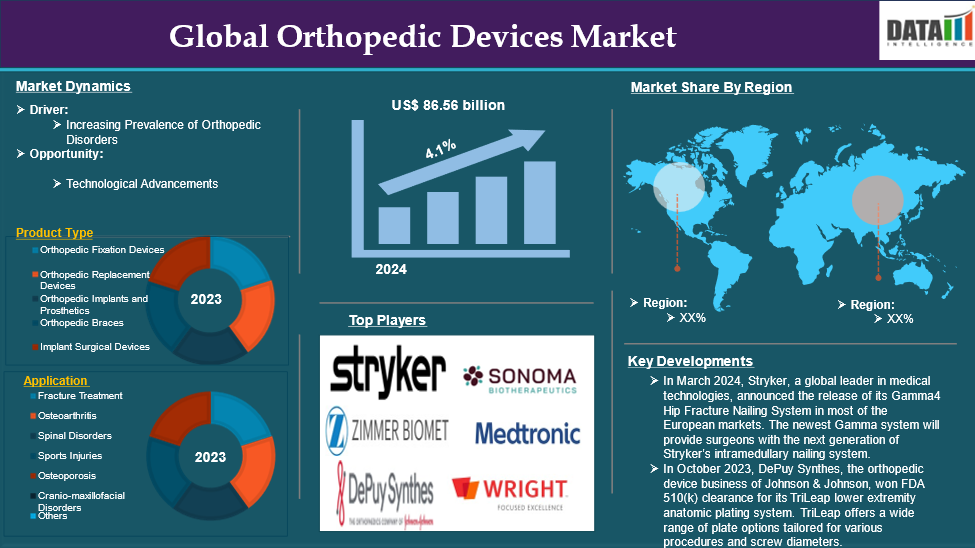
Source: DataM Intelligence
For more details on this report – Request for Sample
Orthopedic Devices Market Dynamics: Drivers & Restraints
Increasing prevalence of orthopedic disorders
The increasing prevalence of orthopedic disorders is expected to be a significant factor in the growth of the global orthopedic devices market. The global orthopedic devices market is poised for significant expansion, owing mostly to the rising prevalence of orthopedic diseases. These disorders, which include a wide spectrum of problems affecting the musculoskeletal system, have emerged as a major public health concern due to their increasing prevalence and the corresponding economic impact on healthcare systems around the world. Due to the increasing number of orthopedic disorders, the demand for orthopedic devices increases.
For instance, according to the World Health Organization, rheumatoid arthritis affects around 18 million people globally. Women account for around 70% of those with rheumatoid arthritis, with 55% being over the age of 55. Rheumatoid arthritis affects 13 million people, with varying degrees of severity. In order to reduce the increasing prevalence of orthopedic diseases, major manufacturers have launched orthopedic devices that are useful in the treatment of various orthopedic disorders. For instance, in February 2023, CurvaFix, Inc., a manufacturer of medical devices that repair fractures in bent bones, announced the release of its smaller-diameter, 7.5mm CurvaFix IM Implant, which is intended to simplify surgery and give strong, stable fixation in small-bone patients.
Robotic procedures, computer-assisted surgical techniques, and the discovery of biocompatible materials have transformed the orthopedic landscape. These developments improve not only surgical precision but also patient outcomes and recuperation timelines. As healthcare providers adopt these new technologies, they will be better prepared to meet the growing need for orthopedic solutions.
High costs of devices
Factors such as high costs of devices are expected to hamper the global orthopedic devices market. The worldwide orthopedic devices market meets significant challenges, particularly given the high cost of these medical technologies. The development, production, and marketing of orthopedic devices require significant expenditure, resulting in higher prices for end users. This price burden might limit patient’s access to required therapies, particularly in low-income areas where healthcare funds are limited. For instance, according to the National Institute of Health, the costs of implants range from $350 to $6,370 right from the basic device to advanced versions. The average per-case cost for an implant was $2,817 (range $1,250 to $7,270).
Orthopedic Devices Market Segment Analysis
The global orthopedic devices market is segmented based on product type, application, end-user, and region.
The orthopedic braces segment is anticipated to dominate the global orthopedic devices market owing to its essential function in several applications across diverse scientific fields. The orthopedic braces sector is anticipated to dominate the worldwide orthopedic devices market, owing to a number of important factors including rising demand for these devices and their critical role in patient care, technological advances, and new product launches. The increasing prevalence of orthopedic diseases, such as arthritis, osteoporosis, and sports-related injuries, has created a greater demand for appropriate support and stabilization solutions.
For instance, according to the International Osteoporosis Foundation, Osteoporosis is predicted to impact 200 million women worldwide, roughly one-tenth of women aged 60, one-fifth of women aged 70, two-fifths of women aged 80, and two-thirds of women aged 90. Furthermore, technological developments in materials and technology have significantly enhanced the functionality and comfort of orthopedic braces. Lightweight materials, customized fits, and integrated support systems have increased the appeal of these devices to patients and healthcare providers. There are recent launches in which the latest technology is being involved in the device. For instance, in August 2024, Aspen Medical Products introduced the Align Orthosis. Align Orthosis, developed in partnership with spine surgeon Han Jo Kim, MD of the Hospital for Special Surgery, is the first prefabricated TLSO designed to reduce the incidence of proximal junctional kyphosis (PJK) after surgery.
Orthopedic Devices Market Geographical Share
North America is expected to hold a significant position in the global orthopedic devices market share
North America will likely account for a significant share of the global orthopedic devices market, owing to its well-established healthcare infrastructure, high demand for novel medical devices, and an increasing patient population requiring orthopedic procedures. As osteoarthritis and osteoporosis become more frequent, the demand for effective orthopedic solutions continues to increase, boosting market expansion in this region.
For instance, according to the Bone Health and Osteoporosis Foundation, approximately 10 million Americans have osteoporosis and another 44 million have low bone density, placing them at increased risk. 54 million Americans, half of all adults age 50 and older, are at risk of breaking a bone. One in two women and up to one in four men will break a bone in their lifetime due to osteoporosis. For women, the incidence is greater than that of heart attack, stroke, and breast cancer combined. Moreover, according to John Hopkins Medicine, 30% of Caucasian postmenopausal women in the United States have osteoporosis, while 54% have osteopenia. The incidence of deficient bone mass rises with age.
The presence of major players in this region, recent product launches, and FDA approvals make North America hold the highest market share. For instance, in October 2024, Smith+Nephew announced that it had launched its Legion-hinged knee (HK) system with Oxinium implant technology in the United States. This implant technology outperforms both metal durability and ceramic wear resistance, as well as corrosion resistance.
Asia Pacific is growing at the fastest pace in the global orthopedic devices market
The Asia Pacific region is emerging as the fastest-growing market for orthopedic devices, owing to a combination of demographic trends, increased healthcare investment, recent launches, and an increasing prevalence of orthopedic diseases. This growth is largely attributed to the rapid increase in the aging population across countries like China and India, where the demand for orthopedic interventions is surging due to age-related conditions such as osteoarthritis and osteoporosis.
For instance, according to the World Health Organization (WHO), 30% of postmenopausal women suffer from osteoporosis. It has been reported that around six crore people in India have osteoporosis and 80% of them are women. The peak incidence of osteoporosis in India occurs 10 – 20 years earlier than in Western countries.
Orthopedic Devices Market Major Players
The major global players in the global orthopedic devices market include Stryker Corporation, Zimmer Biomet, Synthes Inc., Sonoma Orthopaedic Products Inc., Medtronic, Wright Medical Group N.V, Orthofix Medical Inc., Integra LifeSciences, Arthrex Inc., Smith & Nephew plc. among others.
Orthopedic Devices Market Key Developments
August 2026: In North America, orthopedic device companies continued accelerating robotic-assisted surgery and digital technologies. Stryker, Zimmer Biomet, Johnson & Johnson MedTech, Smith+Nephew, and Medtronic remained major players.
July 2026: In North America, Stryker launched the Mako RPS robotic power system for total knee replacement, expanding its Mako platform into handheld orthopedic robotics.
June 2026: In Asia-Pacific, particularly India, China, Japan, and South Korea, orthopedic device adoption continued expanding with demand for joint replacements, trauma devices, and advanced surgical technologies. Stryker, Zimmer Biomet, Medtronic, Smith+Nephew, and Arthrex are key companies.
May 2026: In Europe, orthopedic manufacturers increasingly focused on patient-specific implants, additive manufacturing, robotic surgery, and minimally invasive procedures. Zimmer Biomet, Smith+Nephew, Stryker, and DePuy Synthes continued strengthening their technology portfolios.
April 2026: Globally, the orthopedic devices industry increasingly emphasized robotics, AI-assisted surgery, 3D-printed implants, advanced biomaterials, digital surgical planning, and personalized implants, with companies moving toward integrated technology and implant platforms.
Orthopedic Devices Market Emerging Players
Stoko, Canary Medical, and Loci Orthopedics among others
Why Purchase the Report?
- Pipeline & Innovations: Reviews ongoing clinical trials, product pipelines, and forecasts upcoming advancements in medical devices and pharmaceuticals.
- Product Performance & Market Positioning: Analyzes product performance, market positioning, and growth potential to optimize strategies.
- Real-World Evidence: Integrates patient feedback and data into product development for improved outcomes.
- Physician Preferences & Health System Impact: Examines healthcare provider behaviors and the impact of health system mergers on adoption strategies.
- Market Updates & Industry Changes: Covers recent regulatory changes, new policies, and emerging technologies.
- Competitive Strategies: Analyzes competitor strategies, market share, and emerging players.
- Pricing & Market Access: Reviews pricing models, reimbursement trends, and market access strategies.
- Market Entry & Expansion: Identifies optimal strategies for entering new markets and partnerships.
- Regional Growth & Investment: Highlights high-growth regions and investment opportunities.
- Supply Chain Optimization: Assesses supply chain risks and distribution strategies for efficient product delivery.
- Sustainability & Regulatory Impact: Focuses on eco-friendly practices and evolving regulations in healthcare.
- Post-market Surveillance: Uses post-market data to enhance product safety and access.
- Pharmacoeconomics & Value-Based Pricing: Analyzes the shift to value-based pricing and data-driven decision-making in R&D.
The global orthopedic devices market report delivers a detailed analysis with 60+ key tables, more than 50 visually impactful figures, and 176 pages of expert insights, providing a complete view of the market landscape.
Target Audience 2026
- Manufacturers: Pharmaceutical, Medical Device, Biotech Companies, Contract Manufacturers, Distributors, Hospitals.
- Regulatory & Policy: Compliance Officers, Government, Health Economists, Market Access Specialists.
- Technology & Innovation: AI/Robotics Providers, R&D Professionals, Clinical Trial Managers, Pharmacovigilance Experts.
- Investors: Healthcare Investors, Venture Fund Investors, Pharma Marketing & Sales.
- Consulting & Advisory: Healthcare Consultants, Industry Associations, Analysts.
- Supply Chain: Distribution and Supply Chain Managers.
- Consumers & Advocacy: Patients, Advocacy Groups, Insurance Companies.
- Academic & Research: Academic Institutions.



























































