


Ophthalmology Packaging Market Size
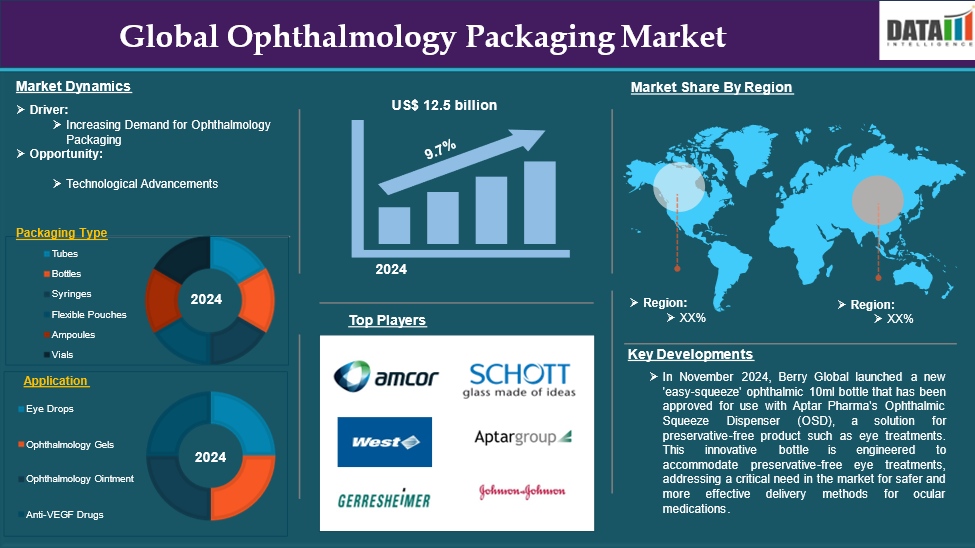
The Global Ophthalmology Packaging Market reached US$13.71 billion in 2025 and is expected to reach US$34.61 billion by 2035, growing at a CAGR of 9.7% during the forecast period 2026-2035, according to DataM Intelligence report.
Ophthalmology packaging refers to specialized packaging solutions designed for eye care products such as medications, medical devices, and surgical instruments. This field includes the design, manufacture, and distribution of packaging materials that assure the safety, sterility, and integrity of ophthalmic products throughout their life cycle. The major purpose of ophthalmic packaging is to protect the sterility of eye drugs and devices. Because many ophthalmic prescription products are delivered topically or intraocularly, any contamination might result in major health hazards, including infections and harmful reactions.
The increasing demand for ophthalmology packaging is the driving factor that drives the market over the forecast period. As the number of ocular disorders increases, the demand for the eye drops increases and the demand for the ophthalmology packaging also increases. For instance, according to the National Institute of Health, 200 million people worldwide are estimated to have AMD, and by 2040, this number is projected to rise to close to 300 million. By 2050, 5.4 million Americans are anticipated to be affected by rising patterns similar to this one.
Ophthalmology Packaging Market Key Takeaways
- 2025 market benchmark: The ophthalmology packaging market is estimated at US$13.71 billion for 2025.
- 2035 outlook: Applying the same CAGR through the fixed forecast period produces a US$34.61 billion market opportunity by 2035.
- Eye drops remain commercially important: High usage across glaucoma, dry eye, allergies, and other ocular conditions supports demand for sterile, precise, easy-to-use dispensing formats.
- North America leads: Established healthcare infrastructure, ophthalmic product manufacturing, technological adoption, exports, and high disease prevalence support the region's significant market position.
- Asia-Pacific offers expansion potential: Growing pharmaceutical manufacturing capabilities, healthcare investment, and ocular disease burden make the region the fastest-growing geographic market in the source analysis.
- Packaging technology is becoming a product differentiator: Smart tracking, tamper-evident systems, preservative-free dispensing, and user-friendly designs can influence patient safety and product positioning.
- Manufacturing economics matter: Source data estimates ophthalmic packaging manufacturing costs at approximately US$0.05 to US$0.50 per unit, depending on package complexity and materials.
Ophthalmology Packaging Market Scope
| Metric | Details |
| Market Size in 2025 | US$13.71 billion |
| Market Size by 2035 | US$34.61 billion |
| CAGR | 9.7% |
| Historic Years | 2023-2024 |
| Base Year | 2025 |
| Forecast Period | 2026-2035 |
| Segments Covered | Packaging Type, Application, Indication, Dosage, Material, End-User, Region |
| Leading Region | North America |
| Fastest-Growing Region | Asia-Pacific |
Executive Summary
For more details on this report – Request for Sample
Ophthalmology Packaging Market Dynamics: Drivers & Restraints
Increasing demand for ophthalmology packaging
The increasing demand for ophthalmology packaging is expected to be a significant factor in the growth of the global ophthalmology market. This growth is driven by a number of factors, including an increase in the prevalence of eye diseases, advances in medication delivery technologies, increase in the e-commerce and a shift toward preservative-free formulation, recent product launches and approvals.
As the number of people suffering from various eye disorders including glaucoma, cataracts, and age-related macular degeneration grows, so does the demand for effective and safe packaging solutions that protect product integrity and patient safety. For instance, according to the Glaucoma Research Foundation, glaucoma affects an estimated 80 million individuals globally. Most interestingly, over half of all glaucoma patients are unaware of their condition. More than 3 million Americans suffer from glaucoma, and over half of them are unaware of their condition. The longer someone lives, the more likely they are to develop glaucoma. Primary open-angle glaucoma is believed to have blinded 8.4 million people around the world in 2010. By 2040, it is anticipated that 22 million people will be blind due to glaucoma.
Furthermore, advances in smart packaging technologies have transformed the face of ophthalmic packaging. RFID and QR code integration improve traceability and safety, enabling for more accurate monitoring of product conditions throughout the distribution process. These technologies not only increase patient adherence to drug regimens, but they also align with rising regulatory demands for transparency and responsibility in pharmaceutical supply chains.
The development of e-commerce is another important element driving the increase of ophthalmic packaging. As more people turn to online pharmacies for eye care, there is an urgent need for secure, tamper-evident, and leak-proof packaging solutions. Manufacturers are responding to this trend by inventing customized packaging that can resist the rigors of direct-to-consumer shipping while guaranteeing that products stay safe and functional once delivered.
High production costs
Factors such as high production costs are expected to hamper the global ophthalmology packaging market. To assure product safety and efficacy, ophthalmic packaging manufacturers must use innovative materials and technology. These severe quality criteria frequently result in higher production costs, which can be especially difficult for smaller businesses who lack the financial resources to engage in complex manufacturing procedures. As a result, high production costs might limit market access and competitiveness, impeding overall growth and innovation in the industry. The average manufacturing costs for ophthalmic packaging are estimated to range between $0.05 and $0.50 per unit, depending on the complexity of the package design and materials utilized. Simple plastic dropper bottles, for example, may be on the lower end of this spectrum, but more advanced designs that use smart technology or specialist materials may be more expensive.
Ophthalmology Packaging Market Segment Analysis
The global ophthalmology packaging market is segmented based on packaging type, application, indication, dosage, material, end-user, and region.
Eye Drops segment is expected to dominate the global ophthalmology packaging market share
Several compelling factors are anticipated to drive the global ophthalmology packaging market, with eye drops leading among them such as increasing prevalence of ocular disorders, recent product launches and approvals and technological advancements. As one of the most regularly used types of medication for a variety of eye problems, eye drops necessitate specific packaging solutions that assure sterility, ease of use, and precise dosing. The rising prevalence of eye illnesses such as glaucoma, dry eye syndrome, and allergies has fueled demand for effective treatments, resulting in an increase in ophthalmic product manufacture and distribution, notably eye drops. This trend is prominent in the significant market share for this sector, which is expected remain consistent as healthcare practitioners and patients rely more on these formulations to manage eye health.
For instance, according to the World Health Organization, cataracts affect approximately 65.2 million people and cause moderate to severe vision loss in over 80% cases. Cataract is responsible for over 51% of blindness in the Eastern Mediterranean Region. Moreover, according to the UH Hospitals, an estimated 3.2 million women age 50 and over, and 1.68 million men age 50 and over are affected by dry eye. The occurrence of dry eye increases with age. SERI reports that nearly 75 percent of people over age 65 will experience dry eye syndrome6, and the condition occurs most often in older women after menopause. As the number of ocular disorders increases, the demand for the eye drops increases and the demand for the ophthalmology packaging also increases.
Furthermore, innovations in packaging technology are helping to drive the expansion of this market. Consumers concerned with safety and efficacy are increasingly turning to innovations like preservative-free formulations and user-friendly delivery technologies. These advancements not only improve patient compliance, but also reflect emerging trends toward environmentally responsible packaging alternatives. As manufacturers invest in R&D to develop smarter and more sustainable packaging alternatives, the eye drops segment will continue to capitalize on improved product offerings that fulfills evolving demands from customers. For instance, in November 2024, Berry Global launched a new 'easy-squeeze' ophthalmic 10ml bottle that has been approved for use with Aptar Pharma's Ophthalmic Squeeze Dispenser (OSD), a solution for preservative-free product such as eye treatments.
Ophthalmology Packaging Market Geographical Share
North America is expected to hold a significant position in the global ophthalmology packaging market share
The dominance of the North American market in the global ophthalmology packaging market is due to various factors such as advanced healthcare infrastructure, robust healthcare infrastructure, technological advancements, high prevalence of ocular diseases, strategic partnerships, increasing export of ophthalmic products, product launches and approvals, and increasing adoption of innovative medical technologies.
The increasing prevalence of ocular disorders in this region increases the demand for ophthalmology packaging. For instance, according to Dry Eye Directory, currently between 16.7 million and 50.2 million Americans have dry eyes. This is between 5-15% of the population. Dry Eye Disease in the USA costs over $55.4 billion to the economy each year. A large population study of over 79,866 people in Netherlands found that 9.1% had dry eye disease.
Moreover, according to the Centers for Disease Control and Prevention, an estimated 9.6 million people in the United States were living with diabetic retinopathy. There were 8.94 million people aged ≥40 years with DR and 1.71 million people aged ≥40 years with vision threatening DR. The prevalence rate was higher among males than females for DR (0.64% vs. 0.47%) and vision-threatening DR (2.74% vs 1.94%). As the number of ocular disorders increases, the demand for the ophthalmology packaging increases and the demand for the ophthalmology packaging also increases.
Furthermore, the increased export of ophthalmic products from North America contributes significantly to the region's market share growth. As North American organizations create innovative packaging solutions that match international requirements, they will be better positioned to take a larger share of the worldwide market. The emergence of internet shopping creates new prospects for growth, as customers seek easy access to eye care products via e-commerce platforms. This transition needs safe and economical packaging solutions that can resist shipping and handling while preserving product integrity.
Asia Pacific is growing at the fastest pace in the global ophthalmology packaging market
The Asia Pacific region is emerging as the fastest-growing market for ophthalmology packaging, owing to a combination of demographic trends, increased healthcare investment, recent launches, and an increasing prevalence of ocular diseases.
The increasing prevalence of ocular diseases is one of the factors that drive the market in this region. For instance, according to the National Institute of Health, according to a survey, India has an unmet need of more than 22 million blind eyes (12 million blind persons), with cataracts accounting for 80.1% of these cases. The annual incidence of cataract blindness is around 3.8 million. The current annual level of performance is approximately 1.6-1.9 million cataract surgeries. To clear the holdup of cataract cases and address the rising incidence, 5-6 million cataract procedures will be conducted yearly, rising to the current rate of 1.7 million per year.
One of the key drivers of this growth has been the rise of the pharmaceutical manufacturing sector in Asia-Pacific countries. Countries such as China and India are emerging as major players in the global pharmaceutical scenario, because of huge investments in healthcare infrastructure and manufacturing skills. The increased manufacturing of ophthalmic products, combined with a greater emphasis on innovative packaging technologies, is expected to fulfill the growing need for eye care solutions. For instance, adding smart packaging features like tamper-evident seals and user-friendly dispensing systems improves patient compliance and safety, making these items more desirable to consumers.
Ophthalmology Packaging Market Global Players
The major global players in the global ophthalmology packaging market include Amcor plc, West Pharmaceutical Services, Inc., Gerresheimer AG, Schott AG, AptarGroup, Inc., Johnson & Johnson Services, Inc., Bausch + Lomb, Aerie Pharmaceuticals, Inc., Merck & Co., Inc., Akorn Operating Company LLC among others.
Ophthalmology Packaging Market Emerging Players
Dou Yee Enterprises, Schott AG, and Bormio Pharma among others
Ophthalmology Packaging Market Recent Developments
August 2026: Globally, ophthalmic packaging development increasingly focused on preservative-free formulations, precise dose delivery, microbial protection, and patient-friendly dispensing systems. Market players are developing ergonomic packaging and delivery technologies to improve usability while maintaining sterility and formulation integrity.
July 2026: In North America and Europe, Aptar continued advancing its ophthalmic drug-delivery portfolio with Beat the Blink™, a horizontal eye-drop delivery concept designed to improve dosing precision and patient experience. The technology incorporates a new nozzle, tip-sealing concept for preservative-free formulations, microbial-safety features, and a child-resistant design.
June 2026: In India, Amcor expanded its healthcare packaging capabilities through a multi-million-dollar investment at its Sira, Karnataka, facility. The expansion strengthens production of high-performance healthcare packaging and patient-centric drug-delivery solutions, supporting growing pharmaceutical packaging demand across India and South Asia.
May 2026: Globally, ophthalmic packaging manufacturers increasingly emphasized plastic-based dispensing systems, single-dose formats, and advanced glass packaging. Plastic accounted for around 50% of market revenue in 2025, while the glass segment is expected to register the fastest growth during the forecast period.
April 2026: The industry continued moving toward sustainable, ergonomic, and high-performance ophthalmic packaging. Amcor's 10-mL easy-squeeze ophthalmic bottle, compatible with Aptar Pharma's Ophthalmic Squeeze Dispenser, offers hybrid and soft variants with reduced squeeze force and precise drop control for preservative-free eye-care products.
Why Purchase the Report?
- Pipeline & Innovations: Reviews ongoing clinical trials, product pipelines, and forecasts upcoming advancements in medical devices and pharmaceuticals.
- Product Performance & Market Positioning: Analyzes product performance, market positioning, and growth potential to optimize strategies.
- Real-World Evidence: Integrates patient feedback and data into product development for improved outcomes.
- Physician Preferences & Health System Impact: Examines healthcare provider behaviors and the impact of health system mergers on adoption strategies.
- Market Updates & Industry Changes: Covers recent regulatory changes, new policies, and emerging technologies.
- Competitive Strategies: Analyzes competitor strategies, market share, and emerging players.
- Pricing & Market Access: Reviews pricing models, reimbursement trends, and market access strategies.
- Market Entry & Expansion: Identifies optimal strategies for entering new markets and partnerships.
- Regional Growth & Investment: Highlights high-growth regions and investment opportunities.
- Supply Chain Optimization: Assesses supply chain risks and distribution strategies for efficient product delivery.
- Sustainability & Regulatory Impact: Focuses on eco-friendly practices and evolving regulations in healthcare.
- Post-market Surveillance: Uses post-market data to enhance product safety and access.
- Pharmacoeconomics & Value-Based Pricing: Analyzes the shift to value-based pricing and data-driven decision-making in R&D.
The global ophthalmology packaging market report delivers a detailed analysis with 60+ key tables, more than 50 visually impactful figures, and 176 pages of expert insights, providing a complete view of the market landscape.
Target Audience
- Manufacturers: Pharmaceutical, Medical Device, Biotech Companies, Contract Manufacturers, Distributors, Hospitals.
- Regulatory & Policy: Compliance Officers, Government, Health Economists, Market Access Specialists.
- Technology & Innovation: AI/Robotics Providers, R&D Professionals, Clinical Trial Managers, Pharmacovigilance Experts.
- Investors: Healthcare Investors, Venture Fund Investors, Pharma Marketing & Sales.
- Consulting & Advisory: Healthcare Consultants, Industry Associations, Analysts.
- Supply Chain: Distribution and Supply Chain Managers.
- Consumers & Advocacy: Patients, Advocacy Groups, Insurance Companies.
- Academic & Research: Academic Institutions.




























































