


Oncology Information Systems Market Size and Forecast
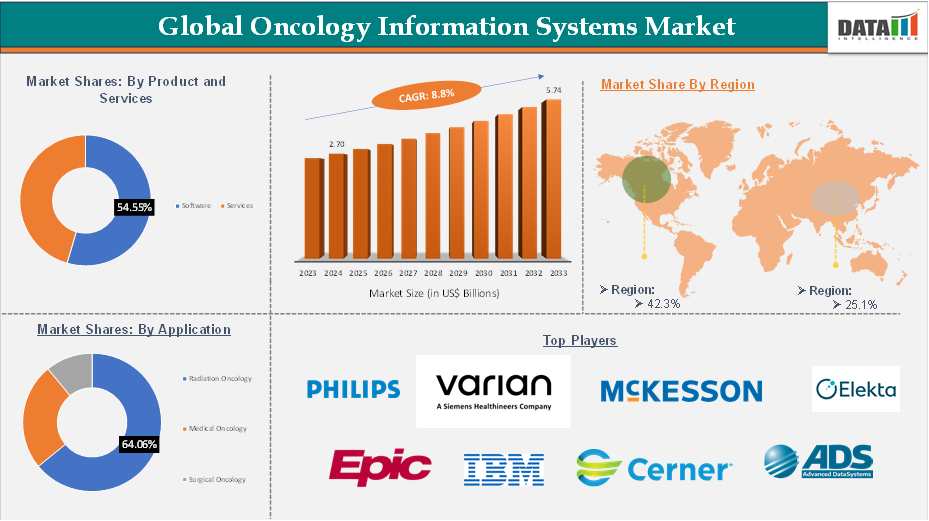
The Oncology Information Systems Market will reach US$ 3.20 billion in 2026, up from US$ 2.94 billion in 2025, and is projected to reach US$ 6.84 billion by 2035, registering strong growth at a CAGR of 8.8% during the forecast period from 2026 to 2035.
Oncology information systems (OIS) manage data on cancer patient hospitalization programs, treatment deliveries, plans, and diagnostic results.
The global Oncology Information Systems (OIS) market is experiencing significant growth due to the increasing cancer incidence, adoption of advanced healthcare IT solutions, and demand for integrated cancer care. OIS helps healthcare providers manage cancer treatment workflows, patient scheduling, and electronic medical records. However, challenges like high implementation costs, data security concerns, and skilled professionals in developing regions may hinder market expansion.
North America currently dominates the market due to its advanced healthcare infrastructure, while the Asia-Pacific region is expected to experience the fastest growth due to increasing healthcare investments and cancer prevalence.
For more details on this report, Request for Sample
Oncology Information Systems Market Scope
| Metrics | Details | |
| CAGR | 8.8% | |
| Market Size Available for Years | 2022-2035 | |
| Estimation Forecast Period | 2025-2035 | |
| Revenue Units | Value (US$ Bn) | |
| Segments Covered | Product & Services | Software, Services |
| Application | Radiation Oncology, Medical Oncology, Surgical Oncology | |
| End User | Hospitals & Diagnostic Imaging Centers, Government Institutions, Ambulatory Surgical Centers, Research Facilities | |
| Regions Covered | North America, Europe, Asia-Pacific, South America, and the Middle East & Africa | |
Key Takeaways
- North America accounted for approximately 42.3% of the global market share in 2024, driven by advanced healthcare IT infrastructure, increasing cancer prevalence, and widespread adoption of precision oncology technologies.
- Software solutions contribute approximately 54.5% of total market revenue, owing to growing demand for centralized oncology data management, treatment planning, and real-time patient monitoring capabilities.
- Radiation oncology applications collectively account for more than 35% of market demand, supported by increasing adoption of image-guided radiotherapy and AI-assisted treatment planning technologies.
- Hospitals and cancer treatment centers represent over 60% of end-user adoption, leveraging integrated oncology information systems to streamline workflows and improve clinical outcomes.
- AI-enabled oncology information platforms are witnessing annual adoption growth exceeding 15%, driven by increasing demand for predictive analytics, clinical decision support, and personalized cancer care solutions.
- Asia-Pacific is projected to register the fastest growth, with a CAGR of approximately 18.5% during the forecast period, supported by expanding healthcare digitalization initiatives and increasing investments in cancer care infrastructure.
- Cloud-based oncology information systems are increasingly improving interoperability, treatment coordination, and remote patient management capabilities across healthcare ecosystems.
- Strategic collaborations among healthcare technology providers, oncology centers, and software developers are accelerating innovation and commercialization globally.
- Growing investments in precision oncology, AI-powered treatment planning, laboratory integration technologies, and digital healthcare platforms are expected to drive long-term market expansion.
Oncology Information Systems Market Dynamics: Drivers & Restraints
Driver: Increasing Prevalence of Cancer Worldwide
The global cancer incidence is driving the growth of the oncology information systems (OIS) market. With millions of new cancer cases diagnosed annually, healthcare systems need efficient, technology-driven solutions. OIS platforms streamline patient data management, facilitate accurate treatment planning, and enable real-time monitoring, contributing to the expansion of the global OIS market.
For instance, as per the International Agency for Research on Cancer, globally, nearly 20 Billion incident cases were reported in 2022. In 2030, nearly 24.10 Billion cases and in 2040, nearly 29.90 Billion cases were expected.
Hence, the rise in cancer incidence helps the healthcare providers face pressure to deliver timely, accurate, and personalized treatment. OIS platforms manage large patient data, support complex treatment planning, and improve workflow efficiency. The growing patient load requires scalable digital solutions to coordinate care across departments and specialists. This trend is accelerating OIS adoption in hospitals, oncology centers, and research institutions, contributing to global market expansion.
Restraint: Data Security and Privacy Concerns
The global oncology information systems market faces challenges in data security and patient privacy due to the growing adoption of cloud-based solutions and stringent data protection regulations. Ensuring end-to-end encryption, secure user authentication, and system interoperability presents technical and operational challenges, potentially slowing market growth in regions with limited cybersecurity infrastructure or regulatory clarity.
Oncology Information Systems Market Segment Analysis
The global oncology information systems market is segmented based on product & services, application, end user, and region.
Product & Services:
The software segment of the product & services is expected to hold 54.5% in the oncology information Systems market
The software segment in the oncology information systems market is experiencing significant growth due to the need for centralized data management, improved treatment planning, and real-time patient monitoring. The rise in cancer incidence is driving healthcare providers to adopt advanced digital tools for efficient clinical workflows and improved patient outcomes.
The shift towards value-based care and personalized medicine has increased demand for integrated software systems for data-driven decision-making and tailored treatment protocols. Technological advancements in AI, cloud computing, and big data analytics are enhancing oncology software's capabilities.
For instance, in May 2204, GE HealthCare unveiled Revolution RT, a new radiation therapy CT solution with innovative hardware and software, aiming to increase imaging accuracy and simplify simulation workflow. The AI-enhanced Intelligent Radiation Therapy platform interfaces with the Spectronic MRI Planner.
Oncology Information Systems Market Geographical Analysis
North America dominated the global oncology information systems market with the highest share of 42.3% in 2024
North America dominates the global oncology information systems market due to advanced healthcare infrastructure, high IT adoption, and significant cancer research investments. The region benefits from EHR integration and interoperability policies. The growing number of cancer cases and focus on precision medicine in the U.S. and Canada encourage healthcare providers to adopt robust OIS platforms. Key market players, technological advancements, and favorable reimbursement scenarios further accelerate the market's growth.
For instance, the American Cancer Society predicts that by 2025, the US will experience 2,041,910 new cancer cases and 618,120 deaths, based on data from central cancer registries and the National Center for Health Statistics. This data is based on population-based cancer occurrence and outcomes.
Asia-Pacific region in the global oncology information systems market is expected to grow with the highest CAGR of 18.5% in the forecast period of 2025 to 2033
The Asia Pacific region is experiencing rapid growth in the oncology information systems market due to rising cancer prevalence, healthcare expenditure, and awareness of advanced technologies. Countries like China, India, and Japan are investing in digital healthcare infrastructure to improve care delivery and patient outcomes. Government initiatives, electronic health records, and telemedicine are driving demand for integrated systems. The rising burden of cancer cases in densely populated areas prompts hospitals to streamline workflows using comprehensive information systems for efficient patient data management and outcome monitoring.
For instance, in September 2024, the Indian Cancer Genome Atlas (ICGA) launched India's first comprehensive cancer multi-omics data portal, offering open access to clinically correlated data from Indian cancer patients, aiming to transform cancer research and treatment.
Oncology Information Systems Market Trends & Insights
AI-Powered Oncology Information Systems
Artificial intelligence is increasingly being integrated into oncology information systems to support treatment planning, predictive analytics, medical image analysis, patient risk stratification, treatment-response prediction and clinical decision support. AI-enabled platforms are shifting OIS from conventional information-management tools toward intelligent clinical-support environments.
Cloud-Based OIS Adoption
Cloud deployment is gaining traction as hospitals and cancer-care networks seek scalable infrastructure, centralized data access and simplified system maintenance. Cloud-based OIS platforms can support multi-site oncology networks while reducing dependence on facility-level IT infrastructure.
Growing Demand for Interoperability
Healthcare providers are prioritizing OIS platforms capable of integrating electronic health records, imaging systems, laboratory information, digital pathology, genomic platforms, pharmacy systems and radiation-treatment technologies. Interoperability is becoming an important factor in vendor selection as oncology care becomes increasingly multidisciplinary.
Precision Oncology Integration
The expansion of precision medicine is increasing demand for OIS platforms capable of incorporating genomic, molecular, biomarker, pathology and clinical information. Integration of these datasets can support personalized treatment selection, multidisciplinary decision-making and treatment-response monitoring.
Expansion of Oncology Data Analytics
The growing volume of clinical, imaging, laboratory and treatment data is creating opportunities for advanced analytics. Healthcare organizations are increasingly using oncology data to evaluate treatment outcomes, identify patient-risk patterns, optimize workflows and support evidence-based decision-making.
Multidisciplinary Cancer Care
The increasing coordination between medical oncology, radiation oncology, surgical oncology, radiology, pathology and other specialties is strengthening demand for integrated information platforms. OIS solutions that provide shared access to patient information can improve coordination across different stages of cancer care.
Cybersecurity and Data Governance
As oncology systems become increasingly connected and cloud-enabled, cybersecurity, patient-data protection and access control are becoming critical technology priorities. Vendors are strengthening security architectures and data-governance capabilities to address growing healthcare cybersecurity requirements.
Real-World Oncology Data
OIS platforms are increasingly positioned as sources of longitudinal clinical information that can support outcomes research, population-health analysis, clinical research and real-world evidence generation. This expands the strategic value of OIS beyond routine hospital workflow management
Oncology Information Systems Interoperability Analysis
Interoperability has become a critical requirement for oncology information systems because cancer treatment involves data generated across multiple clinical and diagnostic environments. Modern OIS platforms increasingly need to connect patient records with imaging, laboratory, pathology, genomic and treatment-management systems.
Major OIS Integration Areas
OIS ↔ EHR/EMR
Patient history, diagnoses, medications and clinical documentation.
OIS ↔ PACS/RIS
Medical imaging, radiology reports and image-based treatment information.
OIS ↔ Laboratory Information Systems
Laboratory results and diagnostic information.
OIS ↔ Digital Pathology
Pathology images, reports and molecular information.
OIS ↔ Genomic Platforms
Genomic profiles, biomarkers and molecular diagnostics.
OIS ↔ Pharmacy Systems
Medication management and oncology treatment information.
OIS ↔ Radiation Treatment Systems
Treatment planning, dose information and treatment delivery data.
Market Analysis
Greater interoperability enables oncology providers to access a more complete longitudinal patient record and facilitates information sharing across multidisciplinary cancer-care teams. Integration with EHRs, imaging platforms, laboratories, pathology systems and genomic technologies can reduce fragmented information environments and improve clinical workflow coordination.
Interoperability is therefore becoming an important competitive differentiator for OIS vendors, particularly as healthcare organizations seek unified platforms capable of supporting complex oncology workflows.
Oncology Information Systems Market Future Trends (2026-2035)
The Oncology Information Systems Market is expected to witness substantial growth throughout the forecast period driven by increasing adoption across precision oncology initiatives, intelligent healthcare innovations, digital healthcare transformation programs, and personalized cancer care developments worldwide. Future market expansion will be supported by cloud-based healthcare technologies, artificial intelligence-enabled clinical capabilities, advanced oncology analytics platforms, and intelligent treatment planning innovations across major global economies.
Increasing investments supporting oncology information infrastructures, precision medicine ecosystems, and advanced healthcare technologies are anticipated to substantially strengthen commercialization opportunities globally. Furthermore, growing demand for highly intelligent and clinically effective oncology information solutions capable of improving patient outcomes while simultaneously enhancing healthcare delivery efficiencies is expected to significantly influence future market dynamics through 2035.
Oncology Information Systems Market Key Players
The major global players in the oncology information systems market include Koninklijke Philips N.V., Varian Medical Systems, McKesson Corporation, Elekta AB, Epic Systems Corporation, IBM, Cerner Corporation, Advanced Data Systems, and Bogardus Medical Systems, Inc., among others.
Recent Developments in Oncology Information Systems Market
- June 2026: Koninklijke Philips N.V. expanded its AI-enabled oncology informatics capabilities by enhancing integrated imaging and cancer care workflow solutions that support precision oncology and multidisciplinary treatment planning.
- June 2026: IBM Corporation strengthened its healthcare AI portfolio by advancing hybrid cloud and data management technologies designed to improve oncology data integration and clinical decision support systems.
- May 2026: Varian Medical Systems (Siemens Healthineers) continued advancing its oncology software platforms by enhancing radiotherapy planning and oncology information management solutions for cancer care providers.
- May 2026: Epic Systems Corporation expanded interoperability capabilities across its electronic health record platform to improve oncology care coordination, treatment tracking, and patient engagement initiatives.
- April 2026: Elekta AB strengthened its oncology informatics portfolio by advancing digital solutions that support radiation oncology workflows, treatment planning, and real-time patient data management.
- April 2026: McKesson Corporation continued expanding its oncology technology offerings through solutions that improve clinical workflow efficiency, practice management, and value-based cancer care delivery.
- March 2026: Oracle Health (formerly Cerner Corporation) enhanced its cloud-based healthcare technologies by expanding oncology-related data management and clinical information capabilities across healthcare systems.
- March 2026: Advanced Data Systems Corporation continued investing in healthcare information management solutions that support clinical documentation, workflow automation, and specialty care practices.
- February 2026: Bogardus Medical Systems, Inc. strengthened its oncology information system offerings by focusing on customised software solutions designed for radiation oncology departments and cancer treatment centers.
Why Choose DataM?
Technological Innovations: DataM explores advancements across intelligent oncology information technologies, artificial intelligence-enabled clinical decision support capabilities, cloud-based healthcare infrastructures, and precision oncology innovations that are enabling organizations worldwide to improve patient outcomes across modern cancer care ecosystems. Emerging technologies involving AI-assisted treatment planning platforms, multimodal oncology data integration capabilities, and intelligent healthcare analytics systems are substantially transforming commercialization opportunities globally.
Product Performance & Market Positioning: The report evaluates how leading market participants deliver oncology information management solutions based on critical performance parameters such as interoperability capabilities, treatment planning efficiencies, clinical workflow performances, patient management characteristics, cybersecurity attributes, and regulatory compliance requirements, highlighting how organizations differentiate through technological innovation and healthcare excellence across global applications.
Real-World Evidence: DataM highlights the adoption of advanced oncology information technologies across cancer treatment centers, radiation oncology programs, precision medicine initiatives, and intelligent healthcare ecosystems worldwide. Industry developments involving AI-enabled oncology treatment planning platforms, cloud-integrated healthcare information systems, and intelligent clinical workflow management technologies continue demonstrating significant commercialization opportunities globally. Additionally, recent advancements supporting integrated genomic analytics capabilities and personalized oncology programs are substantially strengthening the future of intelligent cancer care delivery worldwide.
Market Updates & Industry Changes: The report tracks key developments including oncology information technology investments, strategic collaborations supporting intelligent healthcare technologies, regulatory advancements promoting healthcare digitalization adoption, and increasing oncology infrastructure developments across North America, Europe, and Asia-Pacific supporting next-generation healthcare transformation initiatives.
Competitive Strategies: DataM analyzes how leading organizations expand through healthcare technology innovations, strategic partnerships, intelligent oncology capabilities, product portfolio diversification initiatives, and regional commercialization programs designed to address increasing demand for highly intelligent and clinically effective oncology information solutions worldwide.
Pricing & Market Access: The report explains pricing variations based on software capabilities, deployment models, integration complexities, healthcare infrastructure requirements, regulatory considerations, and commercialization strategies, along with market access opportunities through healthcare institutions, oncology centers, hospitals, healthcare technology organizations, and precision medicine solution providers supporting global commercialization initiatives.
Market Entry & Expansion: DataM identifies attractive growth opportunities driven by increasing investments supporting precision oncology initiatives, accelerating adoption of intelligent healthcare technologies, expanding digital healthcare applications, and growing demand for cloud-enabled oncology capabilities globally. The report further outlines strategic approaches involving regional expansion initiatives, technology differentiation strategies, customized oncology solutions, and collaborative commercialization models designed to support successful market entry and long-term business expansion across emerging and established oncology information systems markets.
Target Audience
The report is strategically developed for stakeholders operating across the global healthcare information technology, oncology diagnostics, precision medicine, healthcare software, and intelligent healthcare technology ecosystem. It provides actionable market intelligence for oncology technology developers, healthcare organizations, hospitals, cancer centers, biotechnology companies, and intelligent healthcare solution providers seeking to strengthen their competitive positioning within rapidly evolving digital oncology markets. Furthermore, government organizations, regulatory agencies, academic institutions, investment firms, translational oncology research laboratories, and strategic business leaders can utilize the report to evaluate emerging technological innovations, commercialization trends, healthcare transformation initiatives, and future growth opportunities shaping the Oncology Information Systems Market through 2035.





























































