


O-RAN (Open Radio Access Networks) Market Size
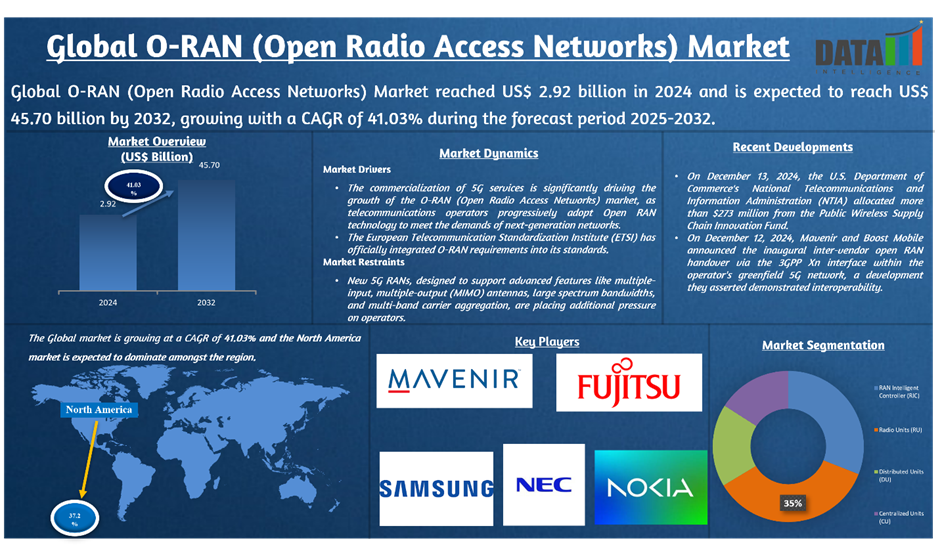
Global O-RAN (Open Radio Access Networks) Market reached US$ 2.92 billion in 2024 and is expected to reach US$ 45.70 billion by 2032, growing with a CAGR of 41.03% during the forecast period 2026-2032, according to DataM Intelligence research.
The O-RAN (Open Radio Access Networks) industry is undergoing swift expansion, propelled by the integration of cloudification in telecommunications networks and a rising demand for adaptable, scalable solutions. Public mobile network operators and private network operators are progressively embracing Open RAN standards as digitalization drives businesses towards automation and cloud solutions. This transition is underpinned by significant factors including the emergence of 5G, network virtualization, vendor diversification and the necessity for enhanced rural connection, as per our research.
O-RAN provides a substitute for conventional, proprietary network systems by separating hardware from software, facilitating a more adaptable and economical methodology. The progression of cellular networks, from AMPS to 5G, has rendered compatibility across several generations increasingly difficult, underscoring the necessity for solutions such as Open RAN to tackle these challenges.
Japan is anticipated to experience substantial expansion in the Open RAN market within Asia-Pacific. The Japanese government's endorsement of 5G implementation, coupled with strategic efforts by leading telecommunications companies, is expediting the adoption of Open RAN. In January 2023, KDDI Corporation, Samsung and Fujitsu partnered to implement 5G Open Virtual Radio Access Network (Open vRAN) stations throughout Japan, showcasing the nation's dedication to enhancing Open RAN technologies.
Executive Summary
For more details on this report – Request for Sample
Market Scope
| Metrics | Details |
| CAGR | 41.03 % |
| Size Available for Years | 2023-2032 |
| Forecast Period | 2025-2032 |
| Data Availability | Value (US$) |
| Segments Covered | Offering, Component, Network Deployment, Frequency Band, End-User and Region |
| Regions Covered | North America, South America, Europe, Asia-Pacific, Middle East and Africa |
| Fastest Growing Region | Asia-Pacific |
| Report Insights Covered | Competitive Landscape Analysis, Company Profile Analysis, Market Size, Share, Growth, Demand, Recent Developments, Mergers and Acquisitions, New Product Launches, Growth Strategies, Revenue Analysis, Porter’s Analysis, Pricing Analysis, Regulatory Analysis, Supply-Chain Analysis and Other key Insights. |
O-RAN (Open Radio Access Networks) Market Dynamics
Driver 1 – Commercialization of 5G services
The commercialization of 5G services is significantly driving the growth of the O-RAN (Open Radio Access Networks) market, as telecommunications operators progressively adopt Open RAN technology to meet the demands of next-generation networks. In October 2022, Vodafone announced the inaugural implementation of Open RAN technology in Germany, backed by prominent European mobile operators.
This deployment incorporates specifications approved by the Telecom Infra Project (TIP), which has been recognized as the framework for expanding Open RAN throughout Europe. This blueprint, now available to the wider ecosystem, is anticipated to improve the architecture and integration of diverse RAN components, serving a pivotal function in one of the largest 5G deployments globally.
In September 2022, Rakuten Mobile commenced commercial 4G and 5G services with Open RAN architecture in Japan. Rakuten is illustrating how Open RAN facilitates enhanced flexibility and vendor variety through the integration of radios from several suppliers, which are essential for the effective implementation of 5G services. These activities underscore the escalating popularity of Open RAN, which is increasingly regarded as a vital facilitator of efficient, scalable 5G networks.
Driver 2 - Regulatory frameworks shaping the future of O-RAN
The European Telecommunication Standardization Institute (ETSI) has officially integrated O-RAN requirements into its standards. This action underscores a worldwide transition to Open RAN and bolsters the O-RAN ALLIANCE's objective to revolutionize the Radio Access Network (RAN) into a more open, intelligent, virtualized and entirely interoperable framework.
Governmental support, particularly from the US and Europe, is expediting the implementation of Open RAN. Regulatory authorities are progressively acknowledging Open RAN as a strategic approach to bolster network security and diminish reliance on particular manufacturers. This is especially significant due to the security issues associated with specific foreign suppliers.
By approving Open RAN, regulators are stimulating competition and encouraging local and smaller technology providers to engage in the telecommunications sector, thereby promoting innovation and reinforcing regional technology ecosystems. Consequently, Open RAN is emerging as a crucial component of next-generation telecommunications infrastructure, corresponding with overarching goals of security, cost-effectiveness and adaptability in international markets.
Restraint: The challenge of carrier-grade scalability
The deployment and management of Radio Access Networks (RANs) are among the most expensive components of telecom networks. New 5G RANs, designed to support advanced features like multiple-input, multiple-output (MIMO) antennas, large spectrum bandwidths and multi-band carrier aggregation, are placing additional pressure on operators.
These developments, while crucial for next-generation connectivity, complicate the scaling process necessary to support not only 5G but also earlier generations like 4G and 3G, creating interoperability challenges.
The complexities of scaling these networks to meet rising data demands are exacerbated by the need to ensure that the Open RAN infrastructure maintains carrier-grade performance, reliability and efficiency. This is a critical barrier to widespread adoption, as network operators are concerned with the balance between technological advancement and maintaining operational efficiency.
O-RAN (Open Radio Access Networks) Market Segment Analysis
The global O-RAN (Open Radio Access Networks) market is segmented based on offering, component, network deployment, frequency band, end-user and region.
The role of radio units in Open RAN hardware
O-RAN (Open Radio Access Networks) Market's Radio Units (RU) segment experienced significant growth between 2022 and 2023. The market for RUs expanded from $0.39 billion in 2022 to $0.63 billion in 2023.
The Radio Unit (RU) is a fundamental element of this segment, acting as an essential link between mobile devices and the network. Radio Units (RUs) are essential to the Open RAN framework, enabling operators to choose hardware from several vendors, hence promoting competition and innovation within the market. This adaptability ultimately results in more efficient mobile networks, enhancing service quality and performance for end-users.
The Open RAN hardware has numerous essential components, including Baseband Units (BBUs), Remote Radio Units (RRUs) and Virtualized RAN (vRAN) servers. These hardware components facilitate the transition of telecom operators from legacy 4G, 3G and 2G systems to entirely virtualized Open RAN solutions. Furthermore, the hardware facilitates the concurrent functioning of many technologies on the same Remote Radio Head (RRH), enabling enhanced voice and data services.
On December 13, 2024, the US Department of Commerce's National Telecommunications and Information Administration (NTIA) allocated more than US$273 million from the Public Wireless Supply Chain Innovation Fund. These funding are intended to support projects associated with the commercialization of Open Radio Unit hardware, underscoring the increasing significance and backing for O-RAN hardware research.
O-RAN (Open Radio Access Networks) Market Geographical Share
Strengthening 5G networks the rise of Open RAN in Europe
O-RAN (Open Radio Access Networks) Market in Europe experienced substantial growth, increasing from a valuation of $0.42 billion in 2022 to $0.70 billion in 2023, as per our research.
The Open RAN market in Europe is growing rapidly due to the continent's drive for 5G adoption and the demand for more adaptable network architectures. European governments are investing in strengthening their networking infrastructure. The European Commission allocated about EUR 700 million in funding from the public under the Horizon 2020 program to promote 5G initiatives in the region.
Investments are essential to accommodate the anticipated 5G traffic volume by 2025. The activities are anticipated to propel market expansion from 2024 to 2030. Prominent entities in UK, including BT Group (including EE) and Vodafone UK, are spearheading Open RAN trials and implementations nationwide. BT Group has initiated multiple projects to test Open RAN alternatives, with the objective of improving network flexibility and minimizing vendor lock-in.
The Germany Open RAN Market possesses a significant market share, with key players like Deutsche Telekom and Vodafone Germany actively investigating Open RAN solutions to enhance network agility and efficiency. Deutsche Telekom has launched many pilot projects and partnerships to evaluate Open RAN technology, with the objective of harnessing its potential for cost savings and vendor diversification.
O-RAN (Open Radio Access Networks) Market Major Players
The major Global players in the market include Mavenir, NEC Corporation, Fujitsu Limited, Nokia Corporation, Samsung Electronics Co., Ltd., Radisys Corporation, Parallel Wireless, ZTE Corporation, AT&T Inc. and Casa Systems, Inc.
By Offering
- Hardware
- Software
- Service
- Consulting
- Deployment and Implementation
- Support and Maintenance
By Component
- RAN Intelligent Controller (RIC)
- Radio Units (RU)
- Distributed Units (DU)
- Centralized Units (CU)
By Network Deployment
- Public Cloud Networks
- Private Cloud Networks
- Hybrid Cloud Networks
By Frequency Band
- Sub-6GHz
- mmWave
- Other
By End-User
- Telecom Operators
- Enterprises/Industries
- Government Authorities
- Others
By Region
- North America
- South America
- Europe
- Asia-Pacific
- Middle East and Africa
Key Developments
- Rakuten Mobile Supports U.S. Open RAN Expansion Through NTIA Program
Rakuten Mobile announced support for the commercial deployment of Open Radio Units (RUs) in the United States under the NTIA’s Public Wireless Supply Chain Innovation Fund. The initiative involves collaboration with U.S. vendors including Airspan Networks and Eridan Communications, strengthening Japan–U.S. cooperation in Open RAN ecosystem development. - AT&T Accelerates Nationwide Open RAN Deployment with Rakuten Symphony
AT&T expanded its partnership with Rakuten Symphony to support large-scale Open RAN deployment across the U.S. AT&T aims to route nearly 70% of its wireless traffic through Open RAN platforms by 2026, reflecting one of the largest commercial Open RAN rollouts globally. - NTT DOCOMO and AWS Commercialize Cloud-Native vRAN Platform in Japan
NTT DOCOMO partnered with Amazon Web Services to commercialize a cloud-native vRAN/O-RAN platform using Amazon EKS Anywhere. The deployment simplifies multi-vendor 5G network operations and advances Japan’s leadership in Open RAN virtualization. - Japan Emerges as Global Benchmark for Open vRAN Deployment
According to Omdia, Japan has become the leading market for commercial Open vRAN adoption, led by Rakuten Mobile, NTT DOCOMO, and KDDI deployments. Industry analysts increasingly view Japan as the global reference market for Open RAN commercialization and interoperability testing. - Multi-Vendor 5G O-RAN Integration Expands Across Japan
Nokia and NTT DOCOMO advanced multi-vendor O-RAN integration projects for 5G networks, enabling interoperability between third-party radio units and cloud-native RAN infrastructure. These deployments improve vendor flexibility and reduce dependence on traditional proprietary telecom architectures.
Why Purchase the Report?
- To visualize the global O-RAN (Open Radio Access Networks) market segmentation based on offering, component, network deployment, frequency band, end-user and region, as well as understand key commercial assets and players.
- Identify commercial opportunities by analyzing trends and co-development.
- Excel data sheet with numerous data points of the O-RAN (Open Radio Access Networks) market with all segments.
- PDF report consists of a comprehensive analysis after exhaustive qualitative interviews and an in-depth study.
- Product mapping available as excel consisting of key products of all the major players.
The global O-RAN (Open Radio Access Networks) market report would provide approximately 78 tables, 74 figures and 201 pages.
Target Audience 2025
- Manufacturers/ Buyers
- Industry Investors/Investment Bankers
- Research Professionals
- Emerging Companies



























































