


Lasik Eye Surgery Market Size & Overview
The global LASIK Eye Surgery Market reached US$ 2.74 billion in 2025 and is expected to reach US$ 4.03 billion by 2033, growing at a CAGR of 4.9% during the forecast period 2026-2033.
LASIK (Laser-Assisted In Situ Keratomileusis) is a revolutionary eye surgery that reshapes the cornea to correct common refractive errors such as nearsightedness (myopia), farsightedness (hyperopia), and astigmatism. The primary goal of LASIK is to improve vision, allowing patients to reduce or eliminate their dependency on corrective eyewear, such as glasses or contact lenses.
During the LASIK procedure, a highly precise laser is used to alter the shape of the cornea, which is the clear front surface of the eye. This reshaping allows light entering the eye to be properly focused onto the retina, leading to clearer vision. In many cases, LASIK offers long-lasting results, providing a permanent solution to refractive vision problems.
Executive Summary
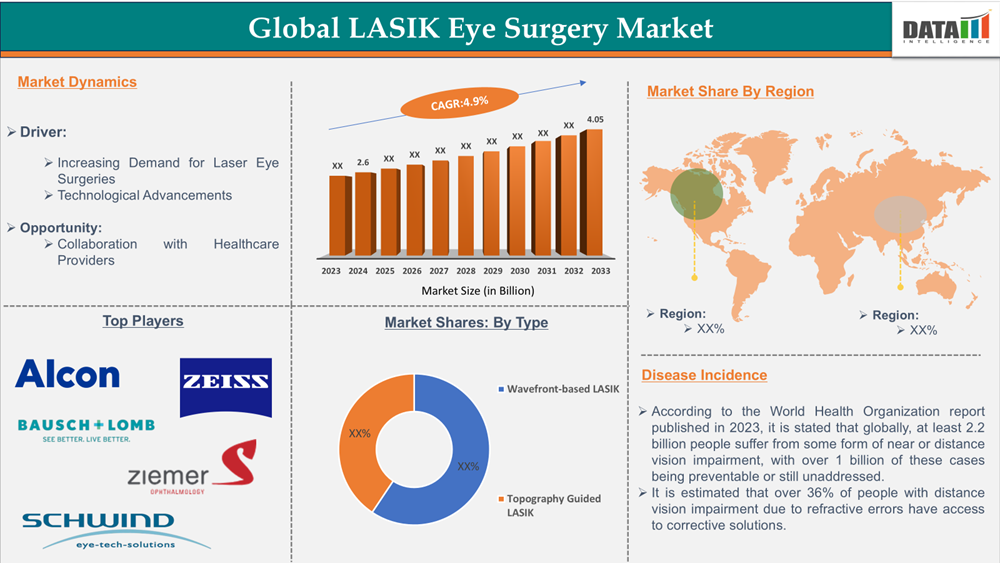
Lasik Eye Surgery Market Dynamics: Drivers & Restraints
Increasing Demand for Laser Eye Surgeries
There is a growing awareness of the advantages LASIK offers, such as improved vision without the need for glasses or contact lenses, which appeals to individuals seeking a more convenient, long-term solution for vision correction. As more people are becoming aware of the safety, effectiveness, and relatively short recovery time of LASIK, the procedure is gaining widespread acceptance.
Additionally, the increasing prevalence of refractive vision issues, especially among younger people due to excessive screen time and digital device usage, has spurred the need for effective, hassle-free vision correction options. For instance, according to the World Health Organization report published in 2023, it is stated that globally, at least 2.2 billion people suffer from some form of near or distance vision impairment, with over 1 billion of these cases being preventable or still unaddressed.
The leading causes of vision impairment and blindness worldwide are refractive errors and cataracts, both of which significantly impact quality of life. It is estimated that over 36% of people with distance vision impairment due to refractive errors have access to corrective solutions.
This highlights a large gap in vision care, presenting a tremendous opportunity for treatments like LASIK, which can effectively address refractive errors, offering a long-term solution to millions of people who are still living with untreated or inadequately managed vision issues.
High Costs of Ophthalmic Devices
The high costs of ophthalmic devices are expected to be a significant factor hindering the growth of the LASIK eye surgery market. LASIK procedures require advanced, high-precision equipment, including excimer lasers, femtosecond lasers, and diagnostic tools for custom treatment planning. These devices are expensive to acquire and maintain, which leads to higher overall procedure costs for patients. As a result, many individuals, especially those in lower-income regions or without adequate insurance coverage, could find the cost of LASIK prohibitive.
Additionally, the high upfront investment required by clinics to purchase and maintain such equipment can limit the availability of LASIK procedures, particularly in emerging markets where healthcare infrastructure may not be as advanced. This combination of expensive technology and associated surgery costs creates a barrier for a large portion of the population, potentially slowing the adoption and growth of LASIK as a mainstream solution for vision correction.
Lasik Eye Surgery Market Segmentation Analysis
The global LASIK eye surgery market is segmented based on type, laser type, indication, end-user, and region.
Growing Demand for Customized Refractive Treatments Supports the Wavefront-Guided LASIK Segment
The Wavefront-guided segment represents an important technology category in the global LASIK eye surgery market, supported by its ability to account for higher-order aberrations in addition to conventional refractive errors. Wavefront technology uses detailed measurements of the eye to support customized treatment planning, while FDA information notes that wavefront-guided LASIK attempts to reduce higher-order aberrations compared with conventional LASIK. Wavefront-guided systems have also received regulatory approvals for specific refractive indications, including myopia, astigmatism, and selected presbyopic-myopia applications.
Reflecting continued development of customized refractive treatment technologies, regulatory authorities continue to evaluate and approve advancements in laser systems used for LASIK. For instance, the U.S. FDA's current list of approved LASIK lasers includes systems such as the WaveLight EX500, MEL90, TECHNOLAS TENEO 317, and iDesign Refractive Studio/STAR Excimer Laser System, demonstrating the continued availability and development of advanced laser platforms for refractive surgery.
Increasing Adoption of Topography-Based Treatment Planning Supports the Topography-Guided Segment
The Topography-guided segment is supported by the increasing use of individualized corneal measurements in LASIK treatment planning. Topography-guided LASIK uses information from a topography map of the cornea to develop the treatment profile, enabling a customized approach based on the individual characteristics of the corneal surface. FDA documentation describes topography-guided treatment as a customized approach that differs from standard LASIK by incorporating individual topography measurements into treatment planning.
The technology continues to be incorporated into approved refractive laser platforms. FDA documentation for the WaveLight system, for example, describes a topography-guided treatment option that uses corneal topography data to plan the laser ablation profile. This development supports the continued role of corneal topography and customized treatment planning within the evolution of LASIK procedures.
High Prevalence of Myopia Supports the Myopia Segment
The Myopia segment represents a major indication category within the LASIK eye surgery market. Myopia is one of the primary refractive errors treated through LASIK, alongside hyperopia and astigmatism. During LASIK, controlled removal of corneal tissue reshapes the cornea and changes its focusing power to correct refractive errors.
The availability of FDA-approved laser systems for myopia and myopic astigmatism further supports the importance of this indication within refractive surgery. FDA records include multiple laser systems with approved indications for the reduction or correction of myopia and associated astigmatism, reflecting the established role of LASIK in treating these refractive errors.
Increasing Use of Outpatient Surgical Settings Supports the Ambulatory Surgical Centers Segment
The Ambulatory Surgical Centers segment represents an important end-user category for LASIK procedures because the surgery is performed in specialized surgical settings using excimer laser and related ophthalmic technologies. The FDA specifically recognizes ambulatory surgical facilities as healthcare facilities involved in the use of medical devices and has included LASIK ambulatory surgical centers within its LASIK oversight activities.
Hospitals also remain an important end-user category, particularly where ophthalmic surgical services and specialized refractive-care infrastructure are available. The selection of a treatment facility depends on factors including the availability of appropriate laser systems, qualified ophthalmic professionals, patient evaluation, and the specific refractive procedure required. FDA guidance emphasizes that the capabilities of individual approved laser systems and the patient's clinical suitability should be evaluated when considering LASIK treatment.
Lasik Eye Surgery Regional Market Analysis
North America Lasik Eye Surgery Market
North America represents an important market for LASIK and advanced refractive surgery technologies, supported by established ophthalmic healthcare infrastructure, availability of advanced laser platforms, and continued regulatory oversight of refractive surgery devices.
The United States is a major contributor to regional demand and has an established regulatory framework governing LASIK laser systems. The U.S. FDA maintains dedicated lists of approved LASIK and refractive-surgery lasers and continues to monitor the safety and effectiveness of regulated ophthalmic devices.
The regional market is supported by demand for:
Laser-assisted refractive correction
Advanced excimer laser systems
Femtosecond laser platforms
Wavefront-guided treatment technologies
Topography-guided LASIK
Specialized ophthalmology and refractive surgery centers
The availability of multiple FDA-approved laser platforms and continuing device modifications supports ongoing technological development within the U.S. refractive surgery market.
Asia-Pacific Lasik Eye Surgery Market
Asia-Pacific represents a significant opportunity for LASIK and broader refractive surgery adoption as ophthalmic healthcare infrastructure expands and access to advanced vision-correction technologies increases across major markets.
China is an important market for ophthalmic technology deployment, with continued investment in advanced refractive surgery equipment. A notable recent development is the June 2026 strategic agreement between ZEISS Medical Technology and Aier Eye Hospital Group for 25 VISUMAX 800 femtosecond laser systems, with deployment planned across Aier's domestic and international network beginning later in 2026.
Major markets across the region include:
China
Japan
India
South Korea
Australia
Southeast Asian markets
Growth opportunities are associated with:
Expansion of specialized ophthalmology facilities
Increasing availability of advanced laser-based vision correction
Investment in modern ophthalmic equipment
Development of refractive surgery capabilities
Adoption of femtosecond laser platforms
Increasing access to advanced diagnostic and treatment technologies
The region's large patient population and continuing development of healthcare infrastructure provide opportunities for ophthalmic technology manufacturers and refractive surgery providers.
Europe Lasik Eye Surgery Market
Europe remains an important market for refractive surgery and ophthalmic laser technologies, supported by established healthcare systems, specialized ophthalmology centers, and the presence of major medical technology manufacturers.
Germany, France, the United Kingdom, Italy, and other European markets contribute to demand for advanced ophthalmic equipment and refractive treatment technologies.
The European market is increasingly characterized by:
Advanced femtosecond laser systems
Excimer laser technology
Customized refractive treatment planning
Wavefront and topography-guided procedures
Advanced ophthalmic diagnostics
Specialized refractive surgery centers
Continued development of laser platforms and increasing availability of advanced refractive technologies are expected to support the evolution of the European LASIK market.
Latin America Lasik Eye Surgery Market
Latin America presents opportunities for LASIK and refractive surgery providers as ophthalmic healthcare capabilities develop and access to laser-based vision correction expands.
Brazil and Mexico represent important markets for ophthalmic services and medical technology, while other countries across the region provide additional opportunities for refractive surgery providers and equipment manufacturers.
Market development is supported by:
Expansion of private ophthalmology services
Increasing availability of specialized eye-care facilities
Adoption of advanced laser-based procedures
Investment in ophthalmic equipment
Growing availability of refractive surgery services
The region's future development will depend on healthcare infrastructure investment, availability of specialized ophthalmologists, affordability of procedures, and access to advanced laser systems.
Middle East & Africa Lasik Eye Surgery Market
The Middle East & Africa market is developing alongside investments in healthcare infrastructure, specialized ophthalmology services, and advanced medical technologies.
Gulf countries, particularly Saudi Arabia and the UAE, are investing in healthcare modernization and advanced medical services, creating opportunities for ophthalmic technology providers and specialized eye-care facilities.
Lasik Eye Surgery Market Competitive Landscape
The global market players in the LASIK eye surgery market include Carl Zeiss Meditec AG, Alcon Inc., Ziemer Ophthalmic Systems AG, Johnson & Johnson, Bausch & Lomb Incorporated, SCHWIND eye-tech-solutions GmbH, among others.
Lasik Eye Surgery Market Scope
| Metrics | Details | |
| CAGR | 4.9% | |
| Market Size Available for Years | 2022-2033 | |
| Estimation Forecast Period | 2025-2033 | |
| Revenue Units | Value (US$ Mn) | |
| Type | Wavefront-based LASIK, Topography Guided LASIK | |
| Laser Type | Excimer Laser, Femtosecond Laser | |
| Segments Covered | Indication | Presbyopia, Hyperopia, Myopia, Astigmatism |
| End-User | Ophthalmology Clinics, Hospitals, Ambulatory Surgical Centers, LASIK Centers | |
| Regions Covered | North America, Europe, Asia-Pacific, South America, and the Middle East & Africa | |
Key Developments in Lasik Eye Surgery Market
- June 2026: ZEISS Medical Technology signed a strategic agreement with Aier Eye Hospital Group for the purchase and installation of 25 ZEISS VISUMAX 800 femtosecond laser systems across Aier’s domestic and international network. The rollout is expected to strengthen access to advanced refractive surgery and support more precise, efficient laser vision correction globally.
- April 2026: ZEISS Medical Technology showcased new digital, AI-powered and surgical workflow innovations at ASCRS 2026, including advancements supporting refractive surgery workflows. The company also highlighted continued development of connected digital care and analytics technologies aimed at improving personalized ophthalmic treatment.
- January 2026: Alcon reaffirmed its focus on wavelight plus as a core technology for LASIK after ending its proposed acquisition of STAAR Surgical. Alcon stated that wavelight plus would remain central to its refractive strategy and highlighted further global launches and innovation across its surgical portfolio.
Why Choose DataM?
Technological Innovations: Explores advancements in LASIK and refractive eye surgery technologies, including excimer laser systems, femtosecond laser platforms, wavefront-guided treatments, topography-guided LASIK, and customized corneal reshaping technologies. The analysis tracks how these technologies support more personalized treatment planning and precision in refractive correction.
Product Performance & Market Positioning: Evaluates LASIK laser platforms and associated technologies based on treatment capabilities, customization, precision, approved refractive indications, and integration of diagnostic and treatment systems. The report compares how manufacturers differentiate their solutions through advanced wavefront and topography-guided capabilities, femtosecond laser technology, and expanding treatment indications.
Real-World Evidence: Highlights the adoption of LASIK and related refractive surgery technologies across ophthalmology clinics, hospitals, and specialized eye-care centers, examining their use for correcting refractive errors such as myopia, hyperopia, and astigmatism. It also considers patient selection, treatment customization, clinical outcomes, and patient-reported considerations relevant to refractive surgery adoption.
Market Updates & Industry Changes: Tracks regulatory approvals, new laser-system indications, technology upgrades, treatment-platform developments, and advances in personalized refractive surgery. Recent FDA records include updates and approvals involving systems from Alcon, Carl Zeiss Meditec, and TECHNOLAS, reflecting continued development of LASIK laser technologies and their approved applications.
Competitive Strategies: Analyzes how leading ophthalmic technology companies strengthen their market positions through laser-system innovation, software upgrades, customized treatment technologies, expanded indications, and integrated diagnostic and surgical platforms. Competitive positioning is assessed across excimer laser, femtosecond laser, wavefront-guided, and topography-guided technologies.
Pricing & Market Access: Examines pricing and market-access factors influencing LASIK services and supporting technologies, including laser platform investment, procedure configuration, technology selection, diagnostic requirements, surgeon expertise, facility infrastructure, and regional healthcare-market conditions. The analysis also recognizes that LASIK pricing is determined at the provider level rather than by the FDA.
Market Entry & Expansion: Identifies opportunities arising from the continuing development of refractive correction technologies, increasing availability of advanced laser platforms, personalization of treatment, and expansion of approved applications. The report assesses potential strategies including technology differentiation, regulatory approvals, partnerships with ophthalmology providers, geographic expansion, and investment in advanced diagnostic and laser capabilities.
The global LASIK eye surgery market report would provide approximately 45 tables, 46 figures, and 180 pages.
Target Audience
- Ophthalmology Clinics & Eye-Care Centers
- LASIK & Refractive Surgery Providers
- Ophthalmic Laser System Manufacturers
- Excimer & Femtosecond Laser Technology Companies
- Ophthalmic Diagnostic Equipment Manufacturers
- Medical Device & Ophthalmology Technology Companies




























































