


Irritable Bowel Syndrome Treatment Market Size
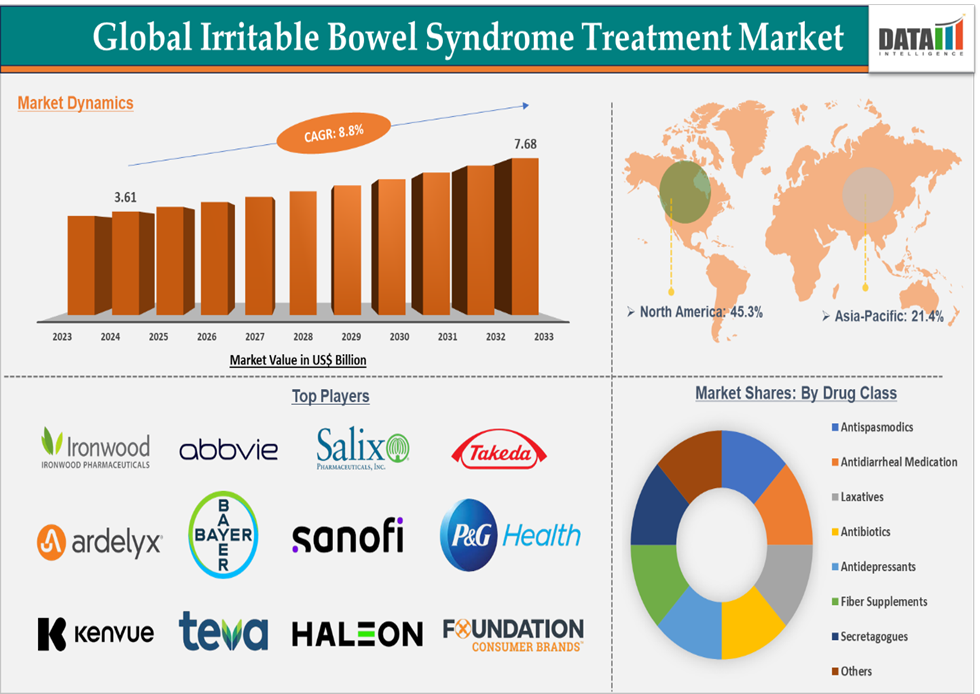
The Global Irritable Bowel Syndrome Treatment Market Size reached US$ 3.93 billion in 2025 and is expected to reach US$ 7.68 billion by 2033, growing at a CAGR of 8.8% during the forecast period 2026-2033.
Irritable bowel syndrome (IBS) is a condition with high unmet needs. Globally, 5% to 10% of the population suffers from this condition. The market for IBS is experiencing significant growth driven by factors such as rising prevalence due to increasing stress levels, unhealthy eating habits, sedentary lifestyles, and an aging population. However, lack of awareness, underdiagnosis in low-income and emerging countries, and lack of disease-modifying therapies can significantly hamper the market growth. The new treatment modalities, such as microbiome-based therapies, can provide new avenues of treatment in the future.
Executive Summary
For more details on this report- Request for Sample
Market Scope
| Metrics | Details | |
| CAGR | 8.8% | |
| Market Size Available for Years | 2025-2033 | |
| Estimation Forecast Period | 2026-2033 | |
| Revenue Units | Value (US$ Mn) | |
| Segments Covered | Disease Type | IBS with Diarrhea (IBS-D), IBS with Constipation (IBS-C), Mixed-Presentation IBS (IBS-M), and Undefined IBS (IBS-U) |
| Drug Class | Antispasmodics, Antidiarrheal Medication, Laxatives, Antibiotics, Antidepressants, Fiber Supplements, Secretagogues, and Others | |
| Regions Covered | North America, Europe, Asia-Pacific, South America, and the Middle East & Africa | |
Irritable Bowel Syndrome Treatment Market Dynamics: Drivers & Restraints
The rising prevalence of irritable bowel syndrome is driving the market growth
Several epidemiological studies were conducted globally to define the population cohorts living with the condition. However, based on the diagnostic criteria employed (Rome III or Rome IV), the prevalence may vary substantially from study to study. However, according to the International Foundation for Gastrointestinal Disorders (IFFGD), irritable bowel syndrome affects approximately 5% to 10% of the world's population, making it one of the most common gastrointestinal disorders. According to its survey results, the majority of the population diagnosed are women, rather than men.
Irritable bowel syndrome is a condition exacerbated by various causes. It can be triggered by changes in lifestyle, excessive stress, consumption of processed foods, mental health conditions, experiencing traumatic events, etc. Anything that disrupts the brain-gut axis can exacerbate IBS.
Globally, all population groups, especially adults, are experiencing stress and mental health issues, which are one of the key contributing factors for IBS.
This signifies the proportion of the population who are at risk of IBS. As the global population ages, with significant changes in lifestyle, food habits, and stress levels, the IBS prevalence is expected to rise substantially, propelling the demand for advanced therapeutics in the forecast period.
Underdiagnosis of irritable bowel syndrome may hamper the market growth
Despite the high prevalence of IBS, the diagnosis rate is substantially low, especially in low and middle-income countries. Lack of awareness, misconception of IBS symptoms with other common gastrointestinal conditions, lack of proper biomarkers, and a limited number of diagnostic tests are all factors that contribute to the underdiagnosis of the condition.
A study published in the Neurogastroenterology & Motility journal in November 2024 stated that among the surveyed primary healthcare physicians in the US and Europe, 80% of them have the perception that 80% of the IBS patients are underdiagnosed in a primary healthcare setting. This underdiagnosis can significantly restrain the market growth by limiting the number of patients who receive appropriate treatment.
Irritable Bowel Syndrome Treatment Market Segment Analysis
The global irritable bowel syndrome treatment market is segmented based on disease type, drug class, and region.
Secretagogues are a class of products that act by stimulating the release of bodily substances like hormones, fluids, enzymes, etc. In irritable bowel syndrome, the secretagogues act by inducing the release of intestinal fluids, which will aid in improving the bowel movement and reducing constipation. These drugs are currently approved by the regulatory bodies, such as the FDA, for use in IBS patients. These include drugs such as linaclotide (Linzess/Constella), lubiprostone (Amitiza), and plecanatide (Trulance).
Due to the presence of brand exclusivity, manufacturers hold greater power in deciding the product price, hence generating higher revenues for their products. Although not widely adopted across the world, and majority of the patient population prefers the generic medication, especially in low & middle-income countries, this segment is poised to grow due to increasing awareness, clinical efficacy, and expansion into growing markets.
Irritable Bowel Syndrome Treatment Market Major Players
The major players in the irritable bowel syndrome treatment market are Procter & Gamble, Haleon Group of Companies., Teva Pharmaceutical Industries Ltd., Ironwood Pharmaceuticals, Inc., AbbVie., Salix Pharmaceuticals, Foundation Consumer Brands., Kenvue Brands LLC., Pfizer Inc., Upsher-Smith Laboratories, LLC., Sanofi, Bayer AG, Atlantis Consumer Healthcare Inc., Alfasigma Group, Takeda Pharmaceutical Company Limited., and Ardelyx. among others.
Recent Developments
- April 2026 – Breakthrough discovery links gut bacteria to serotonin production in IBS treatment
Researchers identified specific gut microbes capable of producing serotonin, a key regulator of bowel function, opening new pathways for microbiome-based IBS therapies targeting gut–brain signaling. - April 2026 – Study highlights role of dietary patterns in IBS symptom management
A recent clinical study found that frequent small meals and consistent eating schedules can significantly reduce IBS symptom severity, reinforcing dietary modulation as a core treatment strategy. - February 2026 – Emerging therapies target gut–brain axis with novel drug mechanisms
New drug classes such as delta-opioid receptor (DOP) agonists are being developed to treat IBS by addressing both gastrointestinal symptoms and stress-related triggers, marking a shift toward neurogastroenterology-based treatments. - January 2026 – Increasing focus on microbiome-modulating therapies for IBS
Probiotics, antibiotics, and microbiome-based treatments are gaining traction as effective approaches to reduce inflammation and restore gut balance, with growing clinical validation. - December 2025 – Butyric acid research shows potential to strengthen intestinal barrier in IBS patients
New findings indicate that butyric acid can improve gut barrier function and reduce intestinal permeability, suggesting a promising therapeutic pathway for long-term IBS management.



























































